Sagittarius Sun Aquarius Moon: The Visionary Collective Idealist
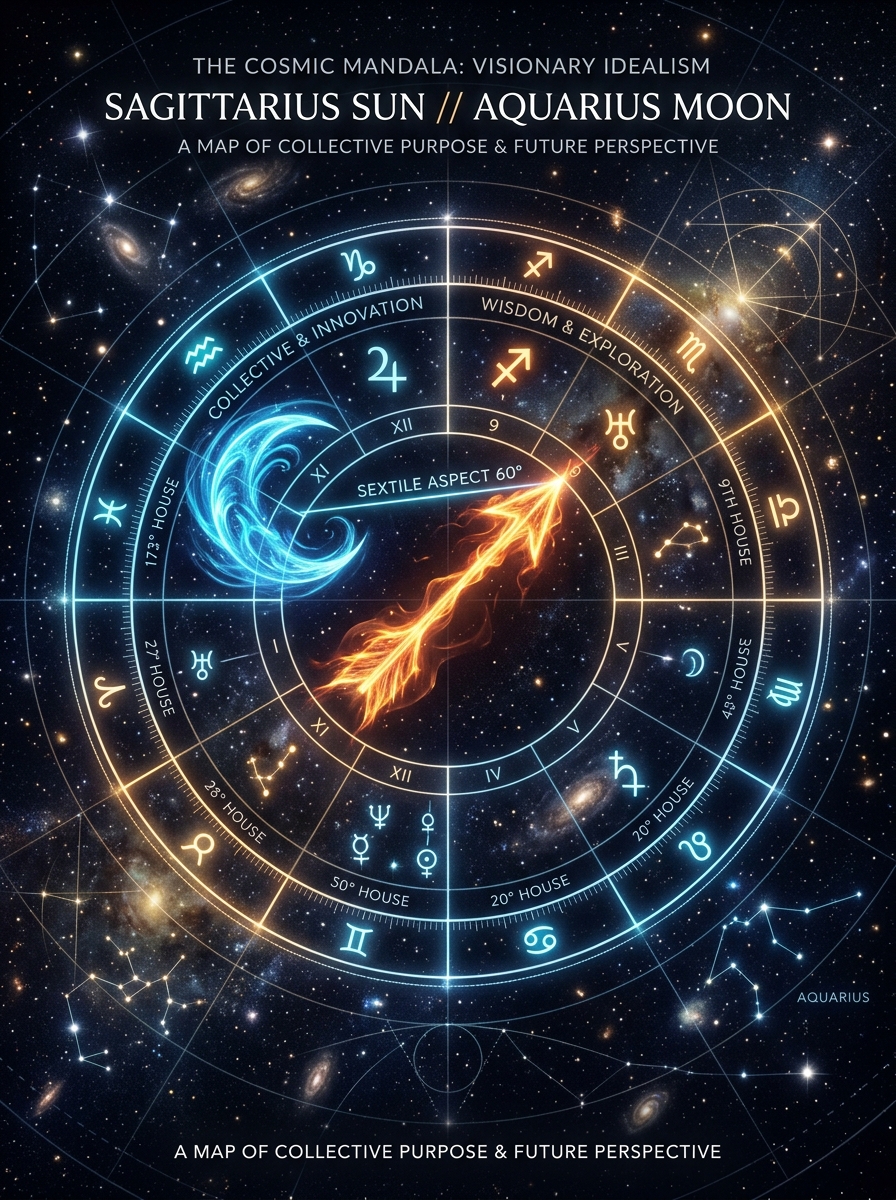
The psychological landscape of an individual possessing a Sagittarius Sun and an Aquarius Moon is a striking study in expansion, intellectual autonomy, and systemic idealism. In the lexicon of psychological astrology, this archetype is frequently termed "the collective idealist" or "the visionary social reformer." Here, the solar core of mutable fire—driven by an insatiable quest for truth, meaning, and horizons yet unseen—coalesces with the lunar container of fixed air, which processes the emotional reality through the lens of objective systemic logic, humanitarian principles, and a radical need for personal freedom.
To live with this combination is to navigate a permanent tension between the urge to leap into the fiery unknown and the structural necessity to build a more equitable framework for the collective. It is a placement that seeks not merely to experience life, but to conceptualize it, to reform it, and to elevate it toward a higher ethical standard. The consciousness of this native is wired for the future, looking past the trivialities of daily survival and the constraints of local traditions in search of the grand laws that govern the human family.
The Elemental Chemistry: Mutable Fire Meets Fixed Air
When mutable fire and fixed air interact, the result is a dynamic, self-sustaining psychic combustion. Fire requires oxygen to burn, and air needs heat to circulate. In this astrological configuration, the solar fire of Sagittarius is continuously fed, fanned, and clarified by the lunar air of Aquarius. The mutable quality of Sagittarius lends adaptability, spontaneity, and a restless desire to wander both physical and philosophical terrains. The fixed quality of Aquarius, conversely, provides a stabilizing, concentrated intellectual focus. This prevents the fire of Sagittarius from burning out in aimless enthusiasm, channeling it instead into long-term social constructs, structural reforms, and ideological movements.
The Dynamics of the Sextile
Because Sagittarius and Aquarius stand in a cooperative sextile relationship (sixty degrees apart), these two elements do not clash; rather, they form an open, conversational conduit within the psyche. The fire of the Sun represents the conscious ego-ideal—the path of self-actualization, the heroic journey of the individual. For a Sagittarius Sun, this hero’s journey is defined by the pursuit of telos (ultimate purpose and meaning). The Aquarius Moon represents the unconscious, the instinctual emotional reactions, and the baseline security needs. For an Aquarius Moon, safety is found in intellectual detachment, objective observation, and a feeling of belonging to a wider network or community rather than a narrow domestic sphere.
When these two forces cooperate, the individual experiences their emotional security (Moon) as a direct support for their conscious goals (Sun). Unlike combinations where the Sun and Moon are in square or opposition, causing a sharp division between what one wants and what one emotionally needs, the Sagittarius Sun and Aquarius Moon person feels most like themselves when they are exploring, teaching, and reformulating the laws of human engagement. Their emotional independence does not threaten their sense of purpose; rather, it provides the exact launching pad required for their expansive journeys. They do not need constant emotional validation to act; their emotional baseline is self-contained, allowing their solar fire to radiate outward into the world with confidence and philosophical clarity. This sextile acts as a bridge where intuition and intellect meet, allowing the native to dream big while maintaining a logical blueprint for execution.
Combustion and Circulation: How Fire Feeds on Air
The combustion of Fire and Air creates an atmospheric phenomenon. Fire expands and rises; Air circulates and encompasses the whole. Psychologically, this manifests as an individual who cannot tolerate claustrophobia in any area of life. The intellectual framework is vast, spanning sociology, philosophy, cosmology, and political theory. The mutable fire of the Sun provides the enthusiasm, the faith, and the initial spark of inspiration, while the fixed air of the Moon provides the structural blueprint, the logical rigor, and the persistence needed to carry that inspiration to its logical conclusion.
However, this elemental mix carries a distinct psychic hazard. If the air is too cold and the fire too intellectualized, the individual may live entirely in the upper atmosphere of their own mind. The concrete, physical reality—the earth underfoot, the messy emotional demands of the immediate present—can be ignored in favor of the beautiful, clean theories of how the world ought to behave. The challenge is to ensure that the fire does not merely consume the oxygen of the mind, leaving the physical body and personal relationships starved of warmth and presence. They must learn to ground this atmospheric energy, bringing the fire down to earth so it can warm real people instead of merely illuminating abstract concepts. This requires a conscious effort to descend from the heights of pure theory into the somatic experience of the physical world.
Planetary Governance: The Triad of Jupiter, Uranus, and Saturn
To fully comprehend the inner architecture of the Sagittarius-Aquarius archetype, we must look to the planetary rulers governing these signs. Sagittarius is ruled by Jupiter, the planet of grace, expansion, philosophical inquiry, and cosmic optimism. Aquarius, in contemporary astrology, is ruled by Uranus—the agent of sudden awakening, rebellion, technological innovation, and individuation. However, we must also look to the traditional ruler of Aquarius, Saturn—the planetary keeper of boundaries, structure, maturity, time, and systemic responsibility.
This planetary triad of Jupiter, Uranus, and Saturn creates a fascinating internal dialogue. The individual is caught in a creative friction between the expansive, boundary-dissolving faith of Jupiter, the radical, rule-breaking vision of Uranus, and the sobering, structural pragmatism of Saturn.
Jupiter's Quest for Philosophical Truth
Jupiter’s influence on the Sagittarius Sun manifests as an innate, unshakeable belief that life is an adventure with an ultimate destination of meaning. This is the part of the personality that seeks wisdom, dives into comparative religion, travels to distant cultures, and speaks with an inherent moral authority. Jupiter bestows a generous, open-handed approach to the world. It wants to say "yes" to life, to believe in the perfectibility of human institutions, and to search for the universal laws that connect all human experience.
In this combination, Jupiter does not express itself through mere hedonism or aimless wandering. Instead, it seeks to align its philosophical quests with the collective needs of the Aquarian Moon. The search for truth becomes a search for social progress, justice, and humanitarian liberation. Jupiter provides the drive to study the classics, to engage in deep philosophical discourse, and to look at the world through a lens of profound optimism. It is the force that whispers that no matter how dark the present moment may seem, humanity is on an evolutionary trajectory toward greater enlightenment. This solar drive is inherently educational and evangelical; it wants to share the fire of knowledge with anyone willing to look up at the stars.
The Uranian Spark and the Saturnian Anchor
While Jupiter expands the horizon, Uranus provides the sudden flashes of genius, the revolutionary impulses, and the desire to break free from outdated traditions. Uranus is the rebel, the outsider, the voice that points out that the emperor has no clothes. It is the modern ruler of the Aquarius Moon, demanding that the emotional landscape remain free from the stifling weight of conventional expectations. Uranus infuses the emotional nature with a quality of electric restlessness, a perpetual urge to innovate, and a deep-seated discomfort with blind conformity. It is responsible for the native's capacity to envision entirely new systems of governance, technology, and social organization.
Yet, it is Saturn—the traditional ruler of Aquarius—that provides the necessary gravity. Without Saturn, the Aquarius Moon would simply drift into eccentric isolation or scatter its energy in perpetual rebellion. Saturn demands that the ideals generated by Uranus and Jupiter be translated into reality. It requires structure, patience, and the willingness to work within the limitations of time and matter.
Liz Greene, in her psychological portraits of the Saturnian dimension, notes that Saturn in relation to Aquarius represents the necessity of taking responsibility for one’s ideals. The Sagittarius Sun Aquarius Moon individual must realize that true social reform is not merely a matter of shouting slogans or writing manifestos; it requires the Saturnian labor of building new institutions, drafting policies, and enduring the slow, painstaking process of cultural evolution. Saturn acts as the anchor that prevents the Uranian balloon from flying away, ensuring that the native's brilliant ideas are structured, tested, and integrated into the real world. This dual rulership of Aquarius means the emotional nature is constantly negotiating between the urge to tear down the old walls (Uranus) and the responsibility to build better ones in their place (Saturn).
Cognitive Landscapes: Strengths, Logic, and Professional Vocations
The cognitive style of the Sagittarius Sun Aquarius Moon is inherently systemic, conceptual, and future-oriented. This is an individual who thinks in terms of patterns, networks, and global trends. They possess an extraordinary capacity for synthesis, easily connecting disparate ideas from history, science, philosophy, and technology to form a cohesive vision of human development.
Cognitive Style and Intellectual Courage
The cognitive architecture of this native is marked by a refusal to accept any ideas on blind faith alone. While the Sagittarius Sun is enthusiastic and intuitive, the Aquarius Moon subjects every intuition to a rigorous, objective logical filter. This creates a highly balanced mental process where inspiration is immediately tested by logic, and logic is warmed by philosophical passion. They are not afraid to question established authorities, scientific dogmas, or social norms. This intellectual courage allows them to think outside the paradigm of their contemporary culture.
Furthermore, they possess a remarkable ability to remain objective under pressure. When others are swayed by emotional appeals, sentimental narratives, or tribal biases, this individual can step back and assess the facts with clinical impartiality. This makes them highly effective investigators, critics, and strategists. They do not seek comfort in their beliefs; they seek structural integrity and objective truth. This cognitive independence means they are often the ones who can speak truth to power, offering solutions that are both radical and practically viable.
Vocational Paths: NGOs, Tech, and Social Research
In the professional realm, the Sagittarius Sun Aquarius Moon individual thrives in environments that offer both intellectual stimulation and a sense of contribution to the common good. They are deeply unsuited for routine, highly bureaucratic, or purely profit-driven careers that offer no room for creative autonomy or ethical alignment.
- Non-Governmental Organizations (NGOs) and Advocacy: Their natural humanitarian drive and global perspective make them outstanding advocates, policy analysts, and directors of non-profit organizations. They excel at raising awareness for social, environmental, or educational causes, utilizing their philosophical eloquence to inspire others. They are the ones who can design a global campaign and execute it with systematic precision.
- Technology and Futurism: With Uranus influencing the Moon, there is often a natural affinity for technology, digital networks, and futuristic concepts. They are drawn to careers in software development, data analysis, systems architecture, or technological ethics, always looking at how technology can be leveraged to democratize information and empower communities. They want to ensure that the digital revolution serves human liberation rather than corporate control.
- Social Sciences and Academic Research: The combination of Jupiterian philosophical inquiry and Aquarian systemic analysis is perfectly suited for sociology, anthropology, political science, and psychology. They make brilliant researchers who can design studies, analyze cultural trends, and write papers that challenge the status quo. They are interested in the macro-patterns of human behavior and how societies evolve over time.
- Alternative Education and Publishing: They are natural teachers, but they prefer non-traditional settings. You will find them working in alternative schools, designing online educational platforms, writing books, or producing podcasts that challenge conventional thinking and expand the intellectual horizons of their audience. They want to teach people how to think, not what to think.
The Architecture of Connection: Friendship, Love, and Radical Autonomy
In the realm of relationships, the Sagittarius Sun Aquarius Moon presents a complex, often paradoxical profile. Both Sagittarius and Aquarius are signs that guard their independence with fierce vigilance. Sagittarius fears physical and intellectual confinement; Aquarius fears emotional enmeshment and the loss of personal sovereignty. Consequently, their approach to love, intimacy, and friendship is marked by a profound need for space, intellectual synergy, and non-traditional structures.
Relational Independence and Intellectual Chemistry
For this individual, the ultimate aphrodisiac is intellectual compatibility. They cannot sustain a romantic partnership, no matter how physically passionate, without a deep, ongoing meeting of the minds. They need a partner who is a fellow traveler, a co-conspirator in the realm of ideas, someone with whom they can discuss politics, philosophy, and the future of humanity late into the night. If a partner cannot match their intellectual curiosity or refuses to engage in conceptual debates, the relationship will eventually feel like a cage.
Furthermore, they require a relationship model that permits absolute freedom of movement and thought. They do not operate well within traditional, possessive relationship paradigms that demand constant reassurance, domestic predictability, or emotional dependency. They need to know that they can pack a bag and travel for a month, or spend a weekend lost in an intellectual project, without facing guilt or emotional manipulation from their partner. They show love by granting their partner the same absolute freedom they demand for themselves, viewing a relationship as an alliance between two fully autonomous individuals walking the same path.
Friendship as the Foundation of Romance
For the Aquarius Moon, friendship is the highest form of human relationship. It is clean, objective, egalitarian, and free from the messy obligations that often clutter romantic life. Therefore, any romantic relationship they enter must be built upon a solid foundation of genuine friendship. They are often more comfortable expressing affection through shared ideals, collaborative projects, or intellectual debates than through conventional sentimentality or intense, driving passion.
This does not mean they are incapable of deep love or loyalty. On the contrary, their loyalty is profound, but it is a loyalty based on mutual respect and shared values rather than dependency. They love their partner as an individual, respecting their unique path of individuation, and they expect the same respect in return. They value partners who have their own passions, their own social circles, and their own intellectual lives, as this reduces the risk of smothering enmeshment that they find so terrifying. They are drawn to partners who can stand on their own two feet, allowing the relationship to be a choice rather than a necessity.
The Esoteric Shadow: Dogmatic Zeal, Stubborn Detachment, and Intellectual Pride
Every astrological archetype contains a shadow side—those aspects of the psyche that are repressed, unacknowledged, or projected onto others. For the Sagittarius Sun Aquarius Moon, the shadow is particularly subtle because it is cloaked in the language of high ideals, objectivity, and moral righteousness.
Jungian psychology emphasizes that the shadow often contains the very qualities the ego-ideal rejects. For this highly intellectual, independent profile, the shadow contains the messy, irrational, dependent, and vulnerable aspects of the human experience.
The Shadow of the Reformer
Because the Sagittarius Sun is convinced of its philosophical or moral truth, and the Aquarius Moon is convinced of its objective, logical correctness, this combination can fall into a trap of immense intellectual arrogance. They can become the "dogmatic reformer"—an individual who is so committed to their abstract ideas of how humanity should live that they become cold, dismissive, and even cruel to the actual human beings in their immediate vicinity.
They may champion global humanitarian causes while ignoring the emotional needs of their children, partners, or friends. They can easily fall into the trap of loving humanity in general, but being unable to stand individual human beings in particular. They can become impatient with the slow, messy, emotional reality of everyday life, viewing others' feelings as irrational inconveniences that get in the way of their grand plans. The reformer's zeal can turn into a chilling indifference to the individual, where the grand scheme is everything and the person in front of them is reduced to a statistic.
The Trap of Fixed Air and Mutable Fire
Although Sagittarius is a mutable sign, Aquarius is fixed. This introduces a surprising stubbornness to the personality. Once they have adopted an ideological position or systemic theory, they can defend it with dogmatic zeal, dismissing any counter-arguments as illogical, outdated, or intellectually inferior. They can become intellectual elitists, separating the world into those who are "enlightened" and those who are "asleep."
Furthermore, their emotional detachment can serve as a defense mechanism against genuine intimacy. When relationship dynamics become emotionally complex, uncomfortable, or demanding, their instinct is to zoom out, analyze the situation from a clinical distance, or simply walk away in the name of "freedom." They use their high-altitude intellect as a shield to protect themselves from the vulnerability of feeling helplessness, neediness, or emotional exposure. By treating emotional issues as mere problems to be solved logically, they avoid the authentic emotional exchange that is necessary for deep healing and integration. They must learn to recognize that a analytical post-mortem of an argument is not the same as offering a warm, silent hug to a hurting partner.
The Evolutionary Journey: Integrating the Heart with the Idea
The evolutionary task for the Sagittarius Sun Aquarius Moon is to bridge the gap between the head and the heart, between the abstract ideal and the warm reality of human connection. Steven Forrest, a leading voice in evolutionary astrology, suggests that the Moon represents the past, the comfortable default settings of the soul, while the Sun represents the light we are striving toward in this lifetime.
For this individual, the Aquarius Moon's default setting is cool, detached, and observant. The evolutionary journey requires them to bring the solar warmth, passion, and generosity of the Sagittarius Sun down into the cool waters of the Aquarian Moon. They must learn to move from being merely observers of the human comedy to active, warm-hearted participants within it.
From Abstract Ideals to Lived Compassion
To achieve psychological integration, this archetype must undergo the painful but necessary work of acknowledging their own vulnerability. They must learn that emotions are not problems to be solved, categorized, or intellectualized, but experiences to be felt. They must allow themselves to feel small, needy, sad, and irrational, recognizing that these messy states are not signs of weakness, but essential components of the human condition.
By embracing their own inner vulnerability, they develop true empathy for others. Their humanitarianism ceases to be a cold, academic exercise in social engineering and becomes a lived, breathing compassion. They learn to listen not just to confirm their own theories, but to hear the suffering and joy of individual souls. In doing so, the collective idealist transforms into the warm, wise, and truly liberating guide they were always meant to be.
The Alchemy of Individuation
Carl Jung’s concept of individuation is highly relevant to this archetype. The Sagittarius Sun Aquarius Moon native must integrate their conscious ego-ideal (the solar path of truth-seeking) with the collective unconscious (represented by the Aquarian connection to the whole). This integration requires them to acknowledge that they are not separate from the collective, nor are they superior to it.
The alchemy occurs when they realize that true freedom is not found in fleeing commitments, but in choosing their commitments consciously. When they use their intellect not to escape emotion, but to understand and honor it, they achieve a state of inner harmony. They become capable of holding a vast, global vision while remaining deeply present to the individual sitting across the table from them. This is the ultimate synthesis of fire and air: a warm, circulating presence that illuminates the mind and comforts the heart. The individual learns to walk with one foot in the sky of ideas and one foot firmly planted in the earth of daily human connection.
Frequently Asked Questions
How does the Sagittarius Sun Aquarius Moon combination handle emotional vulnerability?
The Sagittarius Sun Aquarius Moon combination naturally struggles with emotional vulnerability. Their first instinct when experiencing intense emotions—especially those associated with neediness, grief, or insecurity—is to intellectually detach and analyze their feelings from a safe distance. They treat their emotions as a psychological puzzle to be solved rather than a visceral experience to be felt. They may look at their grief and say, "I am feeling this way because of a childhood pattern," rather than simply allowing themselves to cry. To grow, they must practice staying in their body, resisting the urge to rationalize their feelings, and allowing themselves to share their raw, unedited vulnerability with trusted partners without fearing a loss of their independence.
What are the most compatible partners for this sun-moon combination?
Highly compatible partners for this combination are those who value personal autonomy, intellectual exploration, and open communication. Individuals with strong placements in Air signs (Gemini, Libra, Aquarius) offer the mental stimulation and social ease they crave, while Fire signs (Aries, Leo, Sagittarius) match their passion, adventurous spirit, and optimism. A partner with a strong, grounding Earth placement (like Taurus or Virgo) can provide a helpful anchor, provided they do not attempt to restrict the Sagittarius Sun's need for travel or the Aquarius Moon's need for social freedom. The worst matches are those characterized by extreme emotional dependency, possessiveness, or a demand for rigid traditional domesticity. They need a partner who understands that their need for space is not a rejection, but a prerequisite for their mental and emotional health.
Why do Sagittarius Sun Aquarius Moon individuals often struggle with traditional career paths?
They struggle with traditional careers because their psychological makeup is fundamentally opposed to monotony, strict hierarchy, and meaningless routine. Governed by Jupiter and Uranus, they require intellectual stimulation, a sense of ethical purpose, and the freedom to experiment. A typical nine-to-five desk job that offers no creative control or contribution to the collective welfare will quickly lead to depression or rebellious outbursts. They require roles where they can act as independent agents, conceptual thinkers, or ethical guides—such as in freelance consulting, social research, creative technology, or non-profit leadership. They need to believe in the mission of their work and have the freedom to redefine how that mission is achieved.
How can this profile balance the urge for personal freedom with commitments to a relationship or group?
Balancing personal freedom with collective or relational commitment requires them to establish conscious, explicitly negotiated boundaries. Instead of acting on impulsive urges to flee or withdrawing emotionally when things feel heavy, they must learn to communicate their need for space clearly and proactively. In relationships, this means designing partnerships that intentionally build in "alone time" or independent pursuits. In group settings, it means taking on roles that allow for autonomous execution within a larger cooperative framework. By realizing that commitment does not have to equal confinement, they can dedicate their considerable talents to long-term partnerships and causes without feeling trapped.
What role does Saturn play in the emotional maturity of an Aquarius Moon?
Saturn, the traditional ruler of Aquarius, acts as the crucial maturing force for the Aquarius Moon. While the modern ruler, Uranus, sparks the desire for rebellion, independence, and sudden insights, it is Saturn that demands these impulses be grounded in reality. Emotional maturity for this placement occurs when the individual moves past simple rebellion against convention and begins to take serious responsibility for their ideals and relationships. Saturn teaches them that true freedom is not the absence of commitment, but the conscious choice of what responsibilities to carry. It helps them build a reliable, ethically sound, and enduring emotional foundation, turning their eccentric impulses into structured contributions to the collective.
How does this archetype handle conflict and disagreement in personal life?
In conflicts, this archetype prefers to appeal to logic, principles, and objective facts rather than emotional persuasion. They will state their position clearly, often referencing broad ethical frameworks or historical patterns to justify their stance. However, they can become frustratingly cool and clinical during arguments, which can alienate partners who need emotional reassurance or active validation of their feelings. Their shadow stubbornness (derived from the fixed nature of Aquarius) means they rarely back down once they believe they hold the logical high ground. To handle conflict constructively, they must learn to step off their analytical pedestal and acknowledge the subjective validity of emotional pain, recognizing that some relational issues cannot be resolved with logical arguments.
Comments
Loading comments…