The Root Chakra: Ground, Safety, and the Body’s First Yes
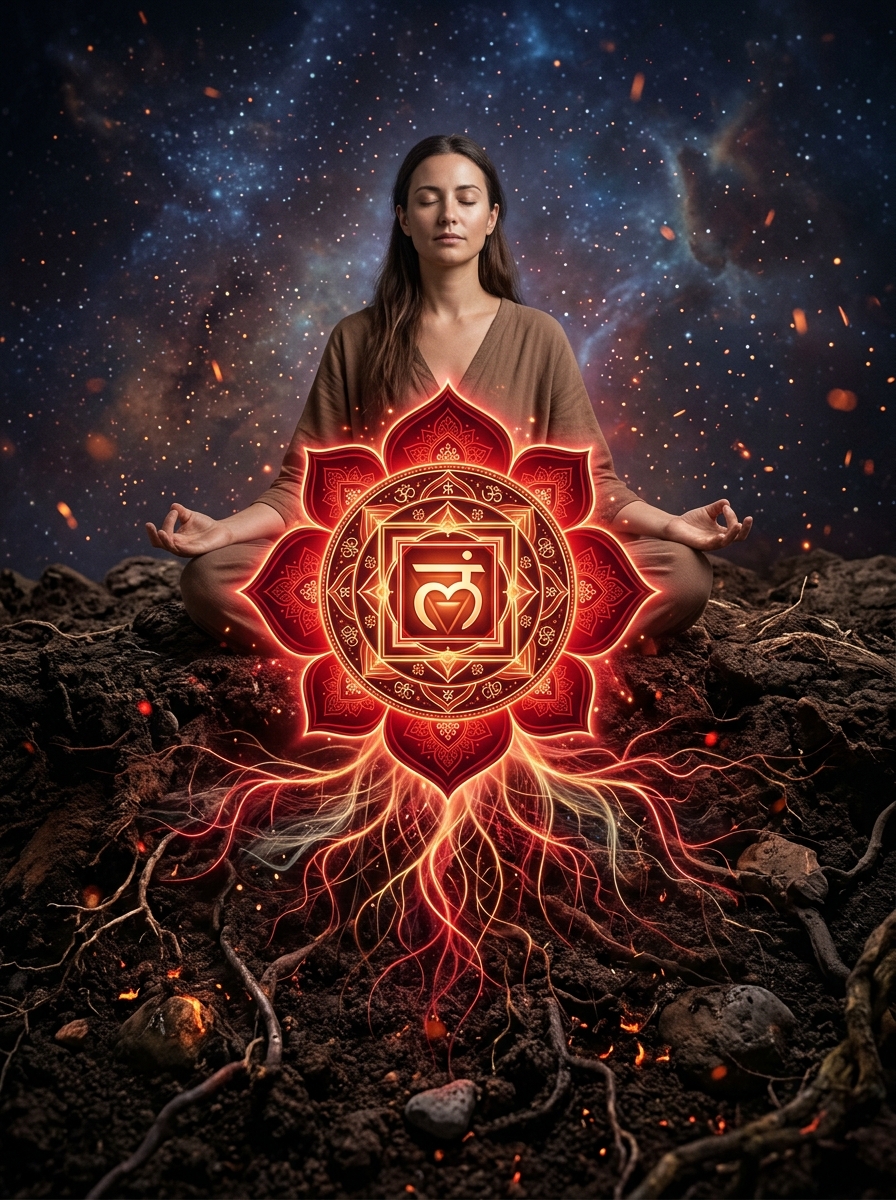
The Root Chakra’s Real Job — Not Grounding, but Incarnation
The Root chakra—Muladhara in Sanskrit—is not a metaphor for feeling steady. It is the psyche’s contract with existence: I am here, I have weight, I can endure, I belong to the earth. This is not the language of self-help but of survival biology, family conditioning, and the body’s most ancient memory. The chakra governs the conditions that make all later growth possible: shelter, hunger, routine, bodily safety, and the confidence to occupy space without apology. When this center is online, the rest of the energetic system has something to stand on. When it is strained, even intuition becomes unlivable.
Muladhara is usually associated with the color red, the element earth, and the base of the spine. Symbolically it is the place where spirit takes on limits, gravity, and consequences—incarnation itself. That is why this center becomes active not only during obvious instability—job loss, illness, displacement—but also during success, intimacy, and change. Anything that asks the body to trust the world more fully will touch the Root.
Its Sanskrit name translates to “root support” or “base foundation,” and that is precise. The question it asks is simple and severe: what, exactly, is holding you up? A person with a balanced Root does not necessarily have a perfect life. They have enough internal and external structure to meet reality without constantly bracing against it. In Jungian terms, the Root belongs to the deep layer where survival instincts, family conditioning, and bodily memory overlap—the animal self before any polished spiritual story is written over it. If that layer is neglected, people often seek substitutes for grounding: compulsive productivity, constant stimulation, rigid control. If it is tended well, the rest of the self can become more creative because it no longer spends all its energy on vigilance. For a precise map of how the Root relates to the other centers, the Chakra Tarot Spread can expose which chakra is compensating for what the Root is not providing.
The Body Location Is the Teaching
The Root chakra sits at the perineum, the base of the spine, and in many traditions includes the pelvic floor and legs as extensions of its domain. It is not a metaphor floating above the body; it is the energetic language of embodiment. The feet, ankles, knees, hips, tailbone, and lower spine all participate in its story. To understand the state of the Muladhara, watch how a person stands, walks, settles, and returns to rest. The physical placement matters because this chakra’s intelligence is about contact. The base of the spine is where ascent begins, but it begins only after contact with the ground has been established.
How It Forms — The Body’s Memory of Safety
The Root is forged in early life and in the ancestral lines that precede it. It carries inherited fear from family systems—scarcity narratives, migration histories, trauma, and any experience that taught the body the world is unsafe. This is not poetic decoration; it is neurological. The nervous system encodes the reliability of the environment during infancy and childhood, and that encoding becomes the baseline for every later relationship with security. A person raised in chronic unpredictability will have a Root that reads even neutral situations as dangerous. Another raised in consistent warmth will have a Root that can rest.
This layer is what Jungians call the shadow of the Root: the unexamined beliefs about survival that run beneath conscious thought. “I can’t afford to relax.” “If I stop working, everything will fall apart.” “No one is coming to help.” These are not intellectual positions; they are somatic convictions stored in the pelvis and lower spine. To balance the Root without addressing that history is to paint over rust. A Chakra Tarot Spread can reveal which inherited patterns are still running the show—cards in the Root position often carry the imprint of ancestry or early wound.
The Ancestral Layer
The earth element of the Root is also the element of lineage. Our bodies carry not only our own survival stories but those of our parents, grandparents, and older. Financial insecurity that began three generations ago can live in the Root as a tightness around money, a fear of having enough, or a compulsion to hoard. This is not mysticism; it is intergenerational transmission of nervous system patterns. Healing the Root often requires distinguishing between the fears that belong to the present and those that belong to the past. Therapy, genograms, and somatic work can help untangle them. The chakra responds to truth more readily than to slogans.
Overactivation and Collapse — Two Faces of the Same Wound
Most descriptions of a blocked Root chakra focus on fear, but the blockage splits into two opposite patterns. One is overactivation: clutching, defensiveness, rigidity, hoarding, territorial behavior, and a constant need to control conditions. The other is collapse: dissociation, passivity, poor follow-through, lack of embodiment, and a strange inability to trust basic continuity. Both arise from the same wound—a felt belief that the ground is unreliable—but they express it differently.
An overactive Muladhara produces a life organized around protection. Such a person may be highly competent, but their competence is armored. They can be hypervigilant about money, health, food, or status. They resist change not because they are lazy, but because they experience change as existential danger. The Root in this state has turned from support into fortress. Conversely, a depleted Root can look softer on the surface and still be severe. The person struggles to initiate, to finish tasks, to maintain routines, or to inhabit their own body consistently. They may attract unstable relationships, drift through responsibilities, or feel chronically “not quite here.” This is not a personality flaw; it is the nervous system reducing contact with overwhelm.
Signs in Daily Life
The clearest signs of Root chakra imbalance are concrete. On the body level: fatigue that rest does not fully fix, tightness in the lower back or hips, digestive irregularity, a generalized sense of being unsteadied. On the emotional level: insecurity without a clear cause, irritability when ordinary plans shift. On the behavioral level: oscillating between hoarding resources and failing to use what one already has. The symbolic pattern is equally revealing. If the Root is weak, the sacral center may seek sensation without containment; the solar plexus may overcompensate through force; the heart may overgive to earn safety. A Chakra Tarot Spread can quickly show which center is carrying the burden the others have outsourced.
What Restores the Root — Repetition, Not Revelation
To balance the Root chakra is to persuade the body that the present is survivable. That rarely happens in one dramatic breakthrough. It happens through repeated signals: predictable meals, protected sleep, financial clarity, deliberate movement, environments that reduce hidden threat. The Muladhara responds to consistency with a deep exhale.
The best balancing practices are mundane in the most sacred sense. Walking, squatting, gardening, cleaning, carrying weight with good form, spending time on or near the ground—all help the Root remember gravity as support rather than threat. Breathwork can help, but only if it is gentle; forcing the breath can agitate an already alarmed nervous system. Slow exhales, attention to the soles of the feet, and long pauses after movement are often more effective than flashy techniques.
The Mundane as Sacred
Sensory regularity matters. Eat at roughly the same times. Keep a corner of your home uncluttered enough to feel unmistakably yours. Pay attention to warmth, texture, and boundaries. The earth element heals through form: blankets, doors that lock, a chair that supports the spine, a budget that reflects reality. None of this is spiritually inferior. For Muladhara, these are the prayers that count.
Do not confuse stimulation with grounding. A burst of exercise, an expensive purchase, or a weekend retreat may create the sensation of resetting, but the Root is assessed by what remains when the novelty fades. True balancing is boring enough to be trustworthy. It produces less drama, not more. It makes life narrower in some ways and wider in others: narrower because chaos loses access, wider because energy is no longer leaking into survival panic.
This is also where shadow work belongs. The Root carries inherited fear that must be faced honestly. That may involve therapy, medical care, financial restructuring, or better boundaries—not just candles and affirmations. The chakra responds to truth more than to slogans. When the underlying history is acknowledged, grounding becomes repair rather than performance.
The Foundation That Lets the Rest of the Wheel Turn
A balanced Root chakra does not make a life perfect; it makes a life inhabitable. It gives the rest of the chakra system permission to function without panic. When Muladhara is steady, the sacral center can feel without drowning, the solar plexus can choose without bullying, and the heart can open without bargaining for survival. The spiritual path becomes less theatrical and more durable.
This is why the Root deserves respect before reverence. It is the first chakra not because it is inferior, but because it is essential. The body cannot ascend by rejecting its base. If you want a usable spiritual life, begin with what can be supported, repeated, and trusted. A Chakra Tarot Spread can show whether the Root is asking for protection, nourishment, or release. The cards will not replace lived change, but they can name its shape with unsettling clarity.
Related
- The Crown Chakra: Sahasrara and the Quiet Intelligence of Spirit
- The Chakra Tarot Spread: A Seven-Card Map of Your Subtle Body
- Throat Chakra Meaning, Signs of Blockage, and How to Balance Vishuddha
- The Star Tarot Spread: A Complete Guide to the Five-Pointed Reading
- Chiron in Scorpio: The Wound That Teaches You to Rise from the Ashes
Comments
Loading comments…