The Crown Chakra: Sahasrara and the Quiet Intelligence of Spirit
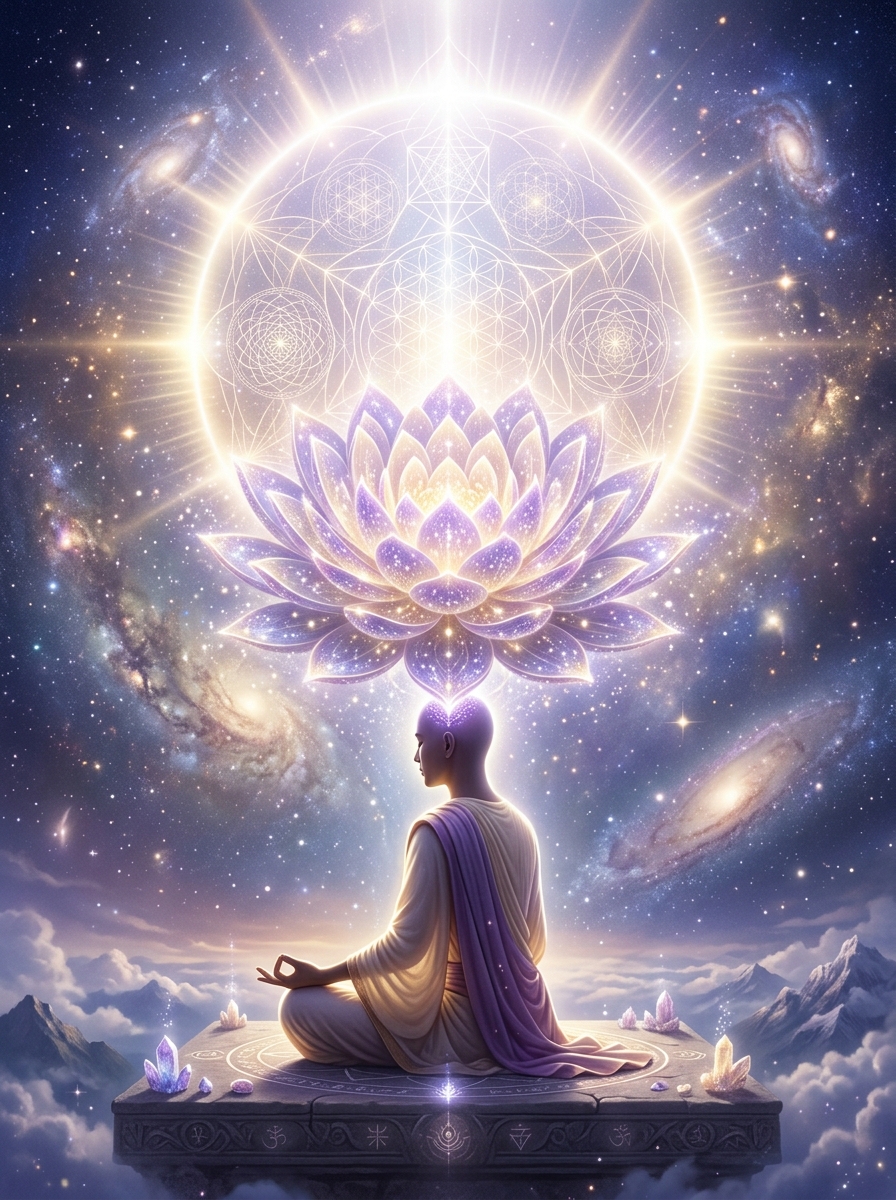
The Crown Chakra Is Not an Escape Hatch
The Crown Chakra—Sahasrara in Sanskrit—is the seventh center of the subtle body, the place where consciousness becomes spacious enough to recognize itself. It is not “above” the person so much as crowning the entire system: the point at which identity thins, the private story loosens, and something larger is perceived. Its basic signature is synthesis. Where the lower chakras organize survival, feeling, and will, the crown asks a different question: what is the self when it is no longer defending, grasping, or narrating? This is the seat of perspective, devotion, faith, and contact with transpersonal meaning. The mistake is to treat it as a permanent glow state. It is more accurately a capacity for clear reception—a way of letting reality teach without the ego hijacking the lesson.
What the crown means in practice is that the psyche has stopped mistaking its own weather for the whole sky. That is not dissociation. It is discrimination joined to wonder. When you work with this center, you are not trying to float above life but to let perception become more honest. The chakra tarot spread can help you see how the seventh center interacts with the other six, because this highest station is never meant to cancel the rest of the system.
Location, Color, and Symbolic Anatomy
The Crown Chakra is classically located at the top of the head, sometimes described just above the fontanelle or as a subtle halo extending upward from the skull. In lived experience, it is more often sensed as pressure, tingling, lightness, or a vertical quieting through the center line of the body. Some feel it most strongly during meditation, prayer, grief, or moments of profound awe; others notice it only by its absence—a sense that life has become mechanically functional but spiritually flattened. That location is symbolically exact: the crown sits at the threshold between embodiment and transcendence, neither abandoning the body nor being confined by it.
In yogic symbolism, Sahasrara is a thousand-petaled lotus—an image of infinite unfoldment rather than fixed form. The traditional color is violet or white. Violet sits at the shortest visible wavelength, near the threshold of what the eye can perceive, making it a fitting emblem for liminality. White gathers every color without emphasizing any single one. Both colors imply transparency, refinement, and a capacity to include difference without fragmentation. The crown does not erase the lower centers; it integrates them. A healthy crown knows that the highest insight must be able to descend into daily conduct. For a fuller map of how this center fits into the subtle body, the chakra tarot spread offers a seven-card reading that traces the same vertical logic.
What a Balanced Crown Feels Like
A balanced Sahasrara does not produce constant ecstasy. It produces orientation. There is a felt trust that life has coherence even when events do not. The person can sit with paradox without rushing to collapse it into certainty, and can receive guidance without outsourcing their judgment. They can pray, meditate, study, or create from a center that is calm rather than hungry. This is where the crown differs from wishful thinking: balanced crown energy does not make life magically easy; it changes the relationship to difficulty. Instead of demanding that every event prove personal worth, the person begins to recognize pattern, timing, and meaning. There is less compulsion to control outcomes, and more subtle permission to participate in the larger design without knowing the whole design in advance.
In tarot language, a functioning crown feels like The High Priestess speaking with The World—intuition with discernment, mystery with completion. In numerological terms, the 7 that rules this chakra carries the energy of contemplation, inquiry, and inward truth. Seven does not rush. It investigates. A balanced crown also makes a person kinder—not performatively spiritual, but less trapped in egoic defense. When the psyche no longer has to prove itself at every turn, compassion becomes less strategic. The self is no longer the center of every scene. That is one of the clearest signs that Sahasrara is open in a stable way. If you want to read this energy alongside the other six centers, the chakra tarot spread provides a structured way to see where the crown is leading and where it might be compensating.
Signs the Crown Chakra Is Blocked or Overactive
When the Crown Shuts Down
A blocked Crown Chakra often looks less dramatic than people expect. It can show up as cynicism, spiritual numbness, alienation, or a sensation that life has become purely utilitarian. The person may be overidentified with facts but starved for meaning, distrusting intuition, mocking reverence, or feeling embarrassed by wonder. In some cases, the blockage appears as mental fatigue that no amount of sleep resolves, because the issue is not rest but disconnection from significance. Another common pattern is existential isolation—a sense that no one and nothing is truly guiding them. Even if daily life is functioning, there is a feeling of inhabiting a sealed chamber. This is not always a “bad attitude”; it can be the psyche’s response to prolonged stress, grief, or betrayal. The crown is often the first center to close when life has taught someone that trust is dangerous. Restoring it requires reintroducing coherence in ways the nervous system can actually believe, which is why grounding practices are essential.
When the Crown Opens Too Wide
An overactive crown can be just as disruptive. It may appear as spiritual bypassing, dissociation, grandiosity, or a tendency to treat embodiment as an inconvenience. The person may chase transcendence while neglecting sleep, food, work, and relationships, becoming addicted to revelations but unable to apply them. Insight arrives faster than integration, and the result is inflation: “I know” replaces “I am learning.” The warning sign is not spirituality itself. It is bypassing the human contract. A destabilized crown can make someone feel cosmic while behaving irresponsibly, and that imbalance often masks fear of ordinary life. If the lower chakras are not respected, the crown becomes a drafty tower with no foundation. For a balanced reading, the crown must be considered alongside the whole vertical system—the chakra tarot spread keeps each center accountable to the others.
How to Balance the Crown Chakra Without Losing Your Feet
The best Crown Chakra practices are not dramatic. They are precise. Meditation is useful, but only when it teaches receptivity rather than trance chasing. A few minutes of silent sitting, with attention on the breath and the top of the head gently softened rather than forced open, is more effective than striving for mystical fireworks. The point is to make room for contact, not to manufacture revelation. Study can also balance the crown, provided it is the right kind of study: texts on philosophy, theology, mysticism, or symbol systems refine the mind’s ability to tolerate complexity. The crown likes patterns, but not rigid certainty. It thrives when intelligence is in service to humility.
Body-based practices are essential because Sahasrara is not separate from the rest of the channel. Walking, restorative yoga, breath awareness, time in nature, and consistent sleep all support the upper center by stabilizing the nervous system. If the body is overloaded, the crown often compensates by fleeing upward. Grounding practices do not “lower” spiritual energy; they make it inhabitable. The highest insight should be able to descend into daily conduct.
If you read Tarot, the Crown Chakra responds well to cards that clarify how spirit is trying to speak through circumstance. The Hermit can indicate inward guidance and disciplined solitude; The Star often suggests restoration and trust; The World speaks to integration and completion. You do not need to force the message into a single “chakra meaning”; the point is to notice whether the crown is asking for retreat, hope, or synthesis. The most useful question is not “How do I open this chakra more?” but “What would help me receive reality with less distortion?” That question is crown medicine. It invites prayer without inflation, contemplation without denial, and reverence without escape. For a structured way to read the full system, the chakra tarot spread gives each center its card, letting the seventh speak to the other six in context.
The healthy crown does not make you less human. It makes you more accurately human: less armored against mystery, less addicted to control, and more capable of letting meaning arrive on its own terms.
Related
- How to Balance Your Chakras: A Practical Map of the Subtle Body
- The Root Chakra: Ground, Safety, and the Body’s First Yes
- The Chakra Tarot Spread: A Seven-Card Map of Your Subtle Body
- The Sacral Chakra: Desire, Fluidity, and the Art of Feeling
- The Heart Chakra: Anahata, the Inner Bridge Between Self and World
Comments
Loading comments…