Rational Thought Number: The Mind’s Ledger and How It Reads Reality
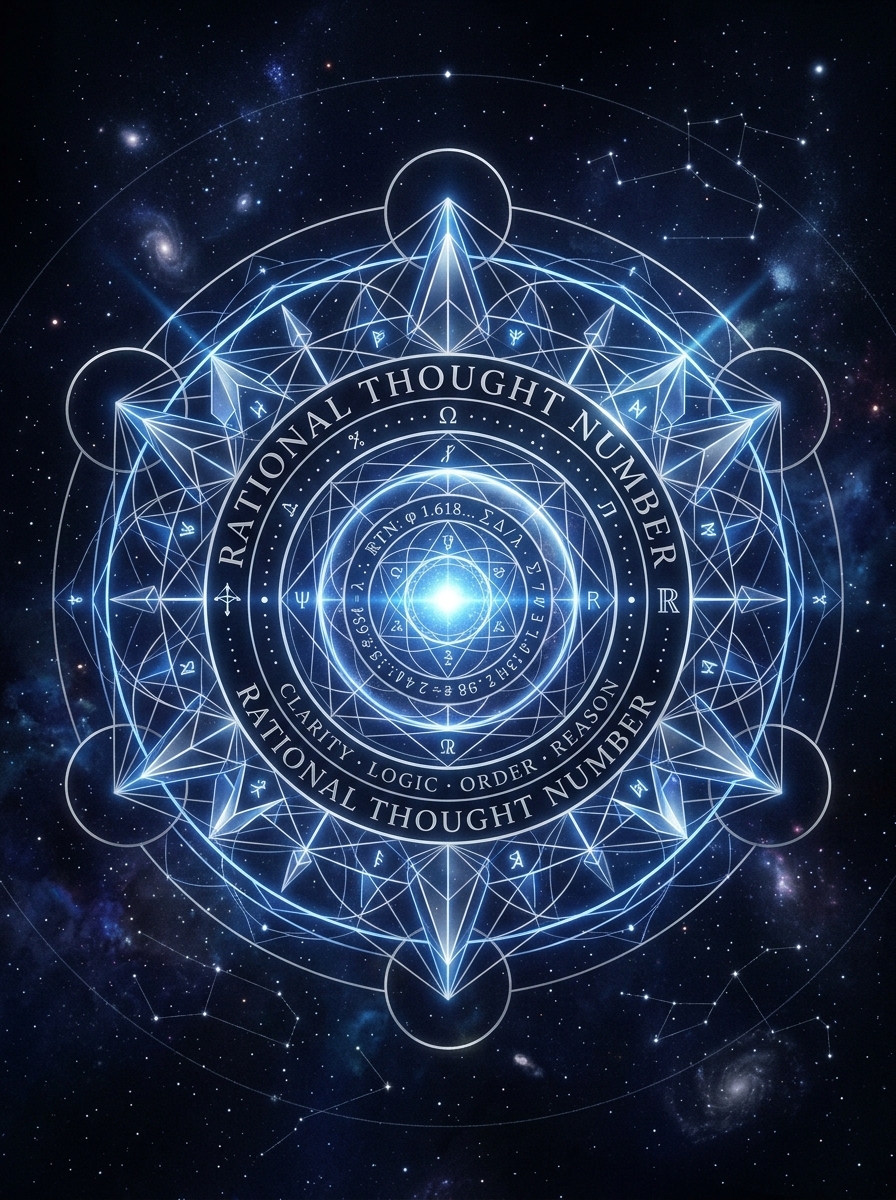
The Rational Thought Number is not a measure of raw intelligence. It is the numerological signature of how your mind organizes experience—the internal style through which you interpret evidence, navigate uncertainty, and decide what counts as true. Where the Destiny Number maps the soul’s evolutionary arc, this number zooms in on the thinking instrument that travels that arc: its reflexes, its blind spots, the particular logic it trusts under pressure.
What the Rational Thought Number actually is
Every mind has a default mode of cognition—a habitual way of turning raw perception into coherent meaning. The Rational Thought Number crystallizes that mode. It is not a label for “cold logic” vs. “warm intuition.” In esoteric terms, rational thought is the shape that feeling takes when it seeks structure. A mind wired to 7 interrogates everything until essence emerges; one wired to 2 reads truth through subtle relational cues rather than linear deduction. Both are rational—in different dialects.
This number derives from the full birth name, reduced using the Pythagorean system, because the name encodes how the psyche presents itself through language and decision. The calculation method is identical to the one used for the Expression Number: convert each letter to its number, reduce each name component to a single digit (or preserve master numbers if your system does), then sum and reduce again. For example, “MAYA ROSE CARTER” yields MAYA = 4+1+7+1 = 13 → 4, ROSE = 9+6+1+5 = 21 → 3, CARTER = 3+1+9+2+5+9 = 29 → 11 (or 2). With master numbers kept, 4+3+11 = 18 → 9; without, 4+3+2 = 9. The choice matters: 11 thinks in visionary flashes, while 2 thinks in resonance. A step-by-step walkthrough of the reduction appears in How to Calculate Your Expression Number.
Why use the full name rather than the birth date? Because the Rational Thought Number reflects the mind’s public instrument—how it reasons, argues, and shapes reality through language. It does not override the Life Path or Soul Urge; it frames how you think through them.
The three cognitive families
Rather than memorizing an array of isolated number descriptions, it is more illuminating to see the Rational Thought Number as falling into one of three broad families—each with a distinct organizing principle.
The decisive architects: 1, 4, 8
These numbers orient thought around structure, action, and consequence. A mind governed by 1 thinks in first principles: direct, initiating, impatient with ambiguity. It cuts cleanly through confusion but can mistake conviction for evidence. 4 thinks like a builder: it demands definitions, sequence, and repeatability. This is the mind that tests a theory before announcing it—trustworthy when flexible, paralyzed when rigid. The numerology of number 4 expands this structure-centered intelligence. 8 evaluates through power and system: who benefits, what scales, what costs. Strategic and unsentimental, its shadow is control through over-certainty. See numerology number 8 for the authority pattern.
The relational evaluators: 2, 6, 9
These numbers govern thought through resonance, ethics, and integration. 2 perceives nuance before structure—tone, timing, subtext. It is often mistaken for indecision, but it is an exquisitely relational intelligence that knows reality is carried beneath the surface. The meaning of number 2 explores this receptive wisdom. 6 is the mind of responsibility: it asks whether a belief is humane and sustainable. Its logic is governed by conscience, which can make it wise or prone to perfectionism. See numerology number 6. 9 thinks in wide circles, capable of synthesis and detachment. This mind understands that problems are larger than the immediate event and that thought must sometimes surrender to time. The number 9 archetype speaks to completion-oriented intelligence.
The exploratory and voltage minds: 3, 5, 7, and the master numbers
These numbers alter the texture of rationality rather than its content—they make the mind more fluid, restless, inward, or electric. 3 thinks through wit and association, discovering truth by circling it in conversation. Its gift is fluency; its weakness is diffusion. The Life Path Number 3 page captures this creative volatility. 5 learns by motion and contrast—restless, adaptive, brilliant at reframing a problem but prone to inconsistency. See number 5’s alchemical catalyst. 7 is the archetypal investigator: it withdraws from noise until essence appears, trusting earned knowledge over borrowed opinion. Its shadow is endless skepticism. The sacred inquiry of number 7 goes deeper.
Master numbers raise the voltage. An 11 rational current arrives as insight before explanation—pre-verbal, visionary, fast. It is not anti-rational; it is supra-rational. The Master Number 11 page and Expression Number 11 both decode that channel. A 22 thinks architecturally on a collective scale—visionary engineering. See Master Number 22 and Expression Number 22. A 33 unites discernment with compassion, seeking to heal through understanding. The Master Number 33 and Expression Number 33 pages explore that rare fusion.
How the number plays out in a life
The Rational Thought Number becomes practical when you observe how a person handles uncertainty. A 4-wired mind may approach relationships as structures to be built: clear agreements, predictable rhythms, shared definitions. A 7 may need intellectual solitude before trust forms. A 2 may appear indecisive in negotiations because it reads the unspoken dynamics before the explicit deal. In work, a 5 thrives on novelty and will stagnate in rigid routines; an 8 excels at scaling projects and managing resources but may neglect the human cost. These are not predictions—they are patterns of emphasis. The number shows where your reasoning naturally strengthens or distorts.
Integration comes when the Rational Thought Number is neither suppressed nor exaggerated. A healthy 4 does not merely obey rules; it builds workable ones. A healthy 7 questions without disappearing into suspicion. Distortion occurs when the number becomes a defense: 1 becomes arrogance, 6 becomes moral overreach, 5 becomes evasive cleverness. The number does not create the flaw; it gives the flaw a recognizable grammar.
The mind does not operate in a vacuum. The Rational Thought Number negotiates with the Soul Urge Number (what the heart truly wants) and the Challenge Number 6 (where duty and love complicate judgment). A person whose rational current is 8 but whose soul urge is 3 may feel torn between strategic control and expressive freedom. The number is not sovereign; it is a mediator.
The spiritual purpose of knowing your rational style
The deepest use of the Rational Thought Number is not self-optimization but discernment. In metaphysical terms, thought is the bridge between raw experience and soul-level understanding. If the bridge is weak, life becomes superstition or impulse. If overbuilt, life becomes sterile certainty. The number reveals how the bridge was designed.
Knowing your rational style allows you to stop demanding that your mind think like someone else’s. A 2 can trust its relational radar without apologizing for it. A 7 can honor the need for withdrawal before forming conclusions. A 4 can accept that not every problem requires a blueprint. This is the gift of numerology: not prediction, but precision—the ability to use your own instrument better, question it more honestly, and let it serve the larger pattern rather than dominate it.
Related
- Balance Number in Numerology: The Inner Measure of Equilibrium
- Angel Number 727: The Quiet Alignment of Faith, Discernment, and Forward Motion
- Angel Number 1110: When Intuition Opens the Door and Will Has to Walk Through
- Angel Number 1133: The Double Spark of Initiative and Grace
- Name Numerology: What Your Name Reveals
Comments
Loading comments…