Pluto in Virgo: The Alchemy of Meticulous Transformation
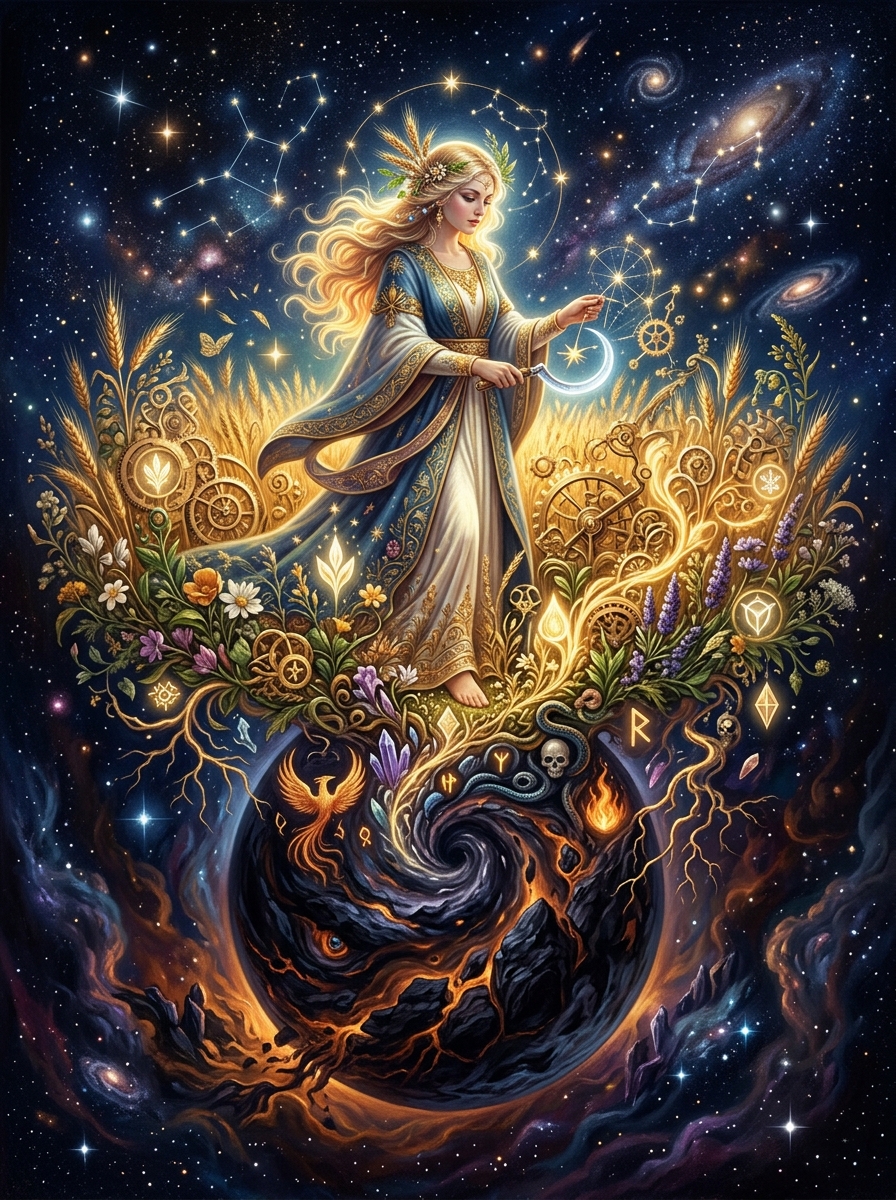
The Generational Landscape: The Crucible of Pluto in Virgo (1956–1972)
To understand Pluto in Virgo, one must look at the seismic collective shifts that occurred while the planet of death, rebirth, and evolutionary pressure traversed the mutable earth sign of the Virgin between late 1956 and 1972. This period represents the birth years of the older tier of Generation X—a cohort positioned at a pivotal historical crossroads. Pluto’s transit here forced a collective confrontation with the very fabric of how humanity manages its material existence, its labor, its health, and its relationship to the natural world. This generation did not inherit a static world; instead, they were tasked with dismantling, analyzing, and rebuilding the mechanical systems of their parents.
Astrologer Liz Greene has often noted that Pluto represents the collective unconscious and its compulsive urge toward survival and regeneration. When Pluto occupies Virgo, this survival instinct is channeled through the Mercurial filter of sorting, refining, and perfecting. The historical landscape of 1956 to 1972 was characterized by the silent, steady integration of systems that would fundamentally alter human civilization. It was the era of the Cold War's technocratic escalation, the space race, the initial deployment of mainframe computers, and the realization that industrial pollution was actively poisoning the planet. The youth of this era grew up witnessing the literal and metaphorical pollution of their environment, which seeded in them a deep-seated evolutionary drive to clean, purge, and repair.
This generation serves as the bridge between the old and the new. They are the architects who took the raw, heavy machinery of the industrial era and distilled it into the microscopic, silent pathways of the microprocessor. Their childhoods were defined by analog toys, mechanical gears, and physical newspapers, yet their adulthoods became entirely dominated by the rise of digital interfaces, spreadsheets, and databases. This dual perspective gave them a unique psychological profile: a deep appreciation for tangible, physical craftsmanship combined with an innate capability to manipulate abstract, systemic data. They did not merely witness the transition from analog to digital; they built it line by line, soldering joint by soldering joint.
From a Jungian perspective, Pluto in Virgo represents the collective confrontation with the archetype of the Shadow in the realm of the ordinary. It is the realization that the demon is not necessarily a grand, mythological beast, but rather the silent accumulation of toxins in the soil, the bureaucratic inefficiencies that crush the human spirit, or the invisible bacteria that escape the sterilized laboratory. This generation’s collective mission has always been about purification. They came into a world that was messy, disorganized, and chemically compromised, and they dedicated their lives to sorting the wheat from the chaff. Their evolutionary path requires them to move from a state of anxious hyper-vigilance about the details of life to a state of deep, grounded trust in the self-organizing intelligence of the universe.
As we dissect this era, we observe that the mid-century optimism of the Pluto in Leo generation (the Baby Boomers, who prioritized individual expression and heroic self-actualization) gave way to the sobering reality of Pluto in Virgo. The grand, dramatic narratives of the self were replaced by the urgent, practical question: How does this actually work? The grand promises of post-war consumerism and industrial chemistry began to show their toxic underbellies. In response, this generation developed an instinctual skepticism toward grand promises. They realized that survival depended not on loud declarations of freedom, but on the meticulous, daily maintenance of the systems that support life. They became the quiet workers of the transition, operating behind the scenes to install the plumbing, write the code, and analyze the data that would run the modern world.
Symbolic Alchemy: Pluto’s Underworld Force Meets Mercurial Earth
To grasp the astrological mechanics of this placement, we must analyze the interaction between the planet Pluto—the lord of the underworld, the agent of ego-death and systemic decay—and Virgo, the mutable earth sign ruled by Mercury. In classical astrology, Pluto is the alchemical fire that burns away the dross to reveal the incorruptible gold beneath. Virgo is the archetype of the craftsman, the healer, the herbalist, and the analytical scribe. When these two forces merge, we witness a form of alchemy that is intensely practical, grounded, and focused on the micro-level of reality. Pluto demands total honesty and transformation; Virgo provides the surgical tools and the analytical frameworks to carry out that demand.
This combination creates a psychological posture that is deeply skeptical of superficial solutions. A person with Pluto in Virgo cannot accept a simple band-aid on a gaping wound. They feel a subconscious compulsion to dissect every problem down to its atomic components to understand how the system works—or why it failed. Here, the Mercurial mind is not used for superficial chatter or light-hearted intellectual games; instead, it is weaponized by Pluto to penetrate the deepest mysteries of the physical plane. This is the placement of the psychic detective, the forensic pathologist, the cellular biologist, and the rigorous editor of human experience.
Unlike Gemini, which represents the airy, communicative side of Mercury, Virgo represents Mercury's earthy, analytical, and diagnostic aspect. In Virgo, Mercury is concerned with the classification, categorization, and utilization of physical matter. It wants to know how to use the mind to improve the material condition. When Pluto's primordial, underworld energy is poured into this container, it forces a deep, often uncomfortable examination of the physical body, the earth, and the daily routine. The mind becomes a tool for survival, and the analysis of details becomes a matter of life and death.
graph TD
    A[Pluto: Underworld Force & Cosmic Fire] --> C[Alchemical Merging]
    B[Virgo: Mercurial Mutable Earth & Precision] --> C
    C --> D[Systemic Analysis & Meticulous Healing]
    C --> E[Shadow: Technocratic Obsession & Hypochondria]
    D --> F[Evolutionary Growth: Practical Sacred Service]
    E --> F
The Mutable Earth Vessel: Form, Scrutiny, and Purification
As a mutable earth sign, Virgo represents the phase of the zodiacal cycle where physical matter is analyzed, sorted, and prepared for integration into larger systems. It is the soil being tilled, the herbs being dried and categorized, and the ledger being balanced. When Pluto enters this mutable earth vessel, it brings an intense, sometimes agonizing focus on the vulnerability of physical forms. Matter is no longer seen as solid and permanent; it is understood as something that is constantly subject to decay, contamination, and transformation.
This creates a collective obsession with purification. The Pluto in Virgo individual feels a deep, instinctual need to keep their physical vessel—their body, their home, their immediate work environment—free from pollution. This is not merely a preference for cleanliness; it is an existential requirement. In the Western esoteric tradition, particularly in the writings of Aleister Crowley, the process of purification is the essential first step in the Great Work. Without purging the elemental impurities from the alchemical vessel, any subsequent magical or spiritual operation is doomed to failure. Pluto in Virgo applies this principle to everyday life, treating the daily routine, the diet, and the filing cabinet as the primary alchemist's lab where the soul is purified through meticulous attention to detail.
Steven Forrest emphasizes that Pluto’s position by sign shows where a generation feels a collective sense of vulnerability and, consequently, where it seeks to establish absolute control. For Pluto in Virgo, this vulnerability lies in the breakdown of daily structures, the onset of physical illness, and the chaotic intrusion of unstructured emotions. The defense mechanism is the implementation of rigorous, Mercurial systems. Through lists, schedules, diagnostic tests, and analytical frameworks, this generation attempts to build a fortress of order to protect themselves from the unpredictable undercurrents of the Plutonian underworld.
The Hermit Archetype and the Rider-Waite-Smith Symbolism
In the Rider-Waite-Smith tarot deck, created by Arthur Edward Waite and illustrated by Pamela Colman Smith, Virgo is associated with Card IX: The Hermit. The Hermit stands alone on a snowy peak, holding a lantern containing a six-pointed star of light, pointing downward toward the path. This card beautifully illustrates the higher expression of Pluto in Virgo. The Hermit is not merely isolating himself out of antisocial sentiment; he has withdrawn from the noise of the world to search for the inner, incorruptible truth. The lantern he holds represents the light of reason and self-awareness, which must be carried into the dark, unexplored territories of the self.
Under Pluto’s influence, this Hermit archetype is forced to descend from the mountain top into the deep valleys of the underworld. The Pluto in Virgo individual must seek the truth within the cells of the body, within the microscopic processes of work, and within the daily, quiet duties of life. The journey of the Hermit becomes an inward descent to face the hidden, shadow aspects of the psyche that manifest as physical tension, anxiety, or systemic inefficiency. By shining the light of meticulous awareness into these dark corners, the individual finds the alchemical gold of self-knowledge and the capacity to guide others through their own processes of purification.
The Labor Revolution: From Gears and Grease to Silicon and Code
One of the most profound manifestations of Pluto in Virgo was the complete restructuring of the global labor landscape. Virgo rules the Sixth House of the astrological wheel, which governs daily work, service, routines, employees, and the tools we use to perform our duties. Before Pluto entered Virgo in 1956, the dominant model of labor was industrial, mechanical, and physical. Factories were filled with massive, roaring machines, and the worker was often a cog in a vast, visible assembly line. By the time Pluto exited Virgo in 1972, the seeds of the post-industrial, information-based economy had been deeply planted.
The Pluto in Virgo generation did not just witness this change; they were the primary agents of it. They took the physical tasks of sorting, filing, calculating, and manufacturing and translated them into digital processes. They replaced the mechanical typewriter with the word processor, the physical ledger with the relational database, and the manual assembly line with automated, computer-controlled systems. This was a profound Plutonian death and rebirth of the workplace. Entire industries that relied on manual, physical repetition were dismantled, and in their place arose the knowledge economy, where value was derived from the precision of one's data analysis and the efficiency of one's systems.
This transformation was not without its trauma. Pluto always demands a sacrifice, and in the realm of labor, the sacrifice was the security of the traditional working class. The heavy industrial jobs that had sustained families for generations began to vanish, replaced by demands for technical literacy, cognitive flexibility, and programming skills. The physical sweat of the factory floor was replaced by the intellectual strain of the cubicle and the software lab. This generation had to adapt to an environment where the tools of production were no longer physical hammers and anvils, but abstract algorithms and logical protocols.
The Demise of the Machine: Transitioning to the Micro-Processor
This transition is best understood through the metaphor of the silicon chip. Silicon, an element derived from sand (earth), became the medium through which human intelligence (Mercury) was digitized and accelerated. The Pluto in Virgo generation looked at the massive, hot, vacuum-tube computers of the early mid-century and set about miniaturizing them. They realized that power did not lie in making machines larger and louder, but in making them smaller, quieter, and more precise.
This focus on the micro-level is a classic signature of Virgo. It is the belief that if you control the smallest unit of a system—the bit, the pixel, the individual line of code—you can control the entire system. This generation developed a religious devotion to coding standards, systems architecture, and database normalization. They understood that a single misplaced character in a line of code could crash a system worth millions of dollars. This reality bred a work ethic that was characterized by intense concentration, long hours of quiet analytical labor, and a deep pride in the invisible craftsmanship of software development. They built the digital infrastructure that the younger generations now take for granted, transforming the nature of human labor from physical exertion to mental optimization.
This engineering mindset also birthed the concept of "systems thinking." Instead of viewing machines as isolated tools, the Pluto in Virgo generation began to see the entire world as an interconnected web of systems, where a change in one small part would ripple through the entire network. They designed the first network protocols, built the early infrastructure of the internet (ARPANET was launched in 1969), and established the principles of relational databases. Their labor was a form of planetary wiring, creating the neural pathways of the global brain that would fully mature in the decades that followed.
Somatic Alchemy: Redefining Healing, Medicine, and Ecological Systems
Just as Pluto in Virgo revolutionized the office and the factory, it also transformed our relationship to the physical body and the environment. Virgo has long been associated with the healer, the herbalist, and the physician. It is the sign that rules the digestive tract, the assimilation of nutrients, and the somatic feedback loops that keep the organism in balance. Under the influence of Pluto, the medical establishment and collective attitudes toward health underwent a radical purification process.
Before this transit, mid-century medicine was highly paternalistic, chemical-centric, and focused on treating symptoms rather than addressing root causes. The Pluto in Virgo generation initiated a massive rebellion against this mechanistic model. They demanded to know what was in their food, what chemicals were being sprayed on their crops, and what side effects their medications were causing. This era saw the birth of the modern environmental movement, catalyzed by books like Rachel Carson's Silent Spring (published in 1962, during the height of Pluto's transit through Virgo). The realization that human health is inextricably linked to ecological balance is a pure expression of Pluto in Virgo's systemic vision.
graph TD
    A[Industrial Chemical Medicine] --> B{Pluto in Virgo Scrutiny}
    B --> C[Holistic Health & Somatic Autonomy]
    B --> D[Ecological Awakening & Conservation]
    B --> E[Preventative Wellness & Diet Reform]
The Body as a Living Temple: The Rise of Holistic Well-being
Under Pluto's transit through Virgo, the modern wellness movement was born. The concept of "holistic health" emerged as a direct challenge to the compartmentalized approach of traditional Western medicine. The Pluto in Virgo generation began to view the body not as a machine to be repaired by external mechanics (doctors), but as a self-regulating, living temple that requires clean fuel, proper maintenance, and spiritual alignment.
This perspective led to a massive resurgence of interest in natural healing modalities, organic farming, vegetarianism, herbal medicine, and preventative care. The focus shifted from treating acute disease to optimizing wellness. People wanted to understand their bodies at a granular level—tracking their nutrition, analyzing their digestive health, and exploring the connection between emotional stress and physical symptoms. This generation popularized yoga, meditation, and acupuncture in the West, integrating these ancient, somatic practices into the daily routines of modern life. They recognized that true health is an ongoing process of purification and alignment, requiring active, daily participation rather than passive reliance on pharmaceutical interventions.
Furthermore, this generation's focus on the gut is deeply astrological. Virgo rules the small intestine, the organ responsible for sorting nutrients from waste, absorbing what is useful, and discarding what is toxic. Pluto in Virgo brought an intense, transformative focus to this physical process. The rise of food allergy awareness, the critique of processed foods, and the understanding of the gut-brain connection are direct results of this generational inquiry. They realized that what we put into our bodies is the ultimate form of physical alchemy, directly affecting our cognitive clarity, emotional stability, and spiritual receptivity.
Ecological Intelligence: Virgo’s Systemic Repair
The ecological awakening of this era was not merely a romantic love for nature; it was an analytical, systemic understanding of the biosphere. Virgo is the sign of systems ecology—the study of how living organisms interact with their physical environment through complex feedback loops. Pluto’s presence here forced humanity to confront the toxic consequences of its industrial hubris.
The Pluto in Virgo generation realized that the earth is a finite, delicate system that cannot endlessly absorb toxic waste. They established the first recycling programs, drafted the foundational environmental protection laws in the United States, and began the slow, arduous process of cleaning up rivers, lakes, and industrial waste sites. They applied their analytical skills to mapping ecological damage, developing environmental science as a rigorous, respected academic discipline. Their contribution was the realization that conservation is not just about saving pretty landscapes; it is about preserving the complex, microscopic systems that sustain all life on this planet.
This systemic ecological view led to the development of permaculture and organic farming standards. The Pluto in Virgo generation realized that industrial agriculture, with its heavy reliance on synthetic pesticides and monoculture, was a toxic violation of the earth's natural balance. They sought to design agricultural systems that mimicked the complexity and resilience of natural ecosystems. By applying Virgo's precision to the observation of natural patterns, they demonstrated that human beings could live in a cooperative, regenerative relationship with the earth, working as active partners in the planet's ongoing self-repair.
The Shadow Side: Technical Obsession, Hypochondria, and Technocracy
Every Plutonian transit carries a heavy shadow, and Pluto in Virgo is no exception. When the evolutionary drive for perfection is corrupted by fear and the desire for control, it manifests as a range of psychological and systemic pathology. For this generation, the shadow is expressed through an obsessive preoccupation with the mechanical, the technical, and the quantifiable, often at the expense of the organic, the emotional, and the spiritual.
At the individual level, the shadow of Pluto in Virgo is experienced as an relentless internal critic. The subconscious demand for perfection can be so intense that it paralyzes the individual, making them feel perpetually inadequate. This can lead to severe anxiety, obsessive-compulsive behaviors, and a profound alienation from one's own body. When the natural somatic intelligence of Virgo is filtered through Plutonian paranoia, it often manifests as hypochondria. The individual becomes hyper-aware of every minor physical sensation, interpreting a transient headache or a digestive flutter as a sign of terminal illness. They may get lost in endless diagnostic loops, seeking out medical tests, alternative therapies, and restrictive diets in a desperate, futile attempt to eliminate all vulnerability from their physical existence.
The Diagnostic Cage: When Scrutiny Becomes Obsession
This obsession with diagnosis and measurement extends beyond personal health into the structure of society itself. The Pluto in Virgo era saw the rise of the technocrat—the expert who believes that all human problems can be solved through data collection, mathematical modeling, and bureaucratic administration. This is the dark side of Mercury meeting Pluto: the reduction of human beings to mere statistics, test scores, and diagnostic codes.
graph TD
    A[Subconscious Fear of Chaos] --> B[Obsessive Measurement & Data Collection]
    B --> C[Loss of Intuition & Creative Flow]
    C --> D[Systemic Rigidness & Bureaucratic Paralysis]
    D --> A
In this technocratic shadow, we find the origin of the modern surveillance state and the culture of endless compliance. Everything must be measured, categorized, and filed away. The danger here is that the soul of the individual is lost in the gears of the system. In their drive to eliminate error, inefficiency, and risk, technocratic systems create a sterile, hyper-regulated environment that stifles creativity, intuition, and authentic human connection. The Pluto in Virgo individual must learn that life cannot be fully understood through a microscope or managed with a spreadsheet; some mysteries must be lived, and some chaos must be allowed to exist.
This shadow also manifests in the educational system as an over-reliance on standardized testing and quantitative metrics. The Pluto in Virgo generation, as they moved into positions of administrative authority, helped design systems that reduced the complex, creative potential of children to a single test score. This bureaucratic reductionism assumes that if something cannot be measured, it does not exist or has no value. This has led to a collective crisis of meaning, where individuals feel disconnected from their unique, creative souls, trapped within the rigid, diagnostic cages of a hyper-rationalized society.
Technocratic Control and the Loss of the Numinous
The ultimate danger of the Pluto in Virgo shadow is the complete eradication of the numinous—the mysterious, unpredictable, and sacred dimension of reality. When Virgo's need for order is driven by Pluto's fear of chaos, it seeks to eliminate any element that cannot be predicted, standardized, or controlled. This leads to a sterile, mechanized worldview where nature is treated as a machine to be optimized and the human body as a biological computer to be programmed.
This mindset can be seen in the extreme forms of biohacking and transhumanism, where the organic limitations of the body are viewed as design flaws to be engineered out of existence. The Pluto in Virgo individual may become obsessed with tracking every biomarker, counting every calorie, and optimizing every minute of sleep, turning their life into an endless, joyless engineering project. In doing so, they lose touch with the natural rhythms of the body and the wisdom of surrender. They forget that the body is not just a machine, but a living partner that knows how to heal, rest, and dream. To transcend this shadow, they must learn to integrate the opposition sign of Pisces, surrendering the analytical mind to the vast, mysterious ocean of collective emotion and spiritual flow.
The Evolutionary Path: Integrating Virgo’s Meticulous Sacred Purpose
The ultimate goal of Pluto's transit through any sign is the alchemy of transmutation—turning the lead of fear and control into the gold of conscious, purposeful expression. For the Pluto in Virgo generation, and for those who carry this placement prominently in their personal birth charts, the evolutionary path lies in reclaiming the sacred dimension of craft, service, and daily life.
To heal their split between the analytical mind and the feeling soul, these individuals must transition from the role of the anxious critic to that of the humble channel. Virgo is historically symbolized by the Virgin holding a sheaf of wheat. In ancient cultures, this did not represent sexual virginity, but rather self-sovereignty—a person who is "one-in-themselves," whole and complete, independent of the expectations of others. The wheat represents the harvest, the fruit of dedicated, daily labor that is offered as nourishment to the community.
graph TD
    A[Anxious Critic: Fear of Failure] --> B[Surrender to the Work]
    B --> C[Sacred Craftsmanship: Daily Ritual as Alchemical Art]
    C --> D[Humble Service: Healing Self and Community]
When Pluto in Virgo aligns with this higher calling, they realize that their capacity for meticulous analysis is not a tool to defend against their fear of death, but a sacred gift to be used in service to the whole. They find deep spiritual fulfillment in the mastery of a craft, whether it is coding software, practicing acupuncture, baking bread, or restoring damaged ecosystems. They understand that the divine is not found only in transcendent, otherworldly experiences, but in the quality of their attention to the present moment. Every detail becomes a potential portal to the sacred. By surrendering their need for absolute control and dedicating themselves to the humble, daily work of repair and purification, they become the quiet alchemists who heal the world from the ground up.
This evolutionary path requires the integration of the Jungian concept of vocatio—a calling to a specific work that is both a personal joy and a service to the community. For Pluto in Virgo, this work must be approached with a spirit of humility and devotion. It is not about achieving fame, power, or heroic status (which belongs to Leo), but about the quiet satisfaction of a job well done. When they work with this attitude, the act of labor itself becomes a form of meditation. The writer editing a sentence, the programmer debugging a line of code, the gardener pulling weeds, the doctor listening to a patient's heartbeat—all are performing a sacred service, restoring order and beauty to a fractured world. Through this dedicated, mindful action, the Pluto in Virgo individual finds the peace and fulfillment that has always eluded their analytical mind.
Frequently Asked Questions
What are the birth years for the Pluto in Virgo generation?
The Pluto in Virgo generation includes individuals born roughly between late 1956 and late 1972. Because Pluto has a highly elliptical orbit, it spends varying amounts of time in each sign of the zodiac. During this specific period, Pluto was traversing the mutable earth sign of Virgo, marking a collective era focused on the transition from industrial to technological labor, the rise of ecological consciousness, and the development of the holistic health movement.
How does Pluto in Virgo affect an individual's career path?
On a personal level, individuals with Pluto in Virgo are drawn to careers that require high levels of precision, analytical skill, and specialized knowledge. They excel in fields such as software engineering, systems analysis, scientific research, medicine, environmental science, and editing. They need to feel that their daily work has a tangible, practical utility and that they are contributing to the efficiency or healing of a larger system. However, they must guard against workaholism and the tendency to become overly critical of colleagues or their own performance.
What is the relationship between Pluto in Virgo and anxiety?
Because Virgo is ruled by Mercury, it is an intellectually active sign that is prone to worry. When combined with Pluto's intense, subconscious energy, this can manifest as a deep-seated anxiety about physical vulnerability, chaos, and loss of control. Pluto in Virgo individuals often internalize their stress, leading to physical symptoms, particularly in the digestive system. Healing this anxiety requires learning to quiet the over-analytical mind, establishing healthy daily routines, practicing somatic grounding, and accepting that perfection is an illusion.
How did the Pluto in Virgo generation impact the environmental movement?
This generation was instrumental in founding the modern environmental movement. Born at a time when industrial pollution was becoming highly visible, they applied Virgo's analytical, systems-oriented approach to ecological conservation. They moved beyond emotional protests to develop the scientific research, recycling technologies, and regulatory policies needed to clean up and protect the planet. They established the foundational understanding that human health is directly connected to the systemic balance of the earth's ecosystems.
What is the primary evolutionary lesson for someone with Pluto in Virgo?
The primary evolutionary lesson for Pluto in Virgo is to move from fear-based control to trust-based service. These individuals must learn to tame their inner critic and surrender their obsession with absolute perfection. By recognizing that the daily routine itself can be a sacred ritual, and that their analytical skills are best used to heal rather than to judge, they can channel their immense focus into practical, transformative work that serves the greater good.
How does Pluto in Virgo manifest in the chart's houses?
In an individual's astrological birth chart, the house location of Pluto in Virgo indicates the specific life area where they will experience their deepest evolutionary struggles, power dynamics, and potential for regeneration. For example, in the Second House, it can lead to intense transformations regarding self-worth and financial security; in the Tenth House, it brings a driving desire to reform professional systems and authority structures. Regardless of the house, Pluto operates through Virgo's qualities of scrutiny, analysis, and dedication, demanding that the individual bring absolute honesty and precision to that specific department of life.
Related
- Pluto in Scorpio: Shadow Work, Generational Crisis, and the Alchemy of Rebirth
- Uranus in Virgo: When Revolution Learns to Count
- Pluto in Sagittarius: The Generation of Truth, Faith, and Global Transformation
- Pluto in Gemini: The Alchemy of Mind and Mass Communication
- Pluto in Capricorn: The Collapse of Authority and the Alchemy of Sovereignty
Comments
Loading comments…