Neptune in the Third House: The Dissolution of the Linear Mind
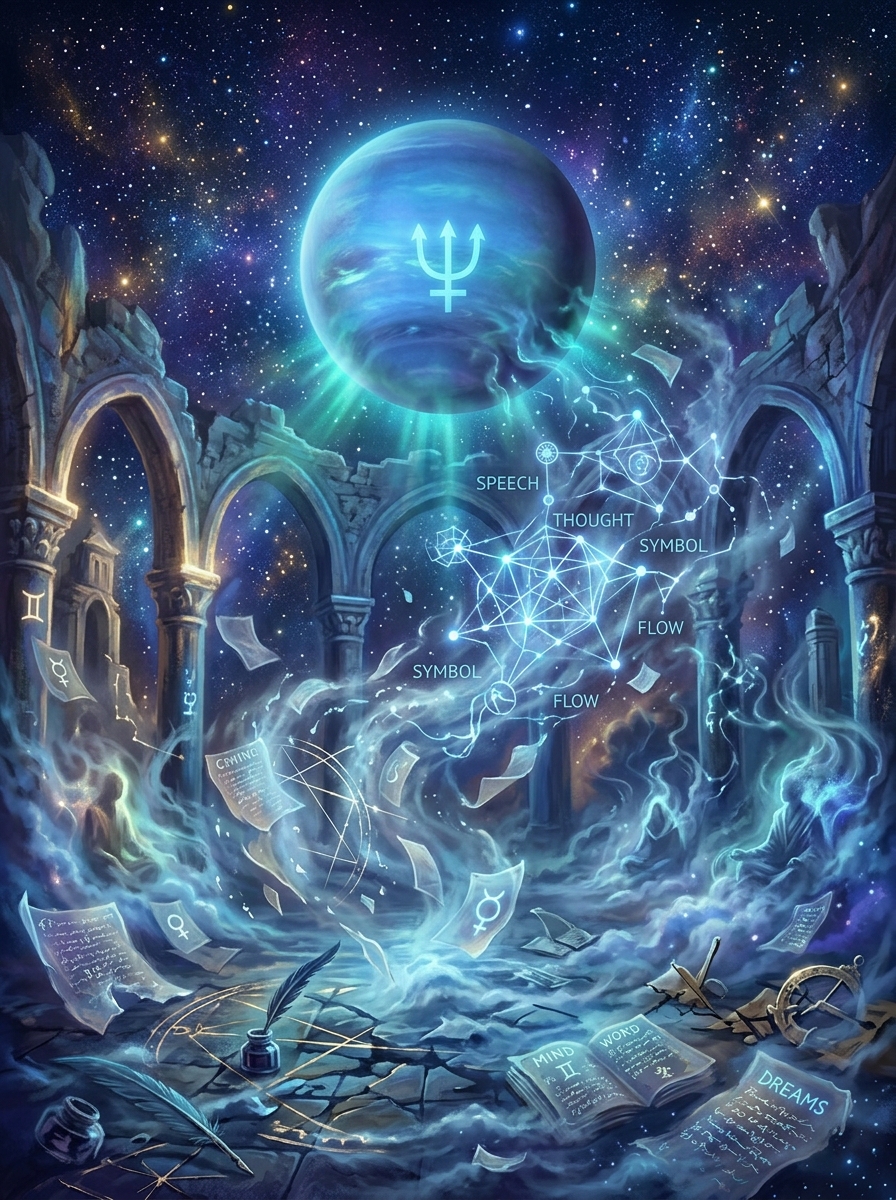
Introduction to Neptune in the Third House: The Dissolving Mind of Hermes
In the sacred architecture of the birth chart, the Third House represents the immediate landscape of the mind. Historically associated with the Gemini-Mercury archetype, this house is the domain of Hermes: the messenger, the classifier, the builder of cognitive bridges. It is here that we learn to label the world, to dissect reality into digestible pieces, and to navigate our neighborhood, both literally and conceptually. The Third House is where we develop our linear syntax, the step-by-step logic required to tell a street sign from a storefront, and the basic grammar of social interaction. It is a house of boundaries, classification, and practical utility.
When Neptune, the planetary embodiment of the boundless ocean, enters this mercurial chamber, the walls of the library begin to sweat. The clean, dry, geometric filing systems of the analytical mind are flooded by the rising waters of the collective unconscious. Neptune represents the urge to dissolve, to transcend limitations, and to return to a state of undifferentiated unity. It is the realm of the mystic, the poet, the dreamer, and the medium. When these two distinct forces collide, the result is a psychological landscape where the linear intellect is continuously softened, permeated, and sometimes overwhelmed by the oceanic tides of the subconscious.
For the native with Neptune in the Third House, the mind is not a computer processing discrete data packets; it is a sensitive instrument submerged in the psychic ether of the universe. In the style of Liz Greene’s psychological portraiture of Neptune, this placement speaks to a deep, often unconscious longing to escape the cold confines of literal truth. The intellectual machinery is repurposed to serve the imagination. The boundaries between the self and the mental environment become semi-permeable membranes. Information is not merely received; it is felt, tasted, and absorbed. The dry logic of Hermes is replaced by the mysterious, symbolic whisperings of the deep sea.
This placement invites us to explore the delicate balance between clarity and chaos. While it grants an extraordinary capacity for artistic expression, emotional sensitivity, and psychic receptivity, it also demands a confrontation with the fog. The challenge for the native is to learn how to walk through the misty corridors of their own intellect without losing their footing, and to translate the wordless songs of the deep into a language that the waking world can comprehend.
The Intersection of Ocean and Intellect
To understand this placement, we must look at how the mercurial need for classification interacts with the neptunian urge for dissolution. In traditional astrology, Mercury is the ruler of the Third House, representing the analytical capacity that divides the world into binary oppositions—good and bad, left and right, self and other. Neptune, on the other hand, knows no such divisions. It represents the psychological drive to merge, to see the interconnectedness of all things, and to dismantle the structures that keep us separated from the divine.
When Neptune resides in the Third House, the intellect becomes an arena for this spiritual drama. The native may struggle with the basic mechanics of linear categorization. To them, a category is a cage. They do not see things in isolation; they see the invisible threads connecting a leaf to the tree, the tree to the forest, and the forest to the sky. This holistic perception makes it difficult to participate in dry, compartmentalized thinking. The mind is constantly seeking the grander, mystical synthesis, often ignoring the practical details that sit directly in front of them. It is a cognitive style that is inherently poetic, prioritizing the resonance of a concept over its literal accuracy.
The Intuitive Mind: Holistic Leaps and Psychic Reception
The cognitive style of a Neptune in the Third House native is fundamentally non-linear. While the standard educational system trains individuals to think in a sequential, logical progression—moving from premise A to conclusion B, and then to action C—the Neptunian mind operates through holistic leaps. The intellect functions more like a radar system or a radio receiver than a calculating machine. It scans the environment, registering subtle emotional frequencies, atmospheric pressures, and unspoken psychological undercurrents, and then synthesizes this massive influx of raw data into a sudden, undeniable flash of knowing.
This is the home of psychic reception. Carl Jung spoke extensively about intuition as one of the four basic psychological functions, describing it as the perception of realities that are not present to conscious awareness. For those with Neptune in the Third House, this intuitive channel is wide open, sometimes to the point of vulnerability. They do not merely hear words; they hear the silent intentions behind them. They walk into a room and instantly absorb the collective mood, often confusing the emotional states of others with their own. This psychic sponge-like quality means that their thinking is rarely objective. It is always colored by the invisible psychic weather of their immediate environment.
Linear Cognitive Path:
[Data Point A] ──> [Data Point B] ──> [Logical Analysis] ──> [Linear Conclusion]

Neptunian Cognitive Path:
      [Psychic Atmosphere]
               │
[Data A] ──  Neptune  ── [Data B] ──> [Holistic Flash of Intuition/Knowing]
               │
     [Subconscious Dreams]
This non-linear architecture can be baffling to more mercurial types. If you ask a Neptune in the Third House native to explain how they arrived at a particular conclusion, they may stumble, hesitate, or offer a metaphor instead of a logical proof. They cannot show their work because the work was not done in a sequence of conscious steps. It was done in the dark, silent depths of the subconscious, emerging fully formed into the light of awareness. Steven Forrest notes that this style of perception requires a profound trust in the whisperings of the soul. To demand that a Neptunian mind justify its insights using pure, sterile logic is to strip those insights of their essential magic.
Non-Linear Cognitive Architecture
This holistic processing is not a defect; it is a highly sophisticated form of intelligence that is poorly understood by a society obsessed with quantification. While a linear thinker is busy analyzing the individual trees, the Neptunian native has already felt the mood of the entire forest. They are capable of making connections between seemingly unrelated fields of study, finding the hidden harmonies between science and art, or psychology and mathematics.
However, this gift comes with a cognitive price. The sheer volume of psychic information entering the brain can cause a form of sensory and mental overload. Without proper filters, the mind can become cluttered with the emotional residue of the people they interact with daily. The native must learn to distinguish between their own thoughts and the mental noise of the collective. This requires a conscious cultivation of mental boundaries, learning when to close the psychic shutters and rest the mind in silence.
Poetic and Metaphorical Communication: The Language of Suggestion
For the individual with Neptune in the Third House, language is not a tool for precision; it is an instrument of evocative magic. They are rarely satisfied with dry, literal, or geometric definitions. To them, words are symbols, rich with historical resonance, emotional color, and spiritual weight. They communicate in a style that is suggestive rather than declarative, preferring to paint a picture, tell a story, or weave a metaphor rather than lay down a hard, unyielding fact.
This communicative preference aligns closely with the Western esoteric tradition, where language is viewed as a medium for the ineffable. In the tarot, the magician uses symbols to bridge the gap between the macrocosm and the microcosm; similarly, the Third House Neptunian uses metaphor to express feelings and concepts that defy literal description. They understand that some truths are too vast to be captured by dry academic prose. They must be approached sideways, through the medium of poetry, myth, and allegory.
- Evocative Imagery: Using language that paints a sensory picture, allowing the listener to feel the message rather than just analyze it.
- Metaphorical Frameworks: Explaining complex concepts by comparing them to natural phenomena, dreams, or archetypes.
- Conversational Rhythm: A flowing, musical cadence in speech that seeks to create an emotional connection with the audience.
- Indirect Expression: Using hints, suggestions, and subtext rather than direct, confrontational assertions.
This poetic sensitivity can make them incredibly persuasive, comforting, and artistic communicators. They have a natural ability to speak directly to the hearts and souls of others, offering words of healing that seem to bypass the critical, defensive structures of the listener's ego. However, in environments that demand literal accuracy, absolute clarity, and rigid definitions—such as legal proceedings, technical writing, or corporate management—this style can lead to significant frustration. The native may feel that they are being forced to speak a foreign, soulless tongue, while others may view their communication as evasive, vague, or overly dramatic.
Beyond Dry Definitions
The struggle to define things literally stems from a deep-seated recognition that definitions are, by their very nature, exclusions. To define a thing is to say what it is not, and to a Neptunian, nothing is entirely separate from anything else. When asked for a simple, direct answer, they often see a web of intersecting possibilities, historical contexts, and emotional nuances.
To thrive, the native must learn the value of code-switching. They must recognize that while metaphor is the language of the soul, literal clarity is often the language of survival in the physical world. Developing the ability to speak clearly and concisely when necessary does not diminish their poetic depth; rather, it provides a secure container for it, ensuring that their creative visions can be understood and appreciated by a wider audience.
Creative and Literary Flow: The Muse and the Quill
Neptune in the Third House is one of the classic signatures of the natural writer, storyteller, and poet. When the channel between the everyday mind (Third House) and the source of universal myth (Neptune) is clear, writing becomes an act of active imagination. The native does not construct stories through dry, mechanical plotting; they channel them. They sit at the desk, quiet the conscious ego, and allow the characters, settings, and themes to rise naturally from the dark waters of the subconscious.
In this state of creative surrender, the writer is not an architect but a medium. They are listening to a voice, observing a dream, and writing down what they see and hear. This inspiration-driven creation can produce works of profound beauty, marked by rich symbolism, psychological depth, and a haunting, atmospheric quality. They excel at world-building, capturing the invisible moods of a landscape, and portraying the complex, contradictory inner lives of their characters.
Mercurial Writing (Plotting):
Outline ──> Character Bios ──> Structural Drafts ──> Polished Script

Neptunian Writing (Channeling):
Silence/Meditation ──> Emotional Resonance ──> Free-flow Writing ──> Intuitive Shaping
However, the challenge of this placement lies in the friction between this inspiration-driven process and the rigid, technical requirements of the writing craft. A novel requires structure, editing, formatting, and consistency—all tasks governed by the dry, analytical faculties of the mind. The Neptunian writer who excels at channeling the muse may find themselves utterly paralyzed when it comes to organizing their draft, cutting unnecessary scenes, or managing the logistical details of publishing. Without a grounded discipline, their brilliant insights remain scattered fragments, beautiful but unfinished dreams locked away in desk drawers.
Crafting Magic: The Inspiration-Driven Writer
To bridge this gap, the native must learn to treat writing as a dual process. The initial stage of creation must be entirely Neptunian: a wild, unstructured exploration of the imagination where the inner critic is completely silenced. During this phase, techniques like automatic writing, dream journaling, and writing to music can be incredibly effective. The goal is to keep the channel open and let the raw material pour onto the page without judgment.
The second stage, however, must invite the structural energy of the opposite house (the Ninth) or the grounding influence of Saturn. The writer must step out of the trance, put on the editor's hat, and analyze the work with a detached, critical eye. By honoring both the oceanic source of their inspiration and the practical mechanics of the craft, the Neptune in the Third House native can transform their raw psychic impressions into lasting, impactful literature.
The Challenge of Dry Logic: Navigating Atypical Learning Styles
One of the most difficult manifestations of Neptune in the Third House occurs within the traditional educational framework. Modern schooling is overwhelmingly mercurial: it values speed, linear logic, rote memorization, standardized testing, and step-by-step analytical reasoning. For a child or adult with a highly sensitive, holistic Neptunian mind, this environment can feel like a foreign country with hostile customs.
Natives with this placement often present with atypical learning styles. They do not retain information by memorizing isolated facts; they need to understand the emotional context, the human story, or the overarching mythic structure behind the data. Without this connective tissue, facts slip through their minds like water through a sieve. This can result in significant struggles with subjects that are highly abstract and linear, such as algebra, formal grammar, or technical science.
- Conceptual Fog: Experiencing temporary mental blanks or "brain fog" when confronted with highly structured, dry information.
- Atypical Processing: Needing to see the finished product or the big picture before being able to comprehend the individual steps.
- Vulnerability to Distraction: A highly active inner world that makes it difficult to maintain focus in noisy, sterile, or uninspiring classrooms.
- Sensitivity to Criticism: Academic struggles can lead to a deep-seated belief that they are intellectually inadequate, fostering a sense of shame around learning.
These difficulties are sometimes diagnosed as processing disorders, dyslexia, or attention-related challenges. While these diagnoses can offer helpful accommodations, from a psychological astrology perspective, they are often the result of an oceanic mind trying to force itself into a narrow, linear pipe. When the educational system fails to recognize their unique cognitive architecture, these individuals may disengage, retreating into daydreaming and fantasy as a coping mechanism.
Traditional Classrooms vs. Oceanic Minds
To overcome these challenges, the native must reinvent their relationship with learning. They must give themselves permission to learn differently. Rather than forcing themselves to study through traditional rote memorization, they should seek out holistic, visual, and narrative-based learning methods.
For example, when studying history, they might focus on the diaries, art, and personal letters of the period to build an emotional connection to the era before memorizing dates. When tackling mathematical concepts, they can seek out structural metaphors or visual representations of the equations. By anchoring dry data to emotional and imaginative hooks, they can bypass their cognitive blocks and unlock their formidable intellectual potential.
Compatible Vocations: Channels for the Intuitive Messenger
Because their minds are wired for empathy, intuition, and symbolic expression, individuals with Neptune in the Third House often struggle in conventional, highly regulated corporate environments. They require vocations that allow them to use their verbal sensitivity and intuitive depth to build bridges of understanding between people. They excel in fields where the unspoken, the emotional, and the creative are valued over the purely literal and quantitative.
Traditional Careers (High Friction):
[Data Analysis]  [Corporate Auditing]  [Technical Support]  [Strict Project Management]

Neptunian Vocations (High Flow):
[Creative Writing]  [Narrative Therapy]  [Poetic Translation]  [Archetypal Counseling]
One of the most natural expressions of this energy is in the field of creative writing and storytelling. Whether as novelists, poets, screenwriters, or songwriters, they have a unique ability to capture the collective moods of their generation and express them in ways that resonate deeply. They are the mythmakers of our time, translating the wordless dreams of the collective into stories that help us make sense of our lives.
Another powerful channel is narrative therapy, counseling, or psychoanalysis. Their natural capacity for empathy and active listening allows them to hear the hidden pain, the unspoken fears, and the symbolic dreams of their clients. They do not merely analyze a psychological diagnosis; they enter the client's inner world, helping them rewrite their personal narrative and find meaning in their suffering. Similarly, fields like poetic translation or mythological studies allow them to play the role of the cultural bridge, translating not just words, but the delicate soul-spirit of a culture or text.
The Power of Empathic Communication
In the professional world, their greatest asset is their ability to read between the lines. In fields like marketing, public relations, and communications, they can sense the subtle shifts in public sentiment before they manifest in data trends. They understand what people are truly longing for—connection, beauty, safety, or meaning—and can design campaigns that speak directly to those unconscious desires.
However, to find professional success, they must ensure they have partners, editors, or project managers who can handle the administrative details they find draining. By aligning themselves with structured individuals who respect their intuitive gifts, they can create a professional environment where their creativity can flourish without being crushed by the weight of daily logistics.
The Shadow of Neptune: Illusion, Confusion, and Escapism
Every astrological placement contains a shadow side, and for Neptune in the Third House, the shadow is woven from the very same mist that fuels their creativity. The most common manifestation of this shadow is chronic mental confusion and indecisiveness. Because they see every side of a situation and feel the emotional resonance of every option, making a simple, logical decision can feel like trying to nail jelly to a wall. They may spin their wheels in endless contemplation, paralyzed by the fear that choosing one path will destroy the beautiful possibilities of the others.
Unconscious self-deception and escapism are also significant risks. When reality becomes too harsh, too dry, or too demanding, the native may retreat into an idealized fantasy world. They may lie to themselves about the reality of a situation, convincing themselves that things are going well when they are actually falling apart. This can manifest as:
- Vagueness and Evasiveness: Avoiding direct conversations or commitments by using ambiguous language or simply disappearing into silence.
- Idealization of the Immediate Circle: Projecting their Neptunian dreams of spiritual perfection onto their siblings, neighbors, or immediate community, only to suffer devastating disillusionment when these individuals inevitably reveal their human flaws.
- Escapist Habits: Spending hours lost in daydreaming, internet rabbit holes, or fiction as a way to avoid dealing with practical, real-world tasks.
- Vulnerability to Misinformation: A lack of critical filters can make them susceptible to conspiracy theories, cult-like groups, or charismatic individuals who offer easy, mystical answers to complex problems.
The idealization of siblings is a particularly poignant theme with this placement. The native may take on the role of the savior, trying to rescue a sibling who is struggling with addiction, mental health issues, or financial instability, often at the expense of their own well-being. Alternatively, they may view their sibling as an idealized saint, feeling chronically inferior in comparison. Healing this shadow requires learning to see their loved ones, and themselves, with clear, compassionate, and realistic eyes.
Dismantling the Fog
To pull themselves out of the Neptunian shadow, the native must develop a commitment to radical honesty. They must learn to look at reality without the softening filter of their dreams. This means practicing the difficult art of saying "no," setting clear boundaries with others, and admitting when they are using fantasy to escape their responsibilities.
It is also crucial for them to build a strong physical connection to their bodies. Because their minds are so active and sensitive, they can easily become ungrounded, floating away into mental abstraction. Physical activities like walking, yoga, gardening, or working with clay can help pull their awareness back down into the physical world, providing a solid anchor for their sensitive minds.
Mature Integration: Grounding the Mystic Mind
The goal of working with Neptune in the Third House is not to eliminate the mist, but to learn how to navigate it with confidence and grace. Mature integration of this placement requires a conscious effort to build cognitive discipline without crushing the delicate, creative spirit. The native must learn to treat their mind not as a chaotic storm, but as a sacred temple where both logic and intuition are honored.
A vital key to this integration lies in the polarity axis of the birth chart. The Third House is naturally balanced by the Ninth House, which is traditionally ruled by Jupiter and associated with higher education, philosophy, systems of belief, and broad perspectives. While the Third House deals with the collection of immediate, local data, the Ninth House seeks to organize that data into a cohesive, ethical worldview.
3rd House Focus (Unintegrated):
[Isolated Psychic Hits] ──> [Atmospheric Confusion] ──> [Mental Overload]

Integrated 3rd/9th Axis:
[Intuitive Insight (3H)] ──> [Philosophical Framework (9H)] ──> [Grounded, Meaningful Action]
By consciously engaging with Ninth House activities—such as studying formal philosophy, exploring structured spiritual traditions, traveling to foreign lands, or pursuing higher education—the native can build a solid intellectual scaffold. This scaffold provides a framework for their intuitive insights, helping them separate genuine psychic reception from mere wishful thinking or anxiety. It allows them to transform their scattered, poetic impressions into a structured body of wisdom that can be shared with the world.
The Balance of the Ninth House Axis
Integrating the Ninth House also helps the native develop a sense of cognitive ethics. They learn to take responsibility for their words, recognizing that their capacity for persuasive, emotional communication carries a duty to speak the truth. They move away from the temptation of gossip and evasiveness, choosing instead to use their voice to uplift, heal, and teach.
Practical steps for daily integration include:
- Structured Routines: Setting aside specific times for creative exploration and separate, distinct times for administrative tasks and organization.
- The "Two-Sided" Journal: Keeping a journal where one page is dedicated to intuitive impressions, dreams, and creative ideas, and the opposite page is used for practical goals, to-do lists, and logical reflections.
- Psychological Boundaries: Practicing mental hygiene by clearing their energy field through meditation, salt baths, or time spent alone in nature after intense social interactions.
- Grounding Exercises: Using the breath to bring awareness back to the physical body whenever they feel the onset of brain fog or mental confusion.
Ultimately, Neptune in the Third House is a gift of extraordinary proportions. When fully integrated, it allows the native to walk through the world with the mind of a poet, the heart of a mystic, and the voice of a healer. They become the translators of the unseen, bridging the gap between the everyday world and the infinite ocean of the soul.
Frequently Asked Questions
Does Neptune in the Third House always cause learning disabilities?
No. While this placement can indicate challenges with traditional, linear learning systems (such as struggles with algebra, rote memorization, or rigid grammar), it does not mean a lack of intelligence. Rather, it indicates an atypical, holistic, and non-linear cognitive style. When information is presented through story, metaphor, and emotional context, these individuals can display remarkable intellectual depth and comprehension.
How can I distinguish between genuine intuition and Neptunian illusion?
This is one of the primary tasks of this placement. Genuine intuition is typically calm, neutral, and immediate—it arrives as a quiet, factual "knowing" in the body. Neptunian illusion or wishful thinking, however, is often accompanied by emotional charge, anxiety, a desire to escape, or an intense need for a situation to be a certain way. Grounding yourself, writing down your impressions, and checking them against physical reality over time will help you learn the distinct "signature" of your true intuitive voice.
I suffer from chronic brain fog. How can I manage this astrologically?
Brain fog with this placement is often a sign of psychic overload. Because your mind is a sponge, you may be absorbing too much mental and emotional noise from your environment. To manage this, practice strict mental hygiene: take regular breaks from social media, spend time alone in silence, and use physical grounding techniques (like exercise or spending time in nature) to pull your awareness back into your body. Look also to the opposite Ninth House to build structured intellectual routines that help organize your thoughts.
What is the relationship between this placement and my siblings?
Neptune in the Third House often points to a complex, highly idealized relationship with siblings. You may view a sibling as a savior, a martyr, or a saint, or you may find yourself taking on the role of their caretaker, absorbing their struggles and pain. Disillusionment is common when they fail to live up to these idealized projections. A mature integration of this placement involves learning to see your siblings as they truly are—flawed, human, and on their own path—and establishing healthy psychological boundaries with them.
Can I be a successful writer if I struggle with outlining and structure?
Yes, absolutely. Many successful Neptunian writers struggle with traditional outlining. The key is to honor your natural process: allow yourself to write the first draft in a state of free-flowing, intuitive exploration (Neptunian flow), and then invite a structured, analytical process (using your Ninth House energy or working with a structured editor) to shape, organize, and polish the raw material during the editing phase.
How does Neptune in the 3rd House affect my daily interactions and conversations?
Your daily communication style is likely soft, empathetic, and suggestive rather than direct and literal. You are highly sensitive to the emotional tone of conversations and can easily read the subtext of what people are saying. While this makes you a deeply comforting and compassionate listener, it can also lead to misunderstandings if you assume others are reading your subtext. You may need to practice expressing your needs and boundaries in a clear, direct, and unambiguous manner.
Related
- Neptune in the 9th House: The Sacred Pilgrimage of the Mystic Mind
- Neptune in the 12th House: The Mystic at the Edge of the Abyss
- Neptune in the 5th House: Ethereal Creativity, Dream Romance, and Spiritual Expression
- Neptune in the 11th House: The Collective Ocean and Social Longing
- Neptune in the Fourth House: Healing the Ancestral Waters
Comments
Loading comments…