Neptune in the 11th House: The Collective Ocean and Social Longing
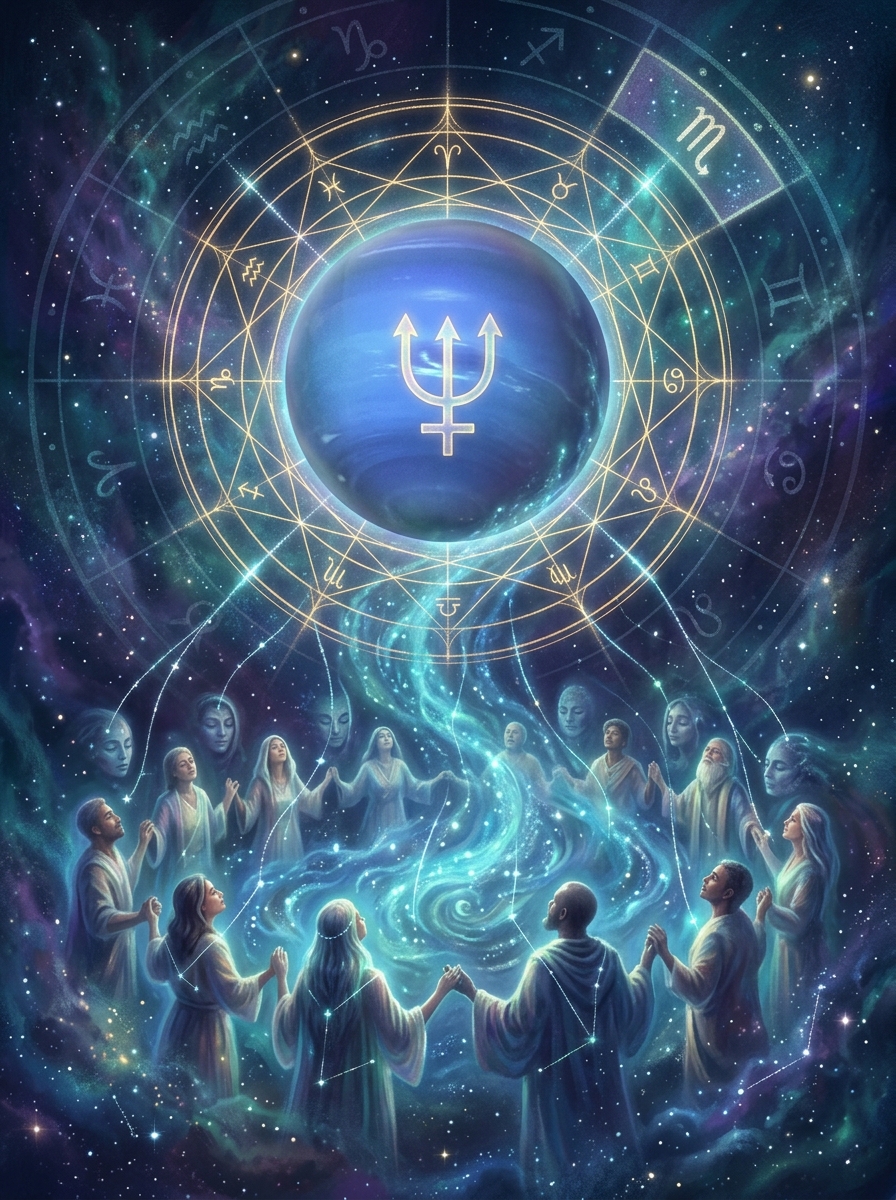
Neptune in the 11th House: The Collective Ocean
When Neptune, the astrological symbol of the infinite, the oceanic, and the boundary-dissolving principle, takes up residence in the eleventh house, the individual's relationship to the collective is irrevocably altered. In traditional astrology, the eleventh house is the good daemon, the realm of alliances, hopes, wishes, and community networks. Historically associated with the rational, structural containment of Saturn and the revolutionary, liberating intelligence of Uranus, the eleventh house is where the individual steps out of the self-contained creative expression of the fifth house to participate in the wider social sphere. However, when Neptune enters this space, the structured walls of Saturn and the sharp, intellectual ideals of Uranus dissolve. The agora of community becomes an ocean.
To understand this placement, one must first appreciate the nature of Neptune itself. Named after the Roman god of the sea (and linked to the Greek Poseidon), Neptune represents the yearning of the drop of water to return to the boundless ocean from which it came. In the natal chart, it points to where we seek transcendence, where we refuse to accept the limitations of physical reality, and where we are most susceptible to illusion, glamour, and self-deception. When this energy is channeled through the eleventh house, the focus of this spiritual longing shifts from the private mystical experience (typically associated with the twelfth house) to the public, social arena. The native does not merely seek personal union with the divine; they seek to experience the divine through and with others.
This placement stands in stark contrast to the planetary energies that naturally rule or reside in the eleventh house. Saturn, the traditional ruler of Aquarius (the sign associated with the eleventh house), demands structure, responsibility, clear boundaries, and hierarchical order. A Saturnian eleventh house seeks to build stable networks based on mutual obligation and long-term commitments. Uranus, the modern ruler of Aquarius, brings an intellectual, revolutionary spark, prompting the individual to seek camaraderie based on shared intellectual concepts, technological progress, and social reform, while fiercely preserving their individual freedom. When Neptune arrives, it washes away Saturn’s boundaries and dilutes Uranus’s intellectual detachment. Instead of a structured network or a group of independent freethinkers, Neptune creates a fluid, psychic matrix where the boundaries between individuals become porous, and the collective unconscious flows freely.
The Dissolution of the Social Ego
For the individual with Neptune in the eleventh house, the boundary between the personal ego and the collective psyche is highly permeable. Carl Jung spoke extensively about the collective unconscious—that vast, shared repository of archetypes, instincts, and memories that belongs to all humanity. While most individuals maintain a healthy, defensive boundary against the overwhelming tides of this collective reservoir, Neptune here acts as a psychic sponge, constantly absorbing the hopes, fears, anxieties, and spiritual longings of the groups to which they belong.
The social ego—the "persona" we present to the world to navigate group dynamics—becomes thin and transparent under Neptune's gaze. The individual does not merely observe the emotional state of a room; they absorb it. If they walk into a group setting filled with tension, anger, or despair, they will often leave feeling physically and emotionally drained, carrying those feelings as if they were their own. This lack of boundary makes social interaction both a source of profound, transcendent connection and a potential minefield of psychological exhaustion. The native must constantly ask themselves: "Is this emotion mine, or does it belong to the room?"
Furthermore, the desire to belong is not merely a social preference for these individuals; it is a profound spiritual hunger. They seek a state of communion where the agonizing sense of personal isolation is dissolved in the warm waters of collective belonging. Consequently, their social interactions are characterized by a deep, instinctual empathy, but also by a profound vulnerability to being swept away by the currents of group dynamics. They are drawn to organizations and friendships that promise to transcend the mundane, looking for a sense of sacred union that is rarely found in the ordinary world of human relationships. This represents a constant search for the divine matrix, where the individual drop of consciousness realizes it was never truly separate from the ocean.
Utopian Ideals and the Return to the Garden
The eleventh house is the repository of our hopes and wishes—the mental blueprints of what we believe the future should look like. Under the influence of Neptune, these hopes are elevated to a mythic, near-religious dimension. The individual is haunted by what Liz Greene describes as the archetype of the "Return to the Garden." This is a deep, psychological longing for a pre-lapsarian state of existence, a primordial paradise where conflict does not exist, resources are shared in perfect harmony, and all human beings are united by unconditional love.
This inner vision drives the native toward humanitarian, environmental, artistic, or mystical causes. They are often drawn to alternative communities, eco-villages, spiritual networks, and progressive political movements that promise to build a better, gentler world. When they look at the suffering of society, they do not see abstract economic problems to be solved with bureaucratic policies; they feel the collective pain as if it were their own. They are motivated by an intense desire to alleviate this pain, offering their energy to organizations that feed the hungry, heal the sick, or protect the vulnerable. In these settings, they can act as selfless channels for divine compassion, working tirelessly behind the scenes without any desire for personal recognition or status.
This search for the "perfect society" is often fueled by a rejection of the harsh, cold realities of modern materialistic culture. The Neptune in the eleventh house individual is highly sensitive to the spiritual emptiness that can characterize contemporary life. They seek to build or join communities that prioritize spiritual values, artistic expression, and emotional connection over material success and social status. They want to create a sanctuary in the world, a place where the soul can breathe and where human relationships are guided by empathy rather than competition.
However, the Neptune in the eleventh house individual must grapple with the fact that their utopian visions are rarely grounded in material reality. Their search for the perfect community is, at its root, a spiritual quest disguised as a social or political project. They tend to look at human associations through a veil of absolute idealism, projecting their inner image of the divine family onto highly flawed, earthly institutions. This romanticization of the collective sets the stage for a recurring, necessary cycle of psychological confrontation. Because they expect human organizations to function with the purity of spiritual realms, they are inevitably forced to confront the shadow side of human nature that exists within every group. This tension between the archetypal ideal and the mundane reality is the crucible in which their spiritual maturity is forged.
The Rite of Social Disillusionment
One of the most defining and painful psychological patterns associated with Neptune in the eleventh house is the cycle of projection, disillusionment, and eventual redemption. Because the longing for spiritual connection is so intense, the individual rarely sees their friends, associates, or ideological communities as they actually are. Instead, they drape them in the shimmering, glamorous fabric of Neptunian perfection.
The Glamour of the Ideal Group
In the early stages of joining a new group, spiritual organization, or social movement, the native often experiences a state of euphoria. They feel they have finally found their "soul family" or the "true path" to saving the planet. They project their internal archetypes of the savior, the saint, and the perfect parent onto group leaders and fellow members. In this state of projection, all red flags are ignored. The rational intellect is bypassed in favor of a romanticized narrative of spiritual alignment. They believe that because the group shares a high-minded goal, its members must be free from petty human vices like jealousy, greed, lust, and the lust for power.
This projection is a form of psychological "glamour"—a term used in esoteric philosophy to describe a state of illusion that distorts perception and replaces reality with a desired fantasy. The individual becomes infatuated with the collective identity of the group, feeling that by merging with it, they are elevated above the mundane struggles of individual life. They may sacrifice their own values, time, and money to support the group's mission, convinced that any sacrifice is justified in the service of such a noble cause. They seek validation and spiritual security in the group's approval, effectively outsourcing their conscience to the collective.
The Shattering of the Ideal
Inevitably, the mundane reality of human nature asserts itself. The spiritual teacher is revealed to have financial or sexual indiscretions; the humanitarian group falls prey to internal power struggles and ego clashes; the artistic collective dissolves over arguments about money and credit. When this happens, the collapse of the projection is catastrophic. The individual feels utterly betrayed, cast out of the garden, and plunges into a state of profound grief and cynicism. They may feel that if this idealized community is corrupt, then all spiritual seeking is a lie, leading to a period of nihilism or deep social alienation.
This disillusionment, though painful, is a vital part of the Neptunian initiatory rite. As Steven Forrest notes, the purpose of Neptune is to teach us the difference between the temporal and the eternal. The pain of social disillusionment forces the individual to realize that no human group, leader, or political system can ever satisfy the soul's longing for divine union. The disappointment they feel is not actually a failure of the group, but the natural consequence of expecting human beings to behave like gods.
When they stop demanding that their human companions be perfect, they can begin to develop a mature, grounded compassion. They learn to love groups and friends not because they are perfect, but in full awareness of their flaws, recognizing that we are all struggling, imperfect beings trying to find our way back to the light. The journey of Neptune in the eleventh house is one that moves from naive idealism through painful disillusionment to a state of quiet, unconditional acceptance of humanity's shared vulnerability.
Sensitive and Synchronistic Friendships
In their personal life, individuals with Neptune in the eleventh house attract companions who mirror the nebulous, sensitive, and creative qualities of the planet. Their friends are rarely conventional, career-driven realists. Instead, they find themselves surrounded by artists, musicians, writers, mystics, healers, psychics, and, in some cases, societal outcasts or individuals struggling with addiction and psychological instability.
These relationships are characterized by a high degree of empathy and emotional depth. The native is drawn to people who possess a rich inner life and a sensitivity that matches their own. They value soul-level connections over superficial social status or shared external hobbies. A friendship for a Neptune in the eleventh house person is a sacred trust, a space where two souls can meet and share their deepest vulnerabilities without fear of judgment.
Telepathic Bonds and Non-Verbal Communion
It is common for the native to experience telepathic connections with their close friends—knowing when they are in distress before they speak, dreaming of them before they call, or communicating through shared silences that convey more than words ever could. These friendships are bound together by an unwritten covenant of mutual sensitivity and spiritual kinship. There is a beautiful, fluid quality to these bonds; they can drift apart for years only to reconnect in an instant, picking up exactly where they left off without any sense of resentment or estrangement. The normal social requirements of constant contact and superficial updates are secondary to the underlying psychic frequency they share.
However, this fluid quality can also manifest as a lack of definition. Because the boundaries are so thin, the native may find themselves playing the role of the perpetual savior or therapist to their friends. They attract people who are in constant states of crisis, absorbing their friends' emotional baggage until they are utterly exhausted. Without realizing it, they may enable irresponsible behavior under the guise of "compassion." They may stay in friendships that are emotionally draining or toxic because they feel guilty about setting boundaries, believing that to walk away would be a betrayal of their spiritual ideals.
Furthermore, the native themselves may struggle with being a reliable friend. Because they are easily overwhelmed by social demands, they may retreat into isolation, failing to return phone calls, canceling plans at the last minute, or "ghosting" friends when they lack the energy to engage. This tendency to drift in and out of people's lives can create confusion and hurt, leaving their friends to feel that the native is distant, unreachable, or emotionally unavailable. Finding a balance between their need for psychic rest and their social commitments is a major developmental task.
Community Vocations: Bridging the Subtle and the Social
Professionally and semi-professionally, Neptune in the eleventh house gives a strong vocation for work that bridges the gap between the subtle, spiritual realms and the social collective. These individuals are naturally suited to roles that involve coordinating, facilitating, or nurturing group experiences that have a therapeutic, creative, or spiritual focus.
Orchestrating the Sacred Collective
Because they are highly sensitive to the emotional atmosphere of a group, they excel at creating safe, nurturing spaces where people can open up and heal. They make excellent facilitators for meditation circles, group therapy sessions, 12-step recovery programs, and spiritual retreats. In these settings, their capacity to hold space without judgment allows others to let down their defenses and experience profound emotional releases. They act as psychic conductors, harmonizing the group energy and helping participants feel connected to a supportive, collective field. This is not leadership based on dominant authority, but on receptive containment—allowing the group's collective wisdom to emerge organically.
They are also drawn to collaborative artistic endeavors. They thrive in theatrical troupes, musical ensembles, film crews, and community art projects where the individual ego is subordinated to a collective creative vision. In these environments, they function as the psychic glue that holds the group together, intuitively sensing the needs of their collaborators and fostering a spirit of harmonious cooperation. They understand that the collective artistic output is greater than the sum of its individual parts, and they find great joy in helping to channel this collective inspiration.
Whether coordinating an eco-village, managing a non-profit charity, or organizing a mystical workshop, their vocational success lies in their ability to act as a channel for a vision that is larger than themselves. They are not interested in traditional corporate leadership or building empires; they want to serve a cause that aligns with their spiritual values. By bringing their sensitivity and capacity for deep connection into the social sphere, they help others experience a sense of belonging and purpose that transcends the material world. Their professional lives are often structured around serving the collective soul.
The Shadow of Neptune in the 11th House
Every astrological placement has its shadow, and for Neptune in the eleventh house, the shadow is particularly insidious because it operates under the guise of high ideals, compassion, and spiritual righteousness. The most prominent danger of this placement is the susceptibility to pathological group dynamics, including cults, dogmatic ideological movements, and echo chambers.
The Narcotic of the Crowd
Because the desire to belong is so urgent, the native may willingly surrender their critical thinking faculties to a charismatic leader or a rigid group dogma. They can easily fall victim to the "groupthink" phenomenon, where dissent is discouraged and the outside world is viewed as corrupt, unenlightened, or hostile. The crowd's energy acts as a psychological narcotic, numbing their individual anxieties and giving them a false sense of certainty and moral superiority. In extreme cases, they may participate in campaigns of collective exclusion or persecution, convinced that they are serving a higher spiritual or moral good, completely blind to the cruelty they are perpetrating in the name of love and unity. They project their shadow onto "outsiders," creating an illusion of collective purity within.
On a more personal level, the shadow manifests as a vulnerability to deception, manipulation, and exploitation by friends and associates. The native's refusal to see the dark side of others makes them an easy target for charlatans, grifters, and psychic vampires. They may find themselves financially exploited by friends who appeal to their generosity, or emotionally manipulated by groups that demand total obedience. They may tolerate dishonesty and boundary violations in their relationships, convincing themselves that to demand honesty or respect would be "unspiritual" or "judgmental."
Finally, the shadow can manifest as social paralysis. The individual may become so overwhelmed by the negativity and complexity of the world that they withdraw from society altogether, retreating into a state of passive isolation. They may spend their lives dreaming of a perfect world or a perfect group of friends, while refusing to engage with the actual, imperfect people around them. This escapist tendency prevents them from grounding their ideals in real-world actions, turning their spiritual longing into a mechanism for avoiding the responsibilities of daily life. The dream of community becomes a substitute for the effort required to build actual relationships.
Mature Integration: Finding the Individual Spark
To integrate Neptune in the eleventh house successfully, the individual must learn to balance the watery, boundary-less nature of this placement with the fire and self-assertion of its polar opposite: the fifth house of individual creative self-expression.
Honoring the Fifth House Axis
The eleventh-house longing to dissolve into the group must be anchored by a strong, well-developed sense of personal identity. If the individual has no solid center, their involvement in groups will always result in loss of self, manipulation, and eventual disillusionment. By cultivating their unique creative talents, hobbies, and personal passions (the domain of the fifth house), they build a sturdy container that can withstand the collective tides of the eleventh house. They must learn to say: "This is who I am, this is what I believe, and this is where I end and the group begins."
The fifth house is ruled by the Sun, representing the individual ego, self-expression, and personal joy. When the native honors this axis, they bring a strong, radiant self into the collective rather than looking to the collective to define them. They realize that they cannot be of service to the group if they lose their individuality. They must develop their own creative voice, stand in their own truth, and cultivate personal hobbies that have nothing to do with saving the world or belonging to a spiritual movement. This creates a healthy psychological circulation between the individual center and the collective periphery.
Cultivating discernment is another critical task. The native must accept that skepticism, boundaries, and critical thinking are not enemies of spirituality, but its necessary protectors. They must learn to ask hard questions, to verify credentials, and to observe the practical, real-world behavior of group leaders and friends rather than relying solely on intuitive impressions. Setting boundaries is not an act of selfishness; it is the highest form of self-respect. When they can say "no" to toxic dynamics and unrealistic demands, they free up their energy to serve the collective in a way that is sustainable, healthy, and genuinely transformative. True compassion does not mean self-erasure; it requires a strong vessel to hold the light.
Frequently Asked Questions
How can I protect myself from absorbing the negative energy of groups or crowds?
If you have Neptune in the eleventh house, protecting your energy is a matter of psychological survival. Grounding practices and visualization techniques are essential. Before entering group settings, visualize a protective boundary or shield around your aura—a bubble of blue or golden light that allows love and positive inspiration to pass through but repels negative, chaotic, or exhausting energies.
It is also important to practice mindfulness in social situations. Check in with your body regularly: are your shoulders tensed? Has your breathing become shallow? If you suddenly feel anxious or exhausted, ask yourself: "Is this emotion mine, or does it belong to someone else in the room?" Additionally, make sure to schedule regular periods of solitude, especially after social events, to discharge any collected psychic debris and reconnect with your own center. Spending time in nature or near water can be incredibly restorative for your Neptunian sensitivity.
Does this placement mean I am destined to always be betrayed by my friends?
No, it does not guarantee betrayal. However, it does point to a strong psychological pattern of projecting unrealistic ideals onto your friends, which inevitably leads to disillusionment when they turn out to be human. If you ignore warning signs and refuse to see people's flaws, you set yourself up for disappointment and feelings of betrayal.
To break this cycle, you must practice conscious discernment. Allow yourself to see your friends clearly—both their beautiful qualities and their limitations. When you accept people as they are, without demanding that they be spiritual saviors or perfect companions, you build relationships on a foundation of reality rather than fantasy. This allows you to form deeply loyal, spiritually rewarding, and enduring bonds that can weather the challenges of everyday life.
How do I know if a group or community I want to join is healthy or cultish?
A healthy spiritual or social community will always respect your individual autonomy, encourage critical thinking, and support your connection to family and friends outside the group. It will have transparent leadership, open financial practices, and room for disagreement. The leaders will be accountable for their actions and will not place themselves above the rules.
A cultish group, conversely, will demand unquestioning obedience, discourage doubt, isolate you from outsiders, and use guilt, shame, or fear to control your behavior. Pay attention to how the group handles disagreement; if dissent is met with exclusion, hostility, or psychological pressure, it is a significant warning sign. If the group demands that you surrender your financial resources, your personal values, or your critical thinking, you should step away immediately.
What are the best creative or spiritual outlets for Neptune in the 11th House?
Individuals with this placement thrive in environments where they can merge their creative expression with a sense of collective purpose. Collaborative arts such as theater, filmmaking, choir, or orchestral music are excellent outlets, as they require individuals to work in harmony to channel a single artistic vision.
On a spiritual level, group meditations, ritual circles, and community-based healing workshops allow you to experience the oceanic unity you crave in a safe, structured format. Volunteering for environmental, animal welfare, or humanitarian charities also provides a constructive outlet for your deep empathy, helping you channel your desire to save the world into practical, grounded service.
How does Neptune in the 11th House interact with other planetary placements in the chart?
The expression of Neptune in the eleventh house is heavily influenced by the rest of the chart. If you have personal planets (like the Sun, Moon, or Mercury) in earth signs, or strong Saturn aspects, you will find it much easier to ground your ideals, set boundaries, and approach groups with practical discernment. The earth element provides a container for Neptune's water.
If, however, your chart is dominated by water or fire signs, or if Neptune makes challenging aspects to your personal planets, you may struggle more with boundary issues, susceptibility to deception, and emotional overwhelm. Understanding the aspectual relationships in your natal chart—such as squares or oppositions from Saturn or Mars to Neptune—can help you identify where you are most vulnerable to self-deception and where you need to work harder to build psychological resilience.
Can this placement indicate fame or recognition within a specific niche?
Yes, Neptune in the eleventh house can sometimes indicate a form of collective recognition or "glamour" projected onto the individual by the public. Because you are highly sensitive to the collective unconscious, you may intuitively understand what the public wants or needs to hear, allowing you to act as a spokesperson or symbol for a specific movement, artistic niche, or spiritual ideology.
However, this public recognition comes with the same dangers of projection and illusion that affect your personal friendships. The public can easily project their own ideals onto you, casting you as a savior or an icon, only to turn on you when you fail to meet their unrealistic expectations. If you experience public visibility, it is vital to keep your ego detached from the projections of the crowd and to maintain a private life anchored in genuine, grounded relationships.
Comments
Loading comments…