Moon Opposition Neptune: The Tender Instability of the Psychic Tide
The Porous Emotional Body
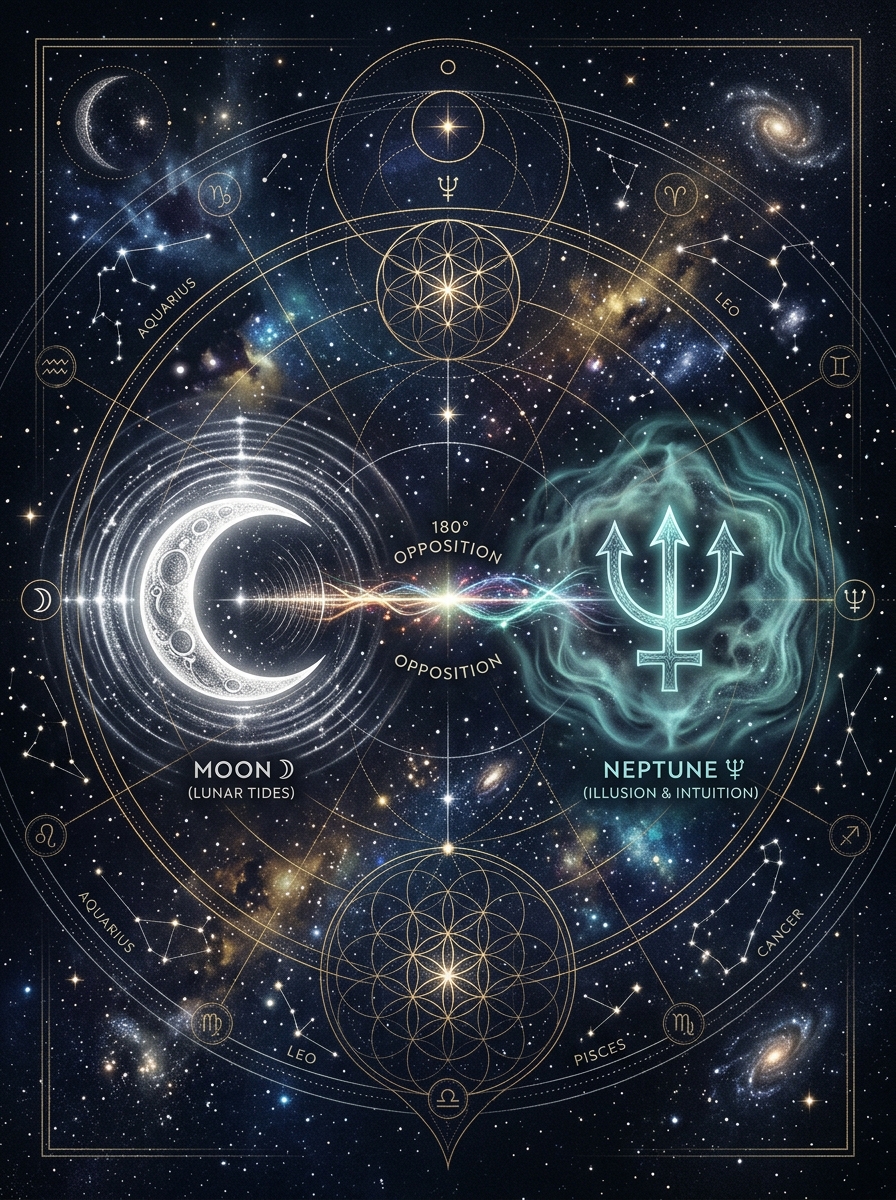
Moon opposition Neptune describes a psyche that registers reality through tides, not hard edges. The Moon wants safety, repetition, and emotional truth; Neptune wants surrender, mystery, and escape from the ordinary container. In opposition, they do not merely conflict — they magnetize each other into a lived paradox: the person feels everything, yet cannot always tell what is theirs, what belongs to someone else, and what has simply drifted in from the atmosphere. This is not a lack of feeling. It is feeling without adequate filtration.
Two drives, one axis
The Moon is the instinctive self: needs, memory, mood, the body’s way of saying yes or no. Neptune is the oceanic principle: yearning, transcendence, fantasy, sacrifice, dissolution. When they oppose each other, the person is caught between needing clear emotional nourishment and being drawn toward what is vast, ambiguous, or unavailable. That tension shows up as a craving for soul-level contact followed by disappointment when real humans remain human.
This chart signature makes the emotional body porous. The long arc is not to choose Moon or Neptune, but to learn a cleaner channel between intuition and projection. The opposition aspect itself reveals how mirrors force integration: every 180° axis asks the native to hold two worlds without collapsing them. Here, the two worlds are the need for secure attachment and the longing for oceanic union.
The feeling without filter
At the practical level, the opposition often manifests as a nervous system that absorbs rather than observes. The person may cry easily, need frequent solitude, or feel exhausted after social contact because emotional boundaries are thin. Yet the same openness grants access to imagination, dream intelligence, and compassionate identification with others. In the best cases, the chart produces someone who can comfort without condescension and create without cynicism. This is the Moon acting as an instrument and Neptune as the amplifier — a combination that can feel like emotional x-ray vision.
How the Opposition Forms
The roots of this aspect lie in early life. The native usually grew up in an environment where emotional signals were contradictory or submerged — a home where what was said and what was felt did not match. Neptune in the birth chart dissolves boundaries, and when it opposes the Moon, the child learns to read the unspoken: the grief behind the smile, the addiction behind the normalcy, the longing behind the silence. That survival skill becomes central to identity.
The permeable nervous system
Because the Moon governs the body’s automatic responses, the opposition often wires the person to absorb others’ moods without realizing it. Walking into a room, they feel the atmosphere before they see the faces. Over time, this can lead to chronic confusion: is this anxiety mine or theirs? Does this sadness belong to a friend, a memory, or the collective? The Neptune in the 12th house placement intensifies this permeability, as the 12th house is the space of dreams, psychic residue, and the ancestral subconscious. The opposition there asks the native to learn rigorous energetic hygiene.
Projection and the rescue reflex
A signature of unmanaged Moon-Neptune interplay is the rescue fantasy. The native may feel compelled to save others from pain, addiction, loneliness, or incoherence — especially if the Moon is in a nurturing sign like Cancer or Pisces. But Neptune without boundaries confuses compassion with absorption. The person can end up carrying emotional weather that was never theirs, producing fatigue and resentment. This pattern is common when the opposition involves the 7th house axis: Neptune in the 7th house can pull the native into relationships that feel fated, only to discover that the partner is a projection of an internal ideal. The lesson is to stop mistaking intensity for truth.
Maturation and Shadow
The deeper task of Moon opposition Neptune is psychological calibration: learning to distinguish intuition from anxiety, empathy from enmeshment, and spiritual longing from avoidance. That learning usually arrives through disillusionment. The wrong person disappoints. The dream job proves too vague. The rescuer role turns corrosive.
The cost of unmanaged Neptune
When the opposition remains unexamined, life becomes a series of “almost” events — almost loved, almost safe, almost seen. The native may drift through relationships that promise transcendence but deliver confusion. Escapism wears a halo: romance, substances, spiritual movements, caretaking, or creative immersion can all soften pain while actually blurring the truth. Steven Forrest often emphasizes that Neptune is where we seek transcendence but must avoid anesthesia. That distinction is crucial here. Without it, the Moon’s need for security is sacrificed to Neptune’s appetite for dissolution.
A shadow expression includes chronic deception — not necessarily lying to others, but lying to oneself about what is real. The person may stay in unhealthy situations because they project a redeeming future onto them. Neptune retrograde can deepen this inward fog, making it harder to see one’s own patterns from the outside.
The disciplined channel
Mature Moon-Neptune people are rarely emotionally simple. They have usually made peace with the fact that not every feeling is a fact, not every longing is a directive, and not every beautiful thing is safe. In the mature stage, the person becomes a translator between worlds: the visible and the invisible, the practical and the numinous. This is where the aspect’s artistry comes alive.
The native can create work that gives form to grief, devotion, memory, and longing without sentimentalizing them. They can hold space for others without swallowing the room. They can love with compassion and remain lucid. The discipline comes from grounding practices — routines, therapy, journaling, body-based work — that re-anchor feeling in lived reality. The point is not to kill imagination; it is to give imagination a spine.
The Opposition in a Life
Rather than separate sections for love, career, and shadow, this consolidated view shows how the core dynamic expresses across different domains.
Relationships as dream-catchers
In intimate partnerships, Moon opposition Neptune often draws the native toward people who seem dreamy, wounded, artistic, or elusive. There is a powerful romantic idealism: the partner is seen through a veil of potential rather than reality. This can create beautiful, soulful connections, but also repeated disappointments when the other person proves to be human. The work is to love what is real, not only what is ideal. When the native stops projecting the savior or the savior-figure, relationships become safe containers for genuine intimacy. For those with Neptune in the 1st house, even the self can be an idealization — the native may need to learn that their own identity is not a fantasy to perform but a grounded presence.
Vocation and artistic permeability
Occupationally, the aspect shines in fields that require emotional attunement and symbolic expression: music, poetry, film, photography, hospice, dream work, counseling, or spirituality. The gift is the ability to sense the invisible and give it form. But the trap is burnout from over-absorption. A creative person with this aspect must pace themselves — Neptune loves the all-night inspiration that leaves the Moon depleted. Practical boundaries around work hours and emotional intake are essential. Neptune in the 10th house can amplify this, pulling the native toward a public identity as healer or artist that may feel more like a costume than a calling unless the inner life is properly separated from the outer role.
The spiritual discipline
Because Neptune governs the longing for union, this opposition often marks a spiritual journey that starts in confusion and ends in genuine wisdom. The native may try many paths — mysticism, religion, nature worship, substance experimentation — before discovering that transcendence is not found in escape but in presence. The Moon needs rhythm, and Neptune needs permeability; together they require alternation: immersion, then retreat; inspiration, then grounding. When the opposition is integrated, the person does not lose the psychic tide — they learn to ride it.
Working With the Tide
This aspect is not “fixed” by becoming less sensitive. It is managed by giving sensitivity a reliable container. The cleanest strategy is verification. Pause before assuming what someone means. Put agreements in writing. Check the feeling twice before acting on it. Sleep on major decisions — Neptune loves the midnight answer that vanishes by noon.
Creative rituals help. Daily grounding practices — walking on earth, cooking, touching fabric, breathing consciously — bring the Moon back into the body. Journaling that distinguishes observation from interpretation can sharpen discernment. The Neptune in the birth chart article offers a broader framework for understanding Neptune’s generational and personal meaning; for this opposition, the key is to remember that Neptune’s fog can be a blessing if you know it is fog. You cannot navigate fog by charging through it. You learn to move slowly, listen for echoes, and trust the landmarks that remain.
The final truth of Moon opposition Neptune is that emotional reality is never purely factual, and spiritual reality is never purely abstract. The person lives at the seam between them. When the seam is honored, this aspect becomes a channel for compassion, art, and profound intuitive knowledge. When it is ignored, life turns hazy, leaky, and sorrowfully over-idealized. The task is to keep the water moving without letting it flood the house.
Comments
Loading comments…