I Ching Hexagram 40: Deliverance — Release, Thunder, and the End of the Stalemate
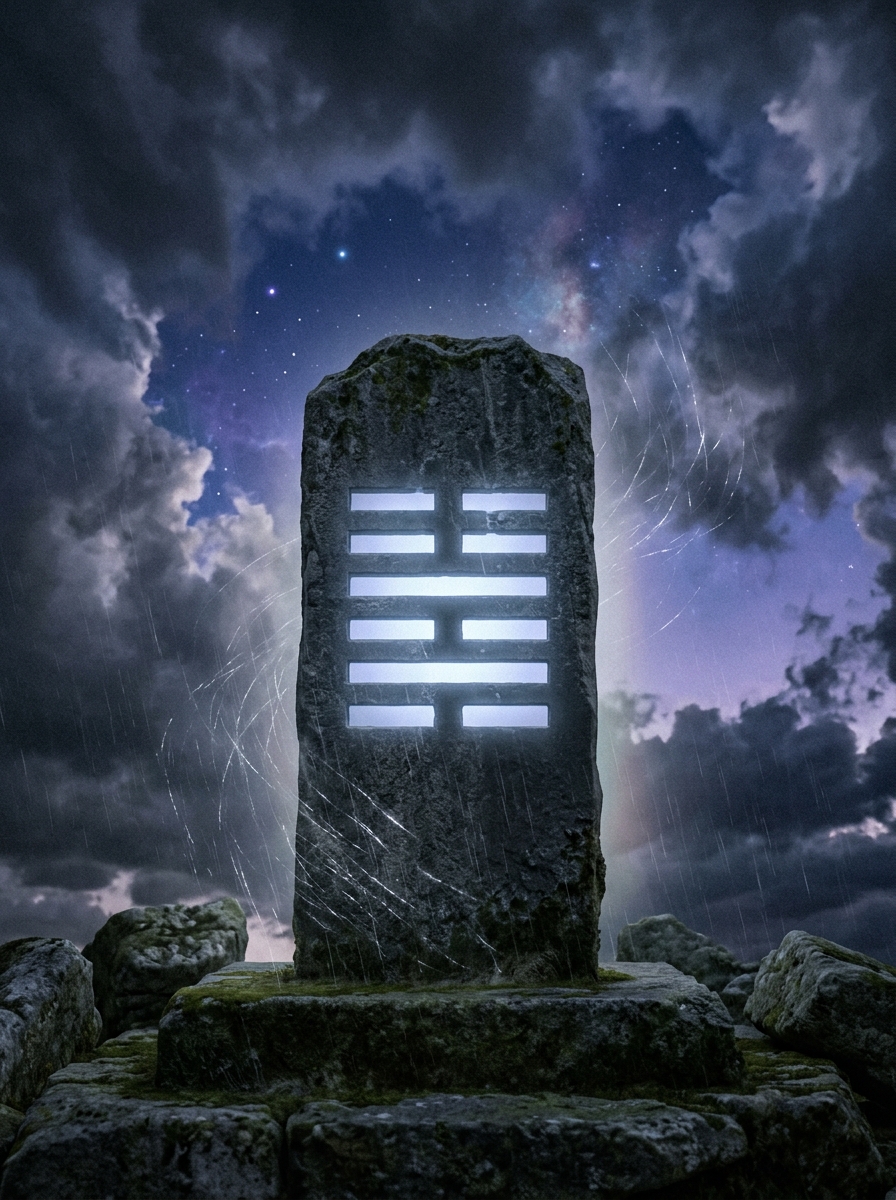
The Core Dynamic — What Deliverance Actually Is
Hexagram 40 is the figure of pressure that has finally reached its breaking point, but the release is not a victory lap. Its image is Thunder below Water: movement inside danger, a stirring force that cannot eliminate the unknown but can move through it. The old commentaries describe it as the season when the frozen lock gives way and the air changes — not because the winter is over, but because the grip has loosened enough to allow motion. The core thesis is precise: Deliverance means the separation of the self from the trouble. The crisis does not necessarily vanish. But it stops being identical with you. That distinction is the entire substance of the hexagram.
The Judgment reads: “Deliverance. The southwest furthers. If there is no longer anything where one has to go, return brings good fortune. If there is still something where one has to go, hastening brings good fortune.” The instruction splits because release can go wrong in two opposite ways. One error is to cling to the emergency after it has passed, mistaking vigilance for virtue. The other is to treat relief as permission to drift, letting the old tension re-form through passivity. Deliverance corrects both by making the direction depend on what remains. If the matter is genuinely over, go back — to the center, to ordinary life, to the rhythms that restore proportion. If business remains, move now. Hesitation is the only fatal posture.
The image of the “southwest” in the I Ching points toward receptivity, community, and the yielding mode of being. In practical terms, the oracle recommends the route that reduces friction and restores humanness — the opposite of trying to dominate a situation after the pressure has begun to dissolve. This is not a hexagram of conquest. It is a hexagram of separability.
The Psychology of Release — How the Knot Loosens
To understand Deliverance is to recognize how the psyche gets trapped in a crisis. Prolonged stress organizes everything: the body learns to live under threat, the mind narrows its field to survival, and the ego mistakes that activation for purpose. The danger is that even after the external cause relents, the internal pattern remains. This is where the hexagram’s split advice becomes psychologically acute. Return is not retreat; it is reentry into a life that no longer requires alarm. Hastening is not panic; it is responsiveness to the opening before the old structure hardens again.
The lower trigram Thunder supplies the impulse — the first stir after stillness, the shock that breaks the trance. But Thunder alone would be reckless. The upper trigram Water supplies the depth — the awareness that the terrain is still uncertain, that one cannot simply charge out. Together they create a movement that is alert, not frantic. The person who lives Deliverance well does not explode out of confinement. They feel the latch come free, check whether the road ahead is clear or blocked, and then take exactly the step that fits.
An ethical dimension runs through this hexagram that is easy to miss. When pressure lifts, resentment often tempts people to strike back, over‑explain, or claim moral stature for having endured. Deliverance prefers cleaner conduct. The release is real precisely because it reduces compulsion. To emerge from confinement only to reenact confinement on others — through blame, self‑dramatization, or a lingering grudge — is to misunderstand the entire figure. The generosity of the hexagram lies in disengagement from the cycle, not in triumph over an enemy.
The Moving Lines — Stages of Cutting Away
The six lines trace how Deliverance matures from a tiny loosening to a decisive finish. They are not separate predictions; they are a sequence of psychological phases, each with its own temptation.
The first three lines describe the early unwinding. The first line is the “toe” — the smallest contact with the ground, the first proof that movement is possible. Here the binding has loosened, but the impulse is still near the surface. The second line shows the traveler setting down a burden that had become heavier than the facts. This is one of the most recognizable moments in the I Ching: the weight is not the problem itself but the extra layer of worry, identity, or defense you added to it. Deliverance here is relief through simplification. The third line warns against premature triumph. A door has opened, and exhilaration tempts you to rush. But the rush recreates tension. The line says that not every opening should be forced wider than it already is; momentum without proportion turns into a new form of bondage.
The next two lines introduce assistance and composure. The fourth line brings a friend — someone who clarifies, steadies, or accompanies. This is important because Deliverance is not always a solo achievement. When crisis loosens, outside perspective can prevent the old fear from reasserting control. Help is not weakness; it is part of the architecture of freedom. The fifth line is the dignified heart of the hexagram. Here the release happens without spectacle, without lingering self‑pity, without hunger to dramatize. In classical terms, this is a ruler who resolves the matter with calm authority. Psychologically, it is the capacity to let a problem go without needing to make the letting‑go itself into a performance — a rare and mature strength.
The top line delivers the most aggressive image: a noble figure shoots a hawk perched on a high wall, then captures it. The hawk is a stubborn remnant of the old danger — something elevated, watchful, hard to dislodge. This line says that sometimes Deliverance requires a decisive finishing stroke. Not every remnant dissolves on its own. Some patterns must be named and neutralized. But the tone is exact, not enraged. The prince does not rage at the hawk; he simply removes what would otherwise continue to menace the landscape.
How Deliverance Plays Out in a Life
Because Deliverance is a procedural hexagram — it describes how release happens, not just that it happens — its expression varies by context without requiring a separate analysis for each domain. The same dynamic applies.
In relationships, Deliverance often appears when a quarrel has exhausted its force or a defensive pattern has begun to soften. The question from the Judgment — return or hasten — becomes concrete. Sometimes relief means returning to the person with the old defensiveness dropped, reentering ordinary connection. Sometimes it means hastening away from a dynamic that has lost its power, because lingering would let the ghost of the conflict reanimate. The error is to treat the release as a mandate to reopen the argument or to demand guarantees. Clean conduct means either full presence or full separation, not a prolonged hover.
In work and material matters, this hexagram signals that a bottleneck is breaking. A stalled project can move; a difficult authority figure loses influence; a problem that felt personal reveals itself as structural and therefore solvable. But Deliverance also warns against celebrating too early. The best move is practical: clear the backlog, finish the pending task, make the transition clean. Relief wasted on sloppy momentum is relief that will have to be earned again.
On the interior level, Deliverance is the hexagram of released psychic charge. The feeling is one of breathing around something that had been occupying your entire field. In Jungian terms, a complex has loosened its grip; the ego can recover proportion. That recovery is the real “deliverance” because it restores choice. You are no longer identical with the problem. You can look at it, rather than through it.
Living the Hexagram Without Misunderstanding It
The temptation with Deliverance is to think it promises easy peace. It does not. It promises separability — the ability to distinguish what is truly still active from what is only echo, and the ability to act without dragging the past behind you. The instant the bond breaks is brief. The correct response is clean conduct: reduce noise, do what is next, leave the old emergency without theatrics. If you need to go back, go back. If you need to move, move. The hexagram is a study in timing after pressure — not before, not during, but at the moment the lock gives way. That moment is enough.
Comments
Loading comments…