The Ultimate Guide to Expression Numbers 1–9: Calculating Your Destiny in Pythagorean Numerology
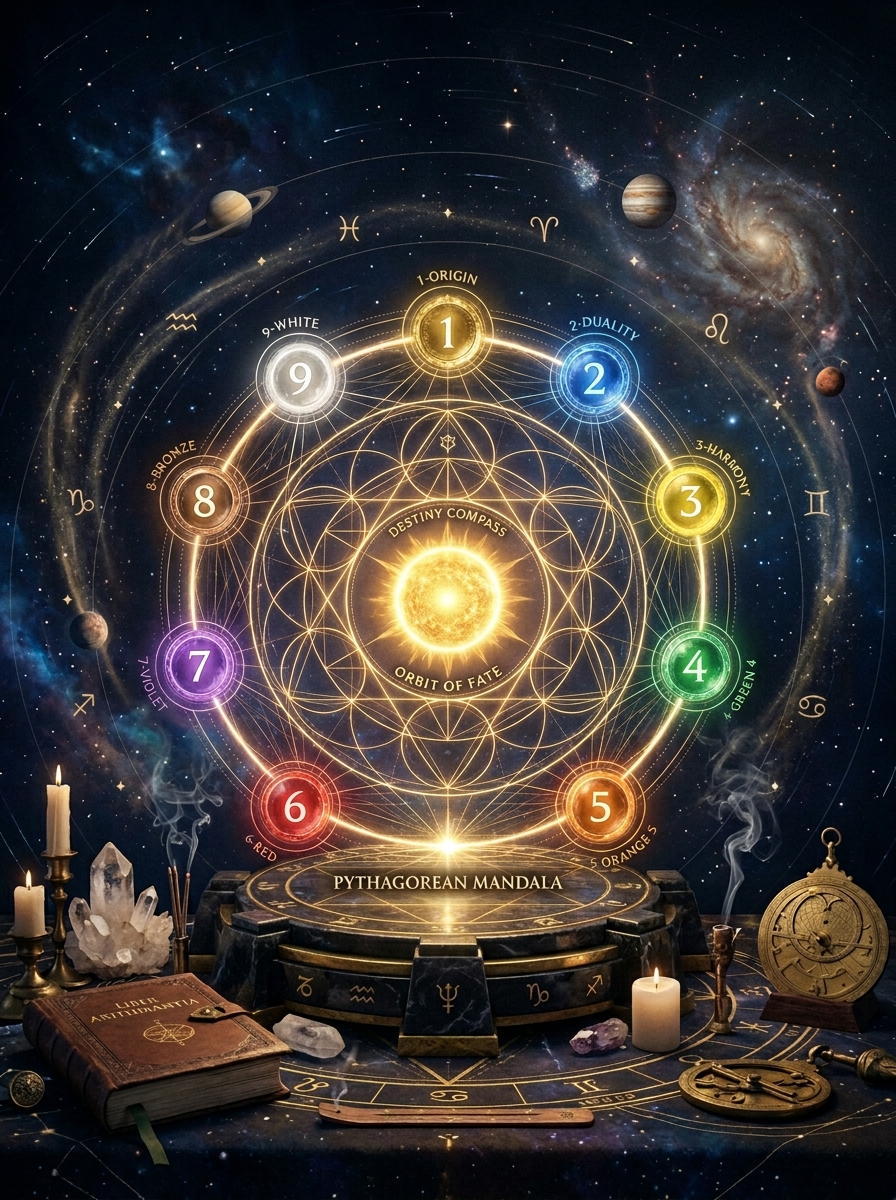
1. The Sonic Signature: The Metaphysics of the Name in Manifestation
In the vast landscape of Western esotericism, a name is never a random sequence of arbitrary syllables or a mere social convenience. It is a dynamic energetic structure, a sonic signature that vibrates within the collective unconscious and models our interactions with the physical world. When we speak of name numerology, we are discussing the mathematical translation of these vibrations. Drawing upon the analytical psychology of Carl Jung, we can understand the full birth name as an archetypal blueprint of the human persona and a critical vehicle for the process of individuation. As the ego emerges from the primary matrix of the unconscious, it requires structure, tools, and a defined boundary to interact with reality. The name provides this container, acting as a magnetic bridge that translates our spiritual essence into active social manifestation.
The pioneering astrologer Liz Greene often emphasized that our psychological character is our fate; the symbols we carry in our birth charts and names are not external forces acting upon us, but rather internal archetypes seeking integration. In Pythagorean numerology, the Expression Number—traditionally referred to as the Destiny Number—acts as the active "how" of this psychological journey. While other numbers in the core profile, such as the Soul Urge, point to our private, hidden desires, the Expression Number is fully manifest. It dictates how we think, how we handle authority, how we approach professional callings, and how we construct our social mask. By analyzing the name as a sonic signature, we uncover the mathematical geometry that underpins our personal mythology. Every letter carries a specific numeric weight, a vibrational tone that, when combined, creates a complex chord. When we understand this chord, we can begin to play it consciously, transforming unconscious shadow projections into active, integrated talents.
This sonic signature operates as an archetype of social manifestation. In classical esoteric traditions, to know the name of a thing was to hold power over its manifest essence. In modern terms, our name is the primary frequency with which we announce ourselves to the cosmos. It represents the psychological inheritance and cultural expectations of our family lineage, yet it also contains the exact codes required for our personal individuation. When we speak our name, we project a specific sonic geometric pattern into the minds and hearts of those around us. This pattern shapes how we are perceived and, consequently, how we respond to the world. It is the bridge between the internal, unmanifested Self and the external, concrete Persona. Through the conscious study of our Expression Number, we can align this persona with our deeper spiritual purpose, ensuring that the mask we wear is a true reflection of our inner light rather than a defensive shield against the demands of life.
This alignment is not static; it is a lifelong alchemical process. Just as a musical theme can be played in different keys and tempos, our Expression Number represents a wide spectrum of potential. By understanding the vibrational frequency of our birth name, we can identify the specific talents we have brought into this incarnation and the psychological shadows we must integrate to achieve wholeness. We will now explore the calculations and archetypal profiles that allow us to decode this personal sonic signature.
2. Calculating the Expression Number: The Pythagorean Alchemical Method
To uncover the mathematical architecture of the name, we must employ the Pythagorean conversion method. Unlike Chaldean numerology, which assigns values based on phonetic sound values, the Pythagorean system is linear and alchemical, linking the twenty-six letters of the Latin alphabet directly to the primary digits 1 through 9. This system is structured as a grid, reflecting the ancient belief that all manifest phenomena can be reduced to the foundational principles of geometry and number.
| 1 | 2 | 3 | 4 | 5 | 6 | 7 | 8 | 9 |
|---|---|---|---|---|---|---|---|---|
| A | B | C | D | E | F | G | H | I |
| J | K | L | M | N | O | P | Q | R |
| S | T | U | V | W | X | Y | Z |
To calculate your Expression Number, you must use the full name as it appears on your original birth certificate. Even if your name was changed later through marriage, adoption, or personal choice, the original birth name remains the foundational blueprint. It represents the initial conditions of your psychological structure, acting as the astrological "first breath" of identity. While subsequent changes (such as marriage, adoptions, or pen names) create minor expressions that overlay your primary blueprint, they never erase the root signature.
The calculation process requires reducing each part of the name (first, middle, and last names) individually to a single digit before adding them together for the final reduction. For example, if a name is John Fitzgerald Kennedy:
- John: J(1) + O(6) + H(8) + N(5) = 20. 2 + 0 = 2.
- Fitzgerald: F(6) + I(9) + T(2) + Z(8) + G(7) + E(5) + R(9) + A(1) + L(3) + D(4) = 54. 5 + 4 = 9.
- Kennedy: K(2) + E(5) + N(5) + N(5) + E(5) + D(4) + Y(7) = 33.
Now, we add the reduced numbers of each part of the name: 2 + 9 + 33. In traditional Pythagorean numerology, the number 33 is a Master Number. When we encounter a Master Number (11, 22, or 33) in the intermediate stages of calculation, we temporarily preserve its double-digit form. However, for the final calculation of the core single-digit Expression Numbers (1 through 9), we reduce it. Thus, 33 reduces to 3 + 3 = 6. Adding the parts: 2 (John) + 9 (Fitzgerald) + 6 (Kennedy) = 17. Finally, we reduce 17 to a single digit: 1 + 7 = 8. Thus, the final Expression Number for John Fitzgerald Kennedy is 8.
If you encounter a Master Number at the end of your calculation (such as a final total of 11, 22, or 33), it represents a higher octave of the single-digit vibration (2, 4, or 6, respectively). While these Master Numbers carry a unique spiritual intensity and a double burden of responsibility, they still operate on the foundational frequency of their reduced single digits. For the scope of this guide, we focus on the primary single-digit expressions 1 through 9, which represent the core archetypes of human manifestation.
3. Expression vs. Life Path: Distinguishing the 'How' from the 'Why'
To understand how the Life Path Number and the Expression Number interact, we can employ a powerful metaphor popularized by modern esoteric teachers like Steven Forrest: the relationship between a traveler, the vehicle they drive, and the road they travel.
The Life Path Number, derived from your birth date, represents the road itself. Because your birth date is an unchangeable historical coordinate, the Life Path is immutable. It represents the external environment, the terrain, the weather, and the specific lessons you will encounter. The Life Path tells you the "where" and "why" of your journey. You cannot change the road, and you cannot avoid the challenges it presents; you can only choose how you navigate it.
In contrast, the Expression Number, derived from the letters of your full birth name, represents the vehicle you drive and the toolkit you carry. It represents your internal capabilities, your behavioral style, your psychological default settings, and your method of action. The Expression Number is the "how" and the "with what" of your journey. It dictates whether you are driving a rugged off-road jeep, a sleek sports car, or a heavy-duty cargo truck.
For example, consider two individuals who both have a Life Path 5, which represents a road of constant change, instability, and sensory exploration. The first individual has an Expression 4, which represents a vehicle built for structure, discipline, and order (the Square). They will navigate their unstable, fast-moving road by building sturdy, temporary structures, establishing strict personal routines, and utilizing systematic thinking. The second individual, however, has the same Life Path 5 but an Expression 3, representing a vehicle of creative expression, communication, and play (the Triad). They will navigate that same chaotic path through storytelling, artistic performance, or writing.
Arthur Edward Waite, in his commentaries on tarot symbolism, often emphasized that the Chariot represents the vehicle of the personality, while the road it travels is determined by a higher, cosmic order. The Chariot is the Expression Number—the tools of the ego—while the destination is the Life Path. The integration of these two numbers is essential for achieving psychological maturity. The tension between our innate character (Expression) and our external circumstances (Life Path) is the primary driver of Jungian individuation, forcing the ego to adapt, confront its limitations, and integrate its shadow.
4. The Initiator Vibrations: Expression Numbers 1 and 2
The journey through the core single-digit vibrations begins with the relationship between the Monad and the Dyad. These represent the polarities of consciousness: the active, initiating force and the receptive, reflective mirror, establishing the framework for human relationships and self-concept.
Expression 1: The Pioneer and Original Spark
The number 1 represents the Monad, the primordial point of origin, the singular spark from which all subsequent creation emerges. In the Tarot, this is symbolized by the Magician, standing between heaven and earth, channeling cosmic forces to initiate change on the physical plane. Individuals with an Expression Number 1 are structurally aligned with the archetypal drive for self-assertion, independence, and original creation. They do not seek to fit into existing frameworks; their psychological mandate is to carve out new paths where none existed before.
The psychological drive of the 1 is best understood through the Jungian lens of the Solar Hero. This archetype is compelled to separate from the collective unconscious, confront the monsters of conformity, and establish a distinct, independent ego. In career alignments, Expression 1 individuals thrive in pioneering roles: entrepreneurs, military leaders, innovative researchers, and creative directors. They possess a natural executive presence and a high tolerance for risk. They are at their best when initiating new projects, providing the initial spark of willpower necessary to overcome inertia.
Every archetype carries its shadow. For Expression 1, the shadow operates on two extremes. The active shadow is ego inflation—an overcompensated sense of self-importance, leading to tyranny, impatience, and an inability to collaborate. This is the figure who believes their will is the only valid law, alienating others through sheer self-assertion. Conversely, the passive shadow is self-annihilation, where the fear of failing to stand alone leads to complete paralysis, leaving the individual dependent on others while harboring deep, unexpressed resentment. Integrating the 1 expression requires balancing raw assertion with a willingness to acknowledge the validity of other centers of consciousness.
Expression 2: The Weaver of Relationships and Sacred Polarity
If the Monad is the initiating spark, the Dyad is the mirror. Expression Number 2 represents polarity, receptivity, and relational reflection. Symbolized by the High Priestess in the Tarot, sitting between the dark and light pillars, those who carry the 2 vibration are designed to navigate the spaces between things—relationships, contracts, diplomacy, and the emotional currents that bind human beings.
The core psychological mechanism of the 2 is relational intelligence. Unlike the self-directed 1, the 2 perceives the world through the lens of the "other." In professional environments, they excel as mediators, advisors, counselors, human resources specialists, and collaborative partners. They possess an extraordinary capacity for deep listening and empathy, acting as a lunar mirror that reflects the unexpressed feelings of those around them. Their strength lies in synthesis, bringing disparate elements into a unified, harmonious whole.
The shadow of the 2 involves codependency and the silent accumulation of passive-aggression. Because the 2 seeks harmony at all costs, they frequently suppress their own needs and desires to keep the peace. This leads to emotional absorption, where they can no longer distinguish their own feelings from the psychic atmosphere of their environment. Over time, this self-suppression curdles into resentment, manifesting as subtle manipulation, passive-aggressive behavior, or sudden, unexpected emotional outbursts. The path to individuation for the 2 requires learning to establish firm psychological boundaries, recognizing that true harmony cannot be built on a foundation of self-erasure.
5. The Builder and Creative Catalyst: Expression Numbers 3 and 4
Beyond the polarity of 1 and 2, we encounter creation and structure. The Triad (3) introduces a third element that resolves the tension of opposites, resulting in self-expression, while the Square (4) grounds this creative energy into the material plane.
Expression 3: The Alchemist of Expression and Creative Radiance
The Triad represents the synthesis of the Monad and the Dyad, resulting in creation and expression. Symbolized by the Empress in the Tarot—the archetype of abundance and manifestation—those with an Expression Number 3 carry a name signature that demands expression. They are here to communicate, perform, write, and bring emotional truth to light.
The psychological energy of the 3 is closely linked to the Jungian archetype of the Puer Aeternus—the eternal youth, filled with optimism, imagination, and a refusal to be bound by the mundane limitations of reality. Vocationally, Expression 3 individuals are drawn to the arts, public speaking, marketing, journalism, and entertainment. They have a natural gift for language and storytelling, possessing the ability to captivate an audience and make complex ideas accessible and emotionally resonant.
However, the Puer archetype faces the shadow of dispersion and superficiality. The 3 is easily seduced by the sparkle of new ideas, often abandoning projects when the initial excitement wanes and the hard work of structured completion begins. Their mental energy can become scattered across too many pursuits, resulting in a lack of depth or tangible results. Socially, the shadow of the 3 manifests as an artificial persona—a reliance on charm, wit, and external validation to avoid confronting deeper, darker emotional realities. To integrate this expression, the individual must develop the discipline to ground their creative sparks in sustained effort, moving beyond mere performance into authentic self-examination.
Expression 4: The Architect of Matter and Sacred Geometry
With the number 4, we enter the domain of physical form. The Square represents stability, structure, and the physical earth. Aligned with Saturn—the cosmic taskmaster demanding discipline and order—individuals with an Expression Number 4 are the builders of the material world, tasked with turning abstract concepts into concrete realities.
Their natural vocational callings lie in engineering, architecture, operations, project management, financial analysis, and law. They possess an innate understanding of systems, procedures, and physical laws. The 4 does not look for shortcuts; they understand that anything of lasting value requires a solid foundation, careful planning, and systematic execution. They are the backbone of any organization, providing the stability and consistency that allows creative enterprises to endure.
Yet, the rigidity of the Square can become a psychological prison. The shadow of the 4 is characterized by stubbornness, dogmatism, and a profound resistance to change. When confronted with chaos or unpredictability, the 4 often responds by tightening control, creating unnecessary rules, and refusing to adapt. This can lead to a narrow, materialistic outlook that rejects intuitive or spiritual dimensions of experience because they cannot be measured or cataloged. For the 4, the developmental task is to cultivate flexibility—to learn that structure should serve as a supportive skeleton rather than an armored shell, allowing room for growth and spontaneous transformation.
6. The Free Spirit and Nurturer: Expression Numbers 5 and 6
The middle of the sequence presents the transition from the stability of the 4 to the dynamic movement of the 5, followed by the balancing harmony of the 6, exploring how we interact with freedom, responsibility, and community.
Expression 5: The Catalyst of Change and Sensual Freedom
The number 5 represents the center of the sequence, serving as the pivot point of change and freedom. While represented by the Hierophant in the Tarot, its active expression is the explorer. Those with an Expression Number 5 carry a restless, adaptable energy, designed to seek new experiences, cross borders, and act as catalysts for transformation.
The psychological drive of the 5 is the pursuit of sensory and intellectual freedom. They are natural communicators, travel writers, sales professionals, public relations agents, and investigative journalists. They possess a remarkable ability to learn languages, adapt to unfamiliar cultures, and navigate crisis situations with poise. The 5 operates as a catalyst, shaking up stagnant environments, introducing new ideas, and challenging outdated dogmas.
The shadow of the 5 is dissipation, addiction, and an inability to commit. Because they fear confinement above all else, they may avoid deep relationships, long-term career paths, or domestic stability, equating commitment with entrapment. This can lead to a superficial life of constant movement without destination. When the psychological tension of their internal restlessness becomes too great, the shadow may manifest as escapist behaviors, sensory indulgence, or substance abuse. Integrating the 5 expression requires recognizing that true freedom is not the absence of restriction, but the conscious choice of what responsibilities to bear.
Expression 6: The Guardian of Harmony and Sacred Stewardship
The Hexad represents balance, beauty, and the integration of opposites. Symbolized by the Lovers in the Tarot, the 6 is the number of relationship and responsibility. Individuals with an Expression Number 6 are aligned with the roles of the nurturer, teacher, and counselor, carrying a magnetic, stabilizing frequency that draws others for guidance.
Vocationally, the 6 excels in fields that require care, aesthetic judgment, and ethical responsibility: medicine, education, counseling, interior design, social work, and community organization. They have a natural talent for creating environments that feel safe, beautiful, and emotionally supportive. They take their duties to family and society seriously, often acting as the emotional anchor for their social circles.
The shadow of the 6 lies in the archetype of the martyr and the controller. Because the 6 has a clear vision of how things should be to maintain harmony, they can easily slip into meddling, overprotectiveness, and emotional manipulation. They may take on the burdens of others to their own detriment, cultivating a subconscious dynamic where they keep others dependent on them to ensure they remain needed. This codependent martyrdom leads to exhaustion and silent resentment. To achieve psychological maturity, the 6 must learn to love without attempting to control, allowing others the freedom to make their own mistakes and walk their own difficult paths.
7. The Seeker, Commander, and Sage: Expression Numbers 7, 8, and 9
The final triad of single digits represents the culmination of human experience. Here, we move beyond individual and communal concerns to explore the mystical search for truth (7), the mastery of material force (8), and the universal dissolution of the ego into the collective soul (9).
Expression 7: The Seeker of Truth and Mystic Intellect
The Heptad is the number of mystery, analysis, and inner wisdom. Symbolized by the Chariot in the Tarot, it represents the mastery of the internal world before conquering the external. Individuals with an Expression Number 7 are designed to look beneath the surface of reality, operating as intellectual and spiritual researchers.
The psychological stance of the 7 is introspective and analytical. They thrive in vocations requiring deep concentration and solitary intellectual work: science, philosophy, psychology, software development, and esoteric research. The 7 seeks the underlying truth of existence, analyzing patterns to uncover the invisible mechanisms of life.
The shadow of the 7 is isolation and cynicism. Because they value intellect so highly, they may develop a defense mechanism of intellectual superiority, dismissing the emotional needs of others. This leads to isolation, where the individual feels misunderstood yet refuses to take the emotional risks necessary to connect. Their analytical mind can also turn inward, degenerating into obsessive overthinking or paranoia. Integrating the 7 requires balancing the head with the heart, allowing vulnerability to soften the intellect.
Expression 8: The Commander of Force and Material Mastery
The Ogdoad represents the intersection of the spiritual and material planes, symbolized by the infinity loop. It is the number of power, authority, and material success. Symbolized by Strength in the Tarot, it depicts the control of raw instincts by spiritual consciousness. Those with an Expression Number 8 carry a name signature that demands confrontation with power, finance, and material creation.
They are aligned with careers in corporate leadership, finance, entrepreneurship, and law. The 8 possesses an innate understanding of power dynamics, resource allocation, and organizational strategy. They are not afraid of heavy responsibility, often seeking out positions of authority where their decisions can shape the lives of others.
The shadow of the 8 is ruthlessness and the reduction of human values to material metrics. When threatened, they may resort to manipulation and the misuse of power to maintain control. They can become workaholics, ignoring their emotional needs in the pursuit of status. At their worst, they view relationships as transactions. The individuation of the 8 requires learning that true power is not coercive control, but internal mastery, using resources to support the collective.
Expression 9: The Compassionate Sage and Universal Soul
The Ennead represents the outer boundary of the single digits, the threshold of completion and universal consciousness. Represented by the Hermit in the Tarot, who holds up a lantern to light the path, individuals with an Expression Number 9 are designed to operate on a grand scale, transcending personal ego boundaries to connect with the collective human experience.
Their career paths are often found in humanitarian work, global education, environmental advocacy, and the healing arts. The 9 has a natural global perspective, feeling a deep empathy for the suffering of humanity. They are called upon to let go of personal attachments, acting as a vessel for universal compassion and creative expression.
The shadow of the 9 is spiritual pride, disillusionment, and an inability to deal with the messy reality of human relationships. Focused on the universal, they can become detached from immediate family, loving humanity in the abstract while neglecting real people. When high ideals clash with the imperfect material world, they may fall into disillusionment or victimhood. Integrating the 9 requires anchoring their universal vision in daily acts of practical kindness, recognizing that transition begins in the details of everyday life.
8. Frequently Asked Questions About Expression Numbers
What if my birth certificate name has a spelling mistake?
In Western esoteric traditions, there are no accidents. The exact spelling legally recorded on your original birth certificate represents the initial cosmic imprint of your incarnation. Even if the mistake was corrected later, the initial document represents the energetic seed, the "first breath" of your identity on the physical plane. You must calculate your primary Expression Number using this exact spelling. Any subsequent corrections or spelling variations create minor expressions, but the birth certificate spelling remains the foundational blueprint of your personality.
Does a legal name change alter my Expression Number?
A legal name change, nickname, or professional pen name does not erase the foundational blueprint of your birth certificate name. Instead, it introduces a "Minor Expression" or an energetic overlay. Think of it as a secondary coat of paint or a temporary costume. While it can help you access specific energies—such as using a pen name with a 3 vibration to assist in writing—your default psychological settings and core talents remain anchored to the original name given at birth. This secondary overlay operates as a minor chord in your energetic symphony, modifying how you express your core traits but never fully replacing the root signature. It is a tool for adaptation rather than a complete rewrite of your destiny.
How does the Expression Number differ from the Soul Urge and Personality Numbers?
The Expression Number represents the sum of all letters in your name, representing your overall talents, behavior, and active destiny (the "how" of your life). The Soul Urge Number is calculated using only the vowels of your name, representing your private motivations, inner desires, and what your soul craves (the "why"). The Personality Number is calculated using only the consonants, representing your external persona, the mask you show to the world, and how others perceive you. Together, these three numbers form your core numerological profile.
Is a higher Expression Number, like 9, more advanced than a lower one?
No. Numerology is a cyclical system of archetypes, not a hierarchical ladder of spiritual evolution. A 9 is not "better" or more spiritually advanced than a 1. A 1 represents the initial creative spark of the cycle, focusing on pioneering action and self-assertion, while a 9 represents the completion and dissolution of the cycle, focusing on universal compassion and letting go. Each number carries its own unique psychological challenges, shadow states, and opportunities for developmental growth. An individual with a 1 expression is learning to stand alone, while a 9 is learning to merge with the whole. Both lessons are equally necessary and challenging, representing different phases of the soul's journey.
What is the relationship between the Expression Number and the Tarot?
In the Western esoteric synthesis, particularly within the hermetic traditions popularized by Arthur Edward Waite, numbers correspond directly to the Major Arcana cards of the Tarot. For example, Expression 1 corresponds to the Magician (willpower, original action), Expression 2 corresponds to the High Priestess (polarity, intuition), and Expression 3 corresponds to the Empress (creative abundance). Exploring the Tarot card associated with your Expression Number provides visual and symbolic keys to aid in your Jungian shadow integration. By meditating on the imagery and archetypal symbols of your corresponding Major Arcana card, you can gain deeper insights into your career potential, behavioral style, and the specific spiritual tools available to you.
Comments
Loading comments…