Dream About Blood: What It Means When Blood Appears in Sleep
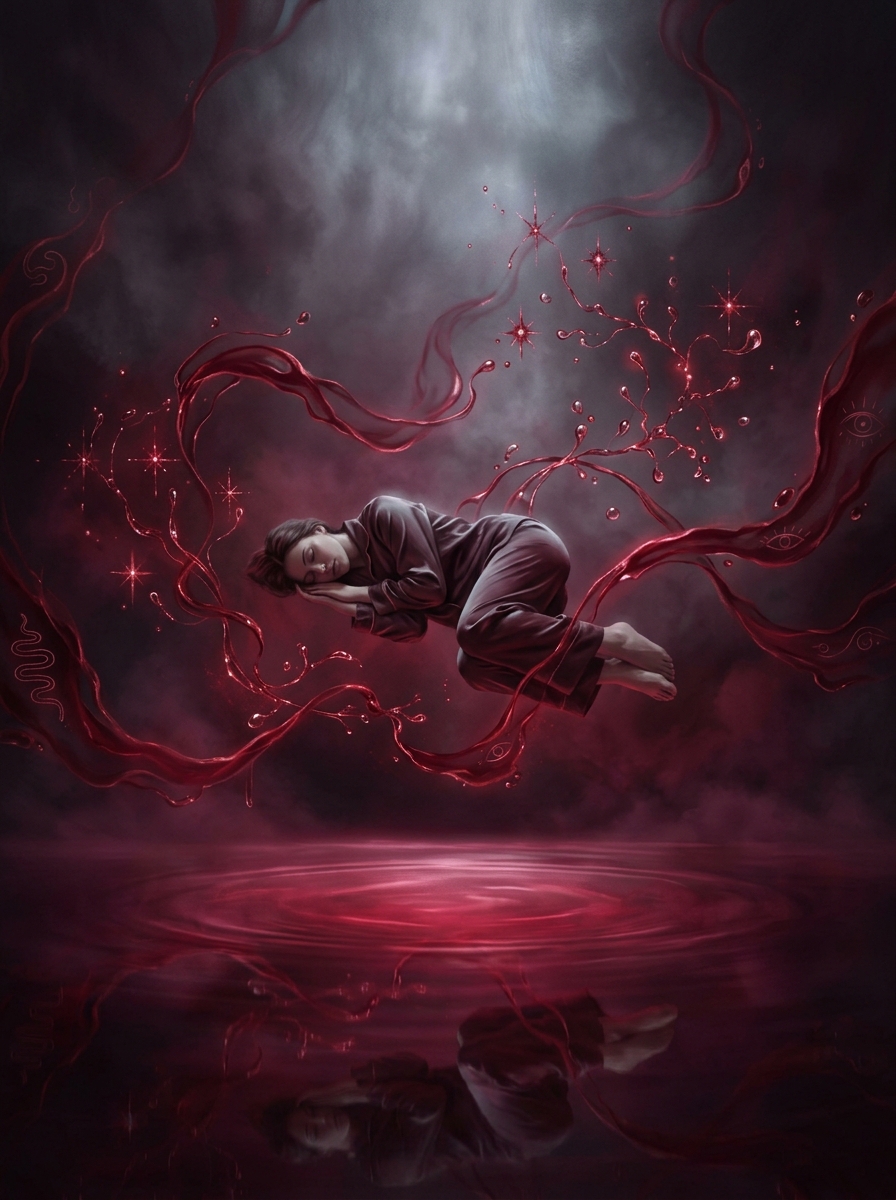
Blood in a dream is never neutral
The core meaning of blood in dreams is intensity with consequence. Something living has been cut, exchanged, threatened, bonded, or renewed. Blood is not a decorative symbol—it marks cost. It can point to injury, yes, but also to lineage, appetite, sacrifice, fertility, shame, rage, and the body’s insistence on staying alive. The right interpretation depends less on the word “blood” itself than on what the blood is doing in the dream.
That is why a dream about blood often feels more urgent than other symbolic dreams. It presses on the sleeper with physical force. In Jungian terms, the image tends to arrive when a psychic situation has become embodied—when the emotional life is no longer abstract, but felt as wound, pulse, contamination, or vitality. If you want a broader map of how dream symbols work in our approach, our about page explains the editorial lens behind this kind of reading.
The first question is not “What does blood mean?” but “What is happening to it?”
Blood leaving the body usually points toward loss, depletion, vulnerability, or exposure. Blood flowing freely can also suggest catharsis: something toxic is finally moving instead of festering. Blood contained, hidden, or smeared on the wrong surface often carries guilt, secrecy, or a sense that an event has left a mark that cannot be washed off. Dreams are rarely literal, but they are rarely random either. The image usually clusters around a real-life pressure point. A person overwhelmed by family obligations may dream of inherited blood or bloodlines. Someone in conflict may dream of bleeding from the mouth, as if speech itself has become damaging. Someone entering a new phase of life may dream of blood as the price of initiation. In each case, blood is the body’s grammar for stakes.
The psychological grammar of blood: body, boundary, and inheritance
Blood dreams are especially powerful because blood sits at the intersection of biology and myth. It is literal substance and symbolic inheritance. Psychologically, it often appears where the dreamer is negotiating three things at once: bodily reality, emotional boundary, and family pattern.
Blood as life force and vulnerability
Blood carries the fact of being alive in a way few symbols can. That is why it can mean vitality, passion, fertility, or erotic charge—not only injury. Some dreams present blood as bright, warm, and abundant, which can indicate a surge of life energy, a creative breakthrough, or a recovery of instinct. In that sense, blood is not always a bad omen. It can show the soul re-entering the body.
But the same substance also marks fragility. A body can live without many things; it cannot live without blood. So the dream may be confronting the sleeper with what truly sustains them and what truly threatens them. If the dream feels more primal than emotional, pay attention to physical stress, sleep deprivation, illness, or menstrual and hormonal changes. The psyche often uses blood to speak in the language of the body because the body is already speaking.
Blood as family line and ancestral pressure
Blood is also kinship. We talk about “blood relatives,” “blood ties,” and “bloodlines” because the image carries inherited force. Dreams in this category often arise when someone is struggling with family roles, inherited temperaments, or loyalties that feel older than choice. You may dream of blood when a parent’s expectation is still living inside you, when you are repeating a family pattern, or when you are trying to separate identity from inheritance.
This is one place where a Jungian reading becomes especially useful. Blood can function like psychic inheritance: what is carried forward from the family psyche, not just the genetic line. A dream of blood in the family home, blood passed between relatives, or blood tied to a birth suggests the dreamer is touching material that belongs to the collective family story rather than a single event. The question becomes: what in me is mine, and what in me is inherited?
How the dream’s emotional tone redirects the meaning
Blood dreams are often misread because people focus on the sight and ignore the feeling. Yet the same image can mean very different things depending on whether the dream feels terrifying, sacred, ordinary, shameful, or cleansing.
Fear points toward harm; calm points toward integration
If the dream is panicked, blood usually represents perceived danger, overwhelm, or a psychic wound that has not been metabolized. The unconscious is sounding an alarm. If the dream is calm or even reverent, blood may be functioning as a sign of initiation, sacrifice, or necessary transition. Ancient rites often used blood because it dramatized irreversible change. Dreams sometimes borrow that older logic.
A calm blood dream can also mean the dreamer is becoming less afraid of what was once unbearable. The psyche will sometimes present an image with less drama once it trusts you can face it. That is not trivial. It often marks increased capacity.
Blood with disgust, shame, or secrecy
When blood is hidden, cleaned up, or emotionally cordoned off, the dream often concerns what the dreamer cannot bear to let others see. Shame dreams are intensely somatic: the body wants to hide evidence or deny need. Blood in this context can signal an exposed vulnerability, but it can also point to the refusal to acknowledge injury. The dream may be asking for honesty before it asks for interpretation.
Sometimes the most important detail is who else is present. If another person in the dream reacts with indifference, the sleeper may feel unseen in waking life. If another person rushes to help, the dream may be staging the possibility of repair. If the dreamer is alone with the blood, the issue may be private grief or solitary endurance.
Specific variations that change the message
The symbol becomes sharper when you notice what kind of blood it is and where it comes from. That is where a dream reading becomes specific instead of generic.
Menstrual blood, childbirth, and fertility imagery
Blood tied to menstruation or childbirth usually speaks to creation, cost, and bodily intelligence. For some dreamers, it reflects concern about fertility, pregnancy, or reproductive health. For others, it symbolizes creative cycles, release, and the return of rhythmic natural order. Unlike injury blood, menstrual blood often carries a more cyclical logic: something is leaving so something else can begin. These dreams are often misjudged as “negative” because Western culture tends to moralize blood when it should simply be read as life in motion. If the dream feels matter-of-fact, the psyche may be normalizing a natural process rather than dramatizing danger.
Animal blood, sacrificial blood, and red liquid that is not obviously human
When the dream includes animal blood, the symbolism often shifts toward instinct, survival, predation, and the untamed body. It can indicate that a more primal layer of experience is active. Sacrificial blood—especially if ceremonial—may point toward surrender, initiation, or the recognition that one phase of life must end for another to begin. If the liquid is red but not clearly blood, the dream may be testing your response to life force without naming it directly. The unconscious often uses near-matches when the feeling is too charged for a plain statement.
Blood on hands versus blood on the environment
Blood on the hands commonly carries the feeling of responsibility, even when no crime is involved. The psyche is fluent in moral stain. You may be carrying regret over a decision, resentment over an outcome, or the burden of having witnessed something without preventing it. Blood on clothing shifts the symbolism outward: public identity, presentation, and social exposure. It can suggest that private turmoil has become visible or that a situation has “marked” you in a way other people can sense.
Blood in the environment—on the floor, walls, or furniture—points to aftermath. The event may already be over, but its residue remains. This kind of dream can indicate a home, family system, or workplace carrying emotional debris that no one wants to name. The room matters: a kitchen suggests nourishment contaminated by tension; a bedroom suggests intimacy mixed with fear; a bathroom suggests purification that has not happened.
How to read your dream without flattening it
The best interpretation of a dream about blood will always come from context: what happened before, what happened after, and what in your waking life currently feels costly, embodied, or inherited. Ask whether the dream’s blood was evidence of injury, proof of vitality, a sign of intimacy, or a mark of shame. Then compare that emotional structure to your current reality.
If the dream points to depletion, it may be urging rest, boundary-setting, or medical attention. If it points to family inheritance, it may be naming an old pattern that still circulates through your choices. If it points to anger, the work may be to find a cleaner form of assertion before resentment begins to bleed through everything else. And if the dream feels sacred rather than frightening, it may be one of those rare moments when the unconscious presents blood as initiation: the price of becoming more fully alive.
For readers who want to move from symbol to deeper pattern, our guides to astrology and tarot are designed to help you read recurring images with precision rather than superstition. Blood is one of those images that refuses to stay in a single category. It can wound, bind, reveal, and revive. In dreams, that complexity is not a problem. It is the point.
Comments
Loading comments…