Dream About a Crowd: Pressure, Witness, and the Shape of Your Place
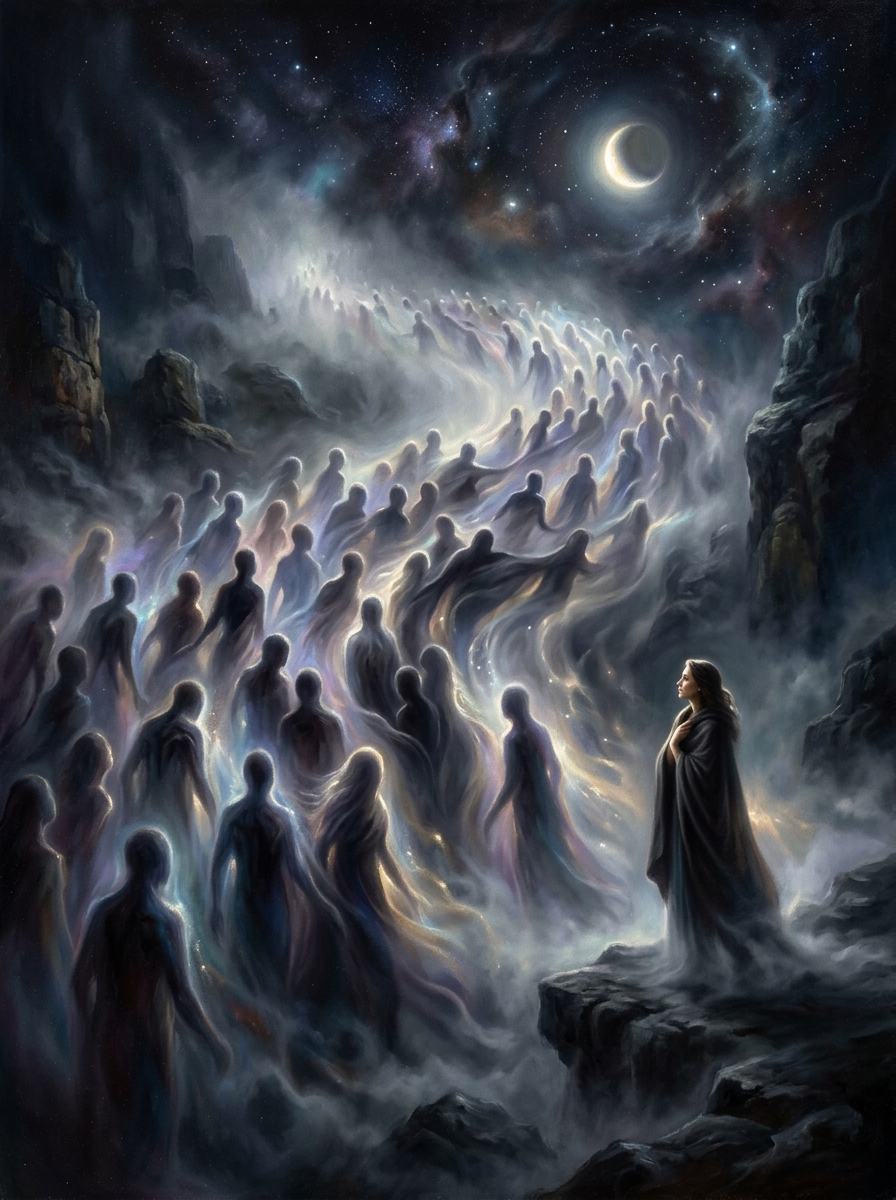
A crowd in a dream is never just a crowd. It is a field of influence — a compression of waking life into one image of social force. The psyche uses massed people to represent situations where your personal rhythm is overrun by other people’s expectations, but the real action is not the number of bodies. It is the position of the self inside the collective. Are you immersed, watching, or trying to push through? That spatial relationship tells you whether the dream is about belonging, overwhelm, visibility, or the slow erosion of individuality.
The Crowd as Psychic Field
Every crowd dream asks one core question: what happens to the self when it enters the many? The answer depends on emotional weather. A friendly, celebratory crowd can mean social affirmation, erotic aliveness, or the relief of being carried by shared purpose. A hostile or suffocating crowd points to psychic crowding: too little solitude, too much demand, no room to hear your own thoughts. The dream does not care whether the setting is a street, a stadium, or a family dinner. It cares about the quality of contact — whether the collective nourishes you or thins you out.
The most revealing detail is often what the crowd is doing. A stationary crowd that watches you brings the theme of visibility: being seen, evaluated, or exposed before you are ready. A moving crowd that blocks your path signals frustration with systems larger than yourself — bureaucracy, family politics, a career environment where individual motion is slowed by inertia. A chasing crowd makes overwhelm urgent: deadlines, social obligations, or converging expectations that press into your body. A joyous dancing crowd invites contact, not performance — resonance without self-betrayal. Each behavior is a distinct psychic grammar, and the dreamer’s task is to read the grammar, not just the image.
Psychological Roots: Persona, Dissolution, and the Inner Tribunal
From a depth-psychological angle, the crowd often represents the collective — the social world, the inherited script, the voice of “what people think.” Here the Jungian concept of the persona is essential: the social mask that adapts to public life. When the mask becomes overworked, dreams answer with massed faces. The dream stages the tension between individuality and conformity, and the emotional tone tells you whether your social identity feels fortified or exposed.
A crowd of faceless or indistinct people points to depersonalization — burnout, social anxiety, or the sense that life has become procedural. But it can also indicate something subtler: your psyche may be noticing how easily a person becomes “one of many” when their own desires have been muted. In dreams, anonymity is not neutral. It is a warning that individuality is being thinned by habit, obligation, or a culture that rewards sameness. The dream is not about strangers; it is about the cost of over-adapting.
There is a Saturnian edge to this pattern. Saturn governs boundaries, structure, and necessary limits. Crowd dreams often become more frequent when those limits are missing or ignored. The psyche shows you what happens when psychic boundaries are porous: everyone gets in, your own signal is drowned out. That is not punishment — it is diagnosis. The dream names a containment problem. For those who read symbolic patterns across systems, this same dynamic appears in the way an astrological chart with a prominent Saturn might describe the need to build interior walls before the collective erodes the self. The insight is structural, not decorative. To deepen your understanding of how such pattern-making works across dream and divination, explore Aurora Arcana’s approach to symbolic fields.
If the crowd feels judgmental, cheering, or hostile, the dream may be dramatizing an internal tribunal. The public is often an exterior costume for an inner critic — your own standards, your family’s standards, a long-absorbed cultural rule about success, beauty, or respectability. The crowd becomes the theater where the persona is either confirmed or humiliated. The dream’s emotional temperature tells you whether that theater is a stage you chose or a stage that chose you.
What the Crowd Is Doing: Variations That Change the Meaning
The most important variation is not the size of the crowd but its behavior. A waiting crowd, a fleeing crowd, a marching crowd — each creates a different psychic grammar. These are not decorative details; they tell you what kind of force is active in the dream.
The crowd watches you
Here the theme is visibility — being seen, performed, or exposed. This can be exhilarating when you are ready to be witnessed, but it can also mean exposure without consent. Dreams of public scrutiny commonly arise during transitions that make you more visible than before: a new role, a creative output, a decision that alters how others see you. The crowd becomes the audience of consequence. You are not merely being looked at; you are being evaluated by imagined consensus.
The crowd chases you or blocks your path
When the crowd pursues, overwhelm has become urgent. Chases through crowded places symbolize deadlines, social obligations, or a sense that too many expectations are converging at once. If the crowd blocks your path, the dream often points to frustration with systems larger than yourself — family dynamics, group politics, a career environment where individual motion is slowed by collective inertia. The dream’s message is not always “run.” Sometimes it is “stop trying to move through the wrong channel.”
The crowd celebrates or dances
A joyous gathering symbolizes participation in life, civic feeling, or shared purpose. If the dream feels open and rhythmic, the collective represents a healthy connection to the world beyond the isolated self. But even a happy crowd can carry a warning: sometimes celebration is the psyche’s way of asking whether you have become too self-contained. The dream may be inviting contact, not performance; resonance, not display.
Each of these variations carries a specific emotional signature. The dreamer’s task is to feel which one is present, not to decode a symbol from a book. This is where the dream’s value lives — in the texture of the felt experience, not in a fixed meaning.
Where the Pressure Lives: The Dream in Waking Life
A crowd dream usually roots in ordinary life more than in mystery. The psyche borrows collective images when your days contain too much interaction, too little privacy, or too much pressure to harmonize with others. But the most revealing layer is not the event that triggered the dream; it is the role you are playing within it.
Belonging vs. self-erasure
If you often dream of a crowd and wake feeling hollow, the dream may be registering a trade-off you have normalized: belonging at the cost of self-definition. This happens in families where harmony is prized over honesty, in workplaces where you must stay agreeable to survive, in relationships where your preferences are deferred too often. The crowd looks like a room full of people, but symbolically it is the place where you disappear into consensus. Such dreams often arrive when a person is overdue for boundaries, solitude, or a sharper articulation of desire.
The setting narrows the meaning
The place of the crowd matters. A train station suggests transition and timing. A street suggests public life and movement. A classroom points to evaluation and social ranking. A temple or concert hall adds ritual force — the collective becomes ceremonial, not merely social. A mass of people in a home usually points to intrusion and the collapse of private space. The environment narrows the interpretation and keeps it from becoming generic. For a fuller framework on how symbolic settings work across dream and divination, see how Aurora Arcana approaches the relationship between image and context.
When the dream feels spiritually charged rather than merely stressful, the image can connect with Neptune: dissolution, permeability, the loss of hard edges. A Neptunian crowd can feel beautiful, foggy, or terrifying precisely because individuality softens in the mass. That can be mystical when chosen and alarming when involuntary. The difference is consent. Does the dream feel like surrender or erasure?
A Saturnian remedy
If the crowd felt oppressive, the practical remedy is often less social input and more inner spacing. Saturn asks for structure: a clearer schedule, a more deliberate social calendar, a firmer boundary around attention. If the crowd felt exhilarating, the dream may be reminding you that contact itself can be nourishing when it does not demand self-betrayal. Either way, the image is about relationship to the many. A crowd can overwhelm, seduce, protect, or erase. Your task is to know which one it was.
What the Dream Asks You to Reclaim
The practical value of a crowd dream is not in guessing a hidden code; it is in locating the part of you that gets lost among others. The dream usually asks for one of three recoveries: a clearer boundary, a truer social role, or a return to solitude that is not loneliness.
If the crowd felt oppressive, the remedy is structural: fewer obligations, more quiet, a firmer sense of where you end and others begin. If it felt exhilarating, the dream may be inviting you to find a community that does not demand performance — a group where you can be more yourself, not less. If the crowd felt indifferent or faceless, the dream is exposing a place where your identity has been thinned by habit or fear of standing apart.
The most telling question is simple: in the dream, did you still have a self? If yes, the crowd represents a field you are learning to navigate with more confidence. If no, the dream is exposing a place where your identity has been eroded. Either way, the image is about relationship to the many — and the choice to enter the collective as a full person, not as a ghost. For a deeper look at how symbolic imagery guides this kind of self-inquiry, learn more about Aurora Arcana’s approach to dreamwork, astrology, and the patterns that hold meaning.
Related
- Dream About a Celebrity: Desire, Projection, and the Mask That Speaks
- Dream About Being Naked: Exposure, Shame, and the Self Without Armor
- Dream About an Ant: Small Work, Hidden Pressure, and Collective Life
- Dream About a Wedding: What It Means When Commitment Dreams Stir the Psyche
- Dream About a Job Interview: Pressure, Judgment, and the Self You’re Becoming
Comments
Loading comments…