Dream About a Cow: The Meaning of Nourishment, Pressure, and Silent Plenty
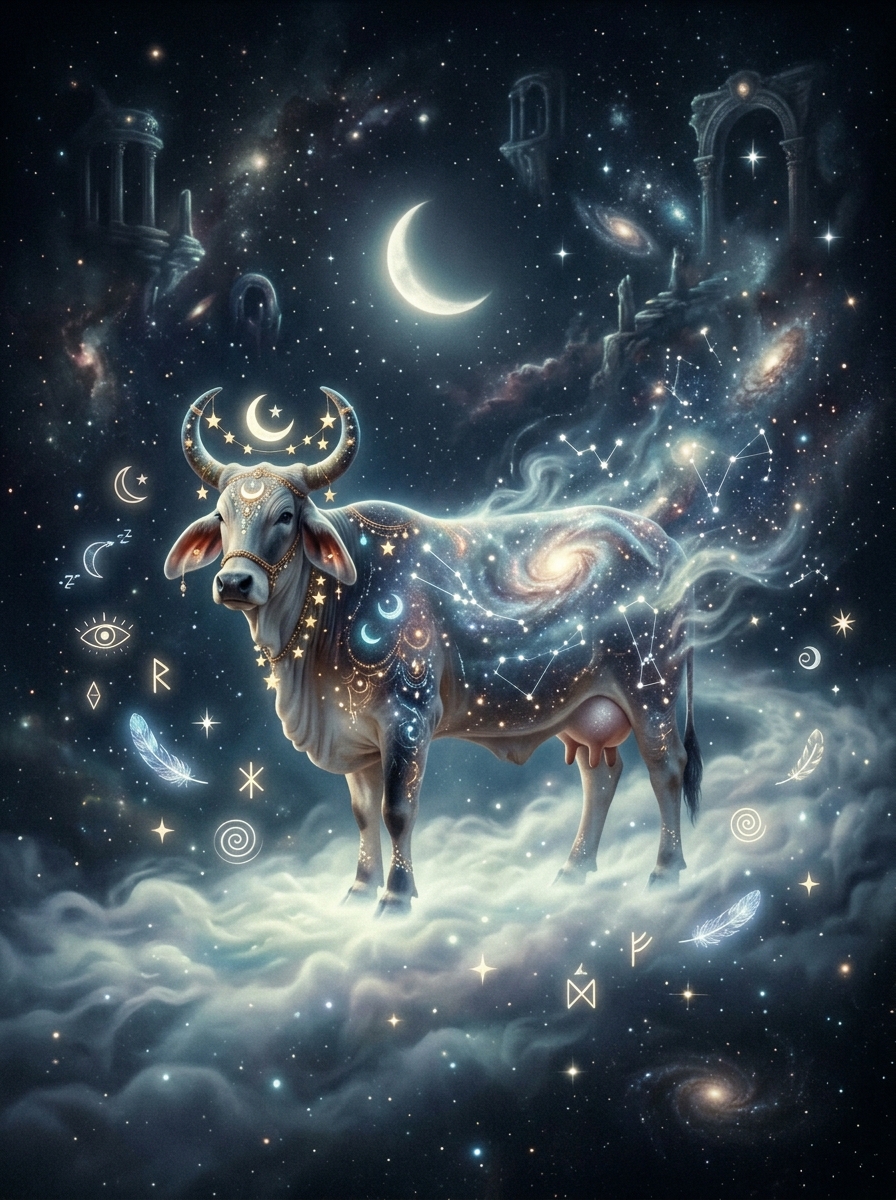
The Cow as Archetype of Sustained Life
A cow in a dream is rarely a random visitor. It arrives when the psyche needs to talk about provision — not the kind that arrives in dramatic bursts, but the kind that keeps the household running, the body fed, and the days repeating. In dream language, the cow belongs to the realm of the domestic earth: it stands on steady ground, chews, gives milk, and asks nothing except to be tended. It is the animal of patient fertility, the sort that produces without spectacle.
This makes the cow a symbol of both nourishment and burden at once. What sustains you also expects something from you. A cow cannot be ignored; it has to be milked, fed, and cared for. That double edge is the core of the symbol. When the dream cow is calm and healthy, it usually reflects a life where the basic structures of support are holding. You may be in a phase of quiet enoughness — not luxury, but sufficiency. When the cow is distressed, the dream is pointing to something that should be feeding you but is instead draining you.
The cow’s meaning is therefore inseparable from the body and its rhythms. Because the animal is large, slow, and domesticated, it often brings attention to appetite, digestion, rest, and the cycles people override until they break down. A cow dream may be the psyche’s way of asking whether you have forgotten the animal facts of being alive: eating when hungry, sleeping when tired, letting life metabolize at its own pace. For a broader framework on how dream symbols speak through bodily and archetypal language, our editorial approach at About Aurora Arcana centers on precisely this kind of grounded reading.
The Dream’s Dramatic Axis: What the Cow Is Doing
The cow itself is only a container; the meaning comes from its condition and action. A cow standing in a field is not the same symbol as a cow chasing you, and a nursing mother cow tells a different story than a carcass. The dream is less interested in the category “cow” than in the specific scene it stages.
A Peaceful Cow, Herd, or Mother
A peaceful cow, grazing or lying in grass, signals that the life force is settled and available. The psyche is telling you to trust ordinary continuity rather than chase drama. If the cow is part of a herd, the emphasis shifts toward belonging and shared rhythm. Herd imagery often softens the pressure of individuality; it suggests that not everything must be solved alone, and that communal cycles — family, workplace, community — are currently supporting you. A mother cow with a calf intensifies the protective, maternal current. This may mirror your own caregiving role, a memory of being cared for, or an instinct to shelter something vulnerable. It can feel tender, but it can also feel claustrophobic if your waking life has become all obligation and no interior space.
A Dead, Sick, or Starving Cow
A distressed cow is the dream’s way of showing that nourishment has been interrupted. Something that should sustain you is instead leaking energy. A dead cow often marks the end of a source of support — the collapse of a domestic arrangement, the exhaustion of a habit, or grief around livelihood or bodily wellbeing. A sick cow carries more ambiguity: the resource is still present but weakened. The question is whether it can continue in its current form. This is the kind of dream that appears during burnout, when the dreamer is still functioning but no longer thriving.
A Cow That Chases, Blocks, or Attacks
When the cow becomes aggressive, the symbolism flips from nurture to pressure. Something presumed benign has grown too large to ignore. Often this is a duty, financial demand, or family expectation that has become intimidating precisely because it is so ordinary. A charging cow can also represent instinct without refinement — a force that is not malicious but is definitely ungoverned. In psychological terms, the dream may be showing the eruption of a part of the self that has been kept passive for too long.
Details That Tilt the Message
Color alters tone: a white cow often emphasizes peace, purity, or ease; a black cow may carry more mystery, heaviness, or unconscious material. Neither is inherently good or bad. Setting matters: an open field suggests natural abundance and room to breathe; a barn or enclosure points to managed resources, family structure, or containment. A cow indoors makes the symbolism more intimate — the instinctual has entered the personal sphere and cannot be ignored. Milk narrows the reading toward nourishment itself, but if the milking feels forced, the dream may be about extraction: being used for output, energy, or emotional supply. Horns add assertiveness or latent aggression; a horned cow is still a cow, but the dream is no longer all softness. A calf amplifies vulnerability and dependency, pointing to a project, relationship, or aspect of self that needs protection.
The Psychological Weight: Body, Mother, and the Instinct to Continue
From a psychological standpoint, the cow represents the earthbound side of the psyche: routine, receptivity, bodily presence, and the long memory of caretaking. Jungian analysis works well here because cows are not symbols of conquest or ego expansion; they belong to the realm of the maintained and the metabolized. They ask what it means to live in a body that needs consistency.
The Maternal Shadow
The cow’s maternal resonance can be comforting, but it has a shadow. The dream may reveal a relationship to the mother archetype that feels sustaining, overbearing, or inaccessible. Some people dream of cows when they are wrestling with dependence: wanting to be fed, fearing control, resenting obligation, or grieving the absence of reliable care. In this sense, the cow can represent the split between being nourished and being consumed by the need for nourishment. A person who grew up equating love with sacrifice may dream of cows when trying to tell whether their generosity is feeding anyone, including themselves.
Persistence Without Spectacle
The cow is not dramatic, and that is precisely why it matters. In a culture that prizes speed and self-assertion, the cow stands for persistence without spectacle. Dreams of cows often appear when the psyche is trying to restore confidence in slow processes — to stop measuring everything by excitement and instead ask whether life is actually sustainable. This is one reason cow dreams can feel both comforting and confronting: they remind you that the body does not care about your ambitions if its rhythms are collapsing. The dream may be less about abstract symbolism and more about a direct psychological inventory: What feeds you? What drains you? What have you been carrying because it is familiar, not because it is yours?
For a deeper exploration of how dream symbols like the cow connect to the mother archetype and the psychology of caretaking, the editorial philosophy behind About Aurora Arcana offers a consistent framework that respects both the personal and the universal.
Reading Your Own Dream: From Symbol to Stewardship
The most useful question after a cow dream is not “Is this good or bad?” but “What in my life is feeding me, and what in my life is feeding on me?” The cow is a symbol of honest accounting. It asks where your energy comes from, where it goes, and whether the structure around you is sustainable.
If the dream was comforting, it may be confirming that a steady source of support is present — a relationship, a job, a daily practice that holds you. If it was disturbing, it may be showing that a resource is endangered or overused. A dead cow does not necessarily foretell literal death; it may signal that a habit or role has worn out its usefulness.
In relationships, a cow dream can reflect the give-and-take of care. Are you the one always providing, or are you being nourished? A peaceful cow suggests reciprocity; a milking scene that feels forced points to imbalance. In work or creative life, a herd can indicate collaboration and shared rhythm, while a sick cow may warn that your output is exceeding your input. In terms of health and body, the cow often calls attention to basic needs: sleep, food, rest. It may be urging you toward routine and away from heroic overextension.
The cow does not call for grand revelation. It calls for stewardship. The dream may be asking you to tend what you have, to stop measuring success by excitement, and to trust that slow, repetitive care is itself a kind of plenty. And if the animal seems to be asking for something you are not giving — attention, gratitude, rest — then the dream is simply the psyche’s way of saying that the body and the life it lives deserve the same patience a cow receives.
Related
- Dream About a Bear: Power, Protection, and the Wild Unsaid
- Dream About a Pig: Greed, Comfort, Instinct, and the Hidden Cost of Plenty
- Dream About a Baby Crying: The Meaning of Need, Grief, and Unfinished Beginnings
- Dream About Crying: When the Night Tells the Truth the Day Avoids
- Dream About a Wolf: What the Wolf Brings to the Door of the Mind
Comments
Loading comments…