Charoite Meaning & Healing Properties: The Stone of Spiritual Thresholds
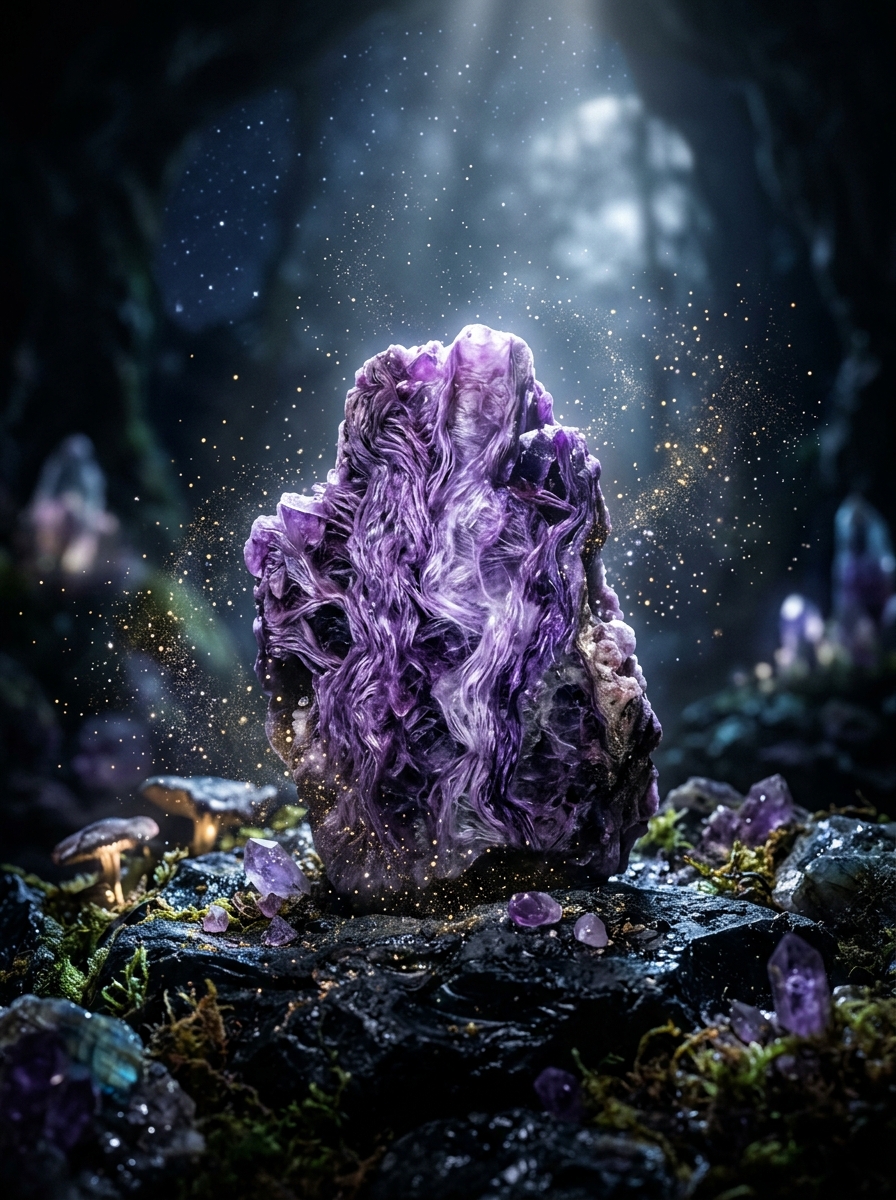
Charoite is not a stone that soothes. It is a stone that reorders. Its violet current works on psychic weather the way a cold front works on stagnant air: it breaks up the pressure systems that have held emotional patterns in place long past their usefulness. The meaning of charoite is closer to initiation than to consolation. Where some crystals stabilize by making life feel quieter, charoite stabilizes by making your inner signal clearer — even when that signal first arrives as discomfort. It reveals the architecture of fear that has become invisible through habit, and it does so without sentimentality. For anyone standing at a genuine threshold — a relationship ending, a career recalibration, a spiritual practice that has stopped delivering the same answers — charoite offers not a bridge but permission to cross.
The Core Dynamic: What Charoite Actually Does
The essential work of charoite is transmutation through revelation. It does not change the content of what you carry; it changes your relationship to that content. In a Jungian frame, it acts as a lantern in the underworld, illuminating the complexes that run on autopilot — the old shame, the inherited duty, the fear that dresses as exhaustion. The stone’s signature effect is a kind of sacred interruption: it halts psychic momentum long enough for discernment to arrive. That is why it belongs to people who are ready to stop circling the same emotional architecture and begin altering it from the inside out.
This makes charoite unsuited for those who want to bypass difficulty. Its meaning is not “everything will be fine.” It is “you can survive the truth long enough to become someone more integrated.” That distinction matters because the stone has become fashionable as a decorative violet accessory, but its proper context is the threshold — the moment when identity itself is under revision. If you are exploring the developmental movement described by the North Node, charoite can symbolize the gritty stamina required to move toward growth that feels unfamiliar but necessary. The North Node asks for expansion; charoite provides the inner fortitude to tolerate the dislocation that expansion demands.
Psychological Roots: Where Charoite’s Energy Forms
The power of charoite lies in its relationship to pattern. Emotionally, it works at the seam where a feeling has hardened into a lifelong loop — grief into bitterness, fear into control, self-doubt into paralysis. The stone is prized not for addressing a single anxiety trigger but for releasing fear that has become ambient, a chronic bracing of the nervous system that has forgotten the difference between alertness and alarm. This is why charoite is often used during grief work, periods of sobriety, or after the end of a relationship that left behind psychic residue: it helps the body remember that vulnerability can be safe.
Mentally, charoite clarifies the difference between intuition and compulsive thought. A flooded mind produces urgency, a constant sense that something must be done now. Charoite is said to create space between stimulus and response — the gap where discernment lives. For highly sensitive people or those overidentified with others’ expectations, the stone does not silence thought but makes it less tyrannical. That quality makes it a natural ally for anyone whose inner life has become crowded with borrowed voices. In astrological terms, this kind of recalibration echoes the work of the sextile aspect, which represents usable opportunity rather than brute force. A sextile does not force change; it opens a channel. Charoite feels like a mineral version of that channel: latent healing capacities that were already present but not yet accessible.
Maturation and Shadow: How Charoite Develops or Distorts
When charoite is working in its mature register, it cultivates what might be called spiritual courage — the willingness to meet what is hidden without panic. The stone’s energy deepens the capacity for emotional sobriety. A person using charoite well becomes harder to fool, especially by their own narratives. They stop outsourcing authority to anxiety, habit, or other people’s projections. The stone supports the process Jung called individuation: the slow differentiation of the true self from the persona that was built for survival.
But charoite has a shadow side, and it is important to name it. Because the stone can produce striking inner clarity, some users mistake that clarity for completion. They feel a flash of insight — I see why I keep choosing unavailable partners — and assume the work is done. This is spiritual bypass: using vision to avoid feeling. Charoite does not permit that. Its energy insists that insight must land in the body and alter behavior. If you find yourself reaching for charoite more often as a talisman than as a tool for disciplined self-inquiry, the stone will begin to feel inert. It rewards attention, not possession.
The shadow also shows up as dissociation. Because charoite opens the third eye and crown chakras, it can pull consciousness upward, away from the ground of ordinary life. For people whose spiritual work has become mentally abstract — all visions, no weight — the stone’s effect can feel unmoored. That is why the heart center matters. Charoite’s secondary resonance in the heart restores temperature and consequence. Insight should alter relationship. If it does not, it remains a theory. The mature practitioner pairs charoite with grounding practices: walking, journaling, conversation that holds the body.
How Charoite Plays Out in a Life
The dynamic of charoite — revelation that demands integration — expresses itself in relationships, vocation, and personal growth without requiring separate analysis for each domain. It is the same pattern, appearing in different contexts.
In relationship, charoite tends to surface the unspoken contracts that have held a bond together: the caretaking disguised as love, the pity that replaces partnership, the fear of aloneness dressed as loyalty. The stone does not break bonds; it reveals their actual texture. Someone working with charoite may find themselves unable to continue a conversation that has been repeating for years, or suddenly capable of naming a boundary they had been swallowing. The courage to speak truth without collapsing into conflict is one of charoite’s most practical gifts. In therapy or difficult conversations, keeping the stone at the throat or heart can help translate intuition into language.
In vocation, charoite clarifies motive. Many people pursue ambition out of compensation — the need to prove worth, to outrun shame, to secure a future that never quite arrives. Charoite asks whether the direction you are moving is truly yours or is a relic of an older strategy. This is especially relevant when the astrological houses that govern career and public life are under activation. The stone favors those who are willing to pause their forward momentum long enough to check the compass. It does not reward speed; it rewards alignment.
In personal growth, charoite works best during endings. Waning moon phases, dream incubation, and periods of intentional release are its natural habitat. The stone’s current is selective: it amplifies release, not accumulation. Use it when you are clearing attachment to a role, disentangling from a family pattern, or noticing where ambition has become armor. Because it supports the moment when an old self loosens its grip and the next one, still invisible, begins to breathe, charoite belongs to anyone who is serious about the slow work of becoming.
Practical Ways to Work with Charoite
Charoite is most effective when used with intention, not as background decor. Its energy is inward-turning and demands contemplation. For meditation, place the stone at the third eye or hold it in the receptive hand. Ask a question that is honest but not leading. Charoite is better at revealing what lies underneath a question than at producing instant answers. It can be especially useful before journaling, tarot reading, or any practice where you need to distinguish signal from noise. If you work with the tarot, it pairs well with the tempering wisdom of The Emperor and The Sun — structure plus vitality, will plus illumination. Charoite favors that combination because it does not want insight to remain abstract.
For dream work, hold charoite before sleep and name one pattern you are ready to stop feeding. Release the stone and let the night do its sorting. The stone can be kept on a nightstand or tucked under the pillow, but the real work is in the naming. For body-centered use, place the stone near the throat when you need to speak truth without collapsing into conflict, or near the heart when you need to receive insight without tightening into defense. Charoite can also be carried in a pocket during periods of decision-making, especially when you know you are tempted to say yes before you have actually checked in with yourself.
Finally, charoite asks for ritual timing. It is well suited to waning moon work, solstices, and any threshold that requires dignity rather than drama. If your chart contains a stellium — a concentration of planets in one house or sign — the stone can function as a pressure regulator, helping the intensity become wisdom rather than endurance. Stelliums demand integration; charoite provides the inner architecture for that integration to hold. Use it sparingly but seriously, and let it mark the crossings where you are willing to become someone you have not yet met.
Related
- Moonstone Meaning and Healing Properties: The Lunar Stone of Inner Tides
- Chrysocolla Meaning & Healing Properties: The Stone of Clear Speech and Steady Waters
- Amazonite Meaning & Healing Properties: The Stone of Clear Boundaries
- Prehnite Meaning & Healing Properties: The Stone of Quiet Knowing
- Rose Quartz Meaning: The Soft Power of the Heart Stone
Comments
Loading comments…