The Cancer-Capricorn Nodal Axis: From Rigidity to Emotional Sovereignty
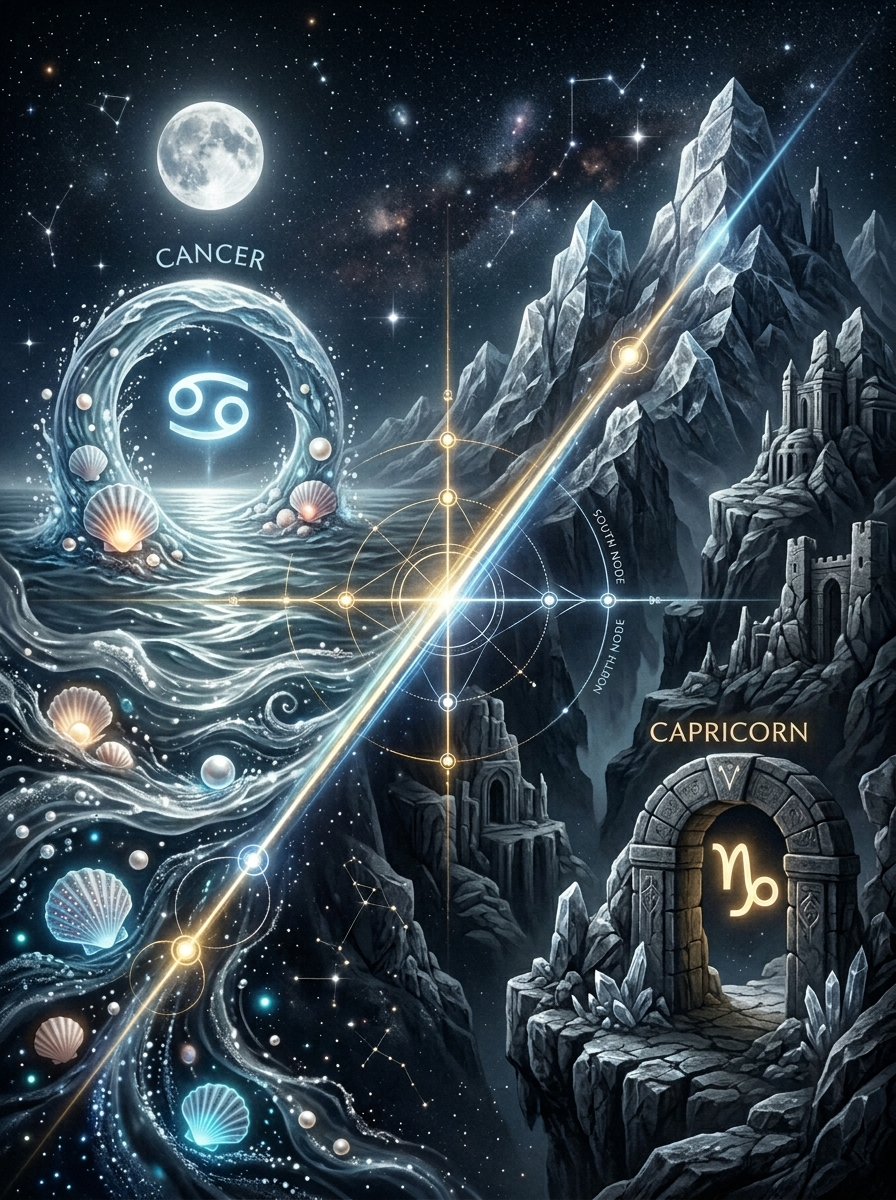
The lunar nodal axis serves as the evolutionary spine of the natal chart, outlining the tension between the soul's karmic history and its developmental calling. When the North Node sits in Cancer and the South Node occupies Capricorn, this tension is expressed as a profound psychological migration from the mountain peak of public achievement to the valley of private emotional belonging. It is a transition governed by the relationship between Saturn, the planetary lord of Capricorn, and the Moon, the luminary ruler of Cancer. In the hands of a native carrying this signature, life becomes an alchemical crucible where the hard, calcified defenses of the Saturnian ego are slowly melted down by the warm, receptive waters of Lunar vulnerability.
For the individual born under this sky, the early portion of life is typically marked by a precocious maturity, a deep sense of obligation, and an unshakeable belief that they must carry the weight of their world alone. To grow, however, they must learn to soften. They must trade the dry, windswept heights of Saturnian self-sufficiency for the tidal, fertile shores of the Moon, discovering that their ultimate security lies not in what they build, but in what they feel.
The Evolutionary Journey of the Cancer-Capricorn Nodal Axis
The evolutionary journey of the Cancer-Capricorn nodal axis is a story of shifting the center of gravity from the outer world of achievements to the inner world of feelings. Capricorn, represented by the Sea-Goat, is a cardinal earth sign that looks toward the mountain peaks. It is ruled by Saturn, the planet of structure, duty, crystallization, and the inexorable march of time. The South Node here suggests that the native is highly familiar with these heights. They arrive in this lifetime with an innate capacity for discipline, a strong sense of responsibility, and a natural tendency to seek safety in external structures. They understand how to climb, how to endure, and how to govern. The problem is that they have spent so much time on the mountain peak that they have forgotten how to breathe in the valley. They have traded their emotional life for a public role, and their identity has become synonymous with their utility.
Cancer, the target of the North Node, is a cardinal water sign ruled by the Moon. It represents the subterranean waters of the self—the realm of the family, the sanctuary, the private life, and the deep, fluctuating currents of subjective emotion. While Capricorn seeks to be respected, Cancer seeks to be safe; while Capricorn values the climb, Cancer values the roots. The evolutionary task is to migrate from the dry, windswept stone of Capricorn to the warm, nurturing tides of Cancer. This is not a simple shift; it is a profound psychological realignment that requires the native to redefine their relationship to success, safety, and self-worth. It forces them to question the societal scripts that equate productivity with humanity, and instead learn to live from a place of emotional authenticity.
The Polar Tension of Saturn and the Moon
In the Western esoteric tradition, the relationship between Saturn and the Moon represents the interplay between form and fluid, structure and flow. Saturn is the principle of boundaries, gravity, and crystallization. It is the skeleton, the skin, the wall, and the clock. The Moon is the principle of receptivity, reflection, and change. It is the blood, the ocean tide, the memory, and the tear. Steven Forrest, in his writings on evolutionary astrology, emphasizes that the nodes represent a developmental spectrum where the South Node is our comfort zone—a place of mastery that has curdled into a trap—and the North Node is our growth edge, the territory of our future growth.
With the South Node in Capricorn, the native's default response to threat is to build a wall, freeze their feelings, and work harder. The North Node in Cancer represents the raw, unmapped territory of emotional responsiveness, requiring the native to drop their armor and allow themselves to feel. The polar tension between these two forces can feel like a constant tug-of-war. The native may fear that if they step off the Capricorn mountain, they will drown in the Cancerian sea. Yet, the goal is not to destroy the Saturnian structure but to make it porous enough to hold the Moon's waters. When the native learns to integrate these forces, they discover that their Capricornian discipline can be used to protect and honor their Cancerian sensitivity, creating a stable, boundaried container where their emotions can flow safely. This is the alchemical marriage of the sunlit mountain and the moonlit sea, where structure serves the flow of life rather than freezing it.
The Burden of Hyper-Independence and Duty (South Node in Capricorn)
The South Node in Capricorn carries a heavy burden of hyper-independence, duty, and chronic self-reliance. This pattern is often established in the early years of life, when the child with this placement learns that their emotional needs are an inconvenience or a danger to the family system. They may have experienced early adultification, stepping in to manage a chaotic household, care for emotionally fragile parents, or carry responsibilities that were far too heavy for their years. In her extensive work on Saturn and the family complex, astrologer Liz Greene notes that Saturnian placements in childhood frequently involve a premature encounter with limits, duty, and emotional isolation. The child adopts the role of the 'strong one,' the pillar who never cries, who excels in school, and who handles every crisis with silent efficiency.
This early survival strategy creates a deep-seated belief that safety is conditional upon strength and utility. The adult native operates under a chronic pressure to perform, treating their own emotional needs as weaknesses or inconveniences to be managed or suppressed. They carry a heavy, silent burden of responsibility, believing that if they let down their guard for even a moment, their entire world will collapse. This hyper-independence manifests as a refusal to ask for help, a tendency to take on everyone else's burdens, and a chronic inability to receive comfort or care from others. The native becomes trapped in their own competence, isolated on a mountain of their own making. They mistake the isolation of their stone fortress for safety, not realizing that the walls designed to protect them are also keeping out the warmth of genuine connection.
The Archetype of the Senex
This psychological stance is closely aligned with the Jungian archetype of the Senex—the Latin term for the Old Man, traditionally associated with the planet Saturn. The Senex represents order, structure, authority, and time. In its positive aspect, it provides wisdom, discipline, and the capacity to build lasting foundations. In its negative, shadowed aspect, the Senex is cold, rigid, suspicious of change, and terrified of chaos. For the Capricorn South Node native, the negative Senex operates as an inner tyrant, policing the personality and suppressing any impulse that seems weak, childish, or emotional.
When the native experiences grief, fear, or longings for comfort, the inner Senex dismisses these feelings as irrational distractions. The body is treated as a machine to be driven to the point of exhaustion, and the personal life is subordinated to the demands of duty and career. The shadow of the Senex is a dry, barren landscape where nothing can grow because the waters of emotion have been frozen solid. Healing requires the native to recognize the voice of the Senex not as absolute truth, but as a defense mechanism designed to protect a vulnerable inner core from the pain of neglect. The native must learn to challenge this inner tyrant, questioning its demands for constant productivity and its pathologization of normal human needs. By doing so, they dismantle the cold authority of the Senex, making room for the nurturing presence of the Lunar feminine.
Embracing Vulnerability, Intimacy, and Belonging (North Node in Cancer)
Embracing the North Node in Cancer requires a courageous descent from the cold mountain peak of Capricorn into the warm valley of vulnerability, intimacy, and belonging. Cancer is the sign of the womb, the family, the sanctuary, and the deep, flowing currents of the subjective self. To move toward this node, the native must learn to value their feelings over their achievements. They must discover that it is not enough to be respected by the world; they must also belong to themselves. This requires a conscious, often terrifying surrender of control. The native must learn to say, 'I am lonely,' 'I am tired,' or 'I do not know how to handle this,' allowing others to see their softness and offer support.
This developmental task is a process of learning to trust the flow of life rather than trying to control it through force of will. The native must move from the Capricornian focus on 'doing' to the Cancerian focus on 'being,' cultivating receptivity, intuition, and emotional sovereignty. They must learn to honor their subjective experience as a valid source of truth, recognizing that their feelings are not irrational distractions but vital signals from the soul. By embracing vulnerability, the native begins to experience the restorative power of emotional connection, breaking through the walls of isolation and entering into a state of genuine intimacy with themselves and others. This transition is not a descent into weakness but an ascent into authentic power, as the native discovers that true resilience lies in their capacity to remain open and feeling in a challenging world.
Softening the Shell: The Crab's Return to the Tide
The archetype of Cancer is represented by the crab, a creature that perfectly illustrates the psychological challenge of this nodal transition. The crab carries a hard, calcified shell to protect its soft, watery interior. It moves sideways, cautious and defensive, ready to retreat into its armor at the first sign of danger. For the Capricorn South Node, the shell has become a permanent prison, locking the soft interior away from all contact. The Cancer North Node calls the crab to soften its shell and return to the tide. It demands that the native allow their boundaries to become permeable, recognizing that real intimacy requires the risk of being touched, seen, and affected by another human being.
Softening the shell is not a surrender of strength; it is the ultimate expression of emotional courage. It is the realization that the capacity to feel, to weep, and to care is far more resilient than the brittle defenses of a frozen ego. By returning to the tide, the native begins to experience the restorative power of emotional connection, replacing the cold duty of Capricorn with the warm, living waters of Cancerian love. They learn that they do not need to carry a heavy armor at all times; they can trust the supportive currents of their relationships and their own emotional resilience. The ocean of emotion, once feared as a place of dissolution, becomes their true source of life and renewal.
Healing the Inner Child and Releasing Perfectionism
Healing the inner child is a central task of the Cancer North Node journey, as the Capricorn South Node native spent their early years acting like an adult and suppressing their own emotional needs. This child was forced to grow up too fast, sacrifice their spontaneity, and earn approval through perfection, discipline, and achievement. As a result, the adult native is often plagued by a relentless perfectionism, constantly setting impossibly high standards and punishing themselves for the slightest perceived failure. They treat themselves with the same cold, demanding rigidity that they experienced in childhood, perpetuating the cycle of emotional neglect. This perfectionism acts as a barrier to intimacy, as the native believes that showing any imperfection will lead to rejection.
To heal this wound, the native must consciously choose to parent themselves with compassion, patience, and warmth. They must separate their self-worth from their productivity, creating a space where they are allowed to make mistakes, be messy, and engage in unproductive play. This requires a radical revaluation of the child within, recognizing that the qualities of playfulness, curiosity, and vulnerability are not weaknesses to be corrected but essential aspects of a whole and healthy psyche. The native must learn to listen to the child's voice, validating their fears and honoring their desire for comfort, safety, and unstructured time. By doing so, they dismantle the harsh standards of Capricorn perfectionism, replacing them with the gentle, accepting embrace of Cancerian self-love.
Active Imagination and the Repressed Child
Carl Jung's technique of active imagination serves as a powerful alchemical tool for this healing process. Active imagination involves entering a meditative state and engaging in a conscious, reciprocal dialogue with personified aspects of the unconscious. For the Cancer North Node native, this means actively seeking out the image of their younger self—the child who had to be strong, the child whose tears were ignored, the child who carried the family's burdens. By sitting with this child in the imaginal space, the native can offer them the protection, validation, and warmth they never received in their formative years.
The native can say to the child: 'You do not have to be perfect anymore. You do not have to work to be loved. I am here to carry the weight now, and you are free to play.' This practice helps to melt the Saturnian ice around the heart, transforming the harsh inner critic into a compassionate guardian and allowing the spontaneous joy of the Divine Child to return to the native's daily life. Through this active dialogue, the native builds a bridge of trust between the adult ego and the repressed child, integrating the child's vitality and capacity for joy into their conscious identity, freeing themselves from the compulsion to perform.
The Alchemical Power of Tears and Emotional Release
In the Western esoteric and alchemical traditions, the process of solutio—the dissolution of rigid, crystallized forms in water—is a central metaphor for psychological transformation. For the individual with the Cancer North Node and Capricorn South Node, this alchemical dissolution is a primary evolutionary requirement. The Capricorn South Node represents a dry, Saturnian structure that resists change through sheer willpower and emotional control. The native's default response to emotional pressure is to freeze, turn to stone, and hold everything together. This creates a state of chronic somatic tension, locking the emotions into the physical structure of the body. The alchemical agent of change that melts this ice is the tear.
Tears are not merely a physiological response to sadness; they are the physical manifestation of the soul's surrender. When a Capricorn South Node native allows themselves to weep, they are performing a sacred act of dissolution, breaking down the calcified 'character armor' that has kept them isolated for decades. This somatic release is essential for releasing the frozen energy of the past. Somatic therapists have long noted that chronic emotional suppression manifests as physical rigidity, particularly in the jaw, neck, shoulders, and spine—the classic Saturnian areas of the body. Crying acts as a natural release valve, melting this muscular armor and restoring a healthy flow of energy throughout the somatic self.
Crying is also a direct challenge to the modern corporate and competitive spaces that the Capricorn South Node native has spent their life navigating. In these Saturnian arenas, emotional display is pathologized as a weakness, and the ethos of 'never let them see you sweat' reigns supreme. By choosing to weep, the native rejects this sterile standard, reclaiming their right to their own humanity. Liz Greene, in her writing on Saturn, emphasizes that the Saturnian ego must experience a symbolic death and flooding if it is to grow beyond its rigid defenses. Tears serve as the physical solvent of this process, releasing stress hormones and restoring homeostatic balance.
In addition to the daily releases, these emotional breakthroughs often occur in major cycles. During transits of the Moon or significant planetary aspects to the Nodal Axis—such as during the Nodal Returns that occur around ages 18–19, 37–38, and 55–56—the native is presented with evolutionary windows where the dam of Saturnian containment can no longer hold. The emotional floodgates open, allowing years of stored grief to be washed clean. By honoring their tears, the native allows the alchemical waters of Cancer to dissolve their defenses, opening the heart to receive the warmth and connection that they have long denied themselves. They discover that their capacity to weep is not a sign of instability but a sacred capacity for purification, clearing away the emotional debris of a lifetime of duty and self-containment, allowing them to fully embody their soft, feeling nature.
Ancestral Healing: Breaking Generational Cycles of Emotional Rigidity
Capricorn is the sign of history, ancestry, time, and legacy. When the South Node is in this sign, the individual's emotional rigidity is rarely theirs alone; it is the inheritance of a family line that has long prioritized survival, duty, and status over emotional warmth. The native's ancestors may have faced physical hardships, migrations, wars, or systemic oppressions that forced them to shut down their emotional responses in order to survive. This survival mechanism was then passed down through the generations as a family code: be strong, do not complain, and do not show weakness. The Cancer North Node native is chosen by their lineage to act as the alchemist who breaks this cycle.
To break this generational cycle, the native must first recognize that their hyper-independence is an ancestral survival strategy rather than a personal virtue. They must consciously refuse to pass the Saturnian legacy of emotional silence on to the next generation. This work involves grieving not only their own losses but also the unexpressed grief of their ancestors. They must walk backward through time, honoring the pain that their lineage had to carry in silence, and consciously declaring that the war is over. By feeling the feelings that their ancestors were forced to suppress, they perform a profound service of generational healing, releasing the family line from the accumulated weight of unspoken trauma.
Breaking the Inherited Legacy of Stoicism
To break the inherited legacy of stoicism, the native must learn to challenge the unwritten family rules that forbid vulnerability and emotional expression. They must be willing to be the one who speaks the unspoken, who cries at the funeral, and who names the family shadow. In the Tarot, the Chariot card—traditionally associated with Cancer and codified by Arthur Edward Waite—represents the vehicle of the soul. The driver of the Chariot wears armor but is guided by a canopy of stars and drives a vehicle that is open to the elements. This card teaches that true protection comes not from building thicker stone walls, but from aligning the armored ego with the celestial guidance of the soul.
By choosing vulnerability, the Cancer North Node native builds a new kind of chariot for their lineage, one that carries the emotional wealth of connection, tenderness, and safety forward into the future, liberating both past and future generations from the prison of inherited stoicism. They become the transitional character who transforms a legacy of dry duty into a lineage of emotional connection, proving that a family's true wealth is measured in love, not merely legacy.
Redefining Home, Comfort, and True Security
For the Capricorn South Node, security is always located in the external world. It is represented by the size of the bank account, the prestige of the job title, the ownership of property, and the respect of the community. These are tangible, measurable structures that Saturn can see and touch. However, the North Node in Cancer reveals that this external security is an illusion. A person can own a fortress and still be emotionally homeless. The evolutionary task of this axis is to redefine security as an internal state, rooted in a regulated nervous system, self-compassion, and a deep, intuitive sense of belonging. The native must transition from seeking safety in external control to cultivating safety within the sanctuary of their own being.
This requires a radical shift in how the native conceptualizes and builds their home environment. The Capricorn South Node native often keeps their living space sterile, minimalist, or purely functional, treating it as a resting station between work shifts rather than a sanctuary. The Cancer North Node calls for an active process of 'homing'—creating a nesting space that nourishes the senses and the heart. This involves surrounding oneself with soft textures, warm lighting, plants, and memory-rich objects that tell the story of their life. It means engaging in the rhythmic, Lunar rituals of cooking, nesting, and domestic care.
Unlike the 'Senex fortress' that uses thick stone walls to shut out the world, the 'Maternal sanctuary' of Cancer uses domestic warmth to restore the self. Building this sanctuary requires the native to become comfortable with slow time, soft textures, and the silent rhythm of domestic life. They must learn to cook for themselves as an act of love, to keep their space clean as an act of respect, and to invite close friends into their home for shared meals.
To build this inner home, the native must cultivate the art of self-nurturing. They must learn to listen to the somatic signals of their body, responding to fatigue with rest, hunger with nourishment, and emotional distress with comfort. When security is moved from the external mountain of achievement to the internal sanctuary of the heart, the native becomes unshakable. They no longer need to control the outer world to feel safe, because they have built a home within themselves that no index fund or job title can ever replace. This internal belonging becomes the anchor that allows them to navigate the storms of life with grace and resilience, no longer needing to hide behind the fortress of Capricornian control. They find that the home they were searching for on the mountain peaks of success was waiting inside them all along, in the quiet, receptive spaces of the heart.
Shifting from Constant Doing to Restorative Being
The Capricorn South Node native is chronically addicted to doing. They feel a deep anxiety when they are not productive, viewing rest as a moral failure or a sign of laziness. This compulsion to act is driven by the fear of emptiness; if they stop doing, they will be forced to feel the deep pool of grief and loneliness that lives beneath their busy schedules. The Cancer North Node calls for a radical shift from doing to being. It invites the native to enter the dark, receptive, and restorative waters of Lunar time, discovering the value of unstructured hours, play, and quiet contemplation. They must learn that their worth is inherent in their existence, not dependent on their output.
This shift is crucial for physiological healing. A chronic focus on goals, deadlines, and achievements (Capricorn) keeps the sympathetic nervous system activated in a state of high arousal. Over time, this chronic stress leads to physical exhaustion, adrenal burnout, and chronic illness. The Moon and Cancer govern the parasympathetic nervous system, which regulates digestion, rest, healing, and somatic regeneration. Shifting from doing to being is therefore a biological necessity, allowing the native's body to heal and recover from the demands of constant striving.
To bridge this gap, the native can construct a helpful transition. They can use their Capricorn scheduling habit constructively by reserving 'blank space' on their calendar—periods where no appointments, goals, or tasks are permitted. During these hours, the native is forced to surrender to the present moment, practicing the discipline of doing nothing and allowing their attention to drift naturally toward whatever brings them immediate comfort.
Rest, for this placement, is not a reward to be earned after a long week of labor; it is a fundamental necessity. The native must practice the discipline of doing nothing, letting go of the checklist and allowing themselves to drift. They must learn to enjoy the simple, sensory pleasures of life—a warm bath, a slow walk by the water, a quiet evening with a loved one—without needing to justify these activities. They must navigate the initial wave of anxiety that arises when the striving stops, learning to sit with the stillness until the nervous system settles. By learning to rest, the native heals the chronic exhaustion of their Capricorn past, allowing their creative, intuitive impulses to arise naturally from a state of quiet presence. They find that in the space of non-doing, the soul is restored, and the life is nourished by the waters of the Moon.
The Wisdom of the Crab: Establishing Healthy Boundaries
A common misconception about the Cancer North Node is that it requires the native to become a boundaryless, overly sensitive pool of emotion, completely vulnerable to every passing energy. This is a misunderstanding of the Cancerian archetype. The Crab is not a soft, defenseless slug; it is a creature equipped with a hard exoskeleton and sharp, powerful claws. The wisdom of the Crab lies in its capacity to set healthy, functional boundaries that protect its soft interior without completely isolating it from the environment.
The Capricorn South Node native is accustomed to setting boundaries through walls of stone—they shut down, walk away, or hide behind professional formality. These walls keep out the bad, but they also keep out the good, leading to profound isolation. The Cancer North Node asks the native to replace these stone walls with the organic, selective boundaries of the Crab. This means using their claws to say a clear, firm 'no' to people and situations that drain their emotional reserves, while keeping their heart open to those who offer genuine warmth and reciprocity. Healthy boundaries are not designed to keep people out; they are designed to make it safe for the self to remain present.
The Sacred Withdrawal of the Crab
In nature, the crab must periodically shed its shell in order to grow. This process, known as ecdysis, is a time of extreme vulnerability. The crab's new shell is soft, leaving it defenseless against predators. During this time, the crab does not try to fight or perform; instead, it withdraws to a safe, hidden place in the sand, waiting for its new armor to harden. For the Cancer North Node native, this biological cycle serves as a profound psychological lesson. They must learn the art of sacred withdrawal, recognizing that they cannot always be strong, active, and available.
When they are going through periods of emotional growth or vulnerability, they must allow themselves to retreat to their sanctuary, withdrawing from the demands of the public sphere to restore their energy. This selective withdrawal is not an act of weakness or avoidance, but a vital self-preservation protocol. By mastering the wisdom of the Crab, the native creates a protected sanctuary where intimacy can flourish and their emotional sovereignty can be maintained. They learn to navigate relationships with discernment, protecting their soft interior while remaining connected to the world around them, using their boundaries to nourish their life rather than defend it.
Frequently asked questions
- What is the primary evolutionary lesson of the Cancer North Node and Capricorn South Node?
- The primary lesson of this nodal configuration is to transition from a default pattern of rigid self-reliance, emotional containment, and external achievement (South Node in Capricorn) toward cultivating vulnerability, self-nurturing, and a deep sense of inner belonging (North Node in Cancer). It is a journey from the cold, structural demands of the Saturnian mountain to the warm, supportive waters of the Lunar sanctuary.
- Why do individuals with this axis struggle so much with asking for help?
- The Capricorn South Node carries a cellular belief that safety is conditional upon strength and utility. Asking for help feels like an admission of failure, weakness, or incompetence, which the native's nervous system equates with abandonment. Overcoming this requires the courage to expose their needs and discover that they can be loved for who they are, not just what they achieve.
- How can I balance my career ambitions with my Cancer North Node growth?
- The goal is integration, not career abandonment. The Capricorn capacity for structure, discipline, and professional focus is a valuable competence. However, the North Node in Cancer insists that professional pursuits must no longer serve as a defense mechanism against emotional intimacy. Career ambitions must be balanced with a rich, nurturing private life and a willingness to rest.
Comments
Loading comments…