Astrological Modalities Explained: Cardinal, Fixed, and Mutable Signs
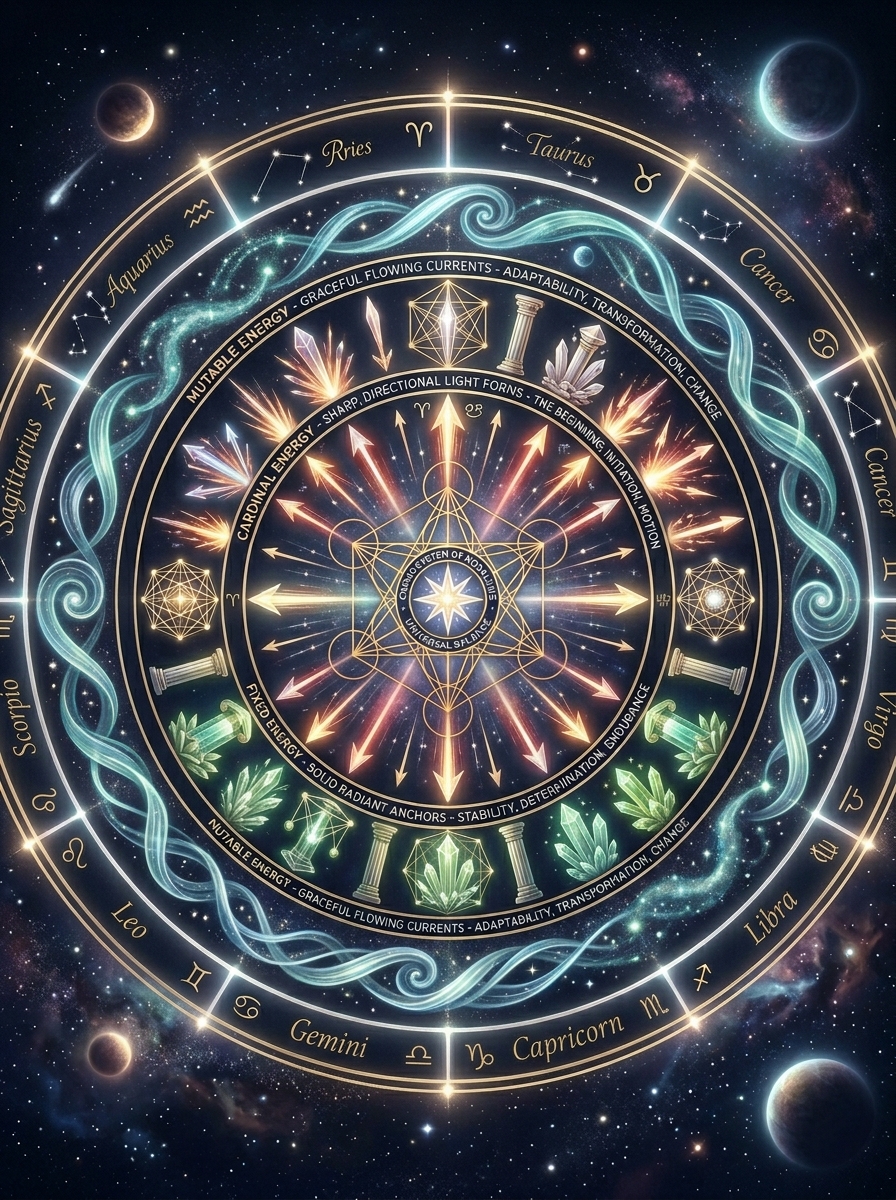
Introduction to Astrological Modalities and Dynamic Qualities
Most people who dip a toe into astrology quickly learn the four elements—Fire, Earth, Air, and Water—and feel reasonably satisfied with that framework. It explains a lot: why Aries and Sagittarius share a restless hunger, why Taurus and Capricorn both prefer solid ground beneath their feet. But elements alone leave a crucial question unanswered: how does each sign actually move through experience? Two signs can share the same element and feel like they inhabit entirely different planets. Taurus and Scorpio are both Fixed signs, yet one clings to comfort while the other clutches depth. Aries and Libra are both Cardinal signs, yet one charges forward alone while the other charges toward relationship. The dimension that accounts for this difference is the modality—sometimes called the quality—of the sign.
In Western astrology, the twelve zodiac signs are organized into three modalities, each containing four signs drawn one from each element:
- Cardinal: Aries (Fire), Cancer (Water), Libra (Air), Capricorn (Earth)
- Fixed: Taurus (Earth), Leo (Fire), Scorpio (Water), Aquarius (Air)
- Mutable: Gemini (Air), Virgo (Earth), Sagittarius (Fire), Pisces (Water)
Together, the modalities describe the temporal and kinetic character of each sign—the rhythm through which it generates, sustains, or disperses energy. Where the element tells you what kind of fuel a sign burns, the modality tells you how that fuel is combusted: as an ignition, as a slow sustained flame, or as a dispersing warmth that radiates outward and eventually fades into the next ignition. Understanding modalities is, as astrologer Liz Greene has argued implicitly throughout her body of work, a matter of understanding the deeper psychological structure beneath the archetypal surface—the process, not just the personality.
This article offers a thorough, psychologically grounded exploration of each modality: its mythological and alchemical roots, its behavioral signature across all four elements, and practical methods for reading modality distribution in a natal chart.
The Threefold Cosmic Rhythm: Creation, Consolidation, and Transition
No modality exists in isolation. The three modalities form an unbroken cycle that mirrors the most fundamental patterns in nature and in Western esoteric cosmology. The Cardinal signs open each of the four seasons (the equinoxes and solstices in the Northern Hemisphere); the Fixed signs deepen and stabilize each season at its midpoint; the Mutable signs dissolve each season as it yields to the next. This is not merely astronomical bookkeeping. It encodes a philosophy about how energy moves through any meaningful process: first it bursts, then it holds, then it releases.
The Alchemical and Mythological Parallels
Classical alchemy mapped this same rhythm onto its three primes—the tria prima described by Paracelsus: Sulphur (the animating spirit, the impulse to initiate), Salt (the fixed body, the principle of form and preservation), and Mercury (the volatile medium, the agent of transformation and dissolution). Cardinal signs carry the Sulphur quality: the raw outward thrust of will. Fixed signs embody Salt: crystallized form, resistance to dissolution. Mutable signs resonate with Mercury: fluid, shifting, mediating between old form and new.
The Hindu concept of the Trimurti—Brahma the Creator, Vishnu the Preserver, Shiva the Destroyer—maps onto this same architecture, though Western esoteric astrology has typically arrived at the pattern through Greek and Neoplatonic channels rather than Vedic ones. What's significant is how universal the triad appears across cosmological systems. Carl Jung, in his work on alchemical symbolism, noted that the psyche itself operates in analogous rhythms: libido progresses outward (Cardinal), achieves investment and depth (Fixed), and then regresses or transforms (Mutable) before a new cycle of progression begins. Reading the modalities through a Jungian lens gives them immediate psychological utility. They are not just descriptions of personality; they are maps of psychic economy.
Seasonal Symbolism and the Zodiacal Wheel
Consider the natural world as a template. Spring opens with Aries—raw, explosive, undeniable. It reaches its fullest, ripest expression at Taurus—slow, sensual, deeply embedded in the Earth. It melts and shifts into summer at Gemini—quicksilver, curious, impossible to pin down. The same pattern repeats for each quarter of the year. This means that Cardinal signs always announce a turning of the wheel—a new direction in time. Fixed signs always consolidate that turning—they make it real, give it substance and duration. Mutable signs always complete the transition—they're the threshold, the in-between space, the composting of one reality into the nutrients for the next.
For the natal chart interpreter, this seasonal awareness is not decorative. A chart dense with Cardinal placements belongs to someone who perpetually feels the pull to start something new, who is psychologically oriented toward the horizon. A chart stacked with Fixed energy belongs to someone who experiences reality as a territory to inhabit deeply, where change registers as threat. A heavily Mutable chart belongs to someone who lives in the liminal—always between identities, always mid-transition. Most charts contain a mix of all three, but the dominant quality shapes the individual's fundamental relationship with time, effort, and change.
The Cardinal Modality: Initiative, Beginnings, and the Will to Found
Defining Cardinal Energy
The word cardinal derives from the Latin cardo, meaning hinge. Cardinal signs are the hinges of the zodiac—the four points where one season swings open and another begins. This etymology is worth sitting with. A hinge is not the door; it is what makes the door move. Cardinal energy is the energy of the initiating moment: the decision to act, the impulse to begin, the willingness to enter new territory before anyone else has mapped it.
Psychologically, Cardinal signs express what Jung called the progressive movement of libido—the forward, outward, world-directed thrust of psychic energy. They orient toward the future rather than the past. They are motivated by the idea of what something could become. The shadow of Cardinal energy is the tendency to begin more projects than one can sustain, to lose interest once the creative excitement of initiation fades, or to become restless in the Fixed phase that any significant undertaking eventually requires.
The Four Cardinal Signs
Aries (Cardinal Fire) is the archetype of self-assertion. Its Cardinal quality combines with the Fire element to produce pure, unfiltered willpower directed outward into the world. Aries does not wait for consensus. Steven Forrest, in The Inner Sky, describes Aries as existing "on the existential frontier"—the part of the psyche that insists on being first, on testing its own edge. The Cardinal quality in Aries means its Fire doesn't smolder—it ignites, explosively, and moves on.
Cancer (Cardinal Water) is perhaps the most counterintuitive of the Cardinal signs, because Cancer is associated with home, attachment, and protective retreat. Yet Cancer is Cardinal—it initiates, though in the emotional and domestic realm. Cancer founding a family, Cancer building a container for belonging, Cancer establishing the conditions under which feeling can be safely explored: these are all Cardinal acts in the Water element. The initiation here is inward and relational, not competitive. As Liz Greene observes in The Astrology of Fate, water signs initiate through feeling and memory rather than will—which makes Cancer's Cardinal quality subtle but no less powerful.
Libra (Cardinal Air) initiates through relationship and concept. It is the sign that opens autumn in the Northern Hemisphere—the moment when the world turns inward and begins to negotiate the coming dark. Libra's Cardinal impulse is toward connection: founding partnerships, establishing aesthetic values, beginning conversations that require balance and reciprocity. The trap of Cardinal Libra is that its need to initiate can become indecisiveness when it encounters the Fixed resistance of its partners or the complexity of its own ideals.
Capricorn (Cardinal Earth) initiates through structure, ambition, and institutional creation. Capricorn at the winter solstice begins the long climb back toward light—a perfect metaphor for its determination to build something durable from lean materials. Cardinal Earth is the energy of the entrepreneur, the architect, the executive: not content merely to participate in existing structures, but driven to found new ones. The shadow is a willingness to prioritize the project over the people.
The Fixed Modality: Resistance, Preservation, and Psychological Centering
Defining Fixed Energy
Fixed signs occupy the middle of each season—the point at which that season has fully arrived and shows no sign of yielding. In February, winter is not retreating; it is winter, unapologetically, at its most fully realized. In August, summer peaks and holds. Fixed energy mirrors this: it does not move unless absolutely compelled to. Where Cardinal signs ask what can I begin?, Fixed signs ask what is worth preserving?
Psychologically, Fixed energy corresponds to the consolidation of libido—the investment of psychic energy into a chosen object, territory, or value, and the willingness to stay there through difficulty. This gives Fixed signs enormous productive potential: they can sustain effort long past the point where a Cardinal sign would have pivoted. The shadow is rigidity, possessiveness, and the transformation of healthy depth into pathological entrenchment. Fixed signs in their shadow expression are not just resistant to change—they experience change as existential threat.
The Four Fixed Signs
Taurus (Fixed Earth) is the archetype of embodied stability. Its Fixed quality grounds the Earth element into something almost geological in its patience and permanence. Taurus does not merely enjoy comfort; it requires sensory continuity as a condition of psychological safety. This is not weakness. It reflects the profound Fixed capacity to inhabit experience fully, to squeeze every ounce of meaning from a chosen reality. The Taurean relationship to value—both material and aesthetic—is Fixed in the truest sense: once something has proven its worth, Taurus will not relinquish it easily.
Leo (Fixed Fire) is perhaps the most dramatically Fixed of the modality's four expressions. Fire at its Fixed point does not spread—it radiates. Leo sustains creative self-expression, maintains loyalty with extraordinary consistency, and holds to its vision of self with a tenacity that can shade into pride. Aleister Crowley's Liber AL vel Legis was in many ways a Leo document—an absolute assertion of individual will, a refusal to compromise the solar self. Fixed Fire is the bonfire rather than the wildfire: contained, brilliant, and sustained.
Scorpio (Fixed Water) is the most psychologically complex of the Fixed signs. Water in its Fixed state does not flow; it deepens. Scorpio's Fixed quality is experienced as intensity, as the capacity to sustain a feeling or an investigation until it reaches its absolute bottom. Liz Greene's Relating explores the Scorpionic Fixed nature through the lens of depth psychology: Scorpio holds to emotional experience with the same tenacity that Taurus holds to material comfort, but what Scorpio preserves is the complexity of the psychic underworld. Fixed Water's shadow is obsession, jealousy, and the refusal to allow transformation even when it is desperately needed.
Aquarius (Fixed Air) surprises people who expect a sign associated with innovation and revolution to be anything other than Fixed. But Aquarius's revolutionary quality is itself Fixed—Aquarius does not experiment with its convictions. It holds to its ideological position with the same tenacity that Scorpio holds to its emotional depth. What Aquarius preserves is the idea, the principle, the system. This is the energy of the utopian who cannot compromise the vision even when compromise would actually advance it. Fixed Air's gift is intellectual integrity; its shadow is ideological rigidity masquerading as principle.
The Psychological Utility of Fixed Energy
For the chart interpreter, a strong Fixed signature in a natal chart describes someone who experiences life as a territory to be inhabited deeply rather than a series of starting lines to cross. These individuals often achieve extraordinary things precisely because they outlast everyone else—they are still in the room, still working the problem, still loyal to the vision, long after the Cardinal signs have moved on and the Mutable signs have shapeshifted. They are the ones who build civilizations. The challenge is to distinguish healthy depth from calcified fear of change.
The Mutable Modality: Adaptability, Dissolution, and the Liminal Threshold
Defining Mutable Energy
Mutable signs arrive at the end of each season, when the current reality is beginning to dissolve into the next. In late February, winter is not yet gone but spring is already pressing at the edges. In late May, spring is cresting before summer floods in. This is the Mutable position: the threshold, the limen, the space between what was and what will be. Mutable energy is fundamentally transitional—it specializes in endings, shapeshifting, synthesis, and the translation of one state of being into another.
Jung's concept of libido regression—the movement of psychic energy inward and backward, toward dissolution rather than forward projection—resonates strongly with Mutable energy. This is not regression as failure; it is regression as preparation, the necessary composting of one cycle before the next Cardinal impulse can ignite. Mutable signs are the psyche's recyclers. They break down old forms so that something genuinely new can emerge.
The Four Mutable Signs
Gemini (Mutable Air) is the sign of perpetual intellectual mediation. Air in its Mutable phase does not settle into the Fixed pattern of Aquarius; it circulates. Gemini moves between ideas, perspectives, conversations, and identities with an ease that can look like superficiality from the outside but is actually a sophisticated capacity for simultaneous holding of multiple realities. The gift of Mutable Air is translation—Gemini can take any idea and make it accessible to almost any audience. The shadow is scattered attention and the inability to commit to a single story long enough to let it deepen.
Virgo (Mutable Earth) is the most paradoxical of the Mutable signs, because Earth seems to resist the dissolving nature of mutability. Yet Virgo's Mutable quality is evident in its service orientation, its capacity for continuous refinement, and its fundamental orientation toward process rather than product. Virgo does not reach a fixed endpoint and declare success; it continually adjusts, corrects, improves. This is dissolution in the Earth element—the ongoing breakdown of what exists into something more precise, more useful, more honest. A.E. Waite's emphasis on disciplined discernment over occult glamour has a distinctly Virgo-Mutable quality to it.
Sagittarius (Mutable Fire) is the philosopher, the traveler, the seeker whose Fire does not hold to a single object (Leo) or ignite a single direction (Aries) but instead spreads across the widest possible horizon in search of meaning. Mutable Fire is the spark that leaps from mind to mind, culture to culture, system to system. Sagittarius synthesizes—it takes what it has encountered and distills it into a worldview that can then be shared, taught, and spread. The shadow is the half-finished thesis, the spiritual tourism that skims the surface of every tradition without committing to any.
Pisces (Mutable Water) represents the most complete dissolution of the zodiac—the final sign, where all individual boundaries become permeable and the self begins to merge back into the oceanic undifferentiated. Pisces is the sign in which Water, already the element most attuned to emotional permeability, reaches its maximum fluidity. Fixed Scorpio holds its depths in containment; Mutable Pisces opens those depths to the infinite. The gift is empathy, imagination, and the spiritual capacity to dissolve the illusion of separation. The shadow is the loss of self in the service of everyone else's reality.
Mutable Energy in Practice
A chart dominated by Mutable placements belongs to someone for whom change is not an event but a medium—they live inside transition the way others live inside stability. These individuals are often gifted communicators, teachers, healers, and artists precisely because they can inhabit multiple realities simultaneously and translate between them. The challenge is to develop enough Fixed grounding to complete what they begin and enough Cardinal clarity to know what direction to pursue.
Chart Synthesis: Evaluating Modality Dominance and Balance in the Natal Chart
Counting and Weighing Modalities
The standard approach to modality analysis in a natal chart begins with a simple inventory: count the number of planets (typically the traditional ten: Sun, Moon, Mercury, Venus, Mars, Jupiter, Saturn, Uranus, Neptune, Pluto) placed in Cardinal, Fixed, and Mutable signs. A significant imbalance—five or more planets in a single modality—suggests that the individual has strong native access to that modality's gifts and strong native vulnerabilities to its shadows.
Weighting matters. The Sun and Moon carry more psychological significance than the outer planets. A Mutable Sun and Mutable Moon in a chart with one other Mutable planet is a more strongly Mutable configuration than three outer planets in Mutable signs with the Sun and Moon elsewhere. Many astrologers also weight the Ascendant and its ruling planet, as these describe the native's instinctive mode of engagement with the world.
What Modality Dominance Reveals
Cardinal dominance describes someone oriented toward new beginnings, who may struggle to sustain and complete what they start. The therapeutic question for a heavily Cardinal chart is: where is the follow-through? What Fixed energy exists in the chart, even if minor, that can be consciously cultivated to provide staying power?
Fixed dominance describes someone with enormous capacity for depth and loyalty who may experience significant difficulty releasing what has outlived its purpose. The therapeutic question is: what are you protecting, and is it still worth protecting? Mutable energy in a Fixed-dominant chart—however small—becomes a lifeline: the part of the psyche that can metabolize change when it becomes unavoidable.
Mutable dominance describes someone who navigates transition with extraordinary grace but may struggle to accumulate, build, or commit to a direction long enough to achieve meaningful density of experience. The therapeutic question is: what do you actually want to build? Cardinal placements in a Mutable-dominant chart provide the igniting impulse; Fixed placements provide the container.
The Absence of a Modality
An absence of planets in an entire modality—which occurs occasionally in natal charts—is in some ways more telling than dominance. A chart with no Fixed planets at all belongs to someone who has very little native access to the Fixed toolkit: sustained effort, resistance to change, the capacity to hold a course through difficulty. This person will likely encounter Fixed experiences repeatedly in the outer world—in partners, employers, obstacles—until they develop a relationship with Fixed energy through those encounters. The horoscope often compensates for what the psyche lacks innately by presenting it persistently in the environment.
Modalities and the Angles
The four angles of a natal chart—the Ascendant, Descendant, Midheaven, and Imum Coeli—fall in signs that share a modality. This is why all four of these angles always occupy signs of the same modality: if the Ascendant is in a Cardinal sign, all four angles are in Cardinal signs. This means the modality of the angles describes the fundamental orientation of the chart—the existential style through which the person engages with identity (Ascendant), relationship (Descendant), vocation (Midheaven), and origin (IC). Cardinal angles describe someone fundamentally oriented toward beginning. Fixed angles describe someone oriented toward endurance. Mutable angles describe someone oriented toward becoming.
Modalities and Interpersonal Dynamics
The Cross of Opposition
Each modality forms what traditional astrology calls a cross: the four signs of each modality are arranged at 90-degree (square) and 180-degree (opposition) angles to one another on the zodiacal wheel. This geometric arrangement—the Cardinal Cross, the Fixed Cross, and the Mutable Cross—encodes the inherent tensions within each modality.
Cardinal signs challenge each other through competition for primacy. Aries wants to assert; Capricorn wants to structure; Cancer wants to nurture; Libra wants to negotiate. All four are initiating energies, which means they can run headlong into one another when not consciously integrated. A person with a Cardinal-loaded chart often experiences internal conflict between multiple simultaneous impulses to begin—as though they are pulled toward several starting lines at once.
Fixed signs challenge each other through competition for permanence. Taurus, Leo, Scorpio, and Aquarius all tend to hold firmly to their respective territories, which produces some of the most dramatically resistant interpersonal dynamics in the zodiac. The famous Leo–Scorpio square, for example, pits the Fixed impulse toward self-expression against the Fixed impulse toward depth and control—neither side gives ground easily. In a single natal chart, a T-square or Grand Cross in Fixed signs describes someone whose inner world is characterized by extraordinary tenacity and equally extraordinary internal standoffs.
Mutable signs challenge each other through competition for relevance. Gemini, Virgo, Sagittarius, and Pisces are all mediators by nature, but they mediate in different registers: intellect, service, philosophy, and spirituality. When they conflict—as they do in squares and oppositions—the tension is often about which framework of meaning gets to govern reality. The Virgo–Sagittarius square is a classic: discernment versus belief, detail versus vista, the particular versus the universal.
Modality Compatibility Between Charts
In synastry—the comparison of two natal charts—modality compatibility is a subtler but often decisive factor. Two heavily Cardinal charts in a relationship can experience enormous excitement in the early stages (so many new beginnings, so much shared energy for initiation) but may struggle to sustain the relationship through its Fixed phase. Two Fixed charts can achieve remarkable longevity and depth, but may also create a relationship characterized by mutual entrenchment. A Cardinal-Fixed pairing often produces the dynamic of the initiator and the sustainer—potentially complementary, potentially frustrating. A Fixed-Mutable pairing can generate creative tension between the Fixed partner's need for stability and the Mutable partner's need for change.
These are not prescriptions or prohibitions. They are frameworks for understanding the kinetic structure of a relationship—which aspects of each partner's modality the other is likely to trigger, challenge, and ultimately develop.
Frequently Asked Questions
What is the difference between an astrological element and an astrological modality?
The element describes the substance of a sign's energy—Fire (spirit and will), Earth (matter and form), Air (mind and relationship), Water (emotion and psyche). The modality describes the motion of that energy—Cardinal (initiating), Fixed (sustaining), Mutable (dissolving). Every sign is defined by both: Leo is Fixed Fire, Virgo is Mutable Earth, Libra is Cardinal Air. The element answers "what kind of energy?"; the modality answers "how does that energy move?" Together, they produce twelve distinct psychological architectures—no two signs are alike because no two signs share both the same element and the same modality.
Can a person born under a Mutable sun sign develop Fixed qualities over time?
Absolutely—and astrology has always held that the natal chart describes potential rather than destiny. A Mutable Sun describes a natural orientation toward adaptability, but the rest of the chart will contain Fixed and Cardinal placements that provide access to those qualities. More significantly, human beings develop through experience. A Sagittarius who has learned from the consequences of scattered attention may cultivate Fixed focus deliberately. Jungian analytical psychology would frame this as the integration of the Shadow—the development of qualities that do not come naturally but are needed for wholeness. The natal chart shows the starting configuration, not the finished product.
Why do Fixed signs have a reputation for stubbornness—and is it deserved?
The reputation is earned, but it requires context. Fixed signs are not simply obstinate—they are invested. Where a Cardinal sign is excited by the prospect of starting fresh, a Fixed sign has made a commitment, and that commitment carries weight. What looks like stubbornness from the outside is often, from the inside, the experience of having put significant psychic resources into something and being unwilling to abandon that investment carelessly. The pathological version of Fixed energy is indeed rigidity: the inability to release what is no longer serving. But the healthy version is integrity, loyalty, and the capacity to endure. The question worth asking when a Fixed sign appears to dig in is always: what are they protecting, and why does that protection feel essential to their sense of self?
How do I find out which modality dominates my natal chart?
The simplest method is to list the zodiac signs occupied by the ten traditional planets in your chart (Sun, Moon, Mercury, Venus, Mars, Jupiter, Saturn, Uranus, Neptune, Pluto) and sort them into Cardinal, Fixed, and Mutable columns. The column with the most planets identifies your dominant modality. For greater nuance, weight the Sun and Moon more heavily than the outer planets—a Mutable Sun and Moon will color the chart significantly even if four outer planets are in Fixed signs. Many free and paid charting services (Astro.com is the industry standard) will display a table of element and modality tallies automatically. Once you have the numbers, the interpretive work begins: what does it mean to have this particular distribution of kinetic styles operating simultaneously in one psyche?
What does it mean if I have a very balanced distribution of modalities in my natal chart?
A relatively even distribution—say, three or four planets in each modality—suggests a person who has native access to the full toolkit: the ability to initiate, sustain, and release. This sounds ideal, and in some respects it is—these individuals are often remarkably adaptive and resilient. The challenge, paradoxically, is that with no strong modal signature, it can be harder to identify one's instinctive mode of engagement. The person may need to work harder to recognize which modality is being called for in a given situation. They may also find that their sense of identity is more fluid than those with strong modal dominance, which can be experienced as either freedom or groundlessness depending on circumstances and developmental stage.
How do modalities relate to the astrological concept of "T-square" and "Grand Cross"?
A T-square occurs when two planets in opposition are both squared by a third planet. If all three planets are in the same modality, it is called a Cardinal T-square, Fixed T-square, or Mutable T-square, and the modality of the configuration shapes its expression dramatically. A Cardinal T-square produces a crisis of direction—multiple simultaneous impulses toward initiation that create friction. A Fixed T-square produces a crisis of entrenchment—psychological or circumstantial deadlock that requires sustained effort to break. A Mutable T-square produces a crisis of diffusion—scattered energy and difficulty concentrating on any single resolution. A Grand Cross occurs when four planets form two opposition pairs that are all mutually squared—a configuration entirely within one modality. Grand Crosses in Fixed signs are perhaps the most legendary in traditional astrology for their combination of extraordinary resilience and profound internal (and sometimes external) conflict. Understanding the modality of a major configuration immediately illuminates its kinetic quality—the how of its challenge, not just the what.
Comments
Loading comments…