Astrological Cusps: The Gateway Points of Your Natal Chart
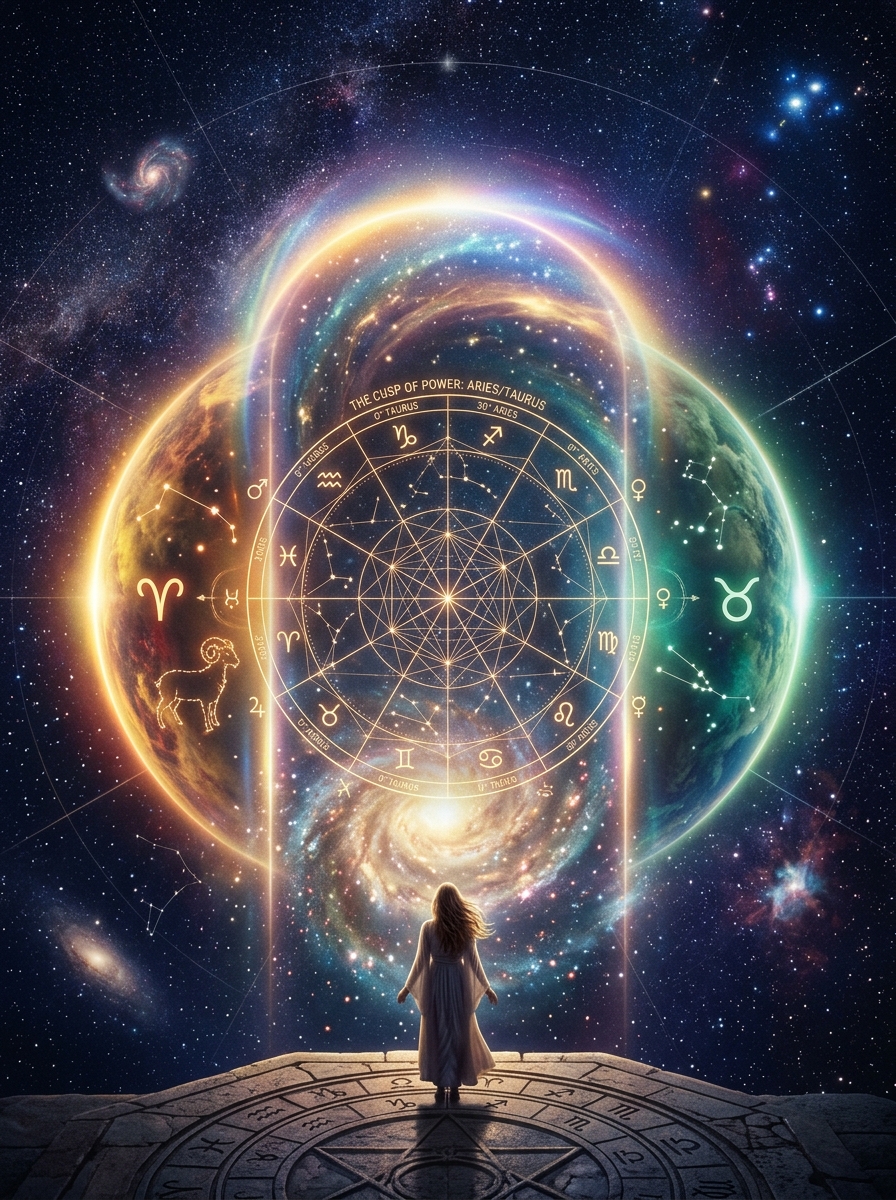
What Is an Astrological Cusp? Defining the Threshold
In the language of astrology, precision matters enormously — and nowhere is that more apparent than at the cusp. An astrological cusp is the exact mathematical boundary that marks the beginning of a house in the natal chart. Think of it as the front door of a room: the cusp defines where one domain of life experience ends and another begins, and it dictates, in the most literal sense, which energies are walking through which door.
But a cusp is far more than a coordinate on a page. Esoterically, it functions as a portal — a threshold where the diffuse symbolic energy of a zodiac sign crystallizes into a specific arena of lived experience. The zodiac itself describes qualities of energy: Aries burns with initiation, Scorpio probes the hidden, Capricorn consolidates and structures. The houses, by contrast, describe contexts of experience: career, family, relationship, creative self-expression, loss, philosophy. The cusp is the seam where archetype becomes action.
Astrological tradition going back to Hellenistic sources understood the twelve houses as divisions of both time and space. Early astrologers were as much astronomers as they were symbol-readers, and the cusp was their most fundamental unit of celestial cartography. When you calculate a natal chart, you are essentially dividing the ecliptic — the apparent path of the Sun through the sky — into twelve sectors, and the borders of those sectors are the cusps.
From a modern psychological standpoint, the cusp carries deep interpretive weight. Liz Greene, drawing on Jungian depth psychology, consistently emphasizes that the house boundaries in a natal chart are thresholds of individuation — places where the unconscious presses against the lived surface of personality. A planet conjunct a cusp is not simply "on the edge" in some neutral, geographical sense. It is poised at a place of maximum psychological tension, where transformation is not just possible but structurally invited. The cusp, in this reading, becomes what Carl Jung called a liminal space: the threshold state between one order of being and another.
For the everyday chart reader, understanding cusps means knowing two things concretely: which zodiac sign appears on the cusp (determining the tone of that house), and which planet rules that sign (becoming the governor of that house's affairs). We'll address both in detail. But first, we need to understand that not all cusps are equal.
The Four Major Angles: The Load-Bearing Walls of the Natal Chart
Among the twelve cusps in any natal chart, four stand apart as uniquely powerful. These are the angular cusps — the Ascendant (ASC), the Imum Coeli (IC), the Descendant (DSC), and the Midheaven (MC) — and they form the structural skeleton of the entire chart. If the natal chart is a building, the four angles are its load-bearing walls; everything else is arranged relative to them.
The Ascendant (ASC): The Cusp of the First House
The Ascendant is the degree of the zodiac that was rising above the eastern horizon at the precise moment and location of birth. It marks the cusp of the first house and is, for most practicing astrologers, the single most important point in the chart. The Ascendant is the mask and the lens simultaneously: it shapes how the world perceives you and how you instinctively perceive the world. Steven Forrest, in The Inner Sky, describes the rising sign as the "style" through which the soul expresses itself in this incarnation — the costume chosen for this particular journey.
A planet conjunct the Ascendant — especially within five degrees on either side — becomes amplified to a striking degree. The planet seems almost to inhabit the body: Mars conjunct the ASC tends toward physical assertiveness and competitive energy; Neptune conjunct the ASC can blur personal boundaries and bestow an otherworldly quality; Saturn conjunct the ASC often manifests as a quality of seriousness, restraint, or felt heaviness in the public persona.
The Midheaven (MC): The Cusp of the Tenth House
The Midheaven is the degree of the ecliptic that was highest in the sky at birth — the culmination point — and it marks the cusp of the tenth house. It rules vocation, public reputation, social authority, and the shape of one's contribution to the larger world. In older astrological traditions rooted in the work of authors like William Lilly, the MC was intimately connected to the father figure as the representative of external authority. In contemporary psychological astrology, it speaks more broadly to the idealized self — the image one constructs for the public stage.
Planets conjunct the MC tend toward prominence. They don't just color a house; they project outward. A Jupiter-MC conjunction can indicate expansive public visibility and philosophical authority; a Pluto-MC conjunction often marks lives defined by radical transformation of public identity, sometimes through crisis.
The Descendant (DSC): The Cusp of the Seventh House
Exactly opposite the Ascendant lies the Descendant, the cusp of the seventh house. Where the Ascendant is the self that initiates, the Descendant is the self that encounters the other — in romantic partnership, contractual relationships, open rivals, and one-on-one confrontations. Jungian astrologers, including Liz Greene, treat the Descendant as the projection screen for the shadow: the qualities we cannot own in ourselves that we habitually see in our partners, for better and for worse.
A planet near the Descendant cusp occupies an especially sensitive relational territory. Venus conjunct the DSC, for example, draws in partners who embody Venusian grace; Chiron conjunct the DSC may indicate that relationships become the arena for deep wounding and eventual healing.
The Imum Coeli (IC): The Cusp of the Fourth House
The IC sits at the very bottom of the chart wheel and marks the cusp of the fourth house. It is the most private, most interior angle — the psychological root system. The fourth house rules ancestry, childhood home, emotional foundations, and the unconscious inheritance from family. The IC represents what is buried beneath the surface of public life, the bedrock from which the Midheaven grows.
Planets at the IC often carry a charged, almost ancestral quality. Pluto at the IC can indicate a family legacy shadowed by hidden power dynamics or loss; the Moon conjunct the IC deepens the already lunar quality of this angle, suggesting emotional life that is richly interior and strongly conditioned by early family experience.
Intermediate Cusps: The Eight Supporting Chambers
Beyond the four major angles lie eight intermediate cusps — the boundaries of the second, third, fifth, sixth, eighth, ninth, eleventh, and twelfth houses. These do not carry the dramatic angular power of the ASC, MC, DSC, and IC, but they are far from insignificant. They mark the thresholds of specific life domains: material resources, communication, creative play, daily work and health, shared resources and mortality, philosophy and long-distance travel, community and friendship, and the realm of the hidden and unconscious.
The Signification of Each Intermediate Cusp
Each intermediate cusp, like its angular counterparts, carries a dual meaning: the sign on the cusp colors the manner in which that life domain expresses itself, and the ruling planet of that sign becomes the natural governor of that house's affairs.
For instance, if you have Aquarius on the cusp of your second house, you bring an unconventional, Uranian energy to matters of income and material security. You may resist conventional employment structures, generate income through technology or innovation, or hold highly individualistic values around money. The ruler of that cusp — Uranus, in modern rulership — then governs second-house matters, meaning that wherever Uranus sits in your chart, by house and sign, reveals further nuance about how financial energy operates in your life.
This chain of meaning — sign on the cusp, ruler of that sign, ruler's house placement and aspects — is one of astrology's most elegant interpretive mechanisms, and it all begins with the cusp itself as the initiating factor.
Reading the Cusp Sign and Its Ruling Planet
The sign on a house cusp determines the qualitative texture of that entire house. This is not merely cosmetic. The sign on the cusp is akin to the key signature in music: it doesn't dictate every note, but it establishes the tonal context for everything played within that register.
Sign on the Cusp: Setting the Tone
A fifth house cusp in Virgo, for example, brings a discriminating, detail-oriented energy to creative expression, romance, and play. Rather than the uninhibited fire of a Leo fifth house or the sweeping romantic idealism of a Pisces fifth, the Virgo fifth house takes joy in craft, precision, and refinement. The creative output here tends toward the meticulous; romance may be approached analytically, even nervously. This is neither better nor worse — it is simply the signature of this particular house in this particular chart.
Similarly, a seventh house cusp in Sagittarius suggests partnerships that center on philosophy, adventure, travel, and the pursuit of meaning. The native is likely to be drawn to partners who expand their worldview, and relationships themselves become vehicles for philosophical exploration. The shadow, as always with Sagittarius, can be a tendency toward restlessness, over-promising, or a flight from the mundane responsibilities that intimacy inevitably requires.
The Ruler as Governor
The ruling planet of the cusp sign is not merely a descriptor — it is an active agent in the chart. Classical astrologers called this planet the "Lord" of the house, and the term captures something important: this planet has authority over that house's affairs in a way that no other planet quite matches.
If Saturn rules your third house cusp (Capricorn on the third), then wherever Saturn sits in your chart becomes deeply relevant to communication, early education, siblings, and local community. A Saturn conjunct Jupiter in the ninth house would suggest that while communication is structured and disciplined, there is an expansive philosophical quality to how the mind operates — discipline in service of wisdom-seeking.
Aleister Crowley's Hermetic work, particularly in Liber 777, codifies these planetary-sign correspondences within a highly structured esoteric framework. Whether or not one works within his particular tradition, the underlying logic — that the ruling planet carries the essential will of the sign — permeates all serious Western astrological practice.
House Systems and Cusp Discrepancies: Why Your Chart Changes
One of the most confusing experiences for an astrology student is pulling up their natal chart in two different software programs — or simply switching the house system setting — and discovering that their planets have seemingly migrated from one house to another. The culprit is the house system: the mathematical method by which the ecliptic is divided into twelve houses, and therefore by which the cusps are calculated.
This is not an error. It reflects the fact that different schools of astrological thought have, over centuries, developed distinct geometric and philosophical frameworks for this division, each with its own internal logic and interpretive implications.
Placidus: The Western Standard
Placidus is by far the most widely used house system in contemporary Western astrology, particularly in the United States and Europe. It divides the sky based on temporal divisions — the time it takes for a degree of the ecliptic to travel from the horizon to the meridian. The result is a system that is deeply tied to the clock: houses are, in a sense, time-slices of the sky at birth.
Psychologically, Placidus maps well onto the unfolding of lived experience through time, which is perhaps why it has become the default for psychological astrologers working in the tradition of Liz Greene and the Centre for Psychological Astrology. Its cusp positions shift dramatically with latitude, which is why Placidus charts can produce very unequal houses — sometimes extremely wide, sometimes extremely narrow — for people born at high latitudes near the Arctic or Antarctic circles.
Whole Sign: The Archetypal Architecture
Whole Sign houses are the oldest extant house system, documented in Hellenistic astrology from the first century CE. In Whole Sign, each house is a complete zodiac sign: the sign containing the Ascendant becomes the entire first house, the following sign becomes the entire second house, and so on. This means the house cusps always fall exactly at 0° of each sign.
The interpretive implication is profound. In Whole Sign, there is no ambiguity about which house a planet occupies — and the four major angles (ASC, MC, IC, DSC) no longer necessarily coincide with house cusps. The MC, for instance, floats freely within whatever house it falls in, rather than anchoring the tenth house cusp.
Many contemporary astrologers, especially those steeped in ancient and Hellenistic techniques, argue that Whole Sign offers a cleaner archetypal structure. The entire sign becomes the house, which means the sign's symbolism suffuses the house completely, without the distorting gradient of a narrow Placidus cusp.
Koch: Earthly Anchoring
The Koch system, developed in the twentieth century by Walter Koch, is a time-based system like Placidus but calculated differently — specifically, it uses the birthplace latitude to create what Koch called a "birthplace system." The houses in Koch are derived from the time it would take the Ascendant degree to travel through specific arcs of the diurnal circle.
Koch tends to produce cusps that differ notably from Placidus, particularly in the intermediate houses. Some astrologers find Koch particularly useful for predictive work with solar arc directions or transits, arguing that Koch cusps are more "earthly" in their sensitivity — more responsive to the concrete circumstances of physical life rather than the psychological interiority that Placidus emphasizes.
Regiomontanus: The Equatorial Division
Regiomontanus divides the celestial equator (not the ecliptic) into twelve equal segments, then projects those divisions onto the ecliptic. Historically, it was one of the dominant house systems of the Renaissance and was used extensively by astrologers of that era, including those who worked within the broader magical traditions that Crowley later synthesized into the Hermetic Order of the Golden Dawn's astrological curriculum.
In Regiomontanus, the house cusps can fall at very different zodiacal degrees than in Placidus or Koch, particularly for the intermediate houses. Practitioners of horary astrology — the branch of astrology that answers specific questions through a chart cast for the moment the question is asked — have long favored Regiomontanus for its geometric precision and its historical pedigree.
Choosing Your System: A Practical Stance
For a student or intermediate practitioner, the proliferation of house systems can feel paralyzing. The honest answer is that there is no universally "correct" house system — each encodes a distinct philosophical model of how the sky relates to the earth and to human experience. The pragmatic approach, endorsed by many experienced practitioners, is to choose one system, learn it deeply, and apply it consistently. Switching systems every time a planet appears in an inconvenient house is, as Steven Forrest might put it, like rearranging the furniture every time you walk in the room.
Planetary Proximity and Liminal Spaces: The Orb Rule
Perhaps no interpretive question generates more debate among astrologers than this one: if a planet is close to a house cusp but technically in the preceding house, which house does it "belong" to?
The concept of the orb — the allowable degree of separation within which a planet is considered "in aspect" to a point or conjunct a cusp — is central here. Most astrologers apply a five-degree orb to house cusps: a planet within five degrees before a cusp is considered to be expressing much of the energy of the following house, even though it technically occupies the current one.
The Five-Degree Rule in Practice
Consider a natal chart with Saturn placed at 28° Virgo, and the cusp of the seventh house at 2° Libra. Technically, Saturn is in the sixth house. But it is only four degrees from the seventh house cusp. Most experienced astrologers would interpret this Saturn as operating in a "liminal" sixth-to-seventh position: it carries the qualities of sixth house concerns (health, daily work, service), but it increasingly presses into seventh house territory (partnership, contractual relationships, open enemies). In a progressed or solar arc framework, Saturn may indeed cross that cusp during the native's lifetime — a transit of profound relational significance.
Jungian Liminality and the Cusp Experience
The Jungian concept of liminality — derived from the Latin limen, meaning threshold — maps onto the cusp experience with striking precision. In anthropology, liminal states describe periods of transition when an individual is "betwixt and between" defined social categories: neither fully one thing nor another. Victor Turner, who developed the concept extensively from van Gennep's earlier work, noted that liminal individuals often carry unusual social power — they are unpredictable, potent, and generative precisely because they are not fully contained by existing structures.
A planet near a house cusp operates in exactly this way. It is neither fully in one house nor fully in another; it occupies a charged, in-between space that is genuinely dual in its expression. Liz Greene's work consistently honors this complexity, resisting the astrological tendency to flatten ambiguous chart positions into neat categorical labels. A Venus conjunct the cusp between the second and third houses does not simply "belong" to one domain — it simultaneously colors how we value and acquire resources and how we communicate and think.
This liminality is not a problem to be solved. It is an opportunity to understand that human experience is rarely confined to neat categories, and that the soul — to use the astrological term without apology — naturally overflows the containers that any map, however precise, tries to impose on it.
Angular Proximity: The Amplification Effect
When a planet falls within the same five-degree orb of one of the four major angles, the interpretive weight becomes even greater. Conjunctions to the ASC, MC, IC, or DSC are among the most powerful configurations in astrology precisely because these angles represent the places of maximum tension between the inner and outer worlds.
A natal Moon within five degrees of the Midheaven, even if technically in the ninth house, will project its lunar qualities — emotional sensitivity, nurturing impulse, need for belonging — strongly into the public and vocational domain. The planet's energy is amplified by the angular proximity, irrespective of which side of the line it technically stands on.
Intercepted Signs and Duplicate Signs on Cusps
In house systems that produce unequal houses — primarily Placidus, Koch, and similar time-based systems — a peculiar phenomenon can arise at high latitudes: intercepted signs and duplicated signs on cusps.
What Are Intercepted Signs?
An intercepted sign is a zodiac sign that appears entirely within a house, without its own cusp. Because the house is wide enough to contain the entire thirty-degree span of the sign, that sign never appears on any cusp. Its mirror image across the chart will be similarly intercepted — if Gemini is intercepted in the ninth house, Sagittarius will be intercepted in the third.
The interpretive significance is considerable. The two planets that rule the intercepted signs (in traditional terms, Mercury for Gemini and Jupiter for Sagittarius in this example) are said to be "unhinged" — lacking the lever of a cusp through which to express their energy directly. The energies these signs represent may feel more difficult to access consciously, more internalized, less immediately available for outer expression.
Duplicated Signs: The Double Emphasis
Conversely, when a sign is duplicated on the cusps, it means that sign rules two houses simultaneously — its own and the adjacent one. This creates an emphasis: the concerns of those two houses become intertwined in a particular way, and the ruling planet governs a broader swathe of life experience than it otherwise would.
Working With Cusps in Transits and Progressions
The cusp is not a static boundary. In the living dynamics of a natal chart activated by transits and progressions, cusps become crossing-points — thresholds that planets are constantly approaching, touching, and departing from as time moves forward.
Transiting a Cusp: Crossing the Threshold
When a transiting planet crosses a natal house cusp — particularly one of the four major angles — the event is rarely subtle. This is especially true for the outer planets: Saturn crossing the Ascendant marks the beginning of a new cycle of self-construction and external responsibility; Pluto crossing the IC can indicate seismic transformations in the family structure, the ancestral inheritance, or the psychological foundation itself.
The period approaching the cusp crossing — sometimes lasting months or even years, in the case of a slow-moving outer planet in apparent retrograde — is precisely the liminal phase described above. The native is living in the borderland, feeling the gravitational pull of the new territory without yet having fully entered it.
Solar Arc Directions and Cusp Activations
In solar arc directions, one of the most widely used predictive techniques in modern astrology, every point in the chart moves forward by approximately one degree per year. When a directed planet crosses a natal cusp — or when the directed ASC or MC reaches a natal planet — the interpretive implications are profound. Steven Forrest's approach to solar arcs emphasizes these cusp crossings as "chapters" in the biography of the soul: moments when new domains of life become available, or when old ones must be surrendered.
Frequently Asked Questions
What exactly is a cusp in astrology, and is it different from being "born on the cusp"?
These are two genuinely different things that share the same word, which generates enormous confusion. In technical natal chart reading, a cusp is the mathematical boundary that marks the beginning of a house — it is a precise degree of the ecliptic, calculated based on birth time and location. Every chart has twelve of them.
"Born on the cusp" in popular astrology refers to something else entirely: being born around the time when the Sun moves from one zodiac sign to the next — roughly within three days on either side of the sign change. This is a loose, colloquial use of the term, and most professional astrologers regard it with skepticism. The Sun is always in one sign or the other at a given moment; there is no "between" position. The cusp, in this pop-astrology sense, is really just acknowledging that a birth chart cast without an exact birth time can introduce uncertainty about the Sun's precise position.
The house cusp, by contrast, is fully calculable with a precise birth time and location, and it carries enormous technical significance.
Why does my chart show different house positions depending on the app or software I use?
Almost certainly, you're looking at different house systems. The most common reason a planet appears in the tenth house in one program and the ninth in another is that one program uses Placidus and the other uses Whole Sign — or Koch, or Regiomontanus, or any of the other systems in wide use.
To determine which system a program is using, look for a settings option labeled "House System" — reputable astrology apps will make this visible and adjustable. It's worth learning which system resonates with your interpretive approach, because the cusps in that system will become your primary reference frame for house-based interpretation.
How do I interpret a planet that's close to a house cusp but technically in the previous house?
The conventional rule of thumb — used by the majority of working astrologers — is to apply a five-degree orb. If a planet is within five degrees before a house cusp, read it as influencing both houses: primarily the house it occupies, but with a strong lean toward the following house as well. The closer the planet is to the cusp, the more strongly it expresses the energy of the approaching house.
Some astrologers, particularly those with a Hellenistic or classical bent, reject this practice entirely and maintain strict house boundaries — the planet is in one house, period, regardless of proximity to the cusp. Both approaches have internal coherence; what matters is applying whichever approach you choose consistently.
What is an intercepted sign, and why does it matter for my chart?
An intercepted sign appears entirely inside a house without occupying any house cusp. This happens in unequal-house systems (like Placidus and Koch) when a house is wide enough to contain an entire thirty-degree zodiac sign. The sign's ruling planet lacks the leverage of a cusp — it cannot express itself through any house's gateway in the conventional way.
Practically speaking, people with intercepted signs often report that the qualities of those signs feel slightly less accessible, more internalized, or more difficult to express outwardly. Psychological astrologers working in the tradition of Liz Greene sometimes interpret interceptions as areas of life where significant developmental work is required before the sign's energy can be fully embodied. Not every astrologer assigns special weight to interceptions, but for those who do, they often reveal subtle but persistent themes in the chart owner's experience.
Does the house cusp sign always match the traditional meaning of that house?
Not necessarily — and this is one of astrology's most generative tensions. The natural sign of the first house is Aries; the natural sign of the seventh is Libra; and so on around the chart. But in any individual's natal chart, virtually any sign can occupy virtually any house cusp (with some constraints imposed by the way the chart wheel works, such as the fact that opposite houses always have opposite signs on their cusps).
When the sign on a cusp differs from the "natural" ruler, the result is a kind of productive friction. Scorpio on the second house cusp, for example, brings Pluto's intensity, secrecy, and transformative power into the domain of personal resources — not the breezy Taurean pragmatism that "naturally" belongs there. The individual may experience money as deeply charged, even taboo; financial crises may serve as vehicles for profound psychological transformation. This is neither a curse nor a blessing — it is the specific signature of this individual's relationship with material life.
Can a house have no planets and still be significant?
Absolutely. In fact, the majority of houses in most natal charts will be empty — there are only ten traditional planets (or twelve if you include Chiron and the lunar nodes, which many modern astrologers do) and twelve houses to fill. An empty house is governed entirely by its cusp sign and the position of that sign's ruling planet, which becomes the "final dispositor" for all matters of that house.
Many people assume that empty houses represent inactive or unimportant life areas. This is a misreading. An empty fifth house does not mean an impoverished creative life; it may simply mean that creativity operates through a clear, uncomplicated channel — the cusp sign and its ruler tell the whole story without the additional complexity introduced by a planetary tenant. Houses become active through transits, progressions, and solar arcs regardless of whether they contain natal planets.
Comments
Loading comments…