Venus in the Third House: The Alchemy of Mind and Harmony
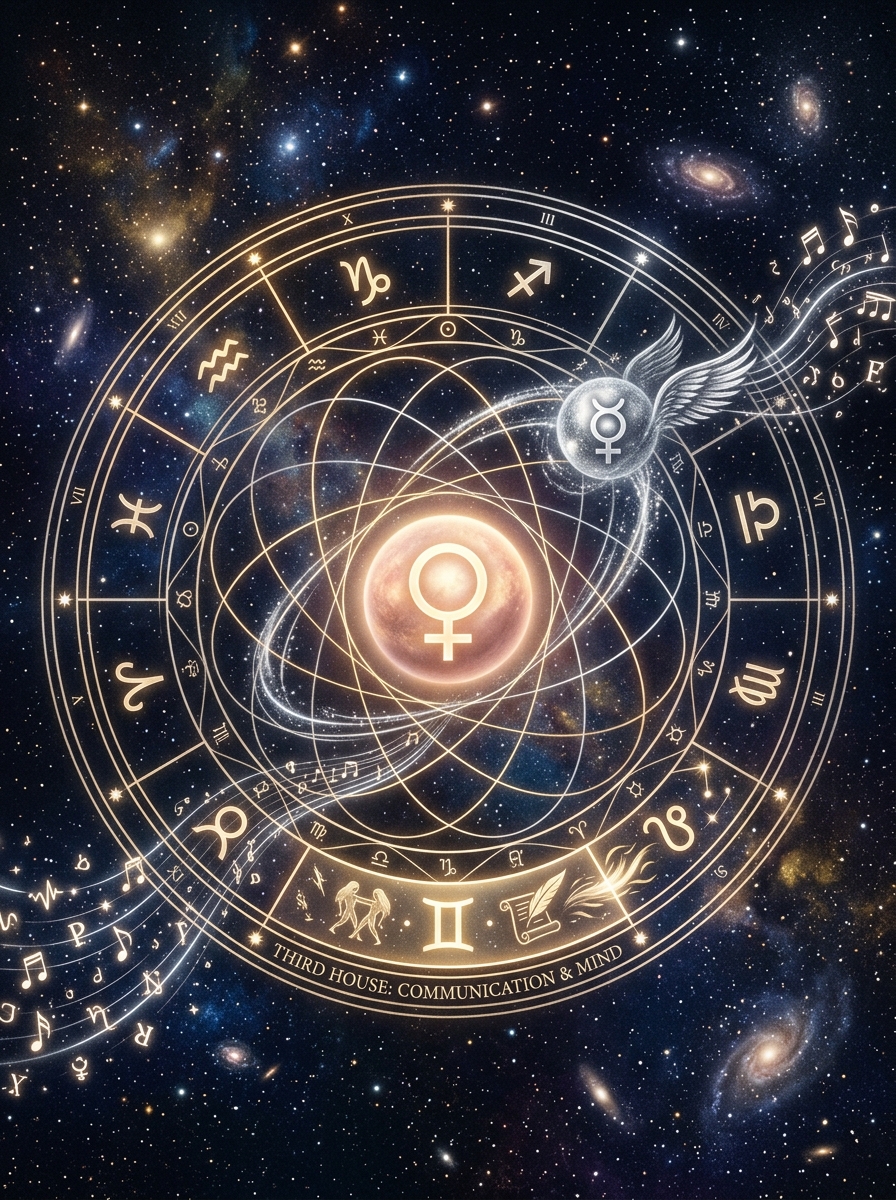
The Archetype of Venus in the Third House: Where Mind and Beauty Merge
In the traditional architecture of the natal chart, the Third House represents the immediate field of experience—the local neighborhood, the daily commute, the schoolroom, the sibling relationship, and the cognitive pathways through which we translate raw sensory input into language. It is a domain naturally aligned with Mercury, ruled by the restless energy of Gemini, characterized by curiosity, classification, and information exchange. When Venus, the planetary embodiment of the Anima, aesthetic valuation, and the relational impulse, descends into this house of the daily intellect, a unique psychological synthesis occurs. Here, the drive for connection (Venus) merges with the cognitive structures of the mind (Mercury). The result is an individual for whom thinking and relating are inextricably bound, creating an intellectual landscape that is both artistically and relationally driven.
In the psychological framework of Carl Jung, the Anima represents the soul-image, the archetype of relationship and aesthetic sensitivity that mediates between the ego and the inner world. When projected outward or integrated inward through the Third House, the Anima speaks. She does not merely feel; she articulates. The logos of the Third House—traditionally dry, logical, and preoccupied with taxonomic classification—is softened and beautified by the Venusian presence. Words cease to be mere tools for transferring data; they become instruments of art, diplomacy, and relational currency. The native with this placement possesses an inherent desire to establish harmony in their immediate environment, utilizing speech as a primary vehicle for achieving social equilibrium. They are acutely aware of the social dynamics around them and seek to use their verbal skills to bridge gaps, mend fences, and create a sense of shared understanding.
Esoteric astrologers like Liz Greene have long noted that Venus represents our value system and what we find beautiful. In the Third House, beauty is found in the elegance of a sentence, the symmetry of an argument, and the clever interplay of ideas. The mind itself is aestheticized. Rather than experiencing thoughts as purely abstract entities, the native feels them as sensory objects. A poorly constructed argument feels discordant, almost physically painful, whereas a well-chosen metaphor has the same soothing effect as a beautiful painting or a classical symphony. The intellectual realm becomes a playground of form, color, and texture, where ideas are evaluated not just for their truth value, but for their aesthetic appeal.
This placement also indicates that the early developmental environment was likely colored by a search for harmony. The school years and the relationship with siblings or early childhood peers are primary arenas where the individual learned the value of compromise, charm, and social adaptation. In the evolutionary astrology of Steven Forrest, the Third House is where we gather raw data to build our map of reality. With Venus here, the map is drawn with pastel colors and elegant contours; the native learns that the world is best navigated through cooperation, pleasant interactions, and intellectual grace. They develop an early understanding that social harmony is a necessary condition for intellectual progress, and they carry this belief into all their future learning and communication endeavors.
The Marriage of Hermes and Aphrodite
To fully appreciate this placement, we must look to the mythological union of Hermes (ruler of the Third House) and Aphrodite (ruler of Venus). Their offspring, Hermaphroditus, represents the perfect union of the masculine, analytical intellect (Logos) and the feminine, relational aesthetic (Eros). In the psychology of the Venus in the Third House individual, this union manifests as a mind that is constantly seeking to relate, and relationships that are constantly seeking to think.
When this planetary energy is functioning constructively, the native acts as an intellectual bridge-builder. They are the natural diplomats of the zodiac, capable of reframing contentious arguments into mutually agreeable terms. They possess a talent for linguistic packaging, understanding that the manner in which a truth is delivered is often just as important as the truth itself. For them, communication is an act of love, and love is an ongoing, stimulating conversation. They are constantly looking for ways to bring people together through the power of the spoken and written word, utilizing their intellectual agility to foster deep connections.
Intellectual Attraction and Sapiosexuality: Loving Through the Logos
For those with Venus in the Third House, the path to the heart invariably winds through the intellect. While physical beauty and emotional depth have their place, they are rarely sufficient to sustain long-term romantic interest if intellectual compatibility is lacking. The phenomenon of sapiosexuality—attraction based on intelligence and mental stimulation—finds its ultimate astrological expression in this house. The mind is the primary organ of attraction, and the exchange of ideas is the currency of love.
For these individuals, the most potent aphrodisiac is a brilliant mind. The courtship process is fundamentally communicative. A witty text exchange, a late-night debate over philosophy, or a shared appreciation for literature will ignite their desire far more quickly than traditional romantic gestures. As Liz Greene observes, Venus represents the impulse to relate, and when placed in a cadent, mental house, this relationship must occur on the plane of ideas. The native needs to feel that their partner is an intellectual equal, someone who can challenge their thinking, introduce them to new concepts, and engage in the playful banter that keeps the relationship alive. Without this mental spark, the relationship quickly feels dry and unsatisfying, regardless of how much comfort or stability it offers.
In relationship dynamics, the Anima/Animus projection is often cast onto intellectual figures. The partner must be a conversationalist, a storyteller, or an intellectual companion. If a partner is silent, uncommunicative, or struggles to articulate their inner world, the Venus in the Third House native will feel profoundly isolated, even if the relationship is otherwise stable and loving. The absence of dialogue is, for them, the absence of affection. They require a partner who is willing to talk through their feelings, share their ideas, and explore the intellectual landscape together.
Dialogue as an Erotic Catalyst
In the sphere of Eros, the exchange of ideas serves as a form of intellectual foreplay. The native experiences a unique thrill when another person understands their mental nuances, catches their literary references, or matches their verbal speed. This is not merely about dry academic intelligence; rather, it is about mental agility, curiosity, and the capacity for expressive dialogue. They are attracted to people who can articulate their thoughts with clarity and style, and who are open to exploring new perspectives.
In practice, this manifests as a dating style that prioritizes shared intellectual pursuits. A perfect date might involve browsing an independent bookstore, attending a lecture, or sitting in a bustling café discussing art, culture, and psychology. The native shows affection by sharing articles, recommending books, and sending thoughtful notes. The love letter, whether physical or digital, is their primary romantic currency. They show they care by engaging with their partner's mind, seeking to understand the precise mechanics of how their beloved thinks and views the world. By treating the intellect as a sacred space for intimacy, they build deep, enduring bonds that are resistant to the passage of time.
Aesthetic Communication and Poetic Expression
A native with Venus in the Third House is gifted with a natural capacity for elegant communication. The voice—both spoken and written—carries a musical cadence, a soothing quality designed to put listeners at ease. This is the placement of the poet, the lyricist, the persuasive orator, and the writer who values the aesthetic texture of language as much as its functional meaning. They understand that words are not just symbols, but vessels of energy that can shape the emotional state of both the speaker and the listener.
In daily interactions, this talent manifests as a refined social grace. These individuals know instinctively how to pay a genuine compliment, how to break the ice in a tense room, and how to use humor to soften difficult messages. They are highly sensitive to the tone, volume, and rhythm of speech. They dislike vulgarity, harsh language, and aggressive debates, preferring instead a civilized, well-reasoned exchange where everyone feels heard and respected. They believe that communication should be an act of beauty, and they strive to bring this quality to every conversation they have.
This linguistic sensitivity often leads to creative pursuits. Many with this placement are drawn to the written word, finding solace and joy in crafting essays, poetry, or fiction. Their writing style is characterized by balance, symmetry, and a rich use of metaphor. They have an eye for detail and an ear for the music of language, understanding how the arrangement of vowels and consonants can evoke specific emotional states in the reader. They are skilled at translating complex emotional experiences into precise, evocative language, making them highly effective communicators in both personal and professional contexts.
The Alchemy of the Written Word
This creative capacity extends beyond professional or artistic pursuits; it is a fundamental aspect of their daily self-expression. The Venus in the Third House native uses language to beautify their world. They decorate their personal journals, write detailed and beautiful letters, and curate their speech to reflect their internal commitment to harmony. They believe that even the most mundane communication can be elevated into a form of art.
In the esoteric traditions of Aleister Crowley and Arthur Edward Waite, language is recognized as a form of magic—a way of shaping reality through the vibration of sound and the crystallization of thought. The Venus in the Third House native instinctively understands this. They recognize that words have the power to heal or to wound, to create beauty or to sow discord. By choosing their words with conscious care, they perform a daily act of psychological alchemy, transforming the mundane chatter of the local environment into something elevated and artistic. They use their verbal skills to create a sanctuary of peace in their immediate world, using language to uplift, inspire, and connect.
Local Harmony and Immediate Bonds: The Micro-Community
The Third House governs our immediate physical environment—the neighborhood, the daily commute, the local community, and the relationships we form with siblings and neighbors. When Venus resides here, these local spaces are transformed into arenas of warmth, beauty, and mutual support. The native seeks to create a micro-cosmos that feels safe, aesthetically pleasing, and socially connected, believing that the health of the local community is a reflection of the overall quality of human life.
Relationships with siblings are often a source of significant joy and support. Under healthy astrological conditions, the native shares a warm, affectionate bond with their brothers or sisters, characterized by open communication and shared aesthetic tastes. Even when sibling rivalry or conflict exists, the presence of Venus creates a strong urge to repair the relationship and find common ground. The sibling is often viewed as a close friend and intellectual companion, someone with whom the native can share secrets and explore ideas. They value the shared history and unique understanding that sibling relationships provide, and they make a conscious effort to maintain these bonds throughout their lives.
Similarly, the native's relationship with their neighbors and local community is usually highly positive. They are the individuals who know the names of the local shopkeepers, organize neighborhood gatherings, and take pride in the appearance and social health of their street. They find beauty in the familiar, local spots—the corner café, the neighborhood park, the community library. They value these spaces as essential hubs for human connection, viewing them not just as physical locations, but as vital extensions of their emotional life. They seek to build a supportive network of local connections, creating a sense of belonging for themselves and those around them.
Siblings, Neighbors, and the Sanctity of the Near
This focus on the local environment reflects a deeper psychological truth: the native seeks to ground their relational values in what is near and tangible. Rather than yearning for abstract, distant ideals (the domain of the opposite Ninth House), they find sacred meaning in the immediate community. They believe that the most important work of connection happens in the small, daily interactions that make up a life.
This dynamic manifests as a desire to beautify the immediate surroundings. The native might plant flowers in a shared alleyway, participate in local community arts projects, or simply make an effort to bring warm, polite interactions to their daily commute. They understand that global harmony begins at home, in the small, daily interactions that define our immediate social landscape. By cultivating kindness and beauty in their neighborhood, they build a solid foundation of peace that radiates outward into the rest of their lives, proving that even the smallest actions can have a profound impact on the collective well-being.
Affective Learning: The Emotional Landscape of Intellect
For individuals with Venus in the Third House, learning is not a cold, purely objective process. Instead, it is deeply tied to emotional connection and aesthetic appreciation. To truly understand a subject, they must fall in love with it. To absorb information, they must feel a personal, relational connection to the source of that information—whether that source is a teacher, a mentor, or the author of a book. They cannot separate the intellect from the heart, and they require a learning environment that honors both.
In educational settings, these natives do not thrive under rigid, authoritarian, or dry academic structures. They need warmth, encouragement, and a supportive, collaborative learning environment. A cold, hyper-analytical instructor who dismisses the emotional dimension of a subject will fail to reach them. Conversely, a passionate, charismatic teacher who treats students with respect and encourages open dialogue will inspire the Venus in the Third House student to excel. The relationship with the educator is often the key that unlocks their intellectual potential, providing the emotional security they need to take intellectual risks and explore new ideas.
This affective approach to education means that the native's interests are guided by their passions. They study what they love, and they love what they study. They are drawn to subjects that explore human relationships, aesthetics, communication, and culture—such as psychology, literature, art history, linguistics, and philosophy. When they study these topics, they do so not just to collect facts, but to feel more connected to the human experience. They seek to understand the emotional and creative impulses behind the ideas they encounter, finding a sense of beauty and meaning in the process of discovery.
The Relational Teacher and Passionate Inquiry
This learning style also influences how they share knowledge with others. When acting as teachers, mentors, or parents, they use warmth, storytelling, and interactive discussion to engage their students' minds. They understand that information is most easily retained when it is wrapped in an emotional narrative, and they strive to make learning a pleasurable, relational experience.
Their inquiry is always relational. They learn by talking through ideas with others, testing their thoughts in the crucible of conversation, and adjusting their perspectives based on feedback. This collaborative approach makes them excellent study partners and valued members of seminars and workshops, where their ability to synthesize ideas and maintain a pleasant group dynamic helps everyone learn more effectively. They create a supportive intellectual community wherever they go, fostering a collaborative spirit that enriches the learning process for everyone involved.
Refined Vocations: The Professional Expression of Verbal Grace
The placement of Venus in the Third House offers a wealth of vocational possibilities, particularly in careers where communication, diplomacy, and aesthetic presentation are paramount. Because their intellect is naturally aligned with their value system, these individuals excel in professions that require them to translate complex, creative ideas into clear, engaging language. They are drawn to careers where they can use their verbal and social skills to create harmony, build connections, and express their aesthetic sensibilities.
One of the most natural expressions of this placement is in writing and publishing. Whether working as copywriters, editors, journalists, novelists, or poets, these individuals bring a rare sense of rhythm and balance to their work. They know how to write copy that is not only informative but also emotionally resonant and persuasive. In fields like creative marketing and public relations, their ability to understand the audience's emotional needs and craft narratives that build trust and connection is a massive asset. They are skilled at finding the perfect words to convey a brand's message, ensuring that it is delivered with style and grace.
Additionally, their natural charm and diplomatic skill make them highly successful in consultative sales, mediation, and advisory roles. They do not sell through aggression or pressure; instead, they sell by building relationships, listening deeply to the client's needs, and presenting solutions with elegance and clarity. They are the peacekeepers and negotiators of the corporate world, often called upon to resolve internal conflicts, draft sensitive communications, or represent their organization in public forums. They use their verbal skills to build bridges and find win-win solutions, creating a supportive and collaborative professional environment.
Other promising career paths include:
- Creative Marketing & Copywriting: Crafting compelling, aesthetic narratives that capture the public imagination and build brand loyalty.
- Publishing & Editorial Work: Polishing and shaping the voices of other writers, ensuring clarity, flow, and artistic expression.
- Public Relations & Spokesperson Roles: Representing organizations with charm, poise, and diplomatic tact during times of transition or crisis.
- Mediation, Diplomacy & Human Resources: Resolving interpersonal disputes and fostering harmony within teams through collaborative problem-solving.
- Lecturing & Creative Education: Teaching humanistic, artistic, or psychological subjects with an engaging, interactive, and relational style.
The Shadow of Venus in the Third House: The Gilded Trap of Superficial Harmony
Every astrological placement has its shadow, and for Venus in the Third House, the primary challenge lies in the avoidance of conflict and the pursuit of superficial peace. Because these individuals value harmony so highly, they are often tempted to compromise their own truth, avoid difficult conversations, and adopt a persona of polite agreement to prevent discomfort. They may prioritize external peace over internal integrity, leading to a fragmented sense of self.
This dynamic can manifest as people-pleasing speech. The native may find themselves saying what others want to hear, rather than what they genuinely believe. They may agree with contradictory opinions depending on who they are speaking with, leading to a fragmented sense of intellectual integrity. In psychological terms, this is a defense mechanism of the ego, trying to protect the self from the anxiety of rejection or disharmony. By smoothing over differences, they believe they are keeping the peace, but in reality, they are often building a fragile, superficial harmony that masks deep, unresolved conflicts. This avoidance of tension can prevent the relationship from reaching true intimacy, as important issues are swept under the rug in the name of politeness.
Another common shadow aspect is refined gossip. The Third House loves information, and Venus loves connection. When combined in an unhealthy way, this can lead the native to use gossip as a social lubricant—a way to build bonds with one person by sharing pleasant but ultimately betraying stories about another. This is rarely done with overt malice; instead, it is often framed as a concern for others or a shared, intimate secret. However, it ultimately erodes trust and undermines the genuine connection the native seeks. They must learn to recognize when their desire for connection is leading them to compromise their ethical standards, and strive to build relationships based on mutual respect and confidentiality.
To mature, the individual must learn that true harmony is not the absence of conflict, but the ability to navigate conflict with honesty and respect. They must develop the courage to speak uncomfortable truths, set boundaries, and tolerate the temporary tension that honest communication sometimes requires. By facing conflict head-on, they can build relationships that are truly resilient and authentic, rather than just superficially pleasant.
Integration and Maturity: The Third-Ninth House Axis and Philosophical Depth
To integrate Venus in the Third House maturely, the native must look across the chart to the opposite house—the Ninth House. While the Third House represents local information, immediate details, and daily communication, the Ninth House represents broad perspectives, higher philosophy, spiritual systems, and the search for ultimate truth. Without the balance of the Ninth House, Venus in the Third House can become lost in trivialities, local gossip, and superficial interactions. They may become so focused on saying the right thing in the moment that they lose sight of the bigger picture and their long-term values.
Integration requires the native to connect their daily verbal charm with a deeper philosophical foundation. They must ensure that their communication is guided by enduring values and an honest search for meaning, rather than a desire for immediate social approval. By anchoring their intellect in the philosophical depth of the Ninth House, their words gain weight and substance. They cease to be merely pleasant; they become profound. They learn to use their verbal skills to express deep, universal truths, transforming their daily interactions into opportunities for spiritual and intellectual growth.
This integration also helps the native overcome the fear of conflict. By understanding that disagreements are a natural part of the human search for truth and growth, they can approach difficult discussions with confidence, knowing that a deeper, more authentic harmony can emerge from honest debate. They learn to view conflict not as a threat to connection, but as a path to a more genuine and lasting peace.
In daily practice, this balance can be cultivated by:
- Engaging in Deep Study: Complementing daily reading with long-term studies of philosophy, comparative religion, or mythology, allowing these broad systems to inform their daily thinking.
- Practicing Radical Honesty: Committing to speaking the truth even when it feels uncomfortable, while maintaining a kind and respectful delivery that honors the relational space.
- Reflecting Before Speaking: Taking time to ensure that their words reflect their core values and long-term perspective, rather than a quick desire to please the listener.
- Using Writing for Self-Discovery: Writing not just to entertain or persuade others, but to explore their own internal truths, beliefs, and philosophical principles, using language as a tool for personal integration.
Frequently Asked Questions
What does it mean to have Venus in the Third House?
Having Venus in the Third House means that your capacity for love, connection, and aesthetic appreciation is expressed through your intellect and daily communication. You value mental stimulation, express yourself with charm and verbal grace, and seek harmony in your immediate environment, including your relationships with siblings, neighbors, and your local community. You find beauty in ideas and seek to build relationships based on intellectual rapport and shared creative interests.
How does Venus in the Third House affect my love life?
In relationships, you are likely a sapiosexual, meaning you are deeply attracted to intelligence and intellectual compatibility. You need a partner with whom you can have stimulating conversations, share ideas, and engage in witty banter. For you, open, honest, and creative communication is the foundation of romantic affection. Without a strong mental connection, physical attraction is rarely enough to sustain your interest over the long term.
What are the career paths for this placement?
Natives with this placement thrive in careers that require refined communication, diplomacy, and aesthetic presentation. Excellent vocational choices include copywriting, creative marketing, public relations, writing, editing, publishing, mediation, consultative sales, and creative education. You excel in any role where you can use your verbal skills to build connections, resolve conflicts, and present ideas with elegance.
What is the shadow side of Venus in the Third House?
The shadow side involves a tendency toward people-pleasing speech, avoiding necessary conflicts, and engaging in refined gossip. To maintain external harmony, you may withhold your true thoughts, agree with opinions you do not share, or use gossip to build superficial bonds. To mature, you must learn to speak uncomfortable truths with kindness and develop the courage to navigate conflict honestly.
How does this placement influence early childhood education?
You likely thrive in collaborative, warm, and creative learning environments. Your education is highly affective, meaning you learn best when you feel an emotional connection to the subject or have a respectful, encouraging relationship with your teacher. Dry, cold, or authoritarian learning environments can stifle your intellectual curiosity, whereas a supportive, interactive classroom will inspire you to reach your full potential.
How does the Third-Ninth House axis relate to this placement?
The Third-Ninth House axis represents the balance between daily, local intellect and higher, universal wisdom. To maturely integrate Venus in the Third House, you must anchor your daily verbal charm and communication style in the philosophical depth and enduring values of the Ninth House. This prevents you from falling into superficiality and ensures that your words carry genuine meaning and purpose.
Comments
Loading comments…