Venus Sextile Jupiter: The Graceful Expanse of Pleasure, Generosity, and Trust
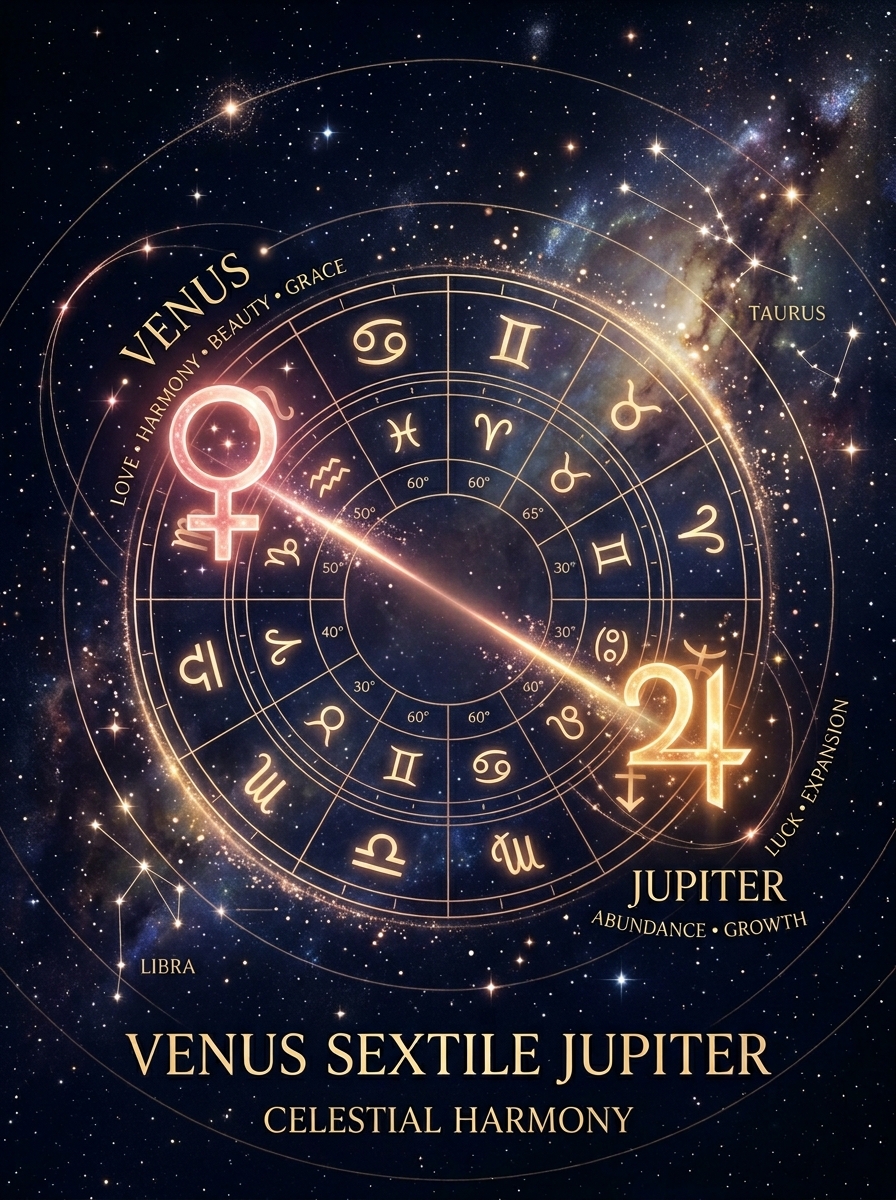
Venus sextile Jupiter does not fuse pleasure and faith into a single bliss-drive; it places them in a cooperative conversation. Where a conjunction might merge the two into a constant appetite, the sextile presents an open door. Venus brings proportion, attraction, tact, and the instinct to harmonize. Jupiter brings enlargement, meaning, generosity, and trust in what will come. In sextile, they produce a psyche that tends to believe beauty is worth pursuing and that good things multiply when shared. This is the signature of someone who makes others feel welcomed, valued, and lightly elevated—not through effort, but through a natural orientation toward life’s abundance.
The Core Dynamic: Grace That Grows by Being Used
A sextile is an aspect of latent talent. It does not force integration the way a square does, nor fuse as a conjunction does. It offers a channel that requires conscious activation. In the case of Venus sextile Jupiter, the channel runs between the instinct for harmony and the appetite for more life. For a deeper look at how the sextile works as a geometric principle, see the astrology of the sextile aspect. Here, the geometry produces a temperament that can usually find pleasure without poisoning it. The native does not have to choose between refinement and expansion; they can refine expansion and expand refinement.
This is not abstract. In real life, it looks like hosting with instinctive generosity, making money through taste or rapport, or possessing a social intelligence that never feels forced. The person does not need to perform warmth; it radiates because they assume the world will return what they give. That assumption often becomes self-fulfilling. Jupiter adds the faith that the investment of Venusian charm will be reciprocated, and Venus ensures the offering is tactful rather than overwhelming. The result is a quality that people feel before they name: an atmosphere of “there is enough.”
But the door only stays open when approached with intention. The aspect’s gift is not a permanent state of grace; it is a usable talent. Those who neglect it find that ease can degrade into complacency. The same generosity that wins friends can become a habit of overpromising. The same taste that creates beauty can become an expensive justification for indulgence. The sextile asks to be enacted, not merely enjoyed.
Psychological Roots: Trust in Pleasure as a Life Principle
The psyche shaped by Venus sextile Jupiter typically develops an early, unforced conviction that pleasure is legitimate. Venus supplies the taste for what is lovely, balanced, and satisfying. Jupiter supplies the narrative that this taste is not trivial—that it connects to something larger, perhaps even ethical or philosophical. Where a person with hard Venus aspects might feel guilt about wanting beauty, someone with this sextile often feels an inner permission to pursue what feels good, provided it does not harm others. That permission becomes a foundation for generosity: they give easily because they trust that more will come.
This trust has roots in the way the two drives cooperate. Venus wants what feels right, balanced, and lovingly arranged. Jupiter wants what widens the horizon, affirms possibility, and adds a future to the present. Together, they create an inner sense that refinement and abundance belong together. The person may care not only whether something is lovely, but whether it is fair, humane, culturally alive, or uplifting. For a related expression of Jupiter’s influence on values, see Jupiter in Libra, where expansion works through partnership and aesthetics. The Venus-Jupiter sextile gives that principle a personal, embodied form.
The shadow side of this psychological foundation is that ease can become a philosophy before it becomes a skill. If abundance arrives early and the native receives consistent social rewards, they may assume that pleasure is self-sustaining. They may avoid confronting the asymmetries in relationships because they prefer the atmosphere of goodwill. The blessing of trust becomes a liability when it substitutes for evidence. The psyche must learn that not every beautiful thing is worth keeping, and not every generous impulse is wise.
How It Matures: From Generous Ease to Discerning Abundance
The maturation of Venus sextile Jupiter is not a move away from pleasure but a move toward precision. Untested blessing can become sentimental excess. Jupiter enlarges whatever it touches, and if the values are vague, the appetite grows vague too. A person may call a relationship “loving” when it is merely comfortable, or call a purchase “well-deserved” when it is a compensation strategy. The remedy is not austerity—that would starve Venus. It is discernment: What exactly is nourishing here? What exactly is mutual? What exactly is beautiful rather than merely pleasant?
This is where the sextile’s potential becomes extraordinary. When the native learns to impose a little structure on their generosity, the aspect produces gratitude with boundaries, abundance without waste, and joy that does not become dissipation. They learn that refinement protects pleasure. A person who knows what they truly love can enjoy more with less. This is not a moralistic lesson; it is an aesthetic one. Tastes become sharper, relationships cleaner, finances calmer, and creativity more enduring.
For a complementary example of Jupiter learning to work with limits, consider Jupiter in Capricorn, where expansion must earn its keep through discipline. The Venus-Jupiter sextile does not require Capricorn’s severity, but it benefits from a similar willingness to test whether a given pleasure is actually worth the resources it consumes. The aspect’s highest expression is not luxury for its own sake, but a life in which comfort, beauty, and expansion reinforce each other without excess.
Life Applications: Love, Creativity, and Social Reach
Because the core dynamic is already established, the life applications flow directly from it. In love, this aspect favors goodwill, magnanimity, and a forgiving memory. The native encourages growth in a partner rather than policing it. They give compliments easily, enjoy gift-giving, and instinctively look for what is admirable. The pitfall is over-accommodation: they may overpromise, overforgive, or stay in one-sided arrangements because they always imagine the relationship becoming more generous later. Compare this with the softer, attachment-based ease of Moon-Venus synastry—here the ease is more spacious, less dependent on fusion, and more vulnerable to inflation.
Creatively, this is an aspect of permission. Venus wants beauty; Jupiter removes some of the shame around wanting it. Many talented people choke on self-consciousness, but this aspect often grants an inner sense that creativity is not an indulgence—it is part of being human. The result may be an artist who works with pleasurable generosity, a designer with a bold but inviting eye, or a writer whose style feels expansive without becoming bloated. For the fifth-house version of this principle, see Jupiter in the Fifth House: the same faith in play and creative luck, now centered on self-expression and romance.
Socially, the sextile shows up as a knack for bridging cliques, cultures, or temperaments. The native can soften tension, make introductions, and create the sense that everyone is included. This is why the aspect can be quietly political—not in the partisan sense, but in the civilizational one: it helps people imagine cooperative life. For a planetary version of that social instinct, look to Jupiter in the Eleventh House, where collective expansion and friendship become central themes. The Venus-Jupiter sextile gives that community-building capacity a warm, personal face.
Yet the same social intelligence can become social diffusion. The person may prefer to keep things pleasant rather than name what is asymmetrical. That is where the sextile’s task becomes psychological rather than decorative. Ease must serve truth, not replace it.
The Life Arc: Carrier of Morale
Over time, Venus sextile Jupiter tends to make a person into a carrier of morale. They may not realize how much their presence changes the temperature of a room until it is absent. Venus gives them the ability to appreciate; Jupiter gives that appreciation a future. Their life often improves when they trust that taste is not trivial and generosity is not weakness. Those are not accessories to character—they are ways of becoming bigger without becoming hard.
In the mature expression, love is less about possession than enlargement, and pleasure is less about escape than participation. The native learns to ask a distinctly Jupiterian-Venusian question: what would make this more beautiful, more just, more alive? Not all answers will be easy, but the question itself is the talent. For a sign that embodies this questioning, see Jupiter in Sagittarius, where the archer’s arrow aims at meaning. The Venus-Jupiter sextile gives that arrow a target: something worth loving. When the aspect is lived well, it produces someone who can bless a room, a relationship, or a life without making the blessing heavy. It is one of astrology’s clearest signatures of graceful growth.
Related
- Venus Conjunct Jupiter: The Joy That Grows Too Large to Hide
- Venus Square Jupiter: When Pleasure Outgrows the Frame
- Sun Sextile Jupiter: The Ease of Generous Selfhood
- Venus Trine Jupiter: The Grace of Plenty, Pleasure, and Social Luck
- Sun Sextile Venus: Ease, Magnetism, and the Art of Being Well-Loved
Comments
Loading comments…