Venus in the Ninth House: The Archetype of Expanded Love
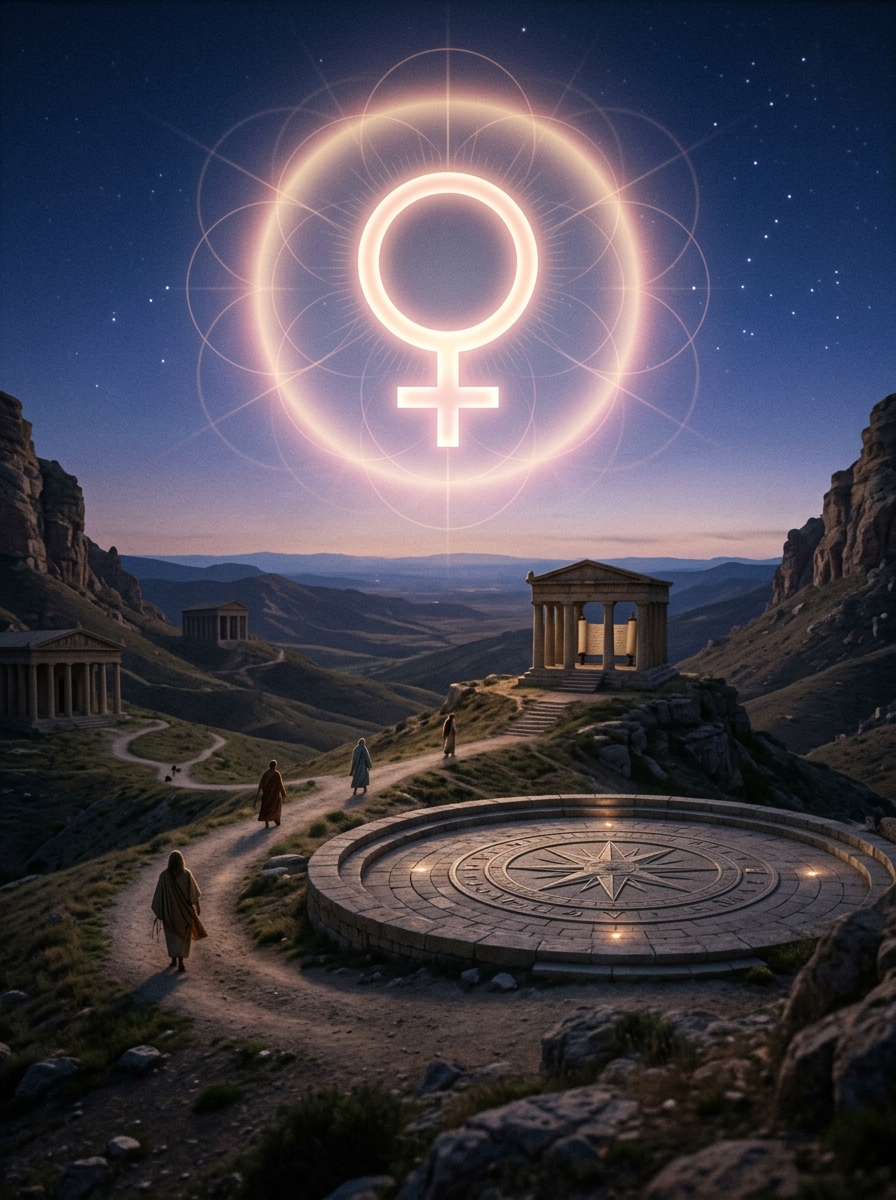
Venus in the Ninth House: The Archetype of Expanded Love
When Venus, the astrological archetype of harmony, aesthetic value, and relational attraction, finds its home in the Ninth House, the experience of love is elevated from a personal desire to a grand, cosmic quest. In the lower houses of the natal chart, Venus operates primarily within the sphere of personal security, social belonging, or domestic safety. However, when placed in the Ninth House—the traditional domain of Sagittarius and its ruler, Jupiter—the Venusian impulse becomes intrinsically linked with the search for higher meaning, truth, and philosophical expansion. For these individuals, relationships are not merely arrangements of convenience or emotional safety nets. Instead, a partnership must represent a journey toward an ever-expanding horizon, a shared pilgrimage of consciousness where both souls seek to understand the deeper laws of the cosmos.
Depth psychologists, including C. G. Jung and Liz Greene, have long emphasized that planets residing in the cadent houses (the Third, Sixth, Ninth, and Twelfth) carry a unique psychological mandate. They serve as conduits between the personal ego and the vast, transpersonal realms of the collective unconscious. When Venus occupies the Ninth House, the individual’s relational patterns are intimately tied to their individuation process. Love is experienced as a numinous force, a teleological event that must possess a clear sense of purpose, trajectory, and destiny. A relationship that does not offer a broader perspective on life, a constant exchange of ideas, or a shared spiritual path will eventually feel claustrophobic. They do not seek to settle down in a stagnant, protective cocoon; they seek a partner with whom they can sail into the uncharted waters of existence, discovering new intellectual and spiritual territories side by side.
Furthermore, this placement instills a deep, aesthetic appreciation for the grand, the ancient, and the culturally rich. The Venusian appreciation for beauty is projected onto expansive landscapes, complex philosophical systems, and historical epochs. For these seekers, beauty is not merely skin-deep; it is a quality of truth itself. They are magnetically attracted to the art, literature, and religious traditions of cultures foreign to their own, finding in these expressions a mirror that expands their appreciation of the human experience. In this way, Venus in the Ninth House merges the aesthetic grace of the minor benefic with the expansive, generous vision of the major benefic, Jupiter, creating an individual who loves the horizon itself and demands that their relational partners join them in their endless pursuit of wisdom.
To fully comprehend this archetype, we must also consider the role of the ruling planet, Jupiter. The house and sign placement of Jupiter in the natal chart will flavor how this Ninth House Venus seeks its expansion. For example, if Jupiter is in a water sign, the quest for meaning in relationships will be deeply emotional and intuitive, whereas a Gemini Jupiter might seek it through an endless accumulation of diverse intellectual data. Regardless of the specific sign, the presence of Venus here indicates that the path to the divine is paved with love, beauty, and relational connection. The individual does not find God in isolated contemplation, but in the meeting of minds, the crossing of borders, and the shared appreciation of the majestic complexity of life.
From a historical perspective, classical astrology associated the Ninth House with the "Joy" of the Sun, marking it as a place of light, illumination, and divine law. When Venus resides in this temple of solar joy, she brings a gentle, relational warmth to what could otherwise be a dogmatic or overly abstract sector of the chart. Classical esotericism suggests that Venus in this position harmonizes the intellect with the heart, allowing the individual to understand cosmic laws not as cold, rigid rules, but as expressions of universal love and aesthetic balance. This historical context enriches our modern psychological understanding, reminding us that for a Ninth House Venus, the pursuit of truth is not a clinical academic exercise, but a sacred, warm-hearted devotion.
Geographic Attraction and Cross-Cultural Romance
For those with Venus in the Ninth House, the familiar parameters of their immediate environment rarely ignite the spark of romantic interest. There is a powerful, almost instinctual attraction to partners who come from different geographic regions, cultural traditions, or religious backgrounds. The foreign partner serves as a psychological catalyst, representing a world far larger than the one the individual was born into. This attraction is not a superficial fascination with the exotic, but rather an evolutionary drive of the psyche seeking to integrate its own unmapped potentials through the mirror of relationship.
The Cultural 'Other' as a Psychological Portal
In the language of depth psychology, the foreign partner often becomes the repository for the projection of the Anima or Animus—the unconscious feminine or masculine aspects of the self. By entering into a relationship with someone from a different culture, the individual with Venus in the Ninth House enters into a sacred dialogue with difference itself. The cultural "Other" acts as a psychological portal, forcing the individual to dismantle their inherited cultural conditioning, question their biases, and expand their cognitive map of reality. The differences in language, customs, and perspective prevent the partnership from falling into a predictable, domestic routine. Instead, the relationship remains a living, breathing laboratory of mutual translation, where the spark of attraction is kept alive by the ongoing challenge of understanding and integrating the unfamiliar.
Moreover, this placement views intercultural relationships as a form of spiritual education. The act of learning a partner’s native tongue, adapting to their cultural customs, and traveling to their ancestral homeland are not seen as chores, but as aesthetic rituals of personal expansion. The individual finds immense beauty in the process of building bridges between worlds, realizing that by loving someone from a different background, they are expanding their own capacity to love the world at large. The relationship becomes a microcosm of global harmony, a tangible manifestation of the Ninth House’s ultimate goal: the synthesis of diverse perspectives into a unified, meaningful whole. This dynamic also plays a critical role in the integration of the shadow; by confronting cultural traits that contrast with their own, the individual is forced to acknowledge the relativity of their own values, leading to a profound psychological maturation that would be impossible within the boundaries of a culturally homogenous union.
Navigating Intercultural Marriage and Shared Worldviews
When these cross-cultural connections solidify into long-term commitments or marriages, the couple must navigate the transition from romanticized projection to daily reality. While the initial stages of the relationship are fueled by the exciting novelty of cultural differences, a sustainable union requires the creation of a shared philosophical and ethical bridge. The couple is challenged to negotiate how they will handle core aspects of life, such as financial management, holiday celebrations, communication styles, and the moral or spiritual education of their children. The integration of different cultural codes requires constant patience, active listening, and a willingness to compromise.
This process demands a high degree of emotional maturity and flexibility. The danger for a Ninth House Venus is the temptation to idealize one's own worldview at the expense of the partner’s, or conversely, to completely abandon one’s roots in a submissive surrender to the partner's culture. The mature integration of this placement involves the co-creation of a "third space"—a unique, hybridized family culture that respects and celebrates both heritages while remaining open to new, shared traditions. By doing so, the partners ensure that their cultural differences remain a source of mutual enrichment rather than conflict, embodying the true spirit of Jupiterian expansion. They learn to view their differences not as obstacles, but as a rich tapestry of perspectives that adds color and depth to their shared life.
The Erotics of Intellect: A Passion for Philosophy and Knowledge
Under the influence of Venus in the Ninth House, the boundary between the mind and the heart becomes beautiful and porous. For these individuals, intelligence is not merely a cognitive asset; it is a primary, undeniable aphrodisiac. They experience a profound emotional and aesthetic devotion to ideas, books, and metaphysical systems, treating the pursuit of knowledge with the passion and intensity that others reserve for human lovers. This is sapiosexuality in its truest astrological form, where the intellect is seen as a landscape of erotic discovery.
Intellectual Devotion: When Ideas Spark Passion
In partnerships, this configuration manifests as an absolute requirement for intellectual compatibility. The individual with Venus in the Ninth House cannot maintain interest in a partner whom they do not intellectually respect. A relationship that lacks deep, meaningful conversations will quickly wither, regardless of physical chemistry. The exchange of ideas, the debate of philosophical doctrines, and the shared exploration of spiritual texts are seen as essential forms of intimacy. For these individuals, a conversation about the nature of consciousness, the structure of the universe, or the symbolisms of ancient mythology is just as romantic as a candlelit dinner. They express their affection by buying books for their partner, sharing articles, and attending lectures together, using the world of ideas as the currency of their love.
This intellectual erotics also manifests as a deep love for books, universities, and places of higher learning. The individual may feel a sense of peace and aesthetic delight in library stacks, lecture halls, or spiritual sanctuaries. They approach their studies not with a dry, academic detachment, but with the warm, appreciative heart of Venus. They seek the beauty within the truth, finding a sense of the numinous in the harmony of a well-reasoned argument or the elegance of an esoteric system. They are drawn to authors who offer a grand synthesis of knowledge, such as Liz Greene, Steven Forrest, or Carl Jung, finding in their writings a sense of relational connection to the cosmos. Their love of philosophy is not an abstract exercise, but a deeply felt emotional necessity; they need to believe that the universe is orderly, beautiful, and filled with meaning.
In the daily container of a partnership, this intellectual passion acts as a protective shield against stagnation. When couples study together, discuss history, or learn a new discipline, they introduce a third element into their dynamic. This third element—the subject of study—prevents the relationship from collapsing under the weight of personal projections and codependency. It provides an objective focus that elevates their connection, turning their partnership into a shared school of life where both individuals are simultaneously student and teacher, bound together by their shared love for the unknown.
Dynamics of the Mentor: Bonds with Teachers and Gurus
The Ninth House is the traditional home of the teacher, the guide, the professor, and the spiritual guru. When Venus, the planet of love and attraction, is positioned in this sector of the birth chart, the individual’s relational energy is frequently projected onto figures of intellectual or spiritual authority. This creates complex interpersonal dynamics characterized by deep admiration, devotion, and occasionally, romantic infatuation.
The Guru Projection and Relational Boundaries
The psychological allure of the mentor lies in their role as a custodian of the wisdom the individual is seeking. The student with Venus in the Ninth House projects their own undeveloped higher mind onto the teacher, falling in love with the wisdom, clarity, and perspective that the mentor embodies. This projection can lead to intense emotional attachments, where the student seeks a close, personal relationship with the guide, sometimes blurring the professional boundaries that are essential for safe learning environments. The teacher becomes a larger-than-life figure, representing the anima/animus or the archetype of the Wise Old Man/Woman, making the attraction feel incredibly compelling and spiritually charged.
Esoteric astrologers have cautioned that this dynamic carries significant psychological risks. The student may surrender their personal authority and critical thinking, placing the guru on an unrealistic pedestal and developing a codependent relationship. The mentor, if lacking in self-awareness, may exploit this devotion to feed their own ego or desire for control. The path to integration requires the individual to recognize that the light they see in the teacher is actually a reflection of their own budding consciousness. The ultimate goal of the mentor-student relationship is not to remain dependent on the guide, but to internalize the lessons, reclaim the projected wisdom, and step into one's own authority. When this projection is successfully withdrawn, the student can appreciate the mentor's humanity while stepping fully into their own intellectual and spiritual sovereignty.
These mentor-student dynamics often begin early in life, shaping the individual's experiences in high school or university. A student may develop a profound attachment to a particular professor, finding that their academic performance and intellectual confidence are directly tied to the mentor's approval. While this can serve as an excellent catalyst for academic achievement, it can also set a pattern for future romantic choices. The individual may find themselves repeatedly drawn to partners who play the role of the teacher or guide, seeking in romance the same validating authority they sought in the classroom. Recognizing this pattern is a crucial step in maturing the Venusian energy, allowing for relationships that are based on equal partnership rather than hierarchy.
Travel as an Emotional and Relational Catalyst
For the individual with Venus in the Ninth House, travel is never merely a form of leisure or escape; it is a sacred pilgrimage of the heart. The act of leaving the familiar behind, crossing physical boundaries, and immersing oneself in a new geographic coordinate acts as a powerful catalyst for emotional opening and relational growth. Many individuals with this placement find that their capacity for love and appreciation is fully unlocked only when they are in motion.
Love on the Move: The Wanderer's Heart
The psychology of travel involves a temporary suspension of the social persona. When we step out of our daily routines, we leave our habits, obligations, and histories behind, entering a state of liminality where we are highly receptive to the unexpected. For Venus in the Ninth House, this state of openness makes them natural candidates for sudden, transformative romances while traveling. These "road romances" are often intense and life-altering, serving as catalysts that shift the individual's worldview and open their heart to new emotional possibilities. The romance is colored by the transient nature of the journey, giving it a poetic, bittersweet quality that aligns perfectly with the Venusian love of the distant.
For those in long-term relationships, traveling together is not a luxury, but a necessity for the survival of the bond. Shared journeys to ancient ruins, breathtaking landscapes, or culturally rich cities provide the shared encounters with wonder and awe that feed the Venusian need for meaning. When a relationship begins to feel stagnant, a change of coordinates can act as a powerful medicine, allowing the partners to see each other outside of their domestic roles, rekindling the spark of appreciation through the shared experience of the unknown. The journey becomes a shared narrative of discovery, reinforcing the idea that they are partners on an adventure rather than participants in a mundane domestic routine.
Furthermore, the transition between traveling and returning home carries its own psychological lessons for this placement. While solo travel can ignite sudden, intense romances that act as brief portals of growth, returning to the local environment forces the individual to integrate these peak experiences into their normal life. They must learn that the magic they felt on the road was not solely a function of the foreign landscape, but an expression of their own opened heart. Learning to carry the spirit of the wanderer into the routine of the home is a major component of integrating this placement, ensuring that the return to everyday life does not trigger a depressive withdrawal or a rejection of their immediate surroundings.
Professional Paths at the Intersection of Beauty and Horizon
In the professional realm, Venus in the Ninth House indicates that the career must be more than a means of survival; it must be a source of meaning, beauty, and personal expansion. These individuals are drawn to careers that allow them to act as cultural mediators, educators, and guides, bringing a touch of Venusian grace to the Jupiterian worlds of higher education, international travel, and philosophy.
Key professional paths include:
- Higher Education and Academia: Teaching subjects that inspire passion, such as comparative literature, philosophy, art history, or cultural anthropology. They excel at presenting complex ideas with an aesthetic beauty that inspires their students, serving as the very guides they once sought. They bring a warmth and relational accessibility to the academic environment, making learning a deeply engaging and collaborative process.
- Transformational Travel Curation: Designing and leading journeys that offer participants more than sightseeing. They curate pilgrimages, cultural immersions, or spiritual retreats that facilitate genuine personal growth and cross-cultural understanding. They possess a natural talent for finding the aesthetic and spiritual essence of a place, creating itineraries that feel like works of art.
- Cultural Diplomacy and Mediation: Working as cultural attachés, international mediators, or translators, bridging the gap between different worlds and helping to foster mutual understanding, collaboration, and aesthetic appreciation across borders. They use their Venusian diplomacy to navigate complex cross-cultural negotiations, creating harmony where there is difference.
- International Arts and Publishing: Managing art galleries that showcase international artists, organizing cross-cultural literary festivals, or publishing translations of philosophical, spiritual, and esoteric texts, making these treasures accessible to a wider audience. They are drawn to literature and art that cross-cultural boundaries, helping to build a global community of ideas.
In all these professions, the individual operates as an ambassador of beauty, demonstrating that the search for truth and the appreciation of art are ultimately part of the same spiritual journey. They find professional fulfillment when they can help others look beyond their immediate horizons, opening minds and hearts to the beauty of the wider world.
The Psychological Shadow: Idealization, Dogmatism, and Escape
Every astrological placement has its shadow, and for Venus in the Ninth House, this shadow is born from the love of the distant, the ideal, and the grand. Because these individuals are so enamored of the horizon, they can easily develop a subtle disdain for the local, the immediate, and the ordinary, using their lofty ideals as a defense mechanism to avoid the vulnerability of real, daily intimacy.
Escaping Daily Intimacy through Distance and Arrogance
One of the primary relational shadows of this placement is the "geographic cure"—the unconscious belief that a change of location or a new, distant partner will resolve all emotional conflicts. The individual may become a chronic wanderer, running away from the hard, grounding work of building long-term intimacy by constantly moving or choosing partners who live thousands of miles away. Long-distance relationships are highly attractive to this shadow, as the physical distance allows the individual to maintain a perfect, untarnished idealization of the partner, free from the inconvenient reality of their daily human flaws. The moment the partner becomes close and demands daily compromise, the ideal collapses, and the Ninth House Venus begins looking toward the next horizon.
Another shadow manifestation is intellectual dogmatism and arrogance. Because these individuals tie their relational values to their beliefs, they can become dogmatic and proud, believing that true harmony is impossible unless their partner shares their exact philosophical, political, or spiritual views. They may attempt to "convert" their partner to their own belief system, adopting a patronizing, teacher-student dynamic that destroys the egalitarian respect necessary for healthy romance. This dogmatic pride replaces mutual appreciation with an intellectual hierarchy, isolating the individual within their own mental fortress. They must learn to tolerate difference in their immediate relationships, realizing that their partner's unique path is just as valid as their own.
Integration and the Axis of Everyday Connection
The path of maturity and integration for Venus in the Ninth House lies in balancing this placement with its polar opposite: the Third House. While the Ninth House looks to the far horizon, the stars, and the grand philosophical synthesis, the Third House governs the immediate neighborhood, the daily routine, the sibling relationship, and the local community. To integrate this axis, the individual must learn to find the numinous not only in the distant cathedral or the complex esoteric book, but also in the quiet, daily details of life.
Integration means bringing the vast, starry sky of Ninth House ideals down into the fertile soil of Third House reality. It involves recognizing that a cross-cultural marriage or a philosophically rich relationship cannot survive on grand visions alone; it requires the daily, humble labor of active listening, clearing up small misunderstandings, managing finances, and doing domestic chores. It means understanding that the partner who is standing right in front of us, with all their human limitations and ordinary routines, can teach us as much about the nature of love as the most elevated spiritual guru. By grounding their lofty ideals in the immediate present, individuals with Venus in the Ninth House can experience a love that is both spiritually expansive and deeply, humanly real.
To put this integration into practice, individuals can establish a daily ritual of "micro-appreciation." This involves focusing Venusian attention on the local, immediate environment. They might take a daily walk through their local neighborhood, intentionally noticing the beauty in the ordinary architecture, the community gardens, or the interactions of their neighbors. In their relationships, they can commit to a practice of daily, honest dialogue about mundane matters, ensuring that they do not use philosophical discussions as a way to avoid talking about their immediate emotional needs. By honoring the Third House, they build a solid foundation upon which the grand arches of their Ninth House dreams can safely stand.
The signs ruling the 3rd and 9th Houses in the natal chart will dictate the style of this integration. For example, a Taurus/Scorpio axis on these house cusps will require grounding deep, transformative spiritual experiences (9th House Scorpio) into practical, tangible daily routines and sensory pleasures (3rd House Taurus). An Aries/Libra axis will require balancing an independent, direct quest for truth (9th House Aries) with diplomatic, harmonious communication in the immediate environment (3rd House Libra). Understanding the elements involved in this axis allows the individual to select the specific practical tools—whether somatic, intellectual, or emotional—that will best facilitate the grounding of their relational ideals into everyday reality.
Frequently Asked Questions
1. Does Venus in the 9th House always mean I will marry a foreigner?
While it does not guarantee a marriage to someone from another country, it indicates a strong psychological attraction to partners who represent a different cultural, religious, or geographic background. You may marry someone from your own country who grew up in a different subculture, or someone who shares your passion for travel and philosophical exploration, thus fulfilling the archetype's need for expansion. The key factor is that the partner must represent an expansion of your worldview, acting as a portal to a larger reality. This configuration values the psychological growth that difference brings over cultural homogeneity.
2. How can I manage the long-distance relationship patterns common with this placement?
To manage these patterns, you must cultivate psychological awareness of the tendency to idealize partners from a distance. If you are in a long-distance relationship, make a conscious effort to discuss the mundane, practical aspects of life, and avoid treating your time together as a continuous vacation. Plan for realistic steps toward physical cohabitation, and be prepared to accept your partner’s everyday flaws once the distance is bridged. Grounding your connection in daily, honest communication is essential to prevent the shock of cohabitation when the distance is finally closed.
3. What is the difference between Venus in the 9th House and Venus in Sagittarius?
While they share a similar thematic resonance—both combining Venusian energy with the Jupiterian search for meaning—they operate differently. Venus in Sagittarius is a zodiacal placement, describing the style and color of your relational energy (which is enthusiastic, freedom-loving, and direct). Venus in the 9th House is a house placement, describing the specific area of life where your relational energy is focused and where you seek value, beauty, and connection (higher education, travel, philosophy, and foreign cultures). You can have Venus in the Ninth House in any zodiac sign, which will modify how that house's themes are approached.
4. How does the mentor-student attraction manifest, and how can I handle it?
This dynamic manifests as a powerful emotional or romantic attraction to teachers, professors, spiritual guides, or anyone who holds authority in a field of knowledge you admire. To handle this, recognize that you are projecting your own inner intellect and spiritual potential onto the mentor. Focus on integrating the wisdom they teach into your own life, and maintain clear, professional boundaries to protect both yourself and the mentor from the complications of projection. Reclaiming your projection allows you to become your own authority, transforming the attraction into a source of personal empowerment.
5. Why do I feel bored in relationships that lack deep intellectual conversation?
With Venus in the 9th House, intellectual compatibility is a core requirement for attraction. For you, the exchange of ideas is a form of intimacy. Without a shared passion for learning, philosophy, or spiritual exploration, a relationship will lack the fuel required to sustain your interest. You need to accept this as a valid relational requirement while also making sure you do not judge partners who express their intelligence in practical or non-academic ways. Finding a balance between intellectual discourse and simple emotional presence is key.
6. What role does depth psychology play in understanding this placement?
Depth psychology is crucial for understanding how Venus in the 9th House projects the inner search for wholeness (individuation) onto external partners and travel experiences. By understanding projections like the Anima/Animus onto the foreign or intellectual "Other," you can reclaim these projected qualities. This transforms your relationships from arenas of fantasy into vehicles for genuine, conscious growth and spiritual integration. It allows you to transition from seeking a savior or guru to sharing a journey of mutual self-discovery.
7. Can Venus in the 9th House suggest meeting a partner while at university or on a trip?
Yes, higher education and long-distance travel are primary domains of the Ninth House. It is highly common for individuals with this placement to meet significant partners during university studies, at academic lectures, in bookstores, or while traveling abroad. The shared context of exploration—whether mental or physical—creates the ideal environment for the Venusian spark to ignite, as it immediately satisfies the placement's need for a partner who represents an open door to a larger world.
Comments
Loading comments…