Venus in the Eleventh House: The Heart’s Place Among Allies
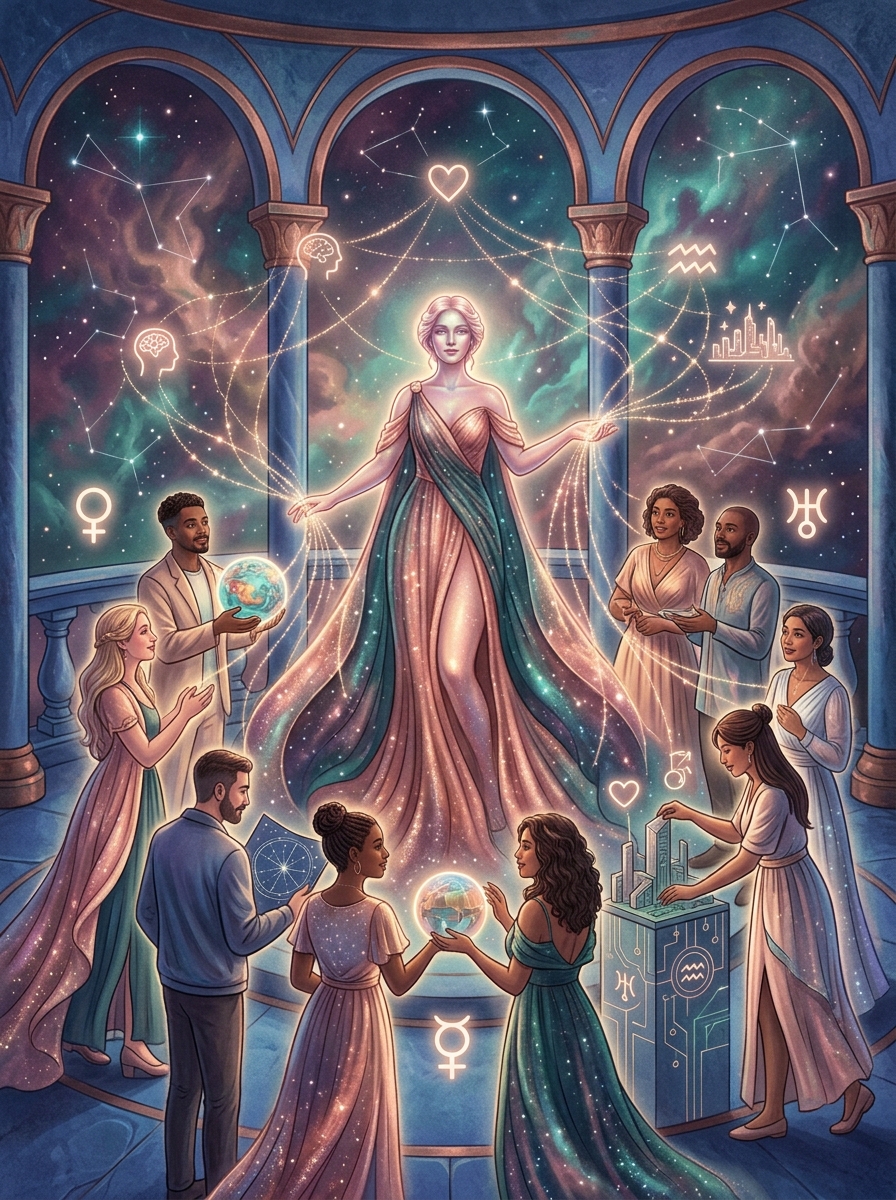
Venus in the eleventh house does not seek love in a vacuum. It seeks resonance in a field of allies, comrades, and collaborators. The core dynamic is that affection, taste, and self-worth become real through social belonging — through the experience of being seen, appreciated, and chosen by a tribe. This placement treats friendship not as a side dish to romance but as the primary medium through which the heart recognizes itself. The 11th house governs circles, causes, shared futures, and the living architecture of “we.” Venus here wants love to circulate rather than attach; it wants to belong to something larger than the dyad.
The instinct is deeply humane. People with this placement often feel most alive when they are among those who “get” their style, humor, ethics, or ideals. Social ease confirms inner value. Yet this is more exacting than it appears. Venus in the 11th is exquisitely sensitive to the atmosphere of a group — a well-matched circle feels like nectar, a mismatched one like subtle humiliation. The native develops a keen instinct for the quality of communities: who includes, who excludes, who performs belonging, and who truly offers it. Popularity alone never satisfies. They want a circle with taste, emotional intelligence, and shared purpose.
For a contrasting expression of social life, compare Venus in the tenth house, where affection seeks public esteem and professional polish, not communal affinity. The 10th asks, “How do I appear?” The 11th asks, “Who is with me?”
The Psychological Roots: How Belonging Becomes Self-Worth
This placement often forms in childhood through experiences where peer acceptance or group admiration felt like the condition for lovability. The person may have learned early that being agreeable, helpful, or aesthetically pleasing within a collective earned them safety and affection. Over time, the need for social confirmation gets wired into the sense of self. Without it, they can feel invisible, unworthy, or even unlovable.
The result is a subtle dependency on consensus. If the group withdraws approval, the person may feel less attractive, less real. This is where Venus in the eleventh house meets the wound of belonging — a dynamic explored in detail with Chiron in the eleventh house. The Venusian response is often to become more accommodating, more charming, more indispensable. But belonging purchased through self-erasure is not belonging at all. The psychological work is to uncouple lovability from social proof and to recognize that the heart’s value does not require an audience.
Yet the placement also carries a gift: the capacity to hold a social field with grace. Early experiences of needing to read a room develop into a sophisticated social intelligence. They know how to make others feel included, how to translate between cliques, how to soften polarization. This is a real talent, but it must be grounded in self-possession, not in vanishing into the group’s expectations.
The Shadow: Social Grace as a Defense
When Venus in the eleventh house operates unconsciously, social grace becomes a defense against rejection. The person becomes a specialist in pleasantness — too good at adapting to the room. They may confuse social fluency with truth, conflate being liked with being known, and keep relationships in the realm of mutual admiration without allowing emotional gravity to deepen.
The shadow here is a quiet fear of exclusion. Because the heart feels at stake in the group, they may avoid conflict, smooth over edges, and perform harmony even when something is out of tune. They can become the friend who never says no, the connector who exhausts themselves curating others’ comfort. In romantic settings, this can manifest as keeping love at the level of camaraderie — adored by many, intimately known by few. The beloved must be a co-conspirator, but vulnerability may feel too risky if it threatens the equilibrium of the circle.
The remedy is not less community; it is more discernment inside it. A healthy Venus in the eleventh house learns that not every network deserves intimacy, and not every friend is automatically aligned. The heart needs its own standards. That discernment is part of the placement’s elegance: not coldness, but selective devotion. For a parallel lesson, see Venus in the second house, where self-worth is built from inner stability rather than outsourced to social reflection.
Mature Expression: The Social Artist and the Future Self
The mature form of this placement is the social artist — someone who knows how to make a tribe feel more civilized, more generous, more alive to one another. They are the person who remembers birthdays, curates gatherings, hosts the table, keeps disparate people in contact. Their presence improves the room. They humanize collectives, soften polarization, and remind a group that style and ethics are not enemies.
But the gift is not just social lubrication. The 11th house is about the future self — the person one is becoming through shared ideals. Venus here does not want mere comfort; it wants an ethical and aesthetic apprenticeship. The right people expand the soul’s vocabulary. The wrong people reduce it to manners. The placement matures by choosing community with discernment and leaving enough solitude to hear one’s own tastes.
This is also the signature of Venus in Aquarius, which often colors this house through sign placement: a taste for the unconventional group, the elegant outsider, the friend who is both stimulating and uncontainable. The Aquarian influence intensifies the theme of love through friendship and the refusal to be owned by another. The heart says yes when attraction feels socially intelligent and ethically aligned.
For a broader vision of expansive group life, examine Jupiter in the eleventh house, which amplifies the beneficent, fortune-bringing side of networks and alliances.
How It Lives: Friendship, Romance, Work
In everyday life, Venus in the eleventh house expresses through a distinct social signature. In friendship, the native is often the connector, the translator between cliques, the one whose presence makes a gathering feel cohesive. Their friendships form around shared tastes — music, art, language, politics, fashion — and they often become the curator of the group’s aesthetic or emotional tone.
In romance, this placement rarely falls for someone solely through private chemistry. Attraction begins with admiration for the other’s mind, ethics, or social ease. The beloved must also be a companion; the lover must be a co-conspirator. Love often emerges from friendship or from shared involvement in a cause, a club, an online community. There is a strong desire for ease without possession, for autonomy inside intimacy. This echoes the spirit of Venus in Gemini, where intellectual exchange is the currency of affection, and Venus in Sagittarius, where shared horizons create the bond.
In work, the placement excels in roles that require social intelligence: networker, host, community manager, artist whose medium is collaboration, or any field where taste and human connection intersect. They may be the person who translates between departments, who designs gatherings that feel alive, who knows how to keep a team humane. Their value is recognized in groups before it is claimed privately.
For contrast with the dyadic focus of relationship, see Venus in the seventh house, which seeks one-to-one mirroring and contractual partnership. The 11th prefers a web of peers and shared futures. One is the mirror; the other is the constellation.
The fullest expression of Venus in the eleventh house is love that circulates without being lost, belonging that affirms without consuming. It wants a circle with a pulse, a future, and a standard of beauty high enough to include the heart.
Comments
Loading comments…