Uranus in the Ninth House: The Prometheus of Higher Belief
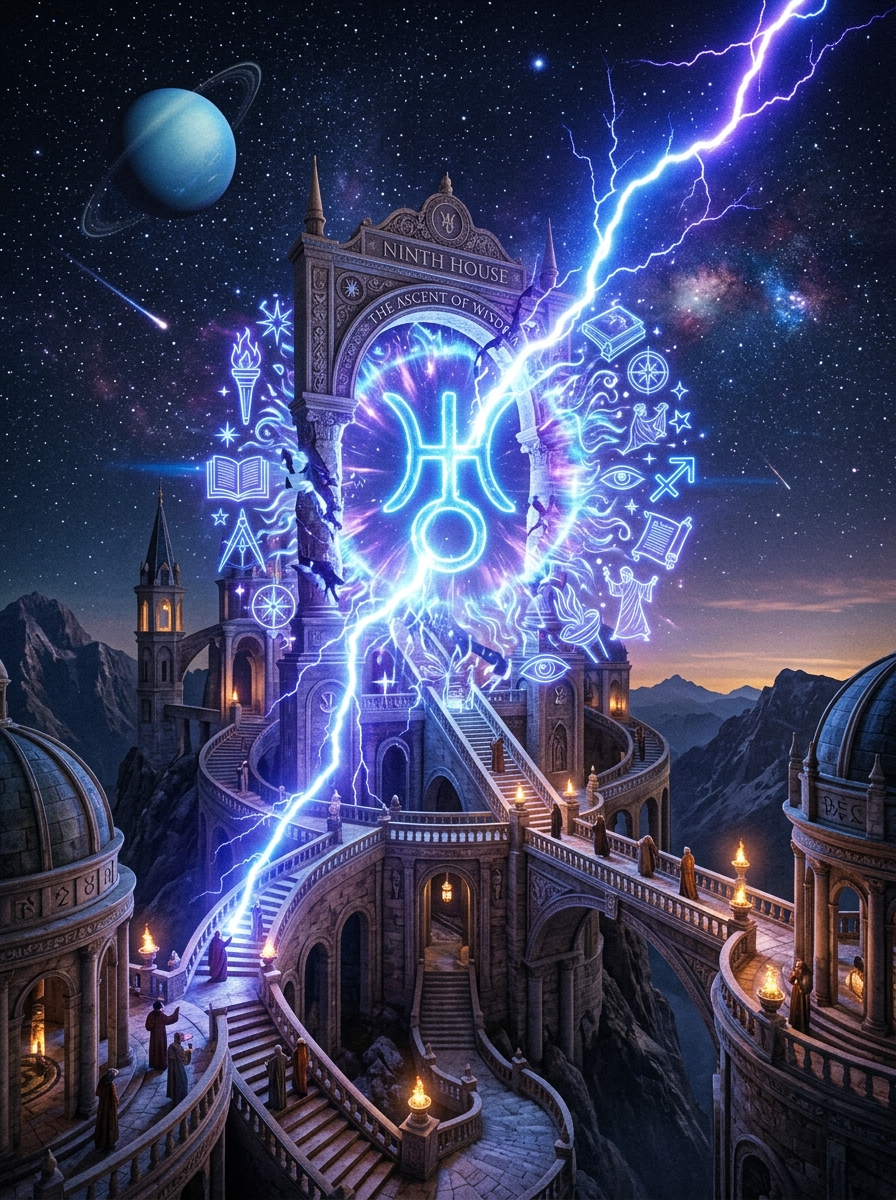
The Prometheus of the Ninth House: Awakening the Higher Mind
In the sacred architecture of the natal chart, the Ninth House serves as the temple of the higher mind, the expansive horizon where the soul seeks to align its individual perspective with the grand operating principles of the cosmos. Traditionally associated with the mutable fire of Sagittarius and ruled by the benevolent, expansive influence of Jupiter, this house represents our philosophical frameworks, our search for meaning, our spiritual practices, higher education, and the long-distance journeys that broaden our existential landscape. It is the realm where we build our personal cosmologies, constructing a framework of belief that allows us to navigate the chaos of the material world. When Uranus—the planet of disruption, sudden revelation, individualization, and revolutionary genius—is placed in this house, the traditional Jupiterian path of gradual, optimistic growth is replaced by sudden, electric, and destabilizing transformations. Uranus functions as a cosmic lightning rod in the house of belief, shattering outdated paradigms and demanding that the individual forge a completely unique path to truth.
To understand Uranus in the Ninth House, one must examine the archetype of Prometheus, the mythological Titan who stole fire from the gods to gift it to humanity, initiating a rapid acceleration of consciousness and technology. This Promethean impulse within the Ninth House manifests as an insatiable urge to decondition the mind from the collective beliefs, cultural dogmas, and religious structures that are inherited from family and society. While a traditional Ninth House placement might seek wisdom through the steady lineage of established institutions, the Uranian native demands direct, unmediated intellectual and spiritual revelation. They do not want to be told what is true; they want to experience the lightning strike of direct gnosis. Astrologer Steven Forrest describes the evolutionary intent of Uranus as the deconditioning of the mind—a radical process of stripping away the conditioned layers of socialization to reveal the authentic, individualized self. In the Ninth House, this deconditioning targets the very core of how the individual conceptualizes reality. The beliefs they hold are not merely intellectual opinions; they are the lenses through which they interpret their entire existence. When Uranus shatters these lenses, it is often experienced as a sudden, psychological earthquake, followed by a profound sense of intellectual liberation.
Jupiterian Expansion vs. Uranian Disruption
The contrast between the traditional ruler of the Ninth House, Jupiter, and its Uranian occupant is stark and forms the central psychological tension of this placement. Jupiter is the archetype of the priest, the philosopher-king, and the optimistic guide. It seeks expansion through integration, finding patterns of harmony and meaning within existing cultural, educational, and religious lineages. Jupiter believes in the ultimate benevolence of the cosmos and seeks to build bridges of understanding through shared values, higher learning, and cultural exchange. It is a slow, warm, and structured fire that warms the temple of belief. Uranus, by contrast, is the archetype of the rebel, the iconoclast, and the technological revolutionary. It does not seek to expand existing systems; it seeks to disrupt them. Uranus operates through sudden, erratic pulses of energy, breaking apart structures that have become rigid or obsolete. Where Jupiter offers a steady path of intellectual advancement, Uranus brings a sudden download of cosmic intelligence, often accompanied by the total collapse of the old mental framework.
This interaction produces an intellectual landscape that is both thrilling and volatile. The individual with Uranus in the Ninth House may feel like an exile in traditional spiritual or academic environments. They are acutely sensitive to the hypocrisy and limitations of dogmatic institutions, and their immediate response is often one of radical rejection. Psychological astrologer Liz Greene notes that Uranus represents the urge for collective progress, but because it is an impersonal, mental planet, it can sometimes display a cold disregard for the human need for stability and gradual transition. In the Ninth House, this manifests as a tendency to reject traditional beliefs not because they are inherently flawed, but because they are traditional. The native must navigate the tension between the Jupiterian need for a stable, coherent worldview and the Uranian demand for constant intellectual revolution. When properly integrated, this placement allows the individual to act as a bridge-builder of a different kind—not by preserving the past, but by bringing the fire of future possibilities into the present, synthesizing ancient wisdom with cutting-edge, revolutionary insights.
Revolutionary Worldviews and Heterodox Philosophy
For the individual with Uranus in the Ninth House, philosophy is not an abstract academic exercise; it is an active, revolutionary force. They possess a deeply individualized, forward-looking worldview that refuses to be confined by standard intellectual categories. They are the ultimate heterodox thinkers, constantly seeking out the margins of philosophy, science, and mysticism to construct a personal system of belief that is uniquely their own. This placement suggests a mind that is highly sensitive to the paradigms of the future, often anticipating intellectual shifts decades before they enter the mainstream. They are drawn to theories that challenge the consensus reality, finding comfort in the radical, the experimental, and the unconventional.
This intellectual independence often manifests as a rejection of established academic structures. The native may find the compartmentalization of modern universities deeply frustrating, as their mind naturally seeks to synthesize seemingly disparate fields of study. They do not see the division between the hard sciences and the esoteric arts; to them, they are different dialects of the same universal language. This cross-disciplinary synthesis is where their genius lies. They are the individuals who look at quantum mechanics and see the reflection of ancient Taoist philosophy, or who analyze the algorithmic patterns of artificial intelligence through the lens of evolutionary astrology. They are not interested in the preservation of academic boundaries; they want to break them down to reveal the underlying, interconnected truth of the cosmos. By bypassing traditional pathways of knowledge acquisition, they develop a custom cognitive architecture that allows them to solve complex problems by looking at them from angles that traditional specialists would never consider.
Synthesizing the Sacred and the Scientific
The drive to synthesize the sacred and the scientific is one of the most potent expressions of a Ninth-House Uranus. Historically, science and spirituality have been positioned as opposing forces, particularly in Western discourse. However, the Uranian native seeks to resolve this dichotomy by applying scientific rigor to metaphysical concepts and infusing scientific paradigms with spiritual wonder. They are drawn to the works of thinkers who bridged this gap, such as Carl Jung, whose theories of synchronicity and the collective unconscious provided a psychological and scientific framework for understanding esoteric phenomena. The native's approach to the divine is often highly technical or mathematical, viewing the cosmos as a complex, self-organizing system of energy and information rather than a court ruled by an anthropomorphic deity.
This synthesis creates a highly dynamic and flexible personal philosophy. While others may cling to a single, monolithic belief system for their entire lives, the individual with Uranus in the Ninth House views their worldview as a working hypothesis, constantly subject to revision in light of new data. They are not threatened by intellectual contradictions; instead, they view them as invitations to ascend to a higher level of synthesis. This can lead to a fascinating, highly eclectic library of influences. A single conversation with a Ninth-House Uranian might touch upon the Hermetic principles of Hermes Trismegistus, the technological singularitarianism of Ray Kurzweil, the psychological archetypes of Jung, the mathematical beauty of sacred geometry, and the evolutionary astrology of Dane Rudhyar. Their intellectual life is a tapestry of radical ideas, woven together by the thread of their own unique perception, forming a highly advanced intellectual toolkit that is constantly updated as new paradigm-shifting discoveries are made.
Sudden, Transformative Long-Distance Travel
The Ninth House has long been recognized as the house of physical travel, specifically journeys that cross borders, oceans, and cultural divides. While a typical Ninth-House journey might involve a well-planned itinerary, a study-abroad program, or a leisurely vacation designed for relaxation, the presence of Uranus transforms travel into a highly volatile, unpredictable, and initiatory experience. For these individuals, travel is rarely comfortable, but it is almost always revolutionary. It is characterized by sudden departures, unexpected detours, and encounters that permanently alter their understanding of themselves and the world.
Uranian travel is often triggered by a sudden, inexplicable urge to flee the familiar. The native may wake up one morning and decide to purchase a plane ticket to a country they have never studied, driven by an intuitive pull that they cannot intellectually justify. Once abroad, they frequently find that their plans are quickly disrupted. Flights are missed, luggage is lost, and reservations are canceled. Yet, it is precisely within these moments of chaos that the magic of Uranus operates. The cancellation of a train leads to a chance encounter with a spiritual teacher; getting lost in a foreign city brings them to a community of like-minded radicals; a sudden illness forces them to slow down and undergo a profound internal inventory. These are not mere travel mishaps; they are Uranian initiations, designed to break the ego’s control and open the mind to a larger reality. The native learns to treat physical travel as a laboratory for the soul, where the volatility of outer circumstances mirrors the rapid evolution of their inner world.
Journeys of Lightning and Initiation
These spontaneous, unplanned journeys function as deep psychological initiations. The act of entering an entirely unfamiliar cultural landscape strips away the native's accustomed social identity, exposing the raw, unconditioned self underneath. For the individual with Uranus in the Ninth House, the foreign environment serves as a mirror for their own internal state of alienation. Surrounded by a language they do not speak and customs they do not share, they are forced to confront their own status as an outsider. This confrontation is not depressing; rather, it is deeply liberating. They realize that the rules and expectations of their home culture are not absolute truths, but merely local customs—one set of programs among many in the human matrix.
The transformation that occurs during these journeys is often sudden and permanent. The native does not return home with souvenirs and photos; they return with a completely new identity. They may have shed a career, a relationship, or a long-held belief system while abroad, having experienced an intellectual or spiritual awakening that makes returning to their old life impossible. The physical displacement of travel triggers a corresponding shift in their psychological alignment. They become citizens of the world, feeling a stronger connection to the global human collective than to the specific nation-state of their birth. This can make them perpetual wanderers, always looking to the horizon for the next lightning strike of geographical and spiritual awakening, viewing each new border crossed as another layer of social conditioning successfully cast aside.
Disruptive Higher Education and Alternative Teaching
In the realm of education, Uranus in the Ninth House behaves like a structural demolitions expert. The traditional university system—with its rigid academic hierarchies, standardized curricula, and emphasis on institutional conformity—is often an uncomfortable fit for the Uranian native. They may enter college with high hopes, seeking intellectual stimulation and deep truth, only to find themselves disillusioned by the bureaucratic machinery of modern academia. The pressure to specialize in a single, narrow subfield feels like an intellectual prison to a mind that naturally seeks to scan the entire horizon of human knowledge.
As a result, their educational path is rarely linear. They may change their major multiple times, take frequent leaves of absence, drop out to pursue independent projects, or reject formal higher education altogether. This does not mean they lack intelligence or a drive for learning; on the contrary, they are often autodidacts of the highest order. They possess an insatiable curiosity and a remarkable capacity for self-directed study. In the digital age, this placement finds its natural home in alternative educational models. They are the students who thrive on massive open online courses (MOOCs), decentralized learning communities, digital libraries, and collaborative research networks. They do not need a professor to hand them a syllabus; they prefer to build their own curriculum, sourcing information from the vast, interconnected network of global knowledge, establishing themselves as self-taught experts in highly specialized, emergent fields.
The Demise of the Ivory Tower
When the individual with Uranus in the Ninth House steps into the role of the educator, they carry this same revolutionary spirit with them. They are determined to dismantle the traditional "ivory tower" model of education, which positions the teacher as an absolute authority and the student as a passive recipient of information. Instead, they champion democratic, collaborative, and experiential teaching methods. They prefer flat hierarchies in the classroom, encouraging their students to challenge their assumptions, ask difficult questions, and participate as active co-creators of knowledge.
The Uranian educator is often drawn to cutting-edge technologies to facilitate learning. They are early adopters of digital publishing, online education platforms, podcasts, and interactive media, using these tools to democratize access to knowledge and bypass traditional institutional gatekeepers. They are also drawn to teaching subjects that are considered fringe, controversial, or highly innovative—subjects that traditional institutions are slow to adopt. Whether they are teaching astrology, cryptocurrency, transhumanism, or radical political theory, their goal is always the same: to awaken the minds of their students, encouraging them to think independently, challenge established paradigms, and break free from collective conditioning.
Non-Conventional Spirituality and Syncretic Faith
The search for the divine is a deeply personal journey for anyone, but for those with Uranus in the Ninth House, it is also a declaration of independence. They possess an inherent skepticism toward inherited religious institutions and dogma. They cannot accept a spiritual system simply because it is the faith of their ancestors, nor can they submit to religious authorities who demand blind faith and obedience. The native's relationship with organized religion is often characterized by early rebellion, followed by a lifelong quest to construct a personalized, syncretic spiritual path.
This rejection of traditional religion is not necessarily an embrace of atheism, though some with this placement do adopt a highly rationalist, secular humanist perspective. More often, they are drawn to contemporary esoteric traditions, Western hermeticism, astrology, magic, and Eastern mystical practices that emphasize direct personal experience of the divine. They are attracted to systems that offer practical techniques for expanding consciousness and aligning with cosmic laws, rather than those that focus on moralistic dogma and guilt. Aleister Crowley’s famous dictum, "Do what thou wilt shall be the whole of the Law," resonates deeply with the Uranian spiritual search—not as a license for hedonism, but as a mandate to discover and align with one's unique, cosmic purpose (the True Will).
Deconstructing the Altar of Dogma
The process of constructing a syncretic faith requires a willingness to deconstruct the sacred altars of the past. The individual with Uranus in the Ninth House is a spiritual scavenger, picking through the ruins of ancient traditions, modern philosophies, and scientific discoveries to find the pieces that resonate with their internal truth. They might practice yoga and meditation, study the Kabbalah, cast astrological charts, and maintain an interest in quantum physics, seeing no contradiction between these diverse systems. Their altar is a dynamic, evolving reflection of their personal journey, rather than a monument to a static creed.
This fluid, highly individualized approach to spirituality can be deeply empowering, but it also carries challenges. Because they reject external authority, they must become their own spiritual guide, a task that requires immense psychological maturity and self-discipline. Without the structure and community support of traditional religious institutions, they can sometimes feel spiritually isolated, wandering in an existential vacuum. However, their primary loyalty is always to the truth, and they would rather wander the wilderness of their own questions than sit comfortably in a temple built on dogmas they no longer believe. They understand that the divine is not a fixed destination, but an ongoing process of revelation, and they are willing to follow that revelation wherever it leads, trusting that the universe itself will provide the answers they seek in its own erratic time.
Vocational Resonance: The Career of the Horizon-Chaser
In the professional sphere, Uranus in the Ninth House demands a career that offers intellectual freedom, variety, and the opportunity to influence the collective worldview. These individuals cannot tolerate routine, bureaucratic offices, or jobs that require them to implement policies they do not respect. They need a vocation that allows them to scan the horizon, identify future trends, and communicate their insights to a broader audience. They are natural horizon-chasers, always looking for the next intellectual frontier.
They are often drawn to careers in cultural journalism, digital media, independent writing, and publishing. As journalists or writers, they act as cultural critics, using their platform to challenge societal assumptions, expose institutional corruption, and introduce revolutionary ideas to the public. They are also highly suited for careers in international human rights, environmental advocacy, and alternative law, where they can fight for systemic change on a global scale. Their work often involves an element of travel, technology, or cross-cultural communication, allowing them to maintain a sense of freedom and expansive possibilities in their professional lives.
Furthermore, they make excellent researchers and innovators in fields like astrology, psychology, and the future sciences. They are the inventors of new methodologies, the creators of alternative educational programs, and the founders of decentralized organizations. They thrive in environments where they can work independently, setting their own schedules and pursuing projects that align with their intellectual passions. While their career path may be unconventional and marked by sudden transitions, they are ultimately guided by a sense of mission—a desire to act as catalysts for the evolution of human consciousness, bringing new concepts down from the ether to help humanity navigate the emerging age.
The Uranian Shadow: Restlessness and Inverse Dogmatism
While Uranus in the Ninth House offers brilliant intellectual gifts and a profound capacity for spiritual liberation, it also carries a potent shadow. The primary danger of this placement is the development of what can be termed "inverse dogmatism." Because the native is so deeply identified with the role of the rebel and the iconoclast, they can fall into the trap of rejecting traditions, structures, and beliefs simply because they are traditional. Their non-conformity becomes a rigid dogma of its own, blinding them to the enduring, time-tested wisdom contained within classical philosophical and religious systems. They may become just as intolerant of tradition as traditionalists are of innovation, creating a polarization that limits their intellectual growth and isolates them from the deeper currents of history.
Another significant manifestation of the Uranian shadow is perpetual existential restlessness. The constant demand for change, novelty, and intellectual excitement can prevent the native from developing depth in any one area of study or spiritual practice. They become spiritual and intellectual dilettantes, skimming the surface of dozens of philosophies without ever committing to the discipline required to master one. Their search for truth becomes a form of addiction, where they are constantly seeking the next intellectual "high" or the next exotic destination to escape the mundane reality of daily life. This can lead to a state of profound alienation, where the native feels disconnected from the earth and the people around them.
This restlessness often extends to their geographical life. They may use travel as a psychological defense mechanism, running away to a new country whenever relationships, careers, or internal conflicts become too challenging. This geographic cure is rarely successful, as they carry their internal restlessness with them wherever they go. The challenge for the native is to recognize when their urge for freedom is a genuine call for expansion, and when it is simply a flight from the necessary work of grounding, commitment, and psychological integration. Without addressing this shadow, the Uranian native risks becoming a perpetual exile, wandering a world where nothing is ever permanent enough to provide true meaning.
Psychological Integration and Balance: Grounding the Lightning Rod
To successfully integrate the electric, disruptive energy of Uranus in the Ninth House, the individual must learn to ground their lightning rod. This grounding process is crucial to prevent the native's brilliant insights from scattering into useless static, and to protect them from the physical and mental exhaustion that can accompany constant nervous system stimulation. The primary key to this integration lies in honoring the opposing astrological axis: the Third House.
While the Ninth House seeks global perspectives, ultimate truth, and distant horizons, the Third House rules the local community, everyday connections, logical analysis, and immediate surroundings. The native must learn that the cosmic truths they discover in the stratosphere of the Ninth House must be translatable into the simple, practical language of the Third House. They must find ways to connect their revolutionary philosophies with the immediate needs of their local community, building relationships with the people next door, rather than only communicating with a digital audience of global strangers. This practice of local connection acts as a psychological anchor, keeping the native grounded in consensus reality and allowing them to test the practical utility of their philosophies in the real world.
Furthermore, they must develop the discipline of intellectual depth. Rather than scattering their energy across a dozen different esoteric systems, they should commit to mastering at least one discipline, recognizing that true liberation is found through deep integration rather than superficial variety. They must also learn to respect the lineage of the past. By studying the historical context of the traditions they reject, they can begin to appreciate the value of the foundations upon which they are building. When Uranus in the Ninth House is balanced by the practical, analytical skills of the Third House, the native is no longer a restless wanderer or a dogmatic rebel. Instead, they become a true Prometheus—a grounded channel for cosmic intelligence, bringing down the fire of future possibilities to illuminate the path for all of humanity, transforming their personal rebellion into a service for the collective evolution.
Frequently Asked Questions
How does Uranus in the Ninth House affect academic success?
Uranus in the Ninth House often indicates an unconventional academic path. The native may struggle in rigid, traditional educational settings that prioritize memorization and conformity over creative, independent thinking. They may experience periods of brilliant academic performance interspersed with sudden drops in interest, major changes, or even dropping out. However, this placement does not indicate a lack of intelligence; rather, it suggests that the individual is an autodidact who thrives in alternative, self-directed, or highly innovative educational models. They are likely to achieve significant intellectual success outside the traditional university framework.
What is the difference between Jupiter in the Ninth House and Uranus in the Ninth House?
Jupiter in the Ninth House is the traditional home of the planet of expansion, leading to a natural alignment with established educational, religious, and philosophical systems. The individual with Jupiter here seeks meaning through integration with these lineages, experiencing a steady, optimistic expansion of consciousness. Uranus in the Ninth House, by contrast, is highly disruptive. It rejects inherited lineages in favor of sudden, erratic downloads of truth and direct, individual revelation. While Jupiter builds bridges within existing structures, Uranus shatters those structures to build entirely new paradigms.
Does this placement guarantee frequent international travel?
While Uranus in the Ninth House strongly indicates a connection to long-distance travel, it does not guarantee a life of leisure travel. Instead, it suggests that when travel does occur, it is sudden, unplanned, and highly transformative. These journeys often act as psychological initiations that disrupt the native's sense of identity and worldview. Additionally, in the digital age, this energy can manifest virtually, where the native travels extensively through the global network of ideas, internet communications, and cross-cultural digital collaborations without physically leaving their home.
How can someone with Uranus in the Ninth House handle existential anxiety?
The constant deconstruction of belief systems associated with Uranus in the Ninth House can lead to bouts of existential anxiety and a feeling of groundlessness. To manage this, the native must consciously develop grounding practices. This includes honoring the Third House axis by focusing on daily routines, physical exercise, and connecting with the local community. They must also learn to sit with uncertainty, recognizing that the absence of a rigid, permanent belief system is not a failure, but an invitation to remain open to the fluid, evolving nature of cosmic truth.
What is "inverse dogmatism," and how do I avoid it?
Inverse dogmatism is the Uranian shadow where the native rejects traditions, classical ideas, and established structures purely for the sake of being different or rebellious. This creates a rigid mental state that is just as dogmatic as the traditional systems they oppose. To avoid this trap, the native must cultivate intellectual humility. They should strive to evaluate ideas based on their inherent merit and utility rather than their age or popularity, recognizing that ancient wisdom and modern innovation are not mutually exclusive, but are often complementary aspects of the same truth.
Related
- Uranus in the Third House: The Rebel Mind and Electric Intellect
- Uranus in the Eleventh House: The Astrological Guide to Collective Awakening and Social Innovation
- Uranus in the 10th House: The Maverick of the Midheaven
- Uranus in the 8th House: Deep Disruption and the Prometheus Archetype
- Uranus in the 12th House: The Cosmic Disruptor in the Subconscious Waters
Comments
Loading comments…