Uranus in Libra: The Revolution of Partnership and Relational Sovereignty
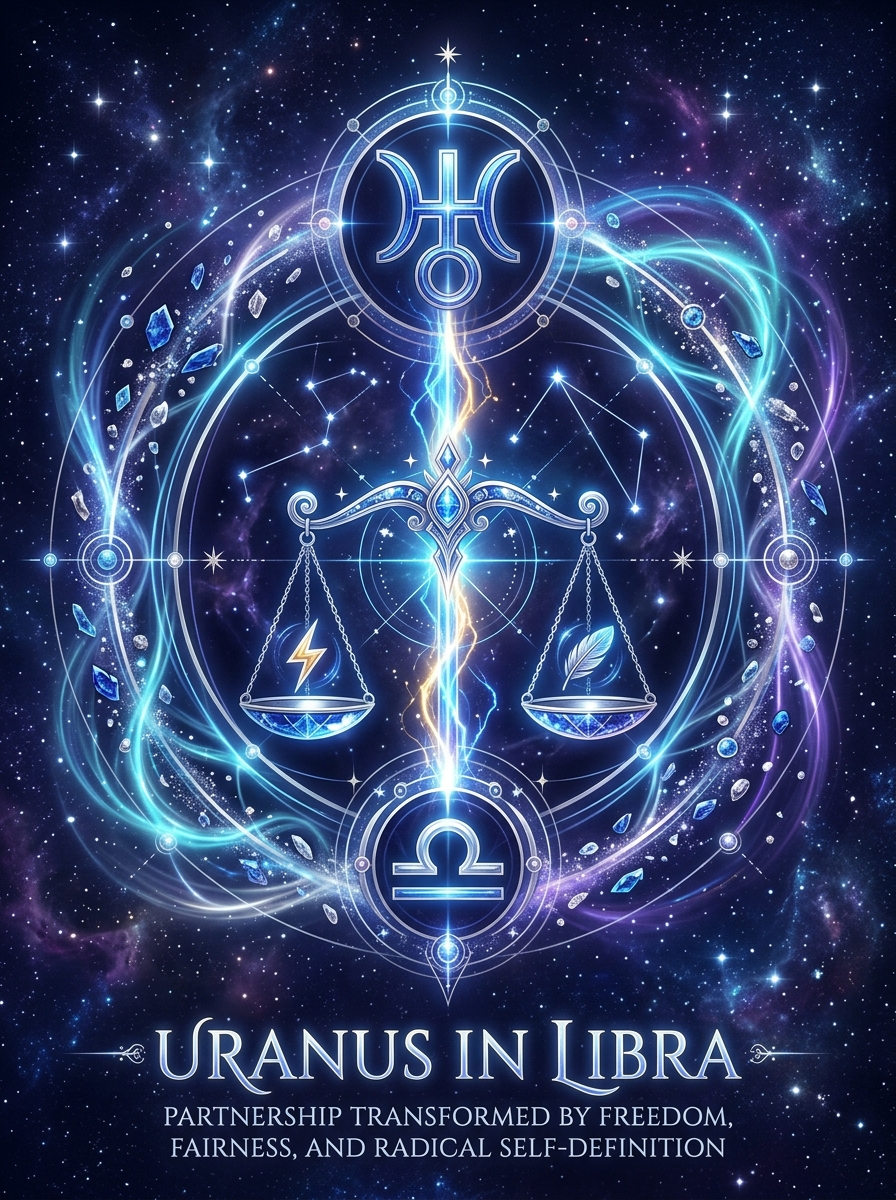
The Archetypal Tension: Uranus's Disruptive Lightning meets Venus's Harmonious Scales in Libra
When the electrical, revolutionary energy of Uranus enters the venusian, cardinal air sign of Libra, an immediate and profound archetypal friction is born. Uranus is the cosmic disruptor, the planet of sudden awakening, Promethean fire, radical individuation, and the breaking of structures that have outlived their utility. It represents the sky-god Ouranos, who rejects the material limitations of the earth and demands alignment with ideal, objective, and transcendent truths. Libra, on the other hand, is the domain of Venus—the archetype of harmony, peace, symmetry, social contracts, and the relational mirror. Libra seeks the bridge, the compromise, the beautiful synthesis of two distinct entities merging into a cooperative union. Libra’s primary concern is the "Other," while Uranus’s primary drive is the preservation of absolute, uncompromising self-sovereignty. This creates a fascinating and complex astrological tension: the planet of separation and radical freedom placed in the sign of connection and partnership.
To understand this placement, we must look at it through the lens of psychological astrology, particularly the works of Liz Greene and Carl Jung. Liz Greene often emphasizes that Uranus represents the urge to transcend the personal ego in favor of a larger, collective ideal. When Uranus is placed in Libra, the collective ideal being revolutionized is the very nature of human relationship itself. This is not a gentle evolution; it is an alchemical process where the traditional, often unequal structures of relating are subjected to the lightning bolts of Uranian insight. The classical Venusian desire for a harmonious, socially acceptable partnership is disrupted by the Uranian insistence on absolute psychological truth and individual authenticity. The native is forced to ask: Can I be truly connected to another without sacrificing my own unique genius and individual path?
Jungian psychology teaches us that in relationships, we constantly project our inner archetypes—the anima and animus—onto the partner. The partner becomes the screen upon which we view our own unconscious desires, fears, and unintegrated qualities. Libra is uniquely prone to this projection, as it naturally seeks completion through the Other, desiring a perfect mirror that reflects peace and symmetry. However, when Uranus occupies Libra, this projection is repeatedly and dramatically shattered. The Uranian force acts as an agent of alterity—forcing the individual to confront the partner not as an extension of their own psychological needs or a convenient mirror, but as a completely separate, sovereign, and unpredictable entity. This confrontation with the true "Other" can feel chaotic and destabilizing, yet it is the necessary catalyst for genuine psychological maturity and individuation.
Furthermore, the air element of Libra serves as a highly efficient conductor for Uranus's electrical charge. Unlike the water signs, which process Uranus through intense emotional crises, or the earth signs, which experience it as structural collapse, Libra processes Uranus intellectually and conceptually. The traditional relationship model—which often relied on unspoken dependencies, rigid gender roles, and the sacrifice of individuality for the sake of marital peace—is exposed under Uranus in Libra as an intellectual falsehood. The generation born with this placement, and individuals who carry it prominently in their natal charts, cannot accept a relationship based on mere convenience, social expectation, or financial dependence. They require an intellectual partnership, an egalitarian alliance where both parties are free to evolve, even if that evolution threatens the stability of the union itself.
In this archetypal landscape, the scales of Libra are no longer static weights seeking a delicate balance; they are dynamic, moving plates navigating the seismic waves of Uranian awakening. This placement demands a restructuring of the mind before the heart can be fully engaged. The traditional romantic illusions must be burned away by Uranian lightning to reveal the raw, honest framework of conscious relating. The ultimate lesson of this archetypal tension is that true harmony cannot be built on the suppression of individual truth. Venusian peace must be forged in the fire of Uranian honesty, transforming relationships from cages of safety into laboratories of mutual consciousness and psychological liberation.
The Uranus in Libra Generation (1968–1975) and the Modern Evolution of Marriage and Divorce
Astrological transits of outer planets mark generational shifts, signaling changes in the collective unconscious that redefine societal norms. Uranus traversed the sign of Libra approximately between 1968 and 1975, a pivotal period in modern history that witnessed a radical deconstruction and reconstruction of social contracts, marriage, and family dynamics. This era was characterized by the peak of second-wave feminism, the rise of the gay liberation movement, the sexual revolution, and the introduction of no-fault divorce laws across the United States. The generation born during this period inherited these cultural shifts, carrying the psychological imprint of this relational revolution deep within their natal charts and manifesting it as they came of age.
Prior to this transit, the Western paradigm of marriage was largely structured around economic stability, social duty, and rigid gender expectations. Marriage was an institution designed to preserve societal order, often at the expense of individual fulfillment. When Uranus entered Libra, it threw a grenade into this traditional structure. The skyrocketing divorce rates of the late 1960s and 1970s were the external manifestation of this astrological transit. Children born to the Uranus in Libra generation grew up witnessing the dissolution of the traditional nuclear family. They saw their parents dismantle marriages that were no longer authentic, experiencing firsthand the psychological instability—and eventual liberation—that came from questioning long-held social pacts. This created a collective understanding that relationships are not permanent fixtures, but evolving agreements.
This early exposure to relational instability led to a unique psychological adaptation. Steven Forrest, a pioneer of evolutionary astrology, notes that the evolutionary intent of Uranus is to free us from the conditioning of the past, encouraging us to step out of the cultural consensus. For the Uranus in Libra generation, this meant shedding the inherited belief that a relationship's success is measured solely by its longevity. Instead, they began to measure success by the quality of growth, mutual respect, and authentic communication within the partnership. They developed a healthy skepticism toward traditional marital vows, recognizing that pledging eternal devotion could sometimes lead to a stagnation of the self. They learned to value the truth of the present moment over the security of a contract.
As this generation reached adulthood in the late 1980s, 1990s, and 2000s, they became the architects of modern relational paradigms. They popularized concepts such as the "living apart together" (LAT) model, co-parenting agreements that transcend romantic partnership, and various forms of ethical non-monogamy and polyamory. Even within conventional marriages, this generation demanded a radical rewriting of the script. The domestic division of labor, the integration of dual careers, and the expectation of intellectual and spiritual equality became standard requirements rather than progressive ideals. They showed that partnership could be flexible, adaptable, and customized to fit the unique needs of the individuals involved, rather than forcing the individuals to fit into a pre-existing mold.
The legacy of the Uranus in Libra generation is the normalization of relational choice and personal agency. They stripped away the stigma of divorce, transforming it from a moral failure into a courageous act of Uranian alignment with personal truth. By proving that relationships can end without destroying the value of the connection, they paved the way for a more honest, conscious, and sovereign way of relating that continues to shape contemporary society today.
House Placements: How Uranus in Libra Operates in Key Areas
To understand how Uranus in Libra manifests for an individual, we must examine its house placement in the natal chart. The house shows the specific arena of life where the Uranian lightning strikes, forcing the individual to dismantle old relational conditioning and seek radical sovereignty. While Uranus affects all areas of connection, its expression is particularly intense and transformative in the angular and social houses—specifically the First, Seventh, and Eleventh houses, where the self and the other meet.
Uranus in Libra in the First House: The Self Reconstructed Through Relational Friction
When Uranus in Libra resides in the First House, the house of self-identity, physical appearance, and personal projection, the individual’s very sense of self is intimately bound up with the archetypal tension of relationship. These individuals are born with a unique paradox: they possess a powerful, independent, and often eccentric personality, yet they are deeply preoccupied with how they relate to others. They do not fit into neat social boxes. Their presence is electrifying and unpredictable, and they often reject conventional standards of beauty and social etiquette, opting instead for an aesthetic that expresses their radical independence. They are here to redefine what it means to be an individual in relation to a partner.
In this placement, the First House Uranus uses Libra's relational lens to constantly reinvent the self. They learn who they are by pushing against the expectations of others, using relationships as a sounding board for their own individuation. They may experience sudden shifts in their identity, changing their career, style, or personal philosophy in the blink of an eye, often leaving their partners scrambling to keep up. This can create significant friction in partnerships, as the Uranus in the First House individual demands the freedom to change their mind and identity without consultation. Their evolutionary lesson is to realize that their identity does not require the permission of the partner, nor does it need to be defined in opposition to the partner. True sovereignty lies in being authentically themselves while remaining open to the transformative mirror of relationship.
Uranus in Libra in the Seventh House: The Mirror of the Unexpected Partner
The Seventh House is the natural home of Libra, representing committed partnerships, marriage, open enemies, and the psychological projection of the shadow. When Uranus occupies this house, the stage is set for a lifetime of relational disruption and awakening. Individuals with this placement often project their own unconscious need for freedom, rebellion, and unconventionality onto their partners. Consequently, they find themselves magnetically attracted to partners who are erratic, highly independent, emotionally unavailable, or socially unconventional—astrologers, artists, revolutionaries, or individuals who refuse to commit to traditional structures.
Through these partners, the Seventh House Uranus individual is forced to confront their own fear of intimacy and engulfment. When the partner acts out the Uranian role by demanding space or abruptly ending the relationship, it forces the native to look inward and ask why they attracted such instability. The shadow work of this placement involves acknowledging that they themselves carry a deep-seated need for radical autonomy that they have projected onto the other. Once they integrate this shadow, they no longer need to attract chaotic partners to feel free. They can construct relationships that are consciously designed to incorporate space, intellectual stimulation, and mutual independence, transforming the Seventh House from a theater of relational crises into a sanctuary of co-sovereignty.
Uranus in Libra in the Eleventh House: The Revolution of Collaborative Networks
The Eleventh House is the natural domain of Uranus (as the ruler of Aquarius), representing groups, friendships, alliances, hopes, wishes, and collective visions. When Uranus in Libra is placed here, the individual’s revolutionary drive is directed toward the reformation of social networks, communities, and collaborative systems. They are the natural facilitators of egalitarian groups, bringing people together under the banner of social justice, intellectual debate, and progressive ideals. They reject hierarchical social structures, insisting that every voice within a group must be heard and valued equally.
These individuals often form highly unconventional friendships, moving through diverse social circles with ease but resisting emotional entanglement within them. They are drawn to humanitarian causes and may become leaders in organizations that fight for relational equality, such as marriage equality movements or alternative family advocacy groups. However, the challenge for Uranus in Libra in the Eleventh House is the tendency to prioritize the collective ideal of relationship over the messy reality of individual friendships. They may champion global harmony while struggling to maintain peace with their immediate peers. Their path is to ground their progressive social ideals in daily, respectful, and balanced interactions, ensuring that their vision of a collaborative future starts with the people standing right next to them.
Personal Aspects: Uranus in Libra Contacting the Sun, Moon, and Venus
The natal aspects formed between Uranus in Libra and the personal planets—the Sun, Moon, and Venus—indicate how this generational revolution integrates with the individual’s core identity, emotional landscape, and romantic desires. These aspects create a direct line of communication between the collective Uranian impulse and the personal ego.
Uranus in Aspect to the Sun: The Individuated Self and the Radical Call to Truth
When Uranus in Libra forms an aspect (such as a conjunction, square, opposition, or trine) to the natal Sun, the individual’s core life purpose is infused with the drive for relational reform and personal individuation. The Sun represents the hero’s journey, the conscious ego, and the path of self-realization. Contact with Uranus means that this journey cannot follow a conventional path. These individuals feel a persistent, inner command to live authentically, even if doing so disappoints their family, culture, or partners. They cannot pretend to be something they are not just to keep the peace.
In the relational sign of Libra, a Sun-Uranus aspect creates a person who is highly conscious of the social dynamics around them, yet refuses to conform to them. If the aspect is a square or opposition, there is a constant, dramatic tension between the desire to be witnessed and appreciated by the partner (Sun) and the urge to shock or break free from relational expectations (Uranus). They may cycle between intense periods of social involvement and sudden, isolated retreats, struggling to find a stable middle ground. If the aspect is a trine or sextile, the integration is smoother; the individual naturally possesses the charisma to inspire others to embrace relational freedom, presenting a model of authentic selfhood that is both balanced and uncompromising. Ultimately, the Sun-Uranus individual is here to shine a light on the truth that self-love and self-understanding are the absolute prerequisites for all healthy connection.
Uranus in Aspect to the Moon: The Quest for Emotional Autonomy
The Moon represents our emotional nature, our subconscious conditioning, our need for security, and our experience of the mother archetype. When Uranus in Libra aspects the Moon, the emotional landscape is characterized by a high degree of sensitivity, rapid mood fluctuations, and a deep-seated association between freedom and safety. For these individuals, emotional security is not found in static, predictable environments; rather, they feel safest when they have the room to breathe, move, and change their emotional expression without judgment.
Psychologically, Moon-Uranus aspects often point to an early childhood environment where the mother or primary caregiver was perceived as unpredictable, emotionally detached, or preoccupied with her own independence. As a result, the child learned to associate emotional closeness with instability or a threat to their survival. In adulthood, this manifests as a strong defense mechanism against emotional engulfment. The moment a relationship feels too close or demanding, the Moon-Uranus individual may experience a sudden, visceral urge to withdraw or create a crisis to restore distance. To heal, they must recognize that their emotional independence does not require them to isolate themselves. By developing emotional self-regulation and communicating their need for space clearly, they can build relationships that feel both safe and free, reconciling the inner child's need for care with the adult's need for autonomy.
Uranus in Aspect to Venus: The Renegade Heart and Aesthetic Revolution
Venus is the ruler of Libra, making the aspect between Uranus and Venus in the natal chart particularly potent. This contact represents the direct collision of the planetary principles of love (Venus) and liberation (Uranus). Individuals with Venus-Uranus aspects are the true renegades of the heart. They are attracted to unusual, exciting, and intellectually stimulating relationships. The traditional romantic script—dating, marriage, mortgage, retirement—feels incredibly boring and restrictive to them. They need a relationship that feels like a continuous adventure.
For these individuals, love is an experiment. They require a high degree of intellectual companionship and shared progressive values in their partnerships. They are easily bored by routine and may unconsciously create drama or seek out long-distance relationships to maintain a sense of excitement and space. In the realm of aesthetics, Venus-Uranus aspects manifest as a love for avant-garde art, revolutionary fashion, and design that challenges conventional tastes. They may also possess an unconventional view of financial structures or values. Their evolutionary task is to learn how to sustain commitment without sacrificing the excitement and growth they crave. When they find a partner who is also committed to personal evolution, they can create a dynamic, ever-renewing connection that proves love is not a contract, but a living, breathing art form.
Shadow Work: Resolving the Conflict Between Radical Autonomy and Relational Intimacy
Every astrological placement has its shadow, and for Uranus in Libra, the shadow is particularly complex because it involves the intersection of two opposing human needs: the need for belonging (Libra) and the need for freedom (Uranus). When these two forces are not integrated, they split, leading to psychological defense mechanisms that sabotage the individual's relationships and inner peace. Shadow work for Uranus in Libra involves bringing these unconscious patterns into the light of conscious awareness and taking responsibility for how they manifest in daily life. It requires moving past intellectualizations to address the raw, emotional currents underneath.
The primary shadow manifestation of this placement is the "flight from intimacy" disguised as spiritual or psychological sovereignty. Individuals with prominent Uranus in Libra placements may intellectualize their fear of vulnerability, claiming that they are "too independent" or "too spiritually advanced" to participate in traditional relationships. They use terms like codependency, autonomy, and boundaries not as tools for healthy relating, but as shields to prevent anyone from getting close enough to touch their core vulnerability. They mistake detachment for freedom, failing to realize that true freedom includes the capacity to choose commitment and endure the messy, unpredictable, and sometimes painful nature of human emotion. True autonomy is not the inability to connect; it is the capacity to connect deeply without losing oneself. They must realize that true liberation does not mean standing alone on a cold mountain, but rather having the strength to stand close to someone without dissolving.
Another common shadow pattern is the projection of the "jailer" onto the partner. When the Uranus in Libra individual feels the natural weight of relationship responsibilities—such as compromising, showing up for emotional support, or discussing future plans—they may experience a sudden wave of panic. Instead of acknowledging their own anxiety, they project it onto the partner, viewing them as demanding, controlling, or traditional. They tell themselves, "My partner is holding me back," or "This relationship is killing my creativity." This projection allows them to play the role of the innocent rebel fighting against a tyrannical oppressor, avoiding the painful realization that the prison they feel is constructed from their own internal conflict. They are running from their own fear of adulthood and emotional accountability, using the partner as a scapegoat for their developmental blocks.
Jungian shadow work requires these individuals to confront their fear of abandonment and engulfment. Often, the fierce defense of autonomy is a preemptive strike: they reject the partner or keep them at a distance so they cannot be abandoned first. By embracing their vulnerability and acknowledging their very human need for connection, they can begin to dissolve the false dichotomy between freedom and intimacy. They can learn to sit with the discomfort of emotional closeness, realizing that a conscious partnership does not diminish their sovereignty, but rather provides a secure container within which they can truly flourish. They must learn that committing to another does not mean erasing themselves, but rather choosing a co-traveler on the path of self-discovery and soul-level transformation.
Astrological Integration: Mastering the Balance of Sovereignty and Connection
The ultimate goal of working with Uranus in Libra is integration—moving beyond the polarization of absolute independence and codependent harmony to find the sacred middle ground of interdependence. Interdependence is the recognition that we are separate, sovereign individuals who choose to share our lives, resources, and hearts with another, recognizing that our connections do not diminish our freedom, but expand it. It is the understanding that we are wired for connection, but that connection is only healthy when built on the foundation of individual authenticity.
To achieve this integration, individuals must cultivate what can be called the "Third Space" in relationship. The Third Space is the relationship itself, treated as a distinct entity that requires care, feeding, and respect, separate from the individual egos of the two partners. In a traditional relationship, the two individuals often merge, losing their boundaries in a collective "we" that stifles individual expression. In a Uranian relationship, the partners may remain so detached that no real connection is formed, leaving both feeling lonely and isolated. The integrated Uranus in Libra path involves maintaining clear, sovereign boundaries (I am me, you are you) while consciously committing to the shared space between them. This is the path of the spiritual warrior in relationship, balancing the Scales of Venus with the Lightning of Ouranos, recognizing that both are essential for the soul's evolution.
This requires a radical commitment to truth and open communication. Traditional Libra often avoids conflict to maintain a superficial peace, but Uranus demands that every truth, no matter how disruptive, be spoken. Integrated Uranus in Libra individuals learn to speak their truth with kindness and aesthetic elegance, using Libra’s relational skill to deliver Uranian insights without destroying the bridge of connection. They learn to view relationship crises not as signs of failure, but as opportunities for growth, realignment, and deeper intimacy. They understand that a relationship must be dynamic to survive, and that occasional disruption is the path to a higher order of harmony.
To practically cultivate this integration, one can establish daily or weekly relational checkpoints—a concept that appeals to Libra's desire for structure and Uranus's need for conscious intention. During these times, partners can discuss not just domestic logistics, but their individual psychological states, their current needs for space, and any whispers of resentment before they turn into Uranian lightning storms. It also requires the cultivation of independent interests, friendships, and projects outside of the relationship. When each partner has a rich, independent life, they bring fresh energy and insights back to the union, keeping the Venusian connection vibrant and preventing the stagnation that Uranus so violently rejects. In this way, integration is not a destination, but a continuous, daily practice of balancing selfhood with shared experience.
Furthermore, integrating this placement means learning to honor both the personal and collective spheres of life. It requires the individual to see that their personal relationships are a reflection of their relationship with the world at large. By developing a practice of radical self-inquiry and evolutionary patience, the native can transform their partnerships into sacred containers of mutual awakening. They show us that it is possible to stand fully in our own power, honoring our unique path and eccentricities, while simultaneously holding the hand of another in deep, committed, and loving partnership. In doing so, they fulfill the highest promise of this placement: the creation of a world where love and freedom are no longer mutually exclusive, but are recognized as two sides of the same sacred coin, representing the ultimate alchemical union of the self and the other.
FAQ: Frequently Asked Questions About Uranus in Libra
What does it mean to have Uranus in Libra in your natal chart?
Having Uranus in Libra in your natal chart indicates that your generation, and you personally, are tasked with revolutionizing the way humanity relates. It creates a psychological drive to break free from traditional, unequal relationship models in favor of egalitarian partnerships that respect individual sovereignty. Depending on the house placement and aspects, it shows where you will experience sudden awakenings, relational shake-ups, and the call to balance your need for personal freedom with your desire for intimate connection. It means relationship is your primary laboratory for spiritual and personal evolution.
How did the Uranus in Libra generation (1968–1975) influence modern relationships?
This generation was born during a time of massive social upheaval, witnessing the rise of second-wave feminism, the sexual revolution, and the normalization of divorce. As adults, they carried these lessons forward, dismantling the rigid, contractual model of marriage. They popularized progressive relationship paradigms like conscious co-parenting, living apart together, and equal division of domestic labor, transforming relationship from a social obligation into a dynamic container for personal growth. They redefined the modern family structure.
What is the biggest relationship challenge for someone with Uranus in Libra?
The biggest challenge is navigating the tension between the fear of engulfment and the fear of isolation. Because of their strong drive for autonomy, they may unconsciously sabotage relationships when they start to feel too close, projecting their fear of commitment onto the partner. Their work is to learn that true freedom is not the absence of connection, but the ability to choose commitment consciously while maintaining healthy, sovereign boundaries. They must learn to tolerate the vulnerability of being truly known.
How does Uranus in Libra affect personal style and aesthetic tastes?
Since Venus rules Libra, Uranus in Libra often manifests as a love for avant-garde, revolutionary, and unconventional art, fashion, and design. These individuals are drawn to aesthetics that challenge the status quo and express a unique, independent vision. They reject traditional standards of beauty, choosing instead styles that represent their intellectual and personal rebellion against conformity, often blending classical symmetry with shocking or futuristic elements.
How can someone with Uranus in Libra integrate this placement healthily?
Healthy integration involves moving from independence to interdependence. This requires practicing radical honesty in relationships, communicating the need for space before a crisis occurs, and doing the shadow work necessary to stop projecting the "jailer" archetype onto partners. By embracing vulnerability and creating a "Third Space" of conscious connection, they can experience deep intimacy without losing their essential freedom.
Does Uranus in Libra guarantee divorce or unstable relationships?
No, Uranus in Libra does not guarantee divorce or instability, but it does indicate that traditional, static relationship models will not work for you. If you attempt to force your relationships into conventional molds based on obligation or dependency, you are likely to experience sudden disruptions. However, if you consciously design your partnerships to allow for mutual growth, intellectual stimulation, and personal space, Uranus in Libra can manifest as a highly stable, long-lasting, and deeply fulfilling partnership built on conscious choice rather than social conditioning.
Comments
Loading comments…