Sun in the 1st House: The Self Made Visible
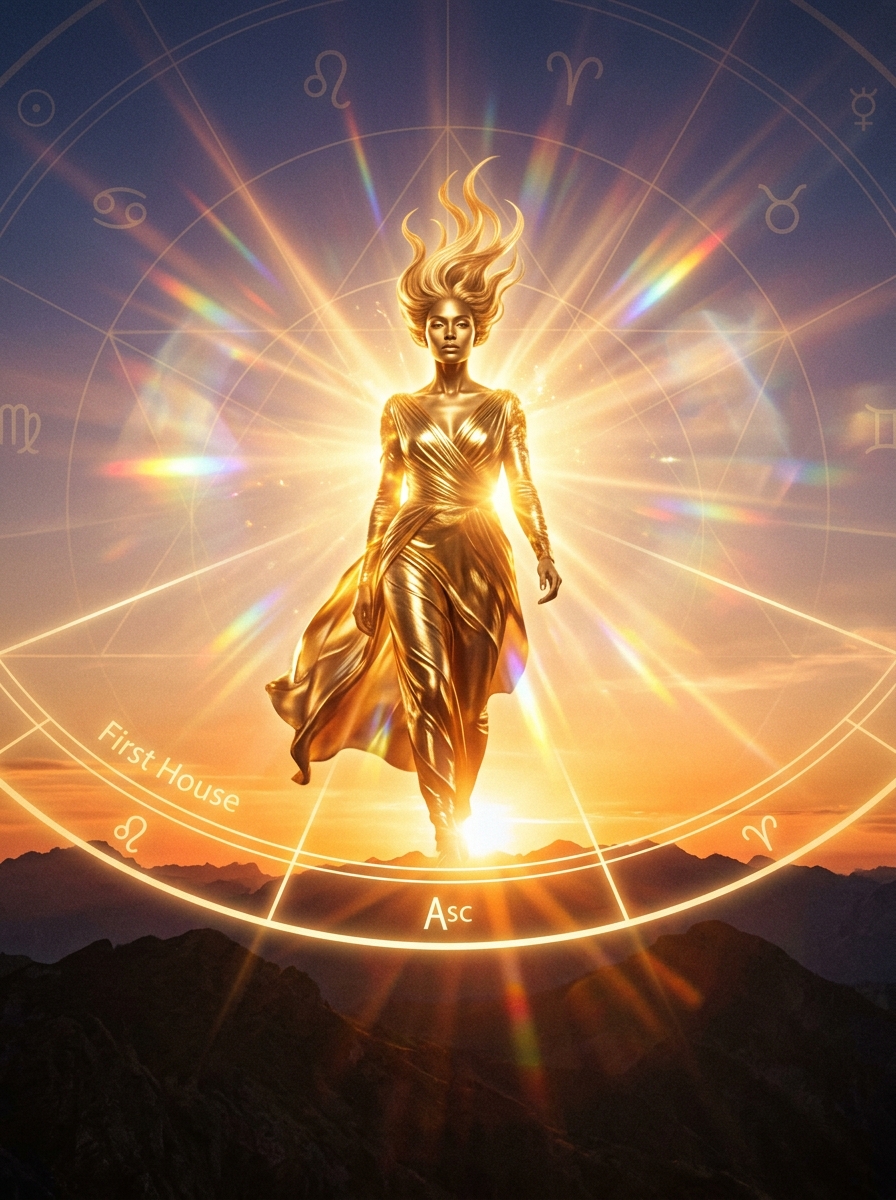
The Sun in the 1st House: Core Meaning and Astrological Significance
In the architecture of a natal chart, placement is everything. The same planet behaves differently — sometimes radically differently — depending on the house it occupies. When the Sun lands in the 1st House, something structurally unique happens: the planet of conscious identity and will meets the house that governs self-presentation, physical appearance, and first impressions. The two functions collapse into one. There is no meaningful gap between who you are inside and who you project outward.
The 1st House as the Threshold of Being
The 1st House begins at the Ascendant — the exact degree of the zodiac that was rising on the eastern horizon at the moment of your birth. Astrologically, the Ascendant is your interface with the world: the way you move through a room, the first read strangers get, the body language and default social register that emerge before you've said a single word. Liz Greene, in The Astrology of Fate, describes the Ascendant as a kind of persona — not a mask in the pejorative sense, but the archetypal shape the ego uses to meet outer reality. It is how consciousness steps out of the private inner world and into lived, shared experience.
Place the Sun here, and the engine of selfhood runs at full throttle from the moment you walk through the door. The Sun — which in classical Western astrology represents the conscious will, the core life force, and the principle of individuation — has nowhere to hide. It rises with the chart itself. Whatever the Sun signifies in your life — your vitality, your creative authority, your heroic journey toward selfhood — it is written plainly on your face, audible in your voice, felt in the quality of your presence before you've spoken a word.
Orientation in the Chart
The 1st House is traditionally classified as an angular house, the first of the four "pillars" that define the chart's structural framework alongside the 4th, 7th, and 10th. Angular houses are houses of immediate action and visible expression; planets placed there are louder, more manifest, and more directly operative in the individual's daily life than the same planets would be tucked into a cadent or succedent house. The Sun already governs the individual's most fundamental orientation toward existence. In the angular house most concerned with the self, that orientation becomes the primary lens through which everything else is experienced and communicated.
The Solar Principle in the Western Tradition
Carl Jung's framework of individuation — the lifelong process of becoming fully, authentically oneself — maps elegantly onto the solar principle. The Sun describes not just what you are, but what you are becoming. It is heroic, purposive, and creative. In Steven Forrest's The Inner Sky, the Sun represents "the essential self... the soul's evolutionary intention for this lifetime." Aleister Crowley, writing in a more esoteric register, aligned the Sun with the principle of pure self-manifestation: every star shining in its own right, by its own necessity. Drop that principle directly into the house of visible selfhood, and you get someone whose entire life project involves being unmistakably, often visibly, themselves — not as a performance, but as a fundamental existential commitment.
Personality Dynamics and Self-Expression
The Transparent Self
People with the Sun in the 1st House are, in a word, legible. Not simple — legibility doesn't preclude complexity — but they rarely cultivate mystery through deliberate concealment. What they think and feel tends to appear on their face, in their posture, in the quality of attention they bring into a room. This transparency can be immensely appealing. There's a directness here that registers as authenticity, and in a culture that increasingly prizes honesty over performance, these individuals often feel refreshingly present.
This doesn't make them extroverts by default. The Sun's sign modifies everything. A Sun in Scorpio in the 1st House will be intense, probing, and psychologically penetrating — but not necessarily voluble. A Sun in Gemini in the 1st House will likely fill every available silence with language and find it energizing. What remains consistent across all signs is the quality of presence: these people are here, fully, whenever they're in the room. Their energy doesn't leak away into background static. It locates itself, clearly and unmistakably, in the present tense.
Personal Magnetism and Natural Authority
There is a gravitational quality to a strong 1st House Sun. Groups naturally orient around these individuals — not always because they're actively seeking to lead, but because the solar energy itself functions like a center of mass. Jung described certain personality types as carriers of the mana personality, borrowing a term from Melanesian anthropology to describe figures who radiate an unusual degree of psychic energy. People gather around them the way iron filings align with a magnetic field.
This magnetism is neither purely social nor purely physical. It's existential. The Sun in the 1st House person seems to know, at some deep cellular level, that they have a right to be here, to take up space, to have their presence registered. Their confidence — even when it hasn't yet been tested or fully earned — is rooted in identity rather than accomplishment. They don't wait for credentials to justify walking into a room as though they belong there. They already know they do.
The Sun's Sign as Frequency Modulator
Because the 1st House is so closely tied to the Ascendant and the entire chart's self-expression mechanism, the Sun's zodiacal sign adds specific texture to how these themes play out. Sun in Aries in the 1st is perhaps the most classically solar signature in all of Western astrology — headlong, physically assertive, direct to the point of bluntness, with a competitive fire that seems to burn on pure instinct. Sun in Taurus in the 1st brings the same full, grounded presence but at a slower, more sensory-focused frequency: these people can be powerfully magnetic precisely because they're unhurried, unmoved by external pressure, rooted in their bodies and their pleasure.
Sun in Capricorn in the 1st gives the solar drive a strategic, often sober quality — authority is present and unmistakable, but it wears a business-casual dress code rather than a cape. Sun in Pisces in the 1st creates a softer, more fluid kind of presence, one that is somehow everywhere at once; these individuals often lead through empathy and imaginative resonance rather than direct assertion. In every case, the house activates the solar energy for maximum visibility; the sign shapes the specific frequency, style, and register of that broadcast.
Physical Presence, Vitality, and Appearance
The Body as Solar Expression
Classical astrology assigned the 1st House rulership over the physical body itself — specifically the head and face, the parts of us that others read first. With the Sun here, physical vitality tends to run high, especially in youth. There's often a natural robustness, a healthy quality of energy, a physical confidence that translates as presence without requiring effort. These aren't necessarily people who look conventionally beautiful by any narrow cultural standard, but they tend to be noticed. They have what photographers call a photogenic quality — not about symmetry or geometry, but about aliveness, about the impression that something real and vital is happening behind the eyes.
Constitution, Energy, and Physical Identity
The Sun governs the vital force — the animating spark that sustains the organism. In the 1st House, this force expresses directly through the physical body rather than being redirected into purely mental or emotional channels. Sun in 1st House individuals often recover well from illness, respond quickly to physical challenge, and tend to enjoy some form of physical engagement with the world. Movement, outdoor exposure, sport, or even just the daily physical act of presence in the world can feel essential to their psychological equilibrium.
The caution embedded in this placement: because so much of their identity is expressed through and experienced in the physical body, health challenges can feel existentially threatening in ways that exceed the purely physiological. When these individuals are ill, depleted, or feel physically diminished — or when aging brings changes to appearance or energy levels — the psychological impact can be disproportionately deep. Learning to separate core identity from physical state is one of the subtler and more important developmental tasks this placement asks for.
First Impressions and Physical Signature
There is frequently something distinctly solar about the physical appearance — a brightness or intensity in the eyes, an upright and self-possessed bearing, a warmth in the complexion, or simply a quality of being fully inhabited in the body. The Sun's sign will modify this signature in specific ways, but the general impression is of someone who looks like they belong wherever they are. Rooms seem slightly smaller when they leave and slightly larger when they arrive.
First impressions left by these individuals tend to be strong and durable. They're rarely forgotten after even a brief encounter. This can work powerfully in their favor — in any professional or social context where first impressions matter, they have a structural advantage. The liability is that people decide quickly who they are based on that powerful initial impression, and then resist revising the picture. Sun in 1st House individuals sometimes find themselves fighting against being perpetually perceived through the lens of the first version of themselves that others encountered.
Relational Dynamics: The Sun in the 1st House in Love
The Challenge of Genuine Mutuality
Here's where the placement gets genuinely complex, and where easy flattery about magnetism and confidence has to give way to something harder. The Sun in the 1st House inclines toward self-focus — not necessarily selfishness in the moral sense, but a strong structural orientation around one's own experience, needs, narrative, and sense of self. In partnerships, this creates a kind of gravitational asymmetry: the Sun in 1st House individual naturally becomes the center around which the relationship orbits, and their partners are implicitly invited to join that orbit.
Some partners find this dynamic thrilling, at least initially. Many find it exhausting over the long haul. The core relational challenge for this placement is learning to make room for another person's solar energy without feeling threatened or diminished. This requires developing what Liz Greene, in her work on relationship astrology, might call "the capacity for genuine encounter" — the willingness to be genuinely affected and changed by another person, to let their reality impinge on yours in ways you didn't plan for and can't control.
Attraction Patterns and Their Evolution
People with the Sun in the 1st House often attract a particular kind of early-life partnership: the admirer. Partners who are drawn by the warmth, the magnetism, the attractive confidence, and who are content to occupy a secondary position in the relational solar system. In the short term, these relationships feel satisfying to both parties — the Sun in 1st House person gets the validation they crave, and the partner gets proximity to an unusually radiant energy.
But these arrangements rarely survive the test of depth. Eventually — and this is a reliable developmental arc for this placement — the Sun in 1st House individual wants to be genuinely seen rather than simply admired. Admiration is a relationship with an image; genuine encounter is a relationship with a person. Partners who were cast as admirers aren't usually equipped to make that transition, and the relationship either evolves painfully or ends.
The Work of Receptivity
The most relationally mature Sun in 1st House individuals are those who have actively developed the capacity to receive. Not just to accept compliments graciously — they're usually excellent at that — but to receive difficulty: a partner's anger, a partner's competing needs, a partner's perception of you that doesn't match your own self-image. The Sun's natural mode is centrifugal: it shines outward. The relational growth edge runs in exactly the opposite direction — inward, toward genuine vulnerability, toward being illuminated by someone else rather than always being the source of the light.
In the esoteric tradition, this is the work of integrating the solar principle with the Venusian principle: moving from the adolescent configuration of love-as-mirror (where the partner primarily reflects your own glory back at you) toward love-as-genuine-encounter with an other who is irreducibly separate from you, who has their own solar fire, their own authority, their own claim on existence.
Career Potential: The Face of the Brand and Personal Leadership
Visible by Design
Professionally, Sun in the 1st House individuals thrive in any role where personal presence is a core component of the work — not a nice addition, but structurally integral. This isn't exclusively about performance or celebrity, though both are available paths. It's about any career where who you are is inseparable from what you do and how well you do it. Entrepreneurs, speakers, teachers, coaches, politicians, attorneys, physicians, therapists, performing artists, journalists, and consultants all fit naturally because the work requires the person to be fully present and identifiable. You can't successfully outsource or anonymize your role in these fields; the work calls the person forward.
Leadership and the Solar Executive
The solar energy concentrated in the 1st House makes for a naturally compelling and often effective leader. Not always the most collaborative or diplomatically nuanced — those qualities depend on chart factors beyond the Sun's placement — but compelling in the specific sense that people genuinely want to follow. There's a coherence to the Sun in 1st House leader that reads, over time, as reliability: you know who they are, you know what they stand for, and that consistency builds trust, even when the consistency manifests as stubbornness in the short term.
The professional shadow of this placement is difficulty with genuine delegation and a tendency to perceive the team as an extension of the self rather than as a collection of independent agents with their own authority and perspectives. The most professionally successful expression of this placement is found when these individuals build something genuinely worth the attention they command — when the solar energy is in service of a vision larger than personal recognition.
Branding, Media, and the Public Face
In any economy that rewards personal visibility — and the 21st-century American economy rewards it extensively — the Sun in 1st House individual has a structural advantage. Their authentic self is their brand. They don't need to construct a persona, because they broadcast one automatically. This serves them well in entrepreneurship, media, consulting, coaching, and any field where "thought leadership" is a meaningful category. Audiences and clients tend to trust them quickly, and that trust, once established, is durable.
The corresponding vulnerability: when professional identity and personal identity fuse completely, professional setbacks can feel like personal annihilations. Being passed over for a promotion, receiving a bad review, losing a client, or watching a project fail can land with the weight of an identity crisis rather than a career bump. Consciously maintaining some psychological separation between what you do professionally and who you are essentially is not weakness for this placement — it is emotional intelligence.
The Shadow Side: Pride, Vanity, and the Need for Validation
When the Sun Eclipses Everything Else
Every astrological placement carries what Jung would call shadow material — the unlived, denied, or exaggerated dimensions of the core energy. The Sun in the 1st House is no exception, and its shadow is in many ways the direct inverse of its gifts. The same qualities that make these individuals magnetic and compelling — the confidence, the strong presence, the natural center-of-gravity energy, the transparent self-expression — can curdle, under specific conditions, into pride, vanity, and an appetite for recognition that edges toward the insatiable.
The Validation Trap
There is often, especially in early life and in the years before genuine psychological work has been undertaken, a deep structural hunger for external validation accompanying this placement. Because the Sun in the 1st House person's identity is so publicly visible, they are simultaneously more exposed to the world's appraisal than most people. Praise registers like sunlight on skin — warm, energizing, immediately pleasurable. Criticism can land like a physical blow, not merely a professional or interpersonal disappointment, but something that feels threatening to the self.
This creates a recognizable psychological pattern: the individual becomes partly dependent on a steady stream of affirmation to maintain their sense of self. Without it, they feel hollow or diminished. With it, they feel briefly whole — until the dose wears off and the cycle begins again. Liz Greene wrote about this configuration as the "solar ego" that continually needs mirroring from the world because it hasn't yet found the inner source of its own light. The person has not yet distinguished between being seen and actually knowing themselves.
The trap is obvious once named: no amount of external validation can substitute for genuine self-knowledge, and the attempt to use it as a substitute creates a permanent dependency that is never resolved, only temporarily satisfied.
Egocentrism and the Difficulty of Sharing the Stage
In its unreflective form, the structural self-focus of this placement manifests as egocentrism: conversations that always loop back to the self, difficulty genuinely listening without mentally preparing the response, a habit of center-staging in group settings that can crowd others out without any malicious intent. These individuals can be unconsciously dominating — the solar energy is always on, always seeking expression, and the 1st House provides it with a direct and unobstructed channel into every interpersonal situation. Other people's solar fires can feel, to them, like competition rather than contribution.
This shows up in specific patterns: talking over others, interpreting everything in terms of how it relates to their own experience, struggling to be genuinely enthusiastic about someone else's success, requiring events and decisions to center them in order to feel engaged. Again, none of this is usually malicious. It's structural — the gravitational pull of a powerful solar placement that hasn't yet learned to coexist with other sources of light.
From Ego to Individuation: The Path Through
The psychological growth trajectory for this placement runs from ego — the defended, performance-oriented self that needs constant affirmation — toward what Jung called the Self, the broader, integrated center of the psyche that includes but transcends the personal ego. As Sun in 1st House individuals mature, the best of them develop a quality of solar generosity: they learn to use their light to illuminate others rather than simply to bask in its warmth themselves. The magnetism is still present and still powerful, but it has been redirected outward. They become, in the deepest sense of the word, illuminating — people in whose presence others feel more visible, more capable, more alive to their own potential, rather than less.
Special Case: Sun Conjunct the Ascendant
When Identity and Persona Fuse
A tight conjunction between the Sun and the Ascendant degree — generally within eight degrees, though more conservative astrologers use a tighter five-degree orb — represents one of the most striking configurations in Western natal astrology. The Ascendant is the threshold of being; the Sun is the core of being. When they occupy essentially the same degree of the zodiac, the two functions don't merely coexist in the same house — they merge into a single, continuous expression.
Every Sun in 1st House theme discussed throughout this article intensifies with a tight Ascendant conjunction. The physical vitality is more pronounced. The magnetic quality reads at a higher frequency. The need for recognition can be more pressing and more openly expressed. The tendency toward self-focus is more deeply habitual, more structural, more difficult to see from the inside precisely because it's so thoroughly woven into the baseline experience of selfhood. These individuals sometimes don't recognize their solar intensity as intensity — to them, it simply feels like being alive.
Orb, Degree, and Gradients of Fusion
As the orb between the Sun and the Ascendant widens, the fusion between solar identity and outer persona becomes less complete. A Sun at fifteen degrees in the 1st House with an Ascendant at zero degrees has all the 1st House themes fully activated, but the persona and the core solar identity retain a degree of separateness. This is, paradoxically, useful: a little psychological daylight between "who I appear to be" and "who I am at core" allows for more flexibility, more capacity to try on different social registers, more resilience when the public image is challenged or changes.
The very tight conjunction, while enormously powerful in terms of solar expression, can create a specific kind of identity rigidity. These individuals sometimes struggle more than most with changes to their appearance, their public image, or the way others perceive them, because their sense of self is so thoroughly identified with that outer projection. Steven Forrest, writing about planets conjunct the Ascendant, notes that such planets become permanently embedded in the persona's architecture — not guests in the 1st House, but structural elements of the self-expression mechanism. For the Sun, this means the call to individuate, to live one's core purpose, is built into every layer of how the person meets the world. It is impossible to turn off.
The Twice-Solar Person
With the Sun conjunct the Ascendant, the individual in some sense carries a doubled solar signature: the solar archetype expressed at the level of core identity (the Sun's natal placement) and simultaneously at the level of outer expression and physical presence (the Ascendant). These individuals often carry solar symbolism in their physical appearance — a brightness, a leonine quality, a warmth that is hard to describe analytically but immediately perceptible to others. They may literally seem to glow, or their energy may have a radiating, centrifugal quality that makes them feel like the source of warmth in whatever space they inhabit.
Path to Maturity: Harmonizing Outer Presence with Inner Depth
The Lifelong Work of the Solar 1st House
The evolutionary arc of Sun in the 1st House is among the most clearly defined in the full catalog of natal placements. The starting configuration is usually a powerful but partly unconscious expression of solar energy — confidence that hasn't yet been genuinely tested, presence that hasn't yet learned its effect on others, identity that is vibrant and alive but also defended, fragile in ways the individual doesn't yet recognize. The destination — never fully arrived at, because individuation is a lifelong project and not a completed achievement — is what we might call conscious radiance: full, generous, self-aware solar expression that gives life to others rather than eclipsing them.
Developing Genuine Interiority
One of the defining developmental challenges for this placement is the cultivation of a genuine inner life that does not require an audience. The 1st House is the most externalized of the twelve houses; all of its concerns face outward — appearance, first impressions, the body as it moves through the world, the impact of presence on the surrounding environment. A Sun planted here tends toward extroversion of identity, toward defining oneself through responses received from the world, toward experiencing the self as fundamentally social and performative.
The mature work is to build a private center — a relationship with oneself that doesn't depend on external reflection. This might take the form of contemplative practice, depth psychology (many Sun in 1st House individuals benefit enormously from Jungian analysis or similar traditions that make the inner world concrete through symbol and image), creative work that is never shared with anyone, or simple practices of solitude and silence that run counter to the outward-facing solar impulse. The goal isn't to suppress the solar expression — that would be a kind of psychic violence against the nature of the placement — but to develop an inner root system deep enough to sustain the solar tree when the weather turns.
Learning to Receive Light
Throughout this article, we've touched on the importance of receptivity in relational contexts. It deserves emphasis here as a broader developmental theme, applicable not just to romance but to the full range of human experience. The Sun's primary mode is centrifugal: it generates, radiates, and shines outward. But in the physics of the solar system, sunlight isn't purely unidirectional — planets reflect it back, and in that reflected light, something of the sun's own nature becomes visible in a new way. In psychological terms: we come to know ourselves more fully through genuine encounter with others, through relationships in which we are genuinely affected and changed, through the experience of having our self-image disrupted and revised.
Sun in 1st House individuals often need to actively practice receptivity — to others' honest perceptions of them, to critical feedback, to the genuine authority and perspective of people who are not in their orbit, to the experience of being a secondary character in someone else's story rather than the protagonist of their own. Crowley's celebrated axiom — "Every man and every woman is a star" — is worth sustained contemplation for this placement: there are other solar centers in the universe, and genuinely acknowledging them doesn't diminish your own light. It extends it.
From Self-Expression to Self-Actualization in Service
At the highest expression of this placement, the individual becomes what we might call a cultural solar source — a person whose clarity of identity, whose willingness to be visibly and fully themselves, creates permission for others to do the same. This is the leadership quality of the mature 1st House Sun: not domination, but exemplification. Not "look at me" but "look at what becomes possible when a human being commits fully to being themselves, without apology and without performance."
This is, ultimately, the deep invitation of the Sun's placement in the house of self. The 1st House may be concerned with individual selfhood, but the Sun's deepest function in any tradition that engages it seriously — psychological, esoteric, or evolutionary — is to give life to everything it touches. The light you carry in the 1st House is yours, absolutely. But it is also, when fully integrated and consciously expressed, a gift to everyone who comes within its range.
Frequently asked questions
- What does it mean to have the Sun in the 1st House?
- Having the Sun in the 1st House means your core identity, conscious will, and vital life force are channeled directly into the house that governs self-presentation, physical appearance, and first impressions. The internal self and the public persona operate as a unified expression rather than as separate layers. You tend to be immediately recognizable, magnetically present, and naturally confident — not because you perform those qualities, but because your essential being radiates outward without much filtering. This placement is associated with strong physical vitality, a need for personal recognition, and a lifelong journey of conscious individuation in the most visible possible arena: the self itself.
- Is the Sun in the 1st House the same as the Sun conjunct the Ascendant?
- They overlap significantly but aren't identical. Any Sun in the 1st House activates the solar themes of visible identity, personal magnetism, and self-expression. But a tight conjunction between the Sun and the Ascendant degree — typically within five to eight degrees — creates a more complete fusion of the solar principle and the persona. With a wide Sun in the 1st House, there's still some daylight between 'who I appear to be' and 'who I am at core,' which allows for more psychological flexibility. With a tight Ascendant conjunction, those two layers have essentially merged: your purpose, your will, your creative fire, and your social face are one seamless broadcast. The conjunction amplifies every theme discussed, including the shadow dynamics around pride, identity rigidity, and the need for validation.
- How does the Sun in the 1st House affect romantic relationships?
- Relationally, this placement creates a structural tendency toward self-focus — not malicious selfishness, but a strong gravitational pull back toward one's own experience, needs, and narrative. In early life especially, these individuals often attract admirers and supporters who enjoy basking in their solar warmth, but those arrangements rarely survive the demand for emotional depth. The real relational challenge is developing genuine receptivity: the ability to be changed by a partner, to make room for someone else's solar energy, to be in another person's story rather than always at the center of your own. The most mature Sun in 1st House individuals in relationships are those who have learned to distinguish between admiration and genuine encounter — and who actively seek the latter, even when it's more uncomfortable.
- What careers are best suited to the Sun in the 1st House?
- This placement thrives in any career where personal presence is a core professional asset. Entrepreneurship, public speaking, teaching, coaching, law, medicine, politics, the performing arts, media, and consulting all fit naturally because the work requires 'who you are' to be inseparable from 'what you do.' In the contemporary economy, Sun in 1st House individuals have a natural advantage in personal branding and thought leadership — their authentic self is their brand, and they don't need to manufacture a persona because they radiate one automatically. The professional caution is that when identity and career fuse too tightly, any setback at work can feel like a personal annihilation. Developing some psychological distance between professional role and core self is important mental health work for this placement.
- What is the shadow side of the Sun in the 1st House?
- The shadow side is the flip side of every strength this placement offers. The natural confidence can become entitlement. The magnetic presence can become domination. The authentic self-expression can slide into performance for approval — an endless feedback loop in which external validation substitutes for genuine self-knowledge. There is often a deep hunger for recognition that, if left unconscious, creates a kind of validation trap: praise feels like oxygen, and criticism can feel disproportionately threatening. The egocentrism shadow shows up in conversations that always loop back to the self, difficulty genuinely listening, and a habit of unconsciously center-staging in group dynamics. Working through this shadow requires moving from what Jung called the solar ego — defended, performance-oriented, needy of mirroring — toward the Self: the broader, integrated center of the psyche that can shine generously outward rather than hoarding light inward.
- Does the zodiac sign of the Sun change how the 1st House placement works?
- Significantly. The house tells you where the energy operates; the sign tells you how. A Sun in Aries in the 1st House is perhaps the most classically solar configuration in astrology: direct, bold, fast, and physically assertive. Sun in Libra in the 1st House expresses the same powerful presence but through charm, aesthetic awareness, and relational finesse — these individuals are equally magnetic but substantially less blunt. Sun in Scorpio in the 1st is intense, searching, and psychologically penetrating, rarely chatty but impossible to ignore. Sun in Virgo in the 1st may initially appear modest, but there's an unmistakable precision and observational authority that commands rooms quietly. In every case, the 1st House activates solar energy for maximum visibility; the sign shapes the specific frequency, texture, and style of that broadcast.
Comments
Loading comments…