Scorpio First Decan: Mars, Plutonian Pressure, and the First Chamber of Depth
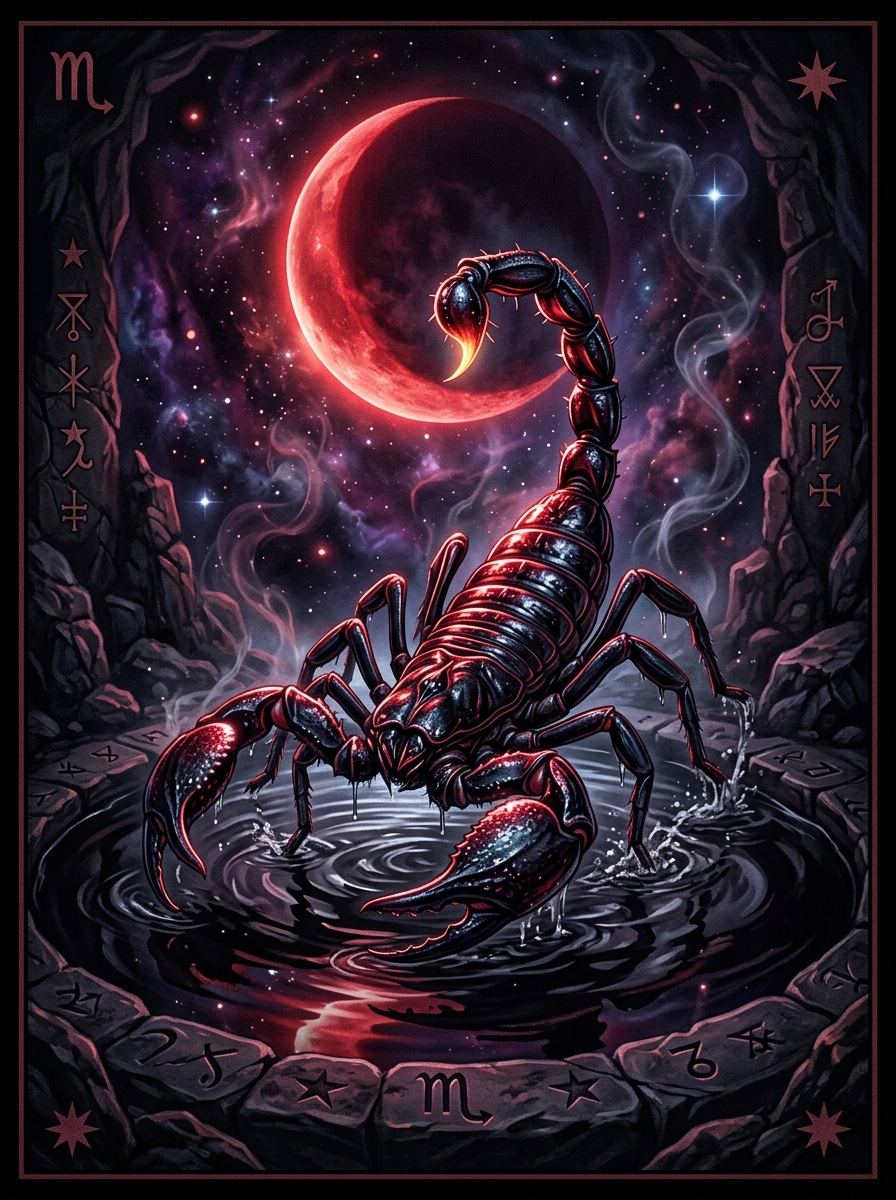
The first decan is Scorpio before it learns to explain itself
The opening ten degrees of Scorpio belong to Mars — not the hot, impulsive Mars of Aries, but the tactical, underground Mars that moves only when the terrain is fully read. This is the sign’s most stripped-down version: instinct over philosophy, privacy over performance, survival over display. Where later decans borrow complexity from other planetary colors, the first decan is pure Scorpio in its raw state: a closed circuit of intensity, secrecy, and surgical timing.
What makes this decan distinct is not depth per se — every Scorpio has that — but the quality of the depth. It is not reflective; it is immediate. The person does not decide to probe; they already know where the weak point is. The body registers truth before the mind has named it. This is the sign’s martial edge, the part that treats every interaction as a potential test of trust and every bond as something that must prove itself under pressure. If you know Mars in Scorpio, you recognize the signature: a will that waits, measures, then strikes where it will count.
The first decan asks the questions that the rest of Scorpio inherits: What is mine? What stays sealed? Who earns access? These are not moody abstractions — they are the architecture of psychic sovereignty. A person with heavy first-decan energy may seem calm while internally cataloging threat vectors, which is why the decan often produces the most guarded Scorpio of all. It does not wear its depth as a badge; it wears it as a reflex.
How the Mars-Scorpio alliance forges the guarded investigator
The wound that teaches precise vigilance
The first decan’s intensity usually forms around an early encounter with vulnerability that proved dangerous. Someone learned that openness costs, that trust can be weaponized, that the world does not reward transparency. Out of that lesson — rarely spoken, always remembered — arises a defensive mastery that looks like a sixth sense. The person can read a room’s hidden currents, detect the gap between what people say and what they mean, and sense when an alliance is real or merely convenient.
This is not paranoia in the clinical sense; it is a learned competence. It shares the penetrating lucidity of Mercury in Scorpio, but the first decan operates less through analysis than through bodily knowing — a tightness in the chest, a shift in temperature, an intuitive grab for the right question. Over time, that competence becomes a craft. The decan learns to observe without needing to confess, to hold silence until the other person fills it, to time disclosure so it lands with maximum effect.
Because Mars is the planet of conflict, the first decan can also turn defensive quickly. It may test loyalty by withholding, creating private rules that feel like tests. When healthy, this produces discernment; when distorted, it hardens into suspicion. The shadow of the first decan is the belief that any relationship is a power struggle in disguise. The mature version learns that discernment and suspicion are not the same — the first protects life; the second keeps life untouchable. This is where Chiron in Scorpio often touches the decan’s story: the wound of betrayal becomes the raw material for healing others, but only if the person first heals the part of themselves that expects every bond to break.
Maturation: from control to alchemy
The discipline to hold paradox
What saves the first decan from its own hardness is the discovery that intensity has a purpose beyond defense. Mars gives heat and direction, but Scorpio at its highest is not a warrior — it is an alchemist. The first decan matures when it stops trying to control every variable and learns to trust process over compulsion. The same force that once guarded a wound can transform it, but only if the person dares to let some vulnerability be chosen rather than forced.
This is the territory of Saturn in Scorpio — the discipline to withstand what would otherwise fracture the personality. The first decan often builds structure because chaos has proven expensive, but that structure can become wisdom if it does not calcify into rigidity. The mature version holds paradox well: closeness without fusion, power without cruelty, privacy without isolation. It can enter the underworld of emotion — its own or another’s — and return with something useful, not merely dramatic.
When the first decan goes shadow, it becomes the part of Scorpio that demands proof so extreme that no ordinary human relationship can satisfy it. It confuses control with safety, and it retaliates where it feels disrespected. The shadow is not the depth; it is the refusal to let depth move. The person may become a hoarder of secrets, a controller of information, someone who keeps others at psychic arm’s length because any approach feels like a violation. The cure is not to become soft, but to distinguish vulnerability from exposure. Vulnerability can be offered; exposure is what happens when choice is absent.
How the decan shows up in a life
At work: the surgical operator
The first decan’s skill set is precision under pressure. It excels in fields that reward psychological acuity, discretion, and the ability to act without hesitation: investigation, triage, surgery, crisis management, finance, research, any work where overexposure is a liability. The person may not be the loudest voice in the room, but they are the one whose observation shifts the plan. This is the decan that can stay calm while others panic, because panic is an information leak. They have already mapped the exits.
In leadership, the first decan does not inspire through charisma but through competence. People trust them because they show up prepared and they do not waste resources. The risk is that the decan’s strategic caution can become paralysis — waiting for perfect intel that never arrives. The mature version learns to act on a threshold, not a guarantee.
In love and loyalty: the earned bond
The first decan does not do casual attachment well. It may appear to, but beneath a surface of polite distance there is always a scan for depth. It wants loyalty that is not merely verbal but shown in behavior — consistency under stress, honesty when it costs something. Trust must be earned over time, through small tests that the other person may not even recognize. This mirrors the emotional seriousness of Moon in Scorpio, but the first decan is less about the feeling itself than the protective architecture built around it.
Once trust is earned, the bond is unforgettable. The person loves with an intensity that is not romantic in the conventional sense but primal: they will guard the other’s vulnerabilities as fiercely as their own. The shadow side appears when fear runs the relationship — when the person demands psychic surrender as proof of commitment, or when they keep score of every perceived slight. The mature first decan learns that love does not require the other to bleed; it requires them to stay.
In persona: the mask of controlled intensity
Because the first decan is so private, it often presents as the archetype described by Scorpio Rising: a persona that controls access, reveals selectively, and communicates through implication rather than declaration. The person may come across as cool, even intimidating, but that coolness is a technique — a way to slow the world down until it shows its hand. The first decan does not need to be liked; it needs to be accurate. Over time, that accuracy can become a genuine gift: the ability to see people clearly without needing to own them.
The larger seasonal context of the sign — the weather of transformation that Scorpio brings each year — is captured in the Scorpio horoscope, but the first decan remains the sign’s most unblurred note. It is where emotion becomes strategy, where survival becomes mastery, and where the refusal to be casually known becomes the beginning of real depth. The first decan does not merely feel deeply; it organizes itself around depth as a necessity. That is why Scorpio, at its core, is not a sign of feeling — it is a sign of force that learns, slowly, to become art.
Comments
Loading comments…