Saturn in Aries: The Crucible of Self-Initiated Will
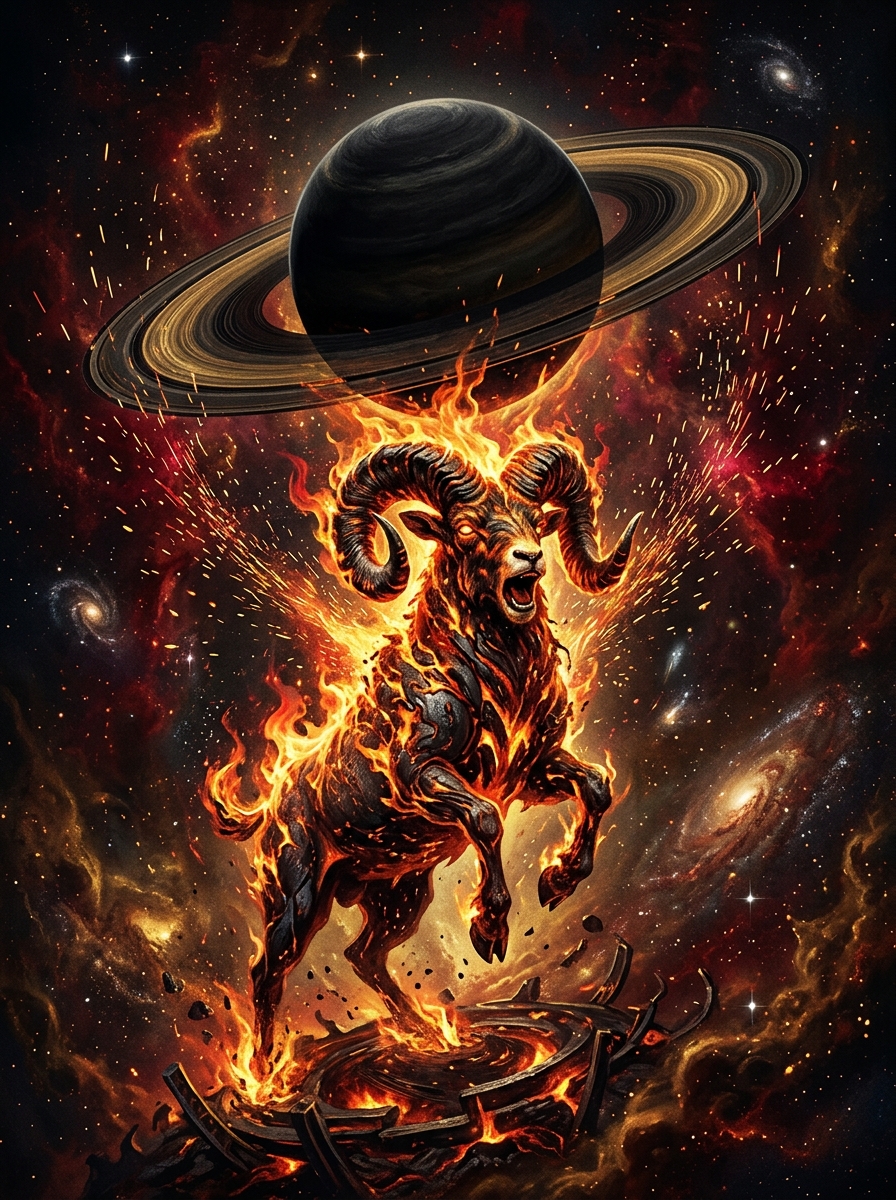
1. Introduction to Saturn in Aries: The Cosmic Crucible of Fire and Boundary
Astrology at its most profound level is a map of evolutionary tensions, a symbolic language that describes the friction necessary for the development of human consciousness. Within the natal chart, few placements embody this friction as intensely as Saturn in the cardinal fire sign of Aries. To understand this dynamic, we must first examine the two forces at play. On one hand, we have Saturn, the ancient Lord of Time, boundaries, restraint, structure, and karma. Saturn represents the psychic gravity that forces us to face reality, accept limitations, build structures, and cultivate patience. It is the archetype of the Senex—the wise, cold, and slow-moving elder who demands discipline, order, and accountability. In the physical body, Saturn governs the bones, teeth, and joints—the literal scaffolding that prevents our physical forms from collapsing under gravity. In the mind, Saturn is the boundary of the ego, the internal filter that tells us what is safe, what is possible, and what must be delayed.
On the other hand, we have Aries, the first sign of the zodiac, ruled by the hot-headed and red-blooded Mars. Aries is the sign of the pioneer, the warrior, and the initiator. It represents the raw, unmediated impulse to exist, to assert the ego, to conquer obstacles, and to move forward with absolute speed and directness. Aries operates on the pleasure of immediate action and the purity of instinct. It does not ask for permission, nor does it look back. It is the spark of cardinal fire that initiates the astrological year, demanding immediate self-actualization. Aries corresponds to the head, the eyes, and the blood, representing the forward-thrusting energy of birth itself.
When Saturn is placed in Aries, these two opposing principles are forced into a lifelong marriage. The result is a cosmic paradox: a speed governor attached to a rocket engine. From the very beginning of life, individuals with this placement experience a deep internal conflict. The natural impulse to act, to assert oneself, and to start new projects is met immediately with an internal check. This check can manifest as a sudden wave of self-doubt, a feeling of inadequacy, or a literal external block that halts progress.
This placement creates a developmental crucible. In the early stages of life, the individual often feels as though their willpower is broken or that their ability to initiate is cursed. Every time they attempt to charge ahead, they hit a wall. They want to run, but Saturn demands they crawl and study the ground first. The spiritual and psychological task of Saturn in Aries is not to extinguish the fire of Aries, nor is it to ignore the lessons of Saturn. Instead, it is to learn how to temper the fire, using the structural framework of Saturn to build a lasting vessel for their martial energy. The individual must evolve from a reactive warrior into a strategic commander, learning that true courage is not the product of sudden, explosive reactions, but the result of sustained, disciplined, and self-directed action over time.
This path requires a complete reevaluation of what it means to be strong. To the immature Aries energy, strength is measured by the speed and intensity of one's attack. To Saturn, strength is measured by endurance, resilience, and the ability to withstand delay and adversity without losing one's focus. The individual with Saturn in Aries must learn to bridge these two definitions. They must discover that boundaries are not just obstacles designed to limit their freedom, but are actually the channels that make their freedom effective. Without a channel, a river spreads out into a shallow swamp; with high, rocky banks, it becomes a powerful current capable of carving canyons.
2. The Archetype of the Fall: Understanding Saturn's Debility in the Sign of the Ram
In the traditional system of planetary essential dignities, Saturn is said to be in its "fall" in Aries. This terminology, inherited from Hellenistic astrology, describes a state of debility where a planet struggles to express its core nature because the sign it occupies operates on a completely different set of values. Saturn finds its exaltation—its most socially harmonious and structured expression—in Libra, the sign of relationships, balance, consensus, and social contracts. In Libra, Saturnian boundaries are established through cooperation, legal agreements, and mutual respect. The rules are clear because they are shared by the collective. There is a social template to follow: be polite, seek balance, consult others, and play by the established rules of the game.
Aries, however, is the polar opposite of Libra. It is the sign of the individual, the solitary actor who must decide and execute without consulting the group. When Saturn operates in the domain of the ram, the individual cannot rely on established societal consensus or pre-packaged rules to feel secure. Traditional institutions, standard corporate structures, and conventional guidelines fail to support them. The rules that work for the collective feel like a straightjacket to Saturn in Aries, yet the absence of rules leads to anxiety and chaos.
This state of debility forces the individual to undergo a difficult but necessary psychological initiation. Because the typical structures of society do not fit their pioneering nature, they must build their own unique, self-reliant methods of self-discipline and boundary-setting. They cannot copy someone else's template. If they attempt to live by traditional, collective rules, they feel suffocated, or they experience a profound loss of personal agency.
Astrologers like Liz Greene point out that a planet in its fall represents a psychic function that has been stripped of its external supports. The individual cannot take the easy way out. For Saturn in Aries, this means discovering that authority cannot be borrowed, inherited, or projected onto others; it must be forged in the fire of personal experience. They must learn to stand alone in their decisions, accepting the consequences of their actions without the safety net of public approval. The fall of Saturn is therefore the birthplace of the self-made individual, who establishes order not through compliance with the status quo, but through the conscious, solitary deployment of their own will.
In this sense, the fall of Saturn in Aries is an evolutionary necessity for the soul. It forces the ego to abandon the comfort of collective consensus. In Libra, Saturn can hide behind the law or behind social conventions. In Aries, there is nowhere to hide. The individual is exposed to the elements, forced to decide what they stand for when no one else is looking and when no rules exist to guide them. It is a lonely path, but it is the only path that leads to true, unshakeable integrity. The person must learn to say, "I do this not because it is the rule, but because it is my will, and I accept the full responsibility for the outcome."
3. The Pendulum of Paralysis and Explosion: The Jungian Shadow of Saturn in Aries
The psychological landscape of Saturn in Aries is often marked by an intense, polarizing dynamic. When a planet of inhibition occupies the sign of raw expression, the psyche tends to split, creating a classic Jungian shadow projection. The ego, fearing the destructive or chaotic potential of its own anger and desire, pushes these impulses into the unconscious. This creates a state of chronic inhibition, where the individual experiences a deep-seated fear of their own power.
The Somatic Cost of Unexpressed Impulses
When the pioneering fire of Aries is blocked by the Saturnian internal critic, the energy does not simply vanish. Denied an outward outlet, it turns inward, manifesting as physical and somatic tension. This is a classic example of muscular armoring, a concept developed by Wilhelm Reich and integrated into modern Jungian somatic psychology. The body becomes a physical prison for the unexpressed self. Individuals with Saturn in Aries often experience chronic physical symptoms:
- Tension Headaches and Migraines: The physical head is ruled by Aries. When the impulse to assert oneself is blocked, the energy constricts in the head, leading to severe pressure, vascular constriction, and chronic headaches. It is the feeling of a volcano trying to erupt through a sealed stone cap.
- Bruxism (Teeth Grinding) and TMJ: This is a literal biting back of words, assertions, or screams of frustration. The jaw becomes a vault where unexpressed anger is locked away, leading to dental wear, chronic jaw pain, and tension in the neck muscles.
- Muscular Armoring in the Upper Body: The body builds a physical defense against its own impulses. The shoulders, neck, and upper back become rigid and frozen, holding the body in a perpetual state of defense against its own impulses. It is the posture of a warrior who is constantly bracing for a blow that never comes, or who is holding themselves back from attacking.
- Adrenal Exhaustion and Fatigue: The nervous system is constantly preparing the body for action (Mars/Aries), pumping adrenaline and cortisol into the bloodstream. However, the internal Saturnian censor repeatedly aborts the mission. This chronic state of preparation without release exhausts the adrenal glands, leading to chronic fatigue, brain fog, and a sense of physical defeat.
This somatic holding pattern is accompanied by a growing sense of resentment. The individual looks at others who assert themselves freely and feels a mixture of judgment and envy, projecting their own repressed desire for action onto the external world. They may perceive their environment as hostile, restrictive, or blocking, failing to realize that the primary jailer is their own internal Saturnian censor.
The Cycle of Eruption: Impulsive Outbursts as Shadow Compensation
Because human psychology cannot tolerate permanent suppression, this state of inhibition eventually reaches a tipping point. The repressed Martian energy builds pressure like steam in a boiler. When the ego's defenses are weakened by fatigue, stress, or alcohol, the Saturnian dam bursts. The result is an explosive, reactive outburst of anger or impulsive action that is often disproportionate to the triggering event.
During these eruptions, the individual may make sudden, reckless decisions: quitting a job, ending a relationship, or engaging in physical confrontation. These outbursts are counterproductive, confirming the ego's worst fears: “See? My anger is destructive. I must control it even tighter next time.” This belief reinstates the Saturnian suppression with even greater severity, restarting the cycle of paralysis and eruption.
The Shadow of Resentment and Passive Aggression
When the direct assertion of will is completely blocked, the Saturn in Aries individual often resorts to passive-aggressive behaviors. Because they fear direct conflict (which they associate with loss of control or punishment), they express their anger indirectly. They may become chronically late, forget important commitments, perform tasks poorly, or use sarcasm as a weapon.
This passive-aggressive behavior is a compromise between the Aries urge to strike out and the Saturnian fear of the consequences. However, it is a self-defeating strategy. It alienates others and prevents the individual from getting their actual needs met, further reinforcing their belief that the world is a cold, unsupportive place where they have no power. Breaking this loop requires learning the art of conscious containment rather than repression. The individual must learn to tolerate the heat of their anger and desire without immediately acting on it or pushing it away. By holding the tension of the fire, they allow it to mature from a reactive impulse into a conscious choice.
4. The Authority Complex: From Childish Rebellion to Sovereign Autonomy
One of the most significant developmental hurdles for those with Saturn in Aries is their relationship with external power structures. Saturn represents the father, the law, the state, the boss, and the rules of the game. Aries represents the urge to be one's own master. Consequently, this placement almost always guarantees a complex, often adversarial relationship with authority figures.
The Father Archetype and the Saturnian Shadow
In early life, this dynamic is typically projected onto the father or primary caregivers. The child may experience the father as a cold, punitive, or blocking figure who thwarts their independence. Alternatively, the father may be weak, chaotic, or absent, forcing the child to develop a defensive, self-protective shell of self-reliance too early. In either case, the child learns that authority is not a source of safety or guidance, but something to be feared, resisted, or managed.
This early experience establishes a template where authority is perceived as something inherently hostile to the self. In adulthood, the individual projects this internal dynamic onto bosses, mentors, institutions, and societal rules. They may interpret any form of feedback, structural constraint, or regulation as an direct attack on their freedom. This leads to two primary defensive postures:
- Defiant Rebellion: The individual constantly picks fights with authority, trying to prove they cannot be controlled. They become the perpetual iconoclast, rejecting any structure simply because it was created by someone else. This is an immature, reactive posture because the rebel's actions are still determined by what they are fighting against; they lack true independence.
- Passive Submission: The individual collapses under the weight of the Saturnian pressure, complying outwardly while nursing a deep, toxic reservoir of passive-aggressive resentment and unexpressed hostility. They become the "good child" or the compliant employee, but their inner fire is slowly extinguished, leading to depression and a lack of vitality.
The Journey of Sovereign Authority
The maturation process involves moving away from these reactive cycles and reclaiming the projected authority. As Jungian analyst Liz Greene points out, the ultimate goal of Saturn is to build an inner structure so solid that external authorities lose their power to intimidate or define us. The individual must move from the role of the rebellious adolescent to that of the sovereign adult.
This transition requires a painful psychological shift. The individual must stop blaming their father, their boss, or society for their limitations. They must realize that their anger at external authority is actually a projection of their own internal critic. The harsh, judgmental voice they hear from the outside is their own internal Saturn, which they have not yet integrated.
When the individual steps into their own sovereign authority, they develop:
- Self-Governance: They establish their own standards of behavior, codes of conduct, and goals, independent of external praise or blame.
- Boundaries without Defensiveness: They can say "no" calmly and firmly, without needing to justify themselves or pick a fight.
- Strategic Navigation: They recognize that external rules are not always personal attacks, but are often neutral structures that can be navigated strategically to achieve their goals.
- Radical Accountability: They accept full responsibility for their choices, refusing to play the victim when things go wrong.
Navigating Institutional and Corporate Hierarchies
In the professional world, Saturn in Aries individuals must learn to manage their authority complex. In a traditional corporate hierarchy, they often struggle. They may experience performance reviews as personal attacks, or feel that their creative ideas are being suppressed by middle management.
To survive and thrive, they must learn to view their superiors not as surrogate fathers to be rebelled against, but as business partners with their own constraints. They must develop the patience to present their ideas within the existing structure rather than trying to blow the structure up. If they cannot find a way to work within the system, they must have the courage to leave and build their own system, rather than staying and complaining.
5. Vocation, Career, and the Crucible of Work
For individuals with Saturn in Aries, the professional sphere is a primary arena for psychological integration. Because their developmental task is to master self-initiated action and authority, their career path is rarely smooth, but it is highly rewarding when aligned with their authentic nature.
Fields of Strategic Action
Saturn in Aries individuals thrive in environments that require decisiveness, courage, and independent action, but they need these qualities to be supported by a clear, disciplined structure. They are uniquely suited for:
- Entrepreneurship and Solopreneurship: Building a business from the ground up allows them to establish their own rules and test their willpower against the reality of the market. Here, Saturn's need for structure is built by the individual, and Aries' need for pioneering action is fully expressed.
- Crisis Management and Emergency Services: In high-pressure situations, the Aries ability to act quickly combines with the Saturnian capacity for calm, structured execution. They make excellent emergency response coordinates, tactical planners, or crisis consultants who can walk into a chaotic situation and immediately establish order.
- Structured Athletics and Coaching: Sports provide a perfect arena where Mars (physical exertion, competition) and Saturn (discipline, training, rules) are naturally integrated. As coaches, they can be demanding but fair, helping others build their own internal discipline.
- Strategic Planning and Leadership in Tech/Pioneering Fields: They excel at leading teams through uncharted territory, acting as the pragmatic builders of new systems. They are the ones who can take a wild, creative idea and build the practical infrastructure to make it a reality.
The Danger of Bureaucratic Stagnation
Conversely, traditional bureaucratic settings, highly corporate environments with slow consensus-based decision-making, and positions where they are micmanaged are deeply toxic for this placement. In these environments, the Aries need for direct action is constantly thwarted by red tape, while the Saturnian need for structure is experienced as an oppressive, external force.
In such roles, the Saturn in Aries individual will either wither into depression or provoke a conflict that leads to their termination. They must have a degree of autonomy and the freedom to fail—and succeed—on their own terms. If they are trapped in a slow-paced job, they must find an outlet for their pioneering energy outside of work, such as a challenging hobby, a sports regimen, or a side business, to prevent their energy from stagnating and turning into somatic illness.
6. Integration and Alignment: Synthesizing Fire with Structure
The ultimate synthesis of Saturn in Aries is the creation of a "disciplined fire." It is the realization that structure is not the enemy of freedom, but its guarantor. Without a container, fire simply consumes its fuel and dies; with a engine block, it drives a vehicle forward.
To achieve this integration, the individual can work with several practical principles:
- Redefining Discipline: Instead of viewing discipline as a punitive external force, they must reframe it as a form of self-respect. Discipline is the promise that the present self makes to the future self. It is the daily practice of aligning one's actions with one's long-term goals rather than one's short-term moods.
- Strategic Patience: Aries wants results yesterday, but Saturn understands that anything of lasting value takes time to build. The individual must practice breaking down their grand, passionate visions into small, manageable, daily tasks. They must learn to fall in love with the process rather than just the victory. This means celebrating the quiet, daily efforts that no one else sees.
- Conscious Assertiveness: Rather than waiting for resentment to build into an explosion, they must practice communicating their boundaries and desires in real-time. This requires developing the language of assertive communication, stating their needs clearly and calmly, without apology or anger.
- Embracing the Wisdom of Failure: Because Aries hates to lose and Saturn fears being inadequate, the combination can make failure feel catastrophic. The integrated Saturn in Aries individual understands that failure is simply data. It is Saturn’s way of showing them where their structure was weak so they can rebuild it stronger. They learn to view failure not as a definition of their worth, but as an essential part of their education.
By marrying the courage of Aries with the wisdom of Saturn, these individuals become true pioneers. They do not just start fires; they build the hearths that keep those fires burning for generations. They develop a quiet, unshakeable confidence that does not need to shout to be heard. They become leaders who inspire others not through charisma or intimidation, but through the sheer weight of their integrity and their demonstrated capacity to endure and build.
7. Saturn in Aries FAQ
How does the Saturn Return affect someone with Saturn in Aries?
The Saturn Return, occurring around ages 29 and 58, is a major astrological milestone. For those with Saturn in Aries, this period is a trial by fire regarding their independence and agency. If they have spent their twenties living according to other people's rules or rebelling reactively, the Saturn Return will force a confrontation. They may experience a crisis that strips away their external supports, forcing them to stand on their own feet. It is a time when they are challenged to transition from seeking permission to claiming their own authority. It is often the time when they start their first business, step into a major leadership role, or finally confront a long-standing authority figure.
Does Saturn in Aries indicate a lack of courage?
On the contrary, Saturn in Aries often points to a deep, hard-won courage. While they may experience initial hesitation, self-doubt, or performance anxiety when taking the lead, this is because they intuitively understand the weight and responsibility of action. A person with an unchecked Mars may act bravely out of impulse, but a Saturn in Aries individual acts bravely despite their fear. Their courage is conscious, tested, and reliable under pressure. It is the courage of the veteran soldier, not the raw recruit.
How does this placement impact personal relationships?
Relationships can be a source of tension, especially if the individual projects their Saturnian restrictions onto their partner. They may choose partners who are overly controlling, seeking an external representation of the authority they have not yet claimed within themselves. Conversely, they may choose partners who are passive, forcing them into the role of the strict, punitive parent. The key to healthy relationships for Saturn in Aries is establishing mutual autonomy. They must learn that they can be close to someone without losing their independence, and that setting boundaries is a way of preserving connection, not destroying it.
Can Saturn in Aries individuals work well in teams?
Yes, but they function best when their role is clearly defined and they have a distinct area of personal responsibility. They struggle in unstructured team environments where decisions are made through endless committee meetings or where responsibility is diffuse. They prefer to be given a goal, a set of constraints, and the freedom to determine how to achieve the result. When these conditions are met, they are highly reliable, productive, and protective teammates who will work tirelessly to ensure the team's success.
How does the transit of Saturn through Aries affect those with this natal placement?
When transiting Saturn conjuncts their natal Saturn, it triggers their Saturn Return, demanding a complete audit of their personal power. When Saturn transits their other Aries placements, it calls for a restructuring of how they initiate projects and express aggression. It is a period of contraction that, while challenging, ultimately refines their willpower and strips away superficial desires, leaving them with a mature, focused path forward.
What is the relationship between Saturn in Aries and the Mars-Saturn aspect?
Natal Saturn in Aries functions similarly to a natal Mars-Saturn aspect (such as the conjunction, square, or opposition) because Saturn is placed in the sign ruled by Mars. This placement infuses the martial energy with Saturnian control. Individuals with this placement will struggle with the same themes as those with Mars-Saturn aspects: learning to pace themselves, managing frustration, and understanding that their power is not diminished by delay, but is instead concentrated and made more potent.
How can a Saturn in Aries individual build healthy self-discipline?
Healthy self-discipline for this placement must be self-initiated and flexible. If the discipline feels like a set of rigid, external rules, the individual will eventually rebel against it. They should focus on building habits that support their personal goals rather than trying to live up to someone else's standards. They should start small, establishing daily routines that they can realistically maintain, and gradually build on their successes. The goal is to build a structure that serves their fire, not a cage that smothers it.
Comments
Loading comments…