Pisces Second Decan: The Mystic Tenderness of the Moon
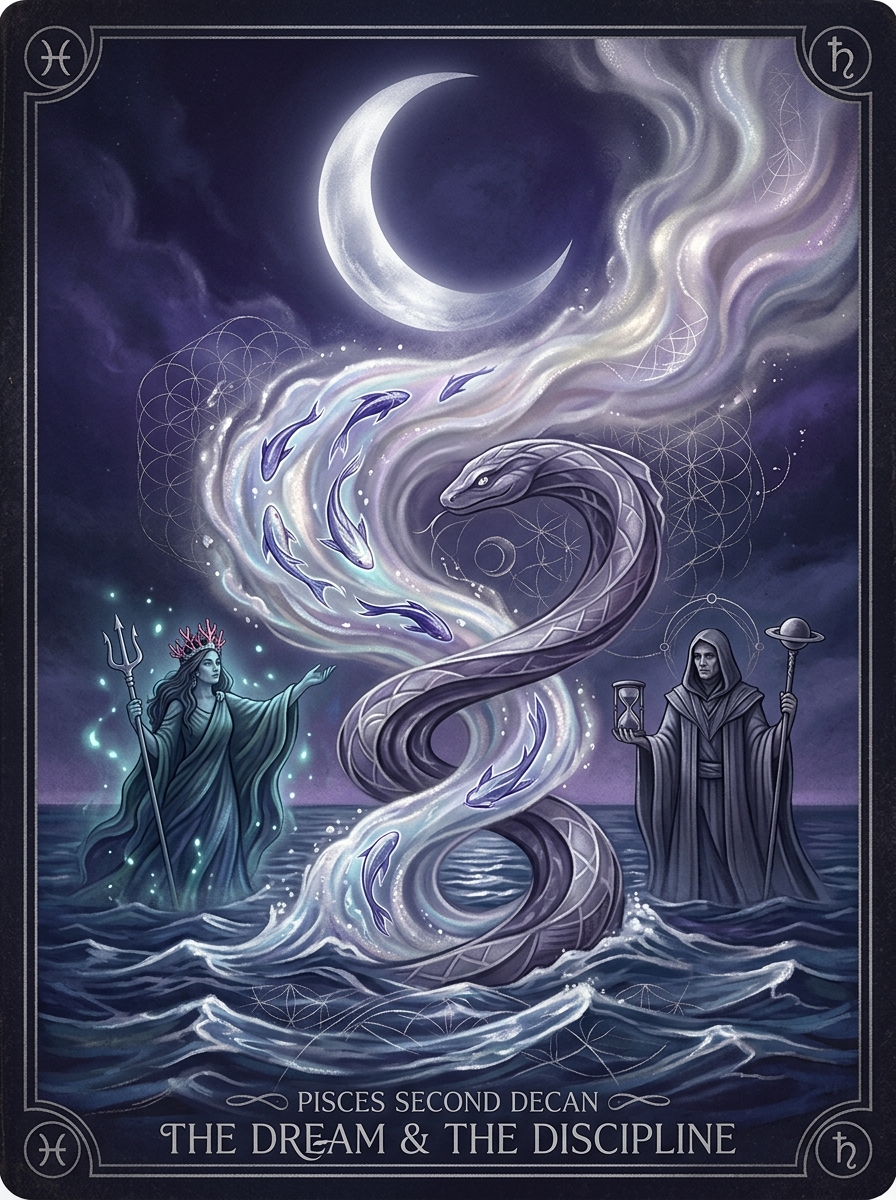
The Moon Turns Pisces Inward
The second decan of Pisces (10°–20°) takes the sign’s oceanic imagination and runs it through the Moon—not the distant, mythic Moon of dream interpretation, but the visceral one of attachment, memory, appetite, and protection. Where first-decan Pisces dissolves into the infinite, this decan dissolves into relationship: with a body, a home, a wound, a longing. The archetype remains Pisces (surrendered, porous, compassionate), but the method becomes lunar (cyclical, pre-linguistic, safety-seeking).
That shift changes everything about how this Pisces energy operates. It does not float above reality; it absorbs reality through the skin. It remembers atmospheres before events. It feels the emotional temperature of a room before anyone speaks, and then carries that reading home in the nervous system. The core question is no longer “How do I merge with the divine?” but “How do I stay tender and safe inside a world that leaks?”
This is why the Pisces second decan often appears softer, more domestic, and more protective than the transcendent or visionary stereotypes of the sign. Its spirituality arrives through kinship, grief, caregiving, and nostalgia rather than through abstract mysticism. The imagination is still boundless, but it is anchored to the memory of what felt like home.
The Psychological Ground: Attachment as a Second Skin
The Moon in astrology governs conditioning—the early imprint of who held us, who frightened us, what emotional patterns became our baseline. In Pisces, those imprints are not filed away; they remain liquid and active. A person with this decan prominent may find their present reactions constantly colored by a childhood atmosphere they can barely name. They do not think about safety; they resonate with it or recoil from it in the same pre-linguistic way an infant turns toward warmth.
This decan produces an extraordinary emotional intelligence that operates below words. It can sense when someone is lying, grieving, or hiding—not through deductive reasoning but through an uncanny attunement to micro-tones in the voice, the pause, the gaze. That clairvoyance is the Moon’s ancient instinct for survival through merging. Pisces provides the boundarylessness; the Moon provides the vigilance. The combination is a psychic sponge with a memory.
The psychological risk here is over-identification. The Moon wants to protect by merging; Pisces already dissolves. So the decan can confuse love with rescue, care with absorption. It can take on the pain of others as if it were its own, not from altruism but from a reflexive inability to distinguish self from environment. That is why understanding this placement often requires examining related lunar complexities, such as Moon in Pisces (where that fusion is natal) or the wound patterns of Chiron in Pisces (where separation is the original injury and merging becomes the compulsive cure).
Maturation and Shadow: The Danger of Living in Memory
The shadow of the Pisces second decan is not cruelty; it is dissociation through devotion. Because the emotional body is so porous, the psyche can decide that boundaries are unbearable and drift into numbness instead. The person idealizes a lost time, a person, a version of themselves that felt safe. Nostalgia becomes a religion. The past is not remembered—it is lived in.
This backward dissolution is the decan’s particular form of escapism. Where first-decan Pisces might escape into fantasy, second-decan Pisces escapes into feeling—specifically, the feeling of what was. It can haunt itself with the memory of emotional belonging that never fully arrived. That is why this decan often carries a sacred grief: a longing not just for union but for the maternal safety that should have attended it.
Healing begins when the native stops asking only “Who needs me?” and starts asking “What environment lets my sensitivity stay alive?” That is a radical pivot—from fusion to cultivation. It turns compassion inward without making it selfish. The Lilith in Pisces archetype surfaces here too: the instinct that refuses to be spiritually sanitized, that demands its wild, wounded, bodily truth be included in any narrative of healing. Without that inclusion, the decan’s tenderness curdles into silent martyrdom.
Maturation looks like learning to contain the tide. The Moon gives the shape; Pisces gives the water. The second decan’s great developmental task is to build a vessel that can hold both—to create emotional boundaries that protect without hardening, and to sustain compassion that does not drain the one who offers it. This developmental arc echoes themes explored in the Second Saturn Return, when a lifetime of porous empathy finally demands structure.
Living the Decan: Love, Work, and Creative Sanctuary
In relationship, the Pisces second decan rarely does casual. It bonds through attunement, loyalty, and an unspoken willingness to absorb what the other cannot carry. Partners often feel deeply seen by this decan—as if their hidden grief has finally found a witness. But that gift carries a shadow: the native may stay too long in relationships that demand emotional caregiving without reciprocity, because their sense of self has fused with the other person's need. Conscious boundary work—learning to discern between intentional care and reflexive rescue—is essential for this decan to love without vanishing.
In work, the decan gravitates toward environments that require emotional sensitivity and symbolic intelligence: healing professions, creative arts, pastoral care, music, film, or any field where the intangible becomes material. The Moon adds rhythm and timing; Pisces adds imagination and compassion. Together they produce work that feels like atmosphere—a film score, a therapy session, a poem that names what the reader could not articulate. The risk is burnout through over-giving, a tendency to absorb collective or client distress without discharging it. The decan needs sabbaticals, rituals, and periods of silence to reset the emotional body. Its relationship to creative flow and healing is akin to the expansive grace described in Jupiter in Pisces: an abundance that must be channeled, not poured out indiscriminately.
Creatively, the decan excels at making the invisible visible. It translates grief into music, nostalgia into film stills, spiritual urgency into rituals. Its art often carries a nocturnal, lunar texture—full of pauses, echoes, and unfinished edges. This is not the bright clarity of a Sun-in-Virgo creation; it is the kind that reveals itself slowly, like a dream remembered an hour after waking.
The Gift: Emotional Architecture
At its highest expression, the Pisces second decan becomes a sanctuary-maker. It does not merely empathize; it builds environments where others can rest their emotional weight. The person learns to hold tenderness without collapsing into it, to offer refuge without losing their own ground. That capacity is rare, and it is the decan’s genuine spiritual contribution.
The final lesson is severe and elegant: compassion without containment becomes leakage, but containment without compassion becomes exile. The Pisces second decan lives between those poles, and its genius is learning to navigate the in-between without denying either. It understands that the vessel must be maintained if it is to hold anything clean. That understanding—the marriage of lunar form and Piscean depth—creates a kind of emotional architecture that makes the world briefly hospitable. It is the same ancient need that surfaces in The Second House in Astrology: the need to feel held, to know what we are worth, to build a foundation for the soul. The second decan of Pisces builds that foundation not from stone but from water—and it holds.
Comments
Loading comments…