The Pinnacles of Life: Navigating the Four Great Seasons of Pythagorean Numerology
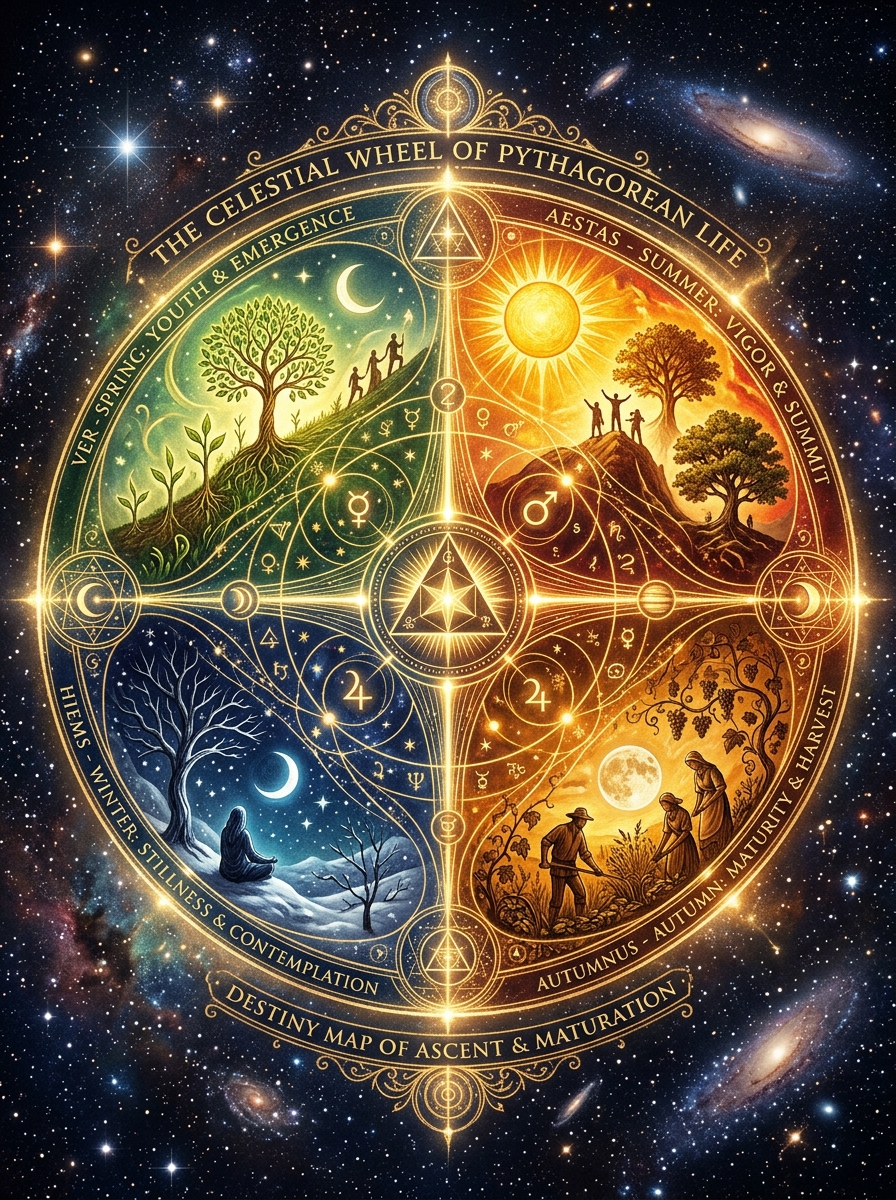
Introduction to the Pinnacles of Life: The Seasons of the Soul
In the modern quest for self-knowledge, we often treat life as a linear progression—a series of neat, predictable steps from education to career, relationship, and retirement. Yet, anyone who has navigated a sudden, inexplicable shift in their inner drive knows that human existence does not unfold along a straight line. Instead, it moves in vast, rhythmic tides. Pythagorean numerology maps these overarching currents through the concept of the Pinnacles of Life. The Pinnacles represent four distinct developmental and spiritual epochs, or "existential seasons," that govern our life path. Each Pinnacle exerts a specific energetic pressure, shaping our focus, altering our values, and presenting us with a unique set of developmental tasks.
Unlike short-term personal years or month-to-month astrological transits, a Pinnacle is a macro-cycle. The first Pinnacle covers our youth and early adulthood, establishing the foundation of our personality and ego structures. The middle two Pinnacles guide our mature productive years, testing our resilience, expanding our relational capacities, and prompting us to build a legacy. The fourth and final Pinnacle spans our elder years, shifting our attention toward integration, wisdom, and spiritual culmination. When we understand which Pinnacle we are currently traversing, we stop swimming against the current of our lives. We learn to cooperate with the prevailing winds of our destiny, recognizing that a season of solitude is not a failure of connection, nor is a season of intense material ambition a diversion from spiritual growth.
Chronos versus Kairos: The Nature of Qualitative Time
To fully appreciate the mechanism of the Pinnacles, we must distinguish between two ancient Greek concepts of time: Chronos and Kairos. Chronos is quantitative time—the mechanical ticking of the clock, the linear sequence of minutes, days, and calendar years. It is chronological, predictable, and indifferent to human experience. Modern Western society is deeply obsessed with Chronos, measuring success and worth by how much we can produce or consume within a given timeframe.
Kairos, on the other hand, is qualitative time. It represents the "opportune moment," the season of readiness, or the right time for action. It is time measured not by duration, but by significance and potential. The Pinnacles of Life operate entirely within the realm of Kairos. They do not care about arbitrary social expectations or standard timelines; instead, they dictate when the soul is ripe for specific initiations.
When we enter a new Pinnacle, we step into a new Kairos. The numeric vibration of that Pinnacle colors the atmosphere of our lives, dictating what kind of experiences will bear fruit and which will meet resistance. If a person is in a Pinnacle governed by the cooperative, inward-facing energy of the number 2, forcing a hyper-aggressive, solo business venture (more suited to a 1 or 8 Pinnacle) will feel like swimming upstream against a torrent. By aligning ourselves with the qualitative rhythm of our current Pinnacle, we honor the organic timing of our personal evolution, understanding that just as winter cannot be rushed into spring, the deep introspection of an analytical cycle cannot be forced into premature external display.
The Jungian Lens: Pinnacles as the Architecture of Individuation
The transition through the Pinnacles is not merely a sequence of external events; it is a psychological process of profound depth. We can understand this journey most clearly by framing it through the analytical psychology of Carl Gustav Jung, specifically his concept of individuation. Individuation is the lifelong developmental process through which an individual integrates the conscious and unconscious aspects of their psyche, moving toward wholeness and realizing their unique potential.
Jung observed that the human psyche undergoes dramatic structural changes as it transitions from the first half of life to the second. In the first half, our primary psychological task is ego-development: adapting to the external world, establishing a career, finding a partner, and securing our place in society. The first Pinnacle corresponds directly to this phase, providing the raw material and environmental challenges necessary to build a functional ego. However, as we cross the threshold into the second half of life—typically during the transition between the first and second Pinnacles—the psyche's demands shift. The ego must surrender its illusion of absolute supremacy and align itself with the Self, the organizing center of the total psyche.
The Persona Shift: Adapting to New Existential Demands
As we transition from one Pinnacle to the next, we are forced to undergo what Jung termed a "Persona shift." The Persona is the social mask we wear to adapt to the expectations of society, protect the ego, and facilitate interpersonal relations. A healthy Persona is flexible; it changes depending on our role, environment, and stage of life. However, it is common to become over-identified with our Persona, confusing our social mask with our true identity.
A change in Pinnacle energy disrupts this identification. For example, if a person spent their first Pinnacle under the influence of a highly independent, self-assertive 1 energy, they may have constructed a Persona of the self-reliant, invulnerable pioneer. If their second Pinnacle shifts to the relational, sensitive vibration of the 2, their old Persona will suddenly feel constricting, brittle, and ineffective. They will experience an existential friction, feeling as though their old ways of relating to the world no longer work. This friction is not a sign of psychological regression, but an invitation to dismantle the rigid structures of the old Persona and allow a more authentic, integrated version of the self to emerge.
Shadow Integration and the Mid-Life Transition
The shift between the first and second Pinnacles, or the second and third, often coincides with the classic mid-life transition—a period characterized by a profound re-evaluation of one's life choices, relationships, and identity. Psychologically, this transition requires us to confront our Shadow—the hidden, repressed, or unacknowledged parts of ourselves that did not fit into our early ego structure or the demands of our initial Pinnacle.
If our early life was dominated by a drive for material success and external validation (often seen in 4 or 8 Pinnacles), the Shadow may contain our suppressed artistic impulses, our vulnerability, and our need for spiritual connection. During the transition between Pinnacles, these repressed elements break through the surface of consciousness, demanding to be seen. As Liz Greene, a pioneer of psychological astrology, notes, the crises of mid-life are not random disasters, but the psyche's desperate attempts to restore balance. By integrating the Shadow qualities highlighted by our new Pinnacle, we move closer to the ideal of Jungian wholeness, transforming what was once a source of internal conflict into a wellspring of creative energy and wisdom.
The Mathematics of Cosmic Maturity: The Pythagorean Rule of 36
Pythagorean numerology rests on the premise that numbers are not merely symbols of quantity, but the fundamental energetic building blocks of the universe. Pythagoras of Samos taught that "all things are number," suggesting that cosmic order is built on mathematical ratios and geometric principles. To calculate the timing of the Pinnacles, numerology uses a formula known as the "Rule of 36." This calculation determines the exact age at which an individual transitions from their first Pinnacle to their second, thereby locking in the timing for all subsequent cycles.
The calculation is straightforward: we subtract the individual's Life Path Number (which must be reduced to a single digit, 1 through 9, even if it is a Master Number like 11 or 22 for the purposes of this specific calculation) from the number 36. The resulting number is the age at which the first Pinnacle ends. For example:
- If a person has a Life Path Number of 1, their first Pinnacle ends at age 35 (36 - 1 = 35).
- If a person has a Life Path Number of 7, their first Pinnacle ends at age 29 (36 - 7 = 29).
- If a person has a Life Path Number of 11, we reduce it to 2 (1 + 1 = 2) for this step, meaning their first Pinnacle ends at age 34 (36 - 2 = 34).
Once the first Pinnacle ends, the second and third Pinnacles each last for exactly nine years, corresponding to a full cycle of the numbers 1 through 9. The fourth Pinnacle then begins and remains active for the rest of the individual's life.
Why 36? The Sacred Geometry of the Tetraktys
To understand why the number 36 is the cornerstone of this cycle, we must look to ancient Pythagorean cosmology and the sacred symbol of the Tetraktys. The Tetraktys is a triangular figure consisting of ten points arranged in four rows (1, 2, 3, and 4 points respectively). For the Pythagoreans, this symbol was holy, representing the organization of space, the four classical elements (earth, air, fire, water), and the harmony of the spheres.
      *          (1)
     * *         (2)
    * * *        (3)
   * * * *       (4)
The number 36 is deeply connected to this geometry. It is the sum of the first four cubes: $$1^3 + 2^3 + 3^3 + 4^3 = 1 + 8 + 27 + 64 = 100$$ But more directly, 36 is the product of the first four numbers in the Tetraktys when integrated through specific astronomical and geometric ratios. In classical astrology and ancient mathematics, 36 degrees represents a decan (one-tenth of a zodiacal sign), and a full circle of 360 degrees is ten times this fundamental unit. Furthermore, 36 is a triangular number (the sum of integers from 1 to 8: $1+2+3+4+5+6+7+8=36$), signifying completion and cosmic maturity.
In human development, the age of 36 represents the point at which our physical, emotional, and mental structures reach full maturity. It is the age when the brain's prefrontal cortex is long established, and our societal conditioning has been thoroughly tested by real-world experience. By anchoring the transition of the first Pinnacle to this mathematical constant, Pythagorean numerology aligns human developmental cycles with the geometry of the cosmos, ensuring that our deepest spiritual transitions occur when our psychological vessels are strong enough to contain them.
Step-by-Step Calculation: Mapping Your Four Pinnacles
To map your own Pinnacles, you will need your full date of birth: month, day, and year. We will walk through the calculations step-by-step, using the birth date of October 14, 1989 as our working example.
Calculating Your Life Path Number
Before finding the Pinnacles, we must determine the Life Path Number, which represents the core theme of your journey and dictates your transition ages.
- Reduce the Month: October is the 10th month. Reduce it to a single digit: $1 + 0 = 1$.
- Reduce the Day: The day is 14. Reduce it: $1 + 4 = 5$.
- Reduce the Year: The year is 1989. Add the digits: $1 + 9 + 8 + 9 = 27$. Reduce 27: $2 + 7 = 9$.
- Sum the Reduced Units: Add the reduced values of the month, day, and year: $1 + 5 + 9 = 15$.
- Reduce to the Final Life Path Number: Reduce 15: $1 + 5 = 6$.
The Life Path Number for this birth date is 6. (Note: If the sum yields a Master Number like 11, 22, or 33, you would keep it as such for your general Life Path, but reduce it to 2, 4, or 6 to calculate your Pinnacle ages).
Using the Rule of 36, we determine the age ranges for this individual's Pinnacles:
- First Pinnacle Age Range: From birth until age 30 ($36 - 6 = 30$).
- Second Pinnacle Age Range: Ages 30 to 39 (First Pinnacle Age + 9 years, so $30 + 9 = 39$).
- Third Pinnacle Age Range: Ages 39 to 48 ($39 + 9 = 48$).
- Fourth Pinnacle Age Range: Age 48 and beyond.
Computing the Four Pinnacle Values
Now that we have the age ranges, we calculate the specific energetic number for each of the four Pinnacles. We use the reduced values of the Month (M), Day (D), and Year (Y). For our example: M = 1, D = 5, Y = 9.
First Pinnacle: The Season of Roots
The First Pinnacle is calculated by adding the reduced Month of birth to the reduced Day of birth. $$\text{First Pinnacle} = M + D$$ Using our example: $$\text{First Pinnacle} = 1 + 5 = 6$$ For this individual, the first 30 years of life are governed by the vibration of the number 6, emphasizing family responsibilities, community integration, and domestic harmony.
Second Pinnacle: The Season of Action
The Second Pinnacle is calculated by adding the reduced Day of birth to the reduced Year of birth. $$\text{Second Pinnacle} = D + Y$$ Using our example: $$\text{Second Pinnacle} = 5 + 9 = 14$$ Reduce 14: $1 + 4 = 5$. From age 30 to 39, this individual's path is governed by the dynamic, adventure-seeking, and freedom-loving energy of the number 5.
Third Pinnacle: The Season of Integration
The Third Pinnacle is calculated by adding the First Pinnacle value to the Second Pinnacle value before they were reduced to single digits, or simply adding their reduced values and reducing again. In standard practice, we add the First Pinnacle and Second Pinnacle values: $$\text{Third Pinnacle} = \text{First Pinnacle} + \text{Second Pinnacle}$$ Using our example: $$\text{Third Pinnacle} = 6 + 5 = 11$$ Here, we arrive at a Master Number 11. Master Numbers (11 and 22) are generally not reduced when they appear as Pinnacle values, as they indicate a period of intense spiritual awakening and psychic sensitivity. From age 39 to 48, this person will navigate the high-frequency demands of the Master Number 11.
Fourth Pinnacle: The Season of Culmination
The Fourth Pinnacle is calculated by adding the reduced Month of birth to the reduced Year of birth. $$\text{Fourth Pinnacle} = M + Y$$ Using our example: $$\text{Fourth Pinnacle} = 1 + 9 = 10$$ Reduce 10: $1 + 0 = 1$. From age 48 onward, this individual's elder years will be governed by the independent, pioneering, and self-determining energy of the number 1.
The Alchemy of Transition: Restlessness, Dissolution, and Rebirth
The transition from one Pinnacle to the next is rarely a seamless, overnight event. Instead, it resembles an alchemical process of purification and restructuring. Esoteric philosophy speaks of the process solve et coagula—dissolve and coagulate. Before a new, higher order of consciousness (coagulation) can establish itself, the old, rigid structures of our identity, lifestyle, and relationships must be broken down and dissolved (solution).
This psychological dissolution typically begins roughly two years prior to the official mathematical transition age. During this pre-transition window, individuals often experience a deep, pervasive sense of restlessness or existential malaise. This is what Steven Forrest, in his evolutionary astrological work, describes as the "fading of the old light." The activities, careers, and social circles that once brought satisfaction suddenly feel hollow. We may feel a mounting frustration, an urge to run away, or an inexplicable sense of grief.
It is vital to understand that this restlessness is not a sign of failure or depressive pathology; it is the psyche's anticipatory response to an incoming energetic shift. The current Pinnacle has yielded all the lessons it can offer. The soil of our life must lie fallow for a time, allowing the old crop to decompose so that it can nourish the seeds of the next season.
[ Active Pinnacle Phase ] ---> [ 2-Year Pre-Transition Restlessness (Solve) ] ---> [ Shift Age ] ---> [ Integration & Rebirth (Coagula) ]
Navigating this identity shift requires radical self-compassion and patience. When we resist the dissolution phase, trying desperately to cling to our old roles, we prolong the crisis, turning necessary developmental pain into unnecessary suffering. By consciously engaging with the alchemical process—allowing our outdated goals to fall away and accepting the temporary confusion of the liminal space—we create the fertile ground required for the new Pinnacle energy to take root.
Archetypal Energies of the Pinnacle Numbers
When a Pinnacle number is active, it colors the entire narrative of that phase of life. Below are the archetypal interpretations of the numbers, blending their psychological themes with practical life circumstances.
Pinnacle Number 1: The Pioneer and the Self-Determined Path
When a cycle is governed by the 1, the primary developmental task is the cultivation of independence, courage, and self-reliance. This is a time to stand on your own two feet, free from the expectations of family or society.
- Psychological Atmosphere: Focus on self-discovery, ego-strengthening, and overcoming codependency. You are challenged to find your voice.
- Practical Themes: Starting a new business, changing careers, living alone, or taking on leadership roles. It can sometimes feel lonely, but this solitude is necessary to forge a strong, unshakeable sense of self.
Pinnacle Number 2: The Diplomat and the Art of Relationship
The 2 Pinnacle shifts the focus from the individual ego to the space between self and other. It is a period dedicated to cooperation, sensitivity, and the slow, patient cultivation of relationships.
- Psychological Atmosphere: Heightened empathy, emotional sensitivity, and a need for inner peace. The challenge is learning to cooperate without losing your identity.
- Practical Themes: Partnerships, marriage, collaborative artistic projects, mediation, and work that requires diplomacy. Success during this phase comes through patience and attention to detail rather than force.
Pinnacle Number 3: The Creator and the Joy of Expression
A 3 Pinnacle is a vibrant, expressive, and social era. The energy is expansive and creative, urging you to share your ideas, emotions, and talents with the wider world.
- Psychological Atmosphere: Optimism, playfulness, and a strong drive for artistic or verbal expression. The primary trap is superficiality, scattering energy, or running from difficult emotions.
- Practical Themes: Writing, public speaking, acting, design, socializing, and travel. This is a season to cultivate joy, embrace community, and trust your creative impulses.
Pinnacle Number 4: The Builder and the Solid Foundation
Under a 4 Pinnacle, the universe demands discipline, order, and hard work. This is the season of practical construction, where you lay down the roots and build structures that will endure.
- Psychological Atmosphere: Focus on stability, patience, reliability, and facing reality. It requires mental fortitude and a willingness to handle routine tasks.
- Practical Themes: Buying property, building a home, establishing long-term business systems, financial planning, and mastering a craft. It can feel restrictive, but the structure you build now is what supports your future freedom.
Pinnacle Number 5: The Explorer and the Wind of Change
A 5 Pinnacle is a whirlwind of movement, freedom, and unexpected opportunities. It is the absolute antithesis of the 4 Pinnacle, demanding flexibility and a willingness to embrace the unknown.
- Psychological Atmosphere: Restlessness, curiosity, desire for adventure, and a need to break free from limitations. The danger is impulsivity and lack of direction.
- Practical Themes: Career changes, frequent travel, relocation, public relations, media work, and experiencing diverse cultures. This cycle teaches you to find stability within yourself amidst a changing outer landscape.
Pinnacle Number 6: The Guardian and the Sacred Duty
The 6 Pinnacle is centered on the home, family, community, and service. It is a deeply nurturing but demanding cycle where you are called to take responsibility for the well-being of others.
- Psychological Atmosphere: Love, duty, idealism, and a powerful urge to heal, protect, and beautify your surroundings. The challenge is avoiding self-sacrifice, codependency, and perfectionist control.
- Practical Themes: Marriage, raising children, caring for aging parents, community leadership, teaching, counseling, and creative endeavors that enhance harmony.
Pinnacle Number 7: The Sage and the Inner Temple
The 7 Pinnacle is a deeply introverted, spiritual, and intellectual epoch. The outer world recedes in importance as you are drawn inward to search for deeper truths, study esoteric wisdom, or master a specialized field of knowledge.
- Psychological Atmosphere: Solitude, skepticism, introspection, and a need for mental clarity. It is a time for analyzing your life and developing your intuition.
- Practical Themes: Research, writing, scientific study, spiritual practices, meditation retreats, and solitary work. Trying to achieve material expansion during this phase is often frustrating; the true rewards are intellectual and spiritual.
Pinnacle Number 8: The Sovereign and the Arena of Power
The 8 Pinnacle is the cycle of material success, authority, and executive power. The universe challenges you to step into the public arena, direct resources, and master the physical world.
- Psychological Atmosphere: Ambition, efficiency, judgment, and the confrontation with personal power and authority. The trap is greed, ruthlessness, or fear of failure.
- Practical Themes: Business leadership, financial investments, managing large-scale projects, legal matters, and achieving recognition. This cycle demands that you align material power with ethical integrity.
Pinnacle Number 9: The Humanitarian and the Art of Release
The 9 Pinnacle is a cycle of completion, universal love, and letting go. It represents the end of a grand cycle, demanding that you surrender personal desires in favor of humanitarian concerns.
- Psychological Atmosphere: Compassion, tolerance, artistic sensitivity, and philosophical integration. It is a period of emotional cleansing and releasing attachments.
- Practical Themes: Philanthropy, teaching, artistic expression on a global scale, concluding long-term projects, and saying goodbye to relationships or situations that no longer serve your growth.
Master Number 11: The Visionary and the Electric Channel
When the 11 is active as a Pinnacle, the individual experiences a highly charged, spiritualized environment. It is a path of high psychic sensitivity and spiritual leadership, requiring a strong, grounded psychological foundation.
- Psychological Atmosphere: Intense intuition, nervous energy, visionary insights, and a feeling of being a channel for higher truth. The primary risk is anxiety, mental overload, or feeling misunderstood.
- Practical Themes: Spiritual teaching, counseling, revolutionary creative work, writing, and inspiring others. This is a calling to live in alignment with absolute integrity.
Master Number 22: The Master Builder and the Cosmic Blueprint
The 22 Pinnacle is the rarest and most demanding cycle. It combines the spiritual vision of the 11 with the practical, systematic building capability of the 4, challenging the individual to ground vast, idealistic dreams into physical reality.
- Psychological Atmosphere: A sense of monumental responsibility, global vision, and the pressure of executing large-scale projects.
- Practical Themes: International organizations, major architectural or ecological projects, writing seminal texts, and creating institutions that outlast the individual. It requires immense dedication, physical endurance, and absolute selflessness.
Frequently Asked Questions
What happens if my Pinnacle number is different from my Life Path Number?
It is extremely common for your Pinnacle numbers to differ from your Life Path Number, and this is actually developmental. Your Life Path Number represents the core lessons, traits, and purpose of your entire life. Your Pinnacles represent the shifting environments and seasonal stages through which you learn those lessons. For example, if you have a Life Path 1 (independent pioneer) but find yourself in a 2 Pinnacle (cooperation and relationship), the universe is teaching you how to maintain your independence and self-determination while navigating the complexities of close partnerships. The friction between your core nature and your current season is where psychological growth occurs.
Can a transition between Pinnacles cause a career crisis or relationship breakdown?
Yes. Because a change in Pinnacle represents a fundamental shift in your psychological needs and life values, it often triggers external shake-ups. The two-year transition window is a common period for career changes, divorces, relocations, or sudden shifts in spiritual orientation. These disruptions are not random; they are the external manifestation of your inner self rejecting structures that no longer align with your developmental needs. When the old light fades, trying to force yourself to stay in the exact same configuration will lead to intense friction and burnout.
Why do some numerologists reduce Master Numbers in the Pinnacles while others do not?
In classical Pythagorean numerology, the Master Numbers 11 and 22 are held to a higher vibrational standard. When they appear in calculations for the Pinnacles, many esoteric practitioners keep them intact because these cycles represent periods of intense spiritual activation and calling that differ qualitatively from the single-digit cycles of 2 and 4. However, because the high voltage of Master Numbers is difficult to maintain constantly, individuals in an 11 or 22 Pinnacle will also experience the daily, practical reality of the corresponding reduced numbers (2 or 4, respectively). Both levels of the archetype remain active.
How do Pinnacles differ from Personal Years?
The difference is one of scale and depth. A Personal Year change occurs every year on your birthday (or at the start of the calendar year, depending on the system used), representing a short-term theme or flavor for that twelve-month period. A Pinnacle, by contrast, is a massive developmental epoch lasting between nine and thirty-five years. If a Personal Year is like the weather on a given week, a Pinnacle is the climate zone you are living in. You will experience nine different Personal Years within the span of a single mid-life Pinnacle, with each Personal Year showing how the overarching Pinnacle theme expresses itself in short-term cycles.
Is it possible to fail a Pinnacle cycle?
From a psychological perspective, there is no "failure," only delayed integration. If an individual strongly resists the lessons of an active Pinnacle—for instance, refusing to take responsibility in a 6 cycle, or clinging to codependent habits in a 1 cycle—they will experience heightened anxiety, frustration, and a sense of being blocked by external circumstances. The universe will continue to present similar challenges until the lesson is integrated. However, the soul is resilient, and the subsequent Pinnacles will offer new opportunities to integrate the lessons that were bypassed in earlier seasons.
Comments
Loading comments…