Neptune in Sagittarius: The Mystic Horizon and the Generation That Rewrote Belief
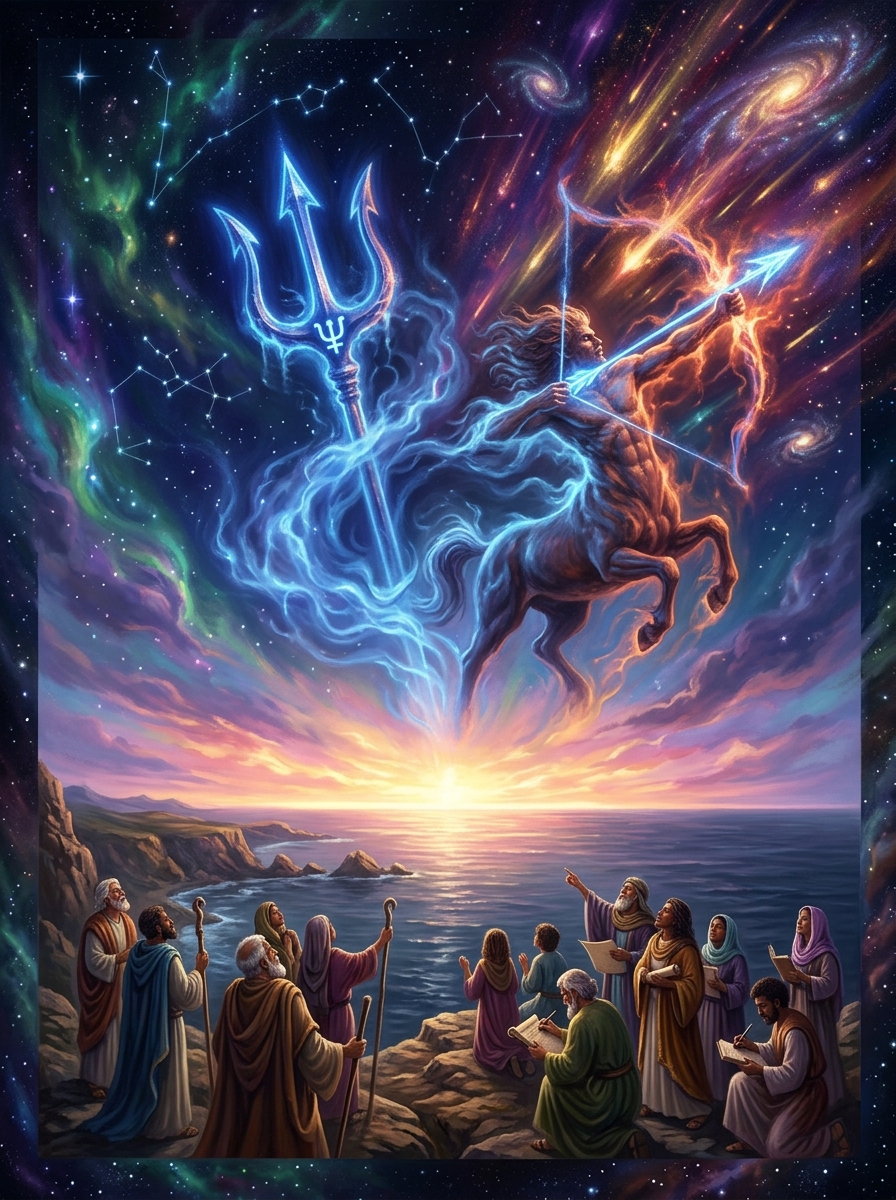
The Generational Archetype of Neptune in Sagittarius (1970–1984)
A Planet That Moves in Generations
Neptune takes approximately 165 years to complete one orbit of the sun, spending roughly fourteen years in each sign. When astrologers speak of Neptune's natal placement, they are speaking not just of an individual but of a cohort — a generation stamped with a shared psychological and spiritual watermark. Neptune in Sagittarius was active from January 1970 to November 1984, with brief retrogrades brushing late Scorpio at the transit's edges, meaning anyone born in that window carries this configuration as a generational signature regardless of their Sun sign, Moon, or Ascendant.
This distinction is crucial for readers first encountering their natal chart. Neptune in Sagittarius is not "your personality" in the way that Mercury or Venus placements are. It is something more like the aquifer beneath the landscape — the invisible water table that feeds how an entire generation approaches meaning, transcendence, and belief. Liz Greene, whose landmark The Outer Planets and Their Cycles remains essential reading for any serious student of generational astrology, describes the outer planets as "the hand of fate operating through the collective." Neptune in Sagittarius is exactly that: a collective dreaming given specific direction by the archer's bow.
The personal dimension of this placement comes through the natal house it occupies, through any close aspects it forms to your personal planets, and through the way the broader generational theme has been individualized by your full chart. Two people born in 1977 may share Neptune in Sagittarius but express it in radically different ways depending on whether that Neptune sits in the 12th house or the 3rd, whether it trines the Sun or squares Saturn. The generational wave is the same; the surfboard and the ride are uniquely yours.
The 1970–1984 Window in Historical Context
The transit began in the crucible of late-1960s countercultural dissolution. The decade that Neptune in Sagittarius would shape opened with the Beatles having just returned from Rishikesh, with the Esalen Institute already running its human potential seminars in Big Sur, and with the first wave of Eastern teachers establishing permanent roots in American soil. The cultural ground was primed for a spiritual expansion that would be distinctly Sagittarian in character: outward-facing, freedom-seeking, philosophically voracious, and drawn compulsively toward what lay beyond the horizon — culturally, geographically, and cosmologically.
By the time Neptune cleared Sagittarius in 1984, it left behind a generation that had grown up watching parents practice Transcendental Meditation, who had seen Eastern teachers become household names, who had watched metaphysical bookstores multiply in every American city. The New Age was not a fringe curiosity to this generation. It was the cultural furniture of their childhood, as ordinary and as invisible as the air.
What makes Neptune in Sagittarius historically distinctive is its sheer scope of spiritual democratization. Where previous generations had encountered transcendence primarily through established churches or through the intellectual filter of academic theology, the Neptune in Sagittarius generation inherited a spiritual landscape without fences — a vast, open plain of traditions, practices, and teachings from every corner of the globe, available to anyone willing to seek.
Alchemy of Water and Fire: The Mystical Vapor of Belief
Neptune's Archetypal Language
In the language of esoteric astrology, Neptune governs the dissolution of boundaries, the longing for oceanic unity, and the transcendence of the personal ego into something larger. Its mythological identity — the Roman sovereign of the deep sea, correspondent to Greek Poseidon — speaks to the primordial, undifferentiated waters that preexist form and persist beneath it. Neptune does not build; it dissolves. It does not define; it blurs. Its gifts are vision, compassion, mystical receptivity, and the capacity for profound empathy. Its perils are delusion, escapism, the loss of the self in fantasy or the fantasies of others.
In psychological terms, Neptune corresponds to what C.G. Jung identified as the experience of the unus mundus — the underlying unity beneath the multiplicity of manifest reality — and to the numinous encounters that rupture the everyday membrane of consensus experience. When Neptune is activated, either by transit or by natal prominence, ordinary life becomes transparent: behind the surface of things, a vast and breathing depth makes itself felt. The question Neptune always poses is how to hold that depth without drowning in it.
Steven Forrest, in The Inner Sky, describes Neptune's essential challenge as the need "to make the mystical practical" — to find a container sturdy enough to hold the dissolution without losing oneself entirely in the oceanic. That container, in Neptune in Sagittarius, is provided by the sign itself.
Sagittarius as the Directional Thrust
Sagittarius, a mutable fire sign ruled by Jupiter, provides something Neptune alone cannot: direction. Sagittarius is the archer, and the archer always has a target on the horizon. Where Scorpio — the sign Neptune had just vacated — turned the gaze inward and downward into the underworld of the psyche, Sagittarius throws it outward and upward toward the far ridge. The Sagittarian impulse is always toward expansion: the foreign land, the undiscovered philosophy, the teacher who holds keys that your current tradition cannot provide.
When Neptune enters Sagittarius, the result is something the alchemical tradition would recognize immediately: steam. The formless, dissolving quality of water is given velocity and direction by fire. Belief becomes expansive, syncretic, and fervent. The spiritual impulse no longer seeks to penetrate darkness (Neptune in Scorpio) but to journey toward light. This is the archetype of the mystical traveler — Rumi's lover pursuing the Beloved across continents, or the American seeker in the 1970s boarding a flight to New Delhi in search of what the Western church could not offer.
The Chemical Marriage of Water and Fire
The alchemical tradition — which both Aleister Crowley's system of ceremonial magick and Jung's Psychology and Alchemy drew upon extensively — called the conjunction of opposites the coniunctio. Water meeting fire does not simply extinguish one or boil off the other; in the alchemical imagination, a third substance emerges: the philosophical vapor, something that partakes of both elements while being fully neither.
Neptune in Sagittarius produces exactly this kind of spiritual vapor — a longing for transcendence that is neither the cold abyss of pure Neptunian dissolution nor the aggressive ideology of pure Sagittarian fire, but something effervescent and hard to pin down. This vapor quality defines the generation's characteristic relationship with spiritual systems. The Neptune in Sagittarius native rarely settles permanently into a single tradition. They are drawn magnetically to synthesis — to the recognition that Vedanta, Sufism, Jungian depth psychology, Tibetan Buddhist tantra, and indigenous shamanic practice are all fingers pointing at the same moon. This is a beautiful and genuinely sophisticated intuition. It is also, as we will examine at length, a source of characteristic difficulty.
The Historical Wave: The New Age Movement and the Guru Phenomenon
The Cultural Signature of Every Neptune Transit
Every Neptune transit through a sign produces a cultural wave corresponding to that sign's archetypal territory. Neptune in Libra (1942–1957) coincided with postwar idealism about relationships, partnership, and international cooperation — the United Nations, the Marshall Plan, and the romantic mythology of the nuclear family all emerged under this transit's sky. Neptune in Scorpio (1956–1970) coincided with the sexual revolution, the psychedelic movement, the assassinations that tore consensus reality open, and a widespread cultural fascination with death, taboo, and the occult.
Neptune in Sagittarius picked up exactly where Scorpio left off and exploded the vertical shaft of psychic depth into a horizontal panorama of philosophical possibility. The themes of Sagittarius — religion, philosophy, foreign cultures, higher education, publishing, the law, and the search for ultimate meaning — were all flooded with Neptunian idealism and spiritual longing. The result was one of the most dramatic reconfigurations of religious life in American history.
The Rise of the New Age
The New Age movement is inseparable from Neptune in Sagittarius. While its roots stretch back through Theosophy, Anthroposophy, and the Western esoteric tradition of the nineteenth century, the movement's popular breakthrough and cultural saturation occurred precisely during Neptune's Sagittarian transit. The combination of Neptune's spiritual idealism with Sagittarius's publishing instinct produced an explosion of metaphysical literature unlike anything seen before: Ram Dass's Be Here Now (1971), Fritjof Capra's The Tao of Physics (1975), Shirley MacLaine's Out on a Limb (1983), and hundreds of titles that moved consciousness-related subject matter from occult specialty shops into mainstream bookstores.
The New Age was Sagittarian in its most characteristic feature: its insistence on synthesis. Where traditional religions maintained doctrinal boundaries — this is the truth, that is heresy — the New Age framework dissolved those distinctions. Astrology, past-life regression, crystal healing, channeled entities, Jungian psychology, and Tibetan Buddhism could all coexist within a single seeker's practice. This is Neptune's dissolving of boundaries operating through Sagittarius's expansive philosophical hunger.
A.E. Waite, whose scholarship on mysticism and Western esotericism provided foundational vocabulary for later generations of practitioners, wrote about the perennial philosophy — the idea that a single truth underlies all religious expressions, that the diversity of traditions is a diversity of languages pointing at the same ineffable reality. The Neptune in Sagittarius generation is the most naturally attuned of any modern cohort to this perennialist intuition. They read Huston Smith and Aldous Huxley and experienced deep recognition rather than mere intellectual assent.
The Guru Phenomenon: Neptune's Most Complex Legacy
The guru phenomenon is perhaps the psychologically richest and most consequential legacy of Neptune in Sagittarius, and it demands careful examination. Neptune's archetypal function involves the dissolution of ego boundaries, the longing for merger with something vast and holy. When this function is activated through Sagittarius's Jupiter-ruled idealism, the result is the projection of divine perfection onto a human teacher — a dynamic as old as organized religion, but given extraordinary amplification by the cultural moment.
The Jungian analyst James Hollis has written extensively about the role of transference in both spiritual and therapeutic relationships — the way the psyche's deepest longing for the numinous naturally attaches itself to a container, usually a human one. The problem arises not in the initial projection, which can carry real wisdom and genuine transmission, but when neither teacher nor student can hold the projection without inflating it into a demand for the teacher's infallibility.
The 1970s and early 1980s produced numerous high-profile cases of guru inflation and subsequent collapse: charismatic spiritual organizations that built powerful communities and then fractured under the weight of their leaders' unaddressed shadow material. In each case, the Neptunian idealization that had drawn thousands into proximity with genuine spiritual teaching eventually encountered the all-too-human reality behind the projected divinity.
Steven Forrest describes this dynamic with characteristic precision in Yesterday's Sky: the Neptune in Sagittarius generation carries a wound around idealized authority — spiritual, philosophical, sometimes intellectual. Having projected the archetype of the Wise Teacher onto figures who ultimately proved mortal, they must eventually reclaim that projected wisdom as their own interior resource. The teacher who falls from grace, in this reading, is paradoxically doing the student a profound service — forcing the development of the inner guru that had been outsourced.
The Sacred Horizon: Travel, Pilgrimage, and the Quest for Foreign Wisdom
Sagittarius and the Numinosity of Distance
Sagittarius is the sign most profoundly associated with foreign lands, foreign philosophies, and the transformative encounter with what lies beyond the familiar. Under Jupiter's rulership, Sagittarius operates on the faith — and it is specifically faith, the fire sign's characteristic mode of knowing — that the truth is somewhere over the next ridge, in the next country, in the teaching of the teacher whose language you haven't yet learned.
Neptune, as the principle of dissolution, erases the boundary between self and world. When Neptune operates through Sagittarius, the result is a kind of sacred longing for the foreign — not mere tourism, but pilgrimage in the fullest sense of that word. The places one travels become numinous containers. The encounter with another culture's spiritual practice doesn't register as an intellectual exercise but as an existential homecoming to a home the traveler never knew they had.
This is the mystical geography of Neptune in Sagittarius: the world as a temple, foreign cultures as chapters of a scripture, and the self as a pilgrim whose identity is continuously remade by the encounter with otherness.
The Backpacker as Pilgrim, the Ashram as America
The 1970s and early 1980s produced a distinctly American form of spiritual travel that is inseparable from Neptune in Sagittarius's cultural signature. The overland trail from Europe through Turkey, Iran, Afghanistan, and Pakistan to India. The ashrams of Rishikesh and Pune drawing tens of thousands of Western practitioners. The Tibetan Buddhist refugee communities in Dharamsala opening their teachings to American students. The Sufi orders of Turkey and Morocco welcoming seekers from New York and California who had read Idries Shah and Rumi in translation.
At its best, this movement represented a genuine Neptunian dissolution of cultural ego — the willingness to be made strange, to sit at the feet of teachers from utterly different cosmological frameworks, to let a foreign symbol system reorganize one's inner landscape in ways that the familiar vocabulary simply could not reach. The American student who emerged from three months in an Indian ashram was genuinely different from the one who had arrived — not because they had acquired new information, but because the encounter with genuine otherness had dissolved some of the invisible assumptions that structure ordinary perception.
The Difference Between Journey and Flight
Yet Neptune in Sagittarius also carries the shadow side of its greatest gift. The same impulse that sends the seeker on a genuine pilgrimage can also be a flight from ordinary life, from ordinary relationship, from the demands of the present moment. Neptune's function is always potentially escapist — the longing for the oceanic can be a longing to escape the bounded, the embodied, the particular.
Liz Greene, in The Astrological Neptune and the Quest for Redemption — her definitive psychological study of Neptune's archetypal operation — identifies this shadow with characteristic precision. The horizon, she argues, is Neptune's most seductive illusion: always visible, always promising, always retreating as one approaches. The spiritual traveler who mistakes the journey for the destination will travel forever and arrive nowhere, accumulating experiences without being genuinely changed by any of them. The point of pilgrimage is not the distance covered but the dissolution that genuine encounter makes possible. And genuine encounter, Greene suggests, requires staying still long enough to let what is foreign actually work on you — which is precisely what perpetual motion prevents.
The Shadow Side: Spiritual Bypass and the Mirage of the Absolute
Naming What Can Go Wrong
No responsible astrological analysis of Neptune in Sagittarius can avoid examining its characteristic shadow expressions. These are not moral failures or personal weaknesses but archetypal risks — the specific ways the highest expression of a placement can collapse into its distortion under the pressure of unexamined fear, unresolved wound, or simple human limitation. Naming them is not criticism. It is the honest cartography that makes conscious navigation possible.
The psychologist John Welwood coined the term "spiritual bypass" in 1984 — at the precise moment Neptune was completing its Sagittarian transit — to describe the use of spiritual beliefs and practices to avoid confronting unresolved psychological wounds. The concept has become central to contemporary contemplative psychology, and it maps with uncanny accuracy onto the characteristic shadow of this placement. Spiritual bypass is what happens when the Sagittarian fire of belief is used not to illuminate the inner landscape but to avoid entering it.
The Paradox of the Dogmatic Seeker
Neptune in Sagittarius's first shadow is paradoxical in a way that surprises people who expect mystical placements to produce open-minded individuals: a placement associated with dissolving rigid boundaries can produce a fierce new rigidity around spiritual beliefs. When the expanded consciousness promised by a teacher, a philosophy, or a practice doesn't arrive on schedule, or when accumulated disappointment with one system reaches a critical mass, the response can be a defensive crystallization into absolute conviction.
This is the shadow face of Sagittarian fire revealing itself through Neptune's intensity: the philosopher who became a fundamentalist, the syncretic seeker who found one system so satisfying that they stopped questioning, the person who traded one form of certainty for another and called it awakening. Neptune provides the oceanic certainty of mystical conviction; Sagittarius provides the philosophical architecture that explains and justifies it. The combination can produce individuals with an unshakeable sense that they have found the single truth — and the fire sign's characteristic bluntness makes them vigorous, sometimes aggressive advocates for it.
The Chronic Seeker and the Deferral of Arrival
The opposite shadow is the one Greene names most memorably: the perpetual student who can never arrive. Every tradition contains something real; every teacher reveals a partial truth; every book opens a genuine door — but no commitment is ever final, because commitment feels like the death of possibility. The horizon is always more interesting than the near ground.
This type may spend decades accumulating an impressive portfolio of spiritual experiences — years in a Zen monastery, years studying astrology, years with a Sufi order, years in a somatic trauma practice — and feel, beneath all that richness, a persistent incompleteness. Not because the experiences weren't real, but because none were ever allowed to root deeply enough for genuine transformation to become unavoidable. Transformation requires staying when every instinct says move on. It requires allowing disillusionment to do its work rather than moving to the next teacher before the current one has finished with you.
The Purifying Function of Disillusionment
The work, in Greene's framework, is not to abandon the quest but to allow the disillusionment that inevitably comes — with teachers, with systems, with the spiritual self — to do its necessary purifying work. Neptune's dissolutions are never accidental. The teacher who falls from grace, the philosophy that cannot hold the paradox of real suffering, the meditation retreat that produces crisis rather than peace — these are not failures of the spiritual path. They are the Neptune in Sagittarius curriculum itself: the gradual, sometimes brutal withdrawal of outer projections in service of the inner source that was always the actual destination.
Neptune in Sagittarius in the Natal Chart: Integration and Mature Spirituality
Reading the House Position
When interpreting Neptune in Sagittarius in a natal chart, the house placement is the primary key to how the generational archetype expresses personally. Neptune's dissolving, idealizing function will operate wherever the archer points — and the house shows which area of life becomes most charged with that particular quality of mystical voltage, longing, and the risk of disillusionment.
Neptune in Sagittarius in the 1st house creates an identity strongly woven from spiritual seeking and philosophical identity. These individuals often present as visionary, ethereal, or difficult to pin down — as though they are perpetually partly elsewhere. There is a natural magnetism and a quality of perceiving more than they can articulate, but also a genuine challenge in maintaining clear ego boundaries between self and the spiritual communities they inhabit.
Neptune in the 9th house — the house that Sagittarius naturally resonates with — amplifies the generational themes to near-unbearable intensity. Philosophy, religion, foreign cultures, and higher education all become sites of numinous significance. This placement frequently produces profound spiritual experiences, deep cross-cultural affinities, and sometimes genuine prophetic or visionary gifts. The corresponding shadow is equally pronounced: when a belief system fails, the 9th-house Neptune in Sagittarius native may experience something close to existential collapse, because the loss of the map feels like the loss of the territory itself.
Neptune in the 7th house consistently projects the teacher or savior archetype onto romantic and business partners. The chosen other carries the projection of divine wisdom; relationships become spiritual quests before they become human partnerships. The work here is the gradual recognition of the inner guru being given away — and the equally gradual development of the capacity to love a human being rather than a projected deity.
Neptune in the 4th house locates the sacred horizon in ancestry, home, and the roots of the psyche. These individuals may pursue spiritual lineage — tracing family heritage, exploring ethnic spiritual traditions, finding in the recovered history of a bloodline a form of cosmological grounding. There is often a numinous quality to the early home environment, whether felt as sacred or as chaotic and without boundary.
Aspects to Personal Planets: The Individual Voice of a Generational Theme
The integration of Neptune in Sagittarius into a fully realized individual spiritual life requires particular attention when it forms tight aspects — within roughly five degrees — to personal planets.
Sun conjunct or square Neptune in Sagittarius produces an identity fundamentally organized around transcendence and meaning-making. At its fullest expression, this is the archetype of the visionary — the individual whose sense of purpose is genuinely spiritual in character, who experiences life as a sustained encounter with something larger than personal ego. The shadow requires equal attention: without a solid philosophical container or a grounded spiritual practice, the Neptune-Sun conjunction can produce an identity that dissolves in the presence of charismatic teachers, that reorganizes itself around successive belief systems without ever locating a stable center.
Moon conjunct or trine Neptune in Sagittarius dissolves emotional boundaries through belief and practice. These individuals often carry genuine empathic and intuitive gifts — a natural permeability to the emotional frequencies of teachers, communities, and spiritual practices. The developmental work involves careful attention to boundaries: whose grief, whose ecstasy, whose longing is actually being felt? The Neptune-Moon trine in particular can produce a spiritual generosity of emotion that, unexamined, becomes a form of emotional self-erasure.
Mercury conjunct or sextile Neptune in Sagittarius generates visionary, synthetic thinking — the ability to perceive pattern across vast philosophical systems and to communicate across the gaps between them. This is the natural territory of the spiritual author, the teacher who translates numinous experience into language that others can use. At its shadow edge, Mercury-Neptune in Sagittarius produces persuasive mystical rhetoric that can be seductive precisely because it floats above the ground of embodied experience, appealing to the longing without delivering the substance.
Saturn aspecting Neptune in Sagittarius is often the key to the entire placement's integration. Saturn provides what Neptune alone cannot: the container, the discipline, the willingness to work consistently within a single form long enough for depth to become possible. The friction between Saturn and Neptune — the realist meeting the mystic — is precisely the creative tension that prevents Neptune in Sagittarius from remaining permanently in the beautiful but ultimately unsatisfying territory of perpetual seeking. The Neptune in Sagittarius native with a strong Saturn aspect learns, often through considerable pain, that the structure is not the enemy of transcendence. It is its prerequisite.
The Developmental Arc: From Projection to Internalization
The developmental arc of Neptune in Sagittarius — both for the generation and for the individual — describes a movement from projection to internalization. In youth, the Sagittarian fire aims toward outer teachers, outer traditions, and outer horizons. The Neptunian idealizing function loads these outer forms with divine significance that makes them magnetic, compelling, and ultimately too large for any human or institution to sustain indefinitely.
Disillusionment comes — and this is not a failure of the spiritual path but its most reliable teacher. The teacher who proved mortal, the philosophy that couldn't hold the full complexity of your experience, the tradition that turned out to be a human institution with all the limitations that implies — each of these disappointments is carrying an important message. What the disappointments collectively say is this: the source of what you were seeking was never out there.
The mature expression of Neptune in Sagittarius is the individual who has metabolized that message — not cynically, not by abandoning the quest, but by recognizing that the arrow and the archer were always the same. They can still travel without needing to flee. They can still study without requiring a final answer. They can still be moved by a great teacher without needing that teacher to be anything other than human.
Greene's most enduring observation about Neptune may be this: Neptune never gives us what we think we want. It gives us what we most deeply are, once all the temporary constructs have been dissolved by experience. For the Neptune in Sagittarius generation, what remains after the gurus, the pilgrimages, the philosophies, the initiation ceremonies, and the long process of disillusionment is something simultaneously simple and vast: the unmediated encounter with the living ground of awareness itself.
That is where the archer's arrow was always aimed. It turns out the horizon was inside.
Related
- Neptune in Capricorn: Redefining Authority and the Architecture of the Soul
- Neptune in the 9th House: The Sacred Pilgrimage of the Mystic Mind
- Neptune in Aquarius: The Generational Shift of Digital Consciousness
- Uranus in Sagittarius: The Generational Quest for Philosophical Freedom
- Neptune in Scorpio: The Generational Search for Spiritual Alchemy
Frequently asked questions
- What years does Neptune in Sagittarius cover?
- Neptune moved through Sagittarius from January 1970 to November 1984, with brief retrogrades touching late Scorpio in early 1970 and again in 1984. Anyone born during this window carries Neptune in Sagittarius as a generational signature in the natal chart, regardless of Sun sign or Ascendant. The border years — 1970 and 1984 — require careful birth-chart calculation to determine which sign Neptune actually occupied at birth.
- How is Neptune in Sagittarius different from Neptune in Scorpio or Neptune in Capricorn?
- Neptune in Scorpio (1956–1970) dissolved psychological taboos, driving fascination with the occult, sexuality, death, and existential depth — a generation marked by the psychedelic revolution and the birth of modern depth psychology in popular culture. Neptune in Sagittarius replaced that underground intensity with an open-horizon spirituality: beliefs became expansive, cross-cultural, optimistic, and travel-oriented. Neptune in Capricorn (1984–1998) then grounded those Sagittarian dreams into institutional and material structures, producing a generation more skeptical of utopian promises but still spiritually curious, whose idealism tends to express through reforming existing systems rather than abandoning them entirely.
- What does Neptune in Sagittarius mean in my natal house?
- The house containing Neptune in Sagittarius shows where the dissolution and idealization of Sagittarian themes plays out personally. In the 9th house — Neptune's natural philosophical domain — the spiritual quest is amplified to full intensity: foreign travel, religion, and higher education all carry numinous charge. In the 7th house, partners may be unconsciously projected as gurus or saviors. In the 4th house, the sacred horizon is found in ancestry and roots. In the 1st house, spiritual identity becomes the primary way of presenting the self to the world. Whatever house Neptune occupies becomes the arena where the generation's collective longing for transcendence manifests as a personal story.
- Is Neptune in Sagittarius prone to spiritual escapism?
- Yes — and this is one of the most carefully documented shadow expressions of the placement. The Sagittarian drive toward the horizon, combined with Neptune's tendency to dissolve boundaries, can produce chronic spiritual tourism: moving from teacher to teacher, system to system, never consolidating a practice deeply enough to allow real transformation. Liz Greene identifies this pattern as 'the quest that dare not arrive,' where the journey itself becomes the only truth and commitment to any single path feels like a kind of spiritual death. The integration work involves recognizing that the perpetual search is sometimes a sophisticated avoidance of the inner territory the outer journeys were pointing toward all along.
- How does Neptune in Sagittarius interact with personal planets in the natal chart?
- When Neptune in Sagittarius forms tight aspects to personal planets, the generational themes intensify into a very personal story. Sun conjunct Neptune in Sagittarius produces an identity strongly organized around spiritual seeking, often with a charismatic visionary quality but a weak sense of self in the absence of a guiding philosophy. Moon conjunct Neptune dissolves emotional boundaries through belief, producing deep empathy and sometimes mediumistic sensitivity, but requiring careful work around whose feelings belong to whom. Mercury conjunct Neptune in Sagittarius generates visionary, synthetic thinking — the natural gift of the spiritual author — but can also produce seductive rhetoric that floats above the ground of experience.
- What is the mature or evolved expression of Neptune in Sagittarius?
- The evolved expression of this placement is the individual who has made peace with not arriving — who can travel without needing to escape, learn without demanding a final answer, and hold the archer's bow without insisting that the arrow land anywhere specific. After moving through the characteristic arc of idealization, devotion, and disillusionment with outer teachers and systems, the mature Neptune in Sagittarius native recognizes that the authority, wisdom, and transcendence they were seeking in gurus and philosophies was always an interior resource being projected outward. The quest becomes a practice of presence rather than a pursuit of the horizon.
Comments
Loading comments…