Moon Square Neptune: The Tendered Edge of Feeling and Dream
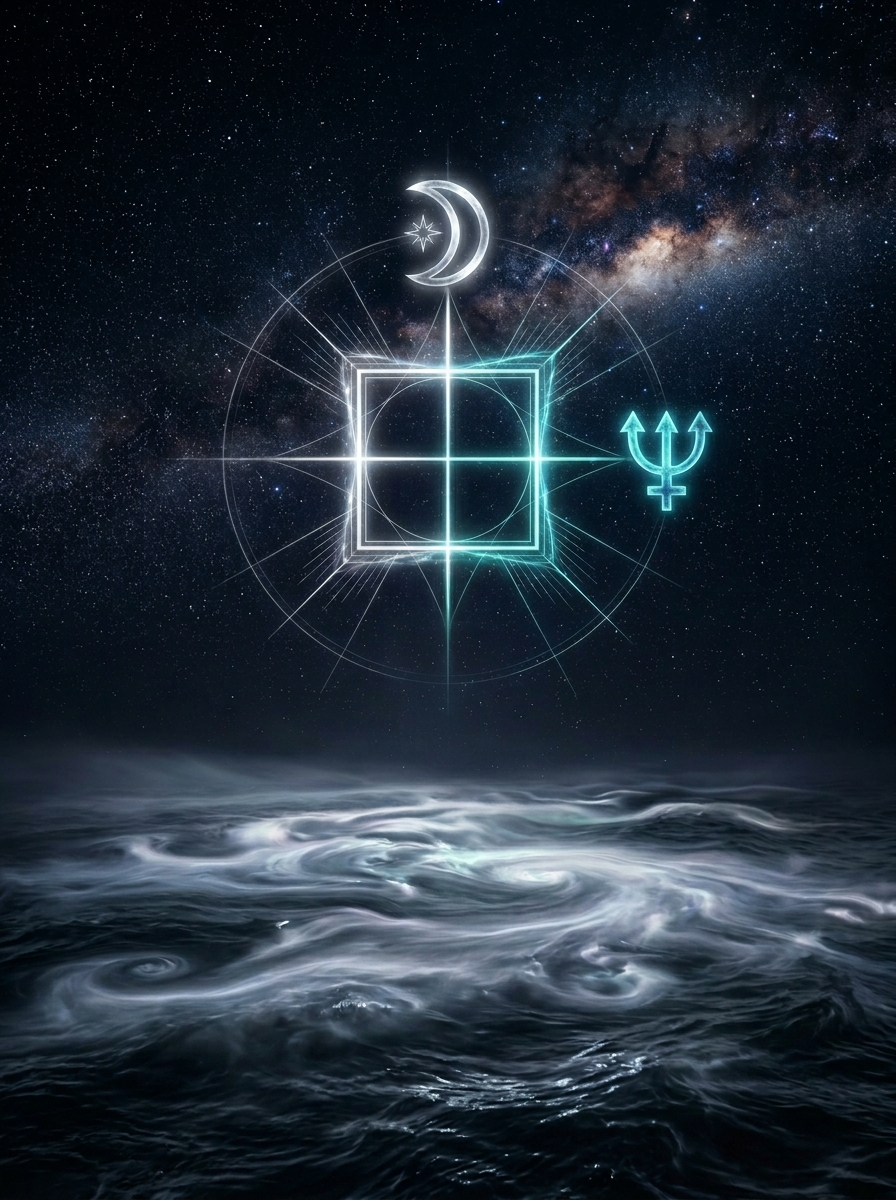
The Core Dynamic: A Nervous System That Dissolves Before It Can Hold
Moon square Neptune polarizes two inescapable needs. The Moon requires emotional safety: predictable attachment, bodily memory, a known shore. Neptune requires transcendence: merger, dream, the vanishing of every boundary that makes the shore real. In a square, these drives do not alternate or negotiate. They collide inside the same moment, leaving the psyche unable to trust either its own instincts or its visions.
The result is not ordinary sensitivity. It is a permeability so deep that the person feels the emotional weather of a room before they feel their own. Mood arrives as atmosphere rather than message. A passing comment can sting for days; a stranger’s grief can settle into the bones. The native often learns to navigate by atmosphere because direct feeling is too unreliable. They may appear empathetic, even psychic, but inside they are asking a question that has no simple answer: Is this mine, or am I receiving?
This aspect’s tension is the engine of its gifts. The square aspect is never comfortable, but it forces growth by refusing to let the two impulses collapse into one another. The Moon cannot be permanently dissolved by Neptune’s fog, nor can Neptune be sealed out by the Moon’s walls. The friction is the curriculum.
How the Square Forms: Childhood, Atmosphere, and the Unspoken
The roots of Moon square Neptune are almost always atmospheric rather than eventful. The childhood home may have been loving but emotionally foggy: a caregiver who was present yet unavailable, lost in private sorrow, addiction, spiritual obsession, or unspoken family secrets. Love was real but inconsistent; safety came with a haze. The child learned to read the caregiver’s mood before reading their own. That skill becomes psychic brilliance — and also self-erasure.
The caregiver, often the mother or a primary maternal figure, may have been idealized through longing. The child sensed a tenderness that could never quite be held in plain sight. This creates a lifelong pattern: the adult keeps searching for that original, elusive love in partners, spiritual communities, or fantasies. The environment itself taught the person that love is something you guess at, not something you trust.
When Neptune is involved, the past is not merely remembered — it is soaked into the nervous system. The native may carry family myths as if they were biology. For a deeper look at how this plays out in the domain of home and ancestry, the page on Neptune in the 4th house explores how the boundary between self and family legacy can dissolve. The square to the Moon intensifies that dissolution until the person must learn, often painfully, to separate inherited feeling from authentic need.
The Shadow Path and the Liberated Path
Unconsciously lived, Moon square Neptune follows a repeating arc: idealize, merge, disillusion, retreat. The native falls for potential, suffering, or spiritual significance rather than for the actual human being. When the fantasy cracks, the disappointment feels like a betrayal — not of one person by another, but of reality itself. This can lead to a soft cynicism disguised as wisdom, or to a perpetual search for a love that never arrives.
The shadow also includes self-gaslighting. The person may absorb family myths so completely that they cannot tell what they actually feel from what they were told to feel. They may excuse neglect because they “understand” the other’s pain, or stay loyal to a fantasy long after the facts have contradicted it. Neptune retrograde often turns this fog inward, making the internal critic a ghost whose accusations are hard to pin down. The article on Neptune retrograde describes how that inward mirroring forces the person to develop discernment as a spiritual practice.
The liberated path emerges when the same permeability becomes a vessel for something larger. The artistic gift of this aspect is not decorative — it is structural. The native’s nervous system works by osmosis: gathering impressions, letting them ferment, then releasing them in forms that bypass logic. Poetry, music, photography, dance, and devotional art all flourish here because the maker does not need to understand the work before it arrives. They only need to stay open enough to receive it.
Compassion, too, is redefined. Rather than a detached kindness, it becomes a shared vulnerability. These people often work beautifully in fields where what matters cannot be quantified: hospice, music therapy, social work, spiritual care. But the gift depends on one discipline: learning to love without adopting illusion as evidence. The boundary is not the enemy of compassion; it is the container that keeps compassion from bleeding into martyrdom.
Living It Out: Love, Work, and the Body
Love and Projection
In romance, Moon square Neptune is famous for projection, but the solution is not to harden the heart. It is to slow down long enough to test impressions against reality. The native may feel an immediate, oceanic connection with someone — but that feeling is not yet knowledge. The relationship must survive the ordinary friction of habit, disagreement, and limitation. When Neptune is involved, the beloved often carries an aura of the sacred. The challenge is to see the actual person, not the halo. For those with Neptune in the 7th house, this dynamic concentrates in relationships themselves, where idealization of the partner becomes a central spiritual test.
Work and Daily Ritual
Because the Moon governs the body’s rhythms, the square often shows up in sleep, appetite, and energy. When emotional life becomes overwhelming, the body may respond with fatigue, dissociation, or vague psychosomatic complaints. Work environments that are purely mechanical or ethically ambiguous can trigger this. The native needs labor that has symbolic weight — caregiving, art, healing — but also practical structure. A daily practice, whether a morning walk, a journal, or a fixed creative session, becomes the shore that prevents drift. The page on Neptune in the 6th house offers a detailed view of how routine can become sacred liturgy rather than drudgery.
The Body as Truth-Teller
The body often knows what the mind will not admit. With this square, a vague sense of “off” is usually accurate. The difficulty is distinguishing genuine intuition from nervous-system alarm learned in childhood. The person can learn to trust the body by naming sensations precisely: not “I feel wrong,” but “my stomach is tight and my shoulders are cold.” Precision turns atmosphere into data. Over time, the square becomes less a confusion and more a compass.
When the aspect is part of a larger configuration like a T-square, the pressure multiplies but so does the potential for integration. The same tension that once felt like drowning can become a structured apprenticeship in emotional truth.
The Tension as Teacher
Moon square Neptune is not a flaw to be eliminated. It is a design that forces the soul to learn how to hold mystery without losing itself in it. The person who matures this aspect becomes a translator between the visible and the invisible: the Moon provides human need, Neptune provides meaning, and the square provides the friction that keeps either from dominating. The goal is not to end the fog but to navigate it — to feel everything without being undone, to love without illusion, and to remain tender without becoming lost in what tenderness can imagine.
Comments
Loading comments…