Moon in the 6th House: Emotional Grounding Through Daily Ritual and Service
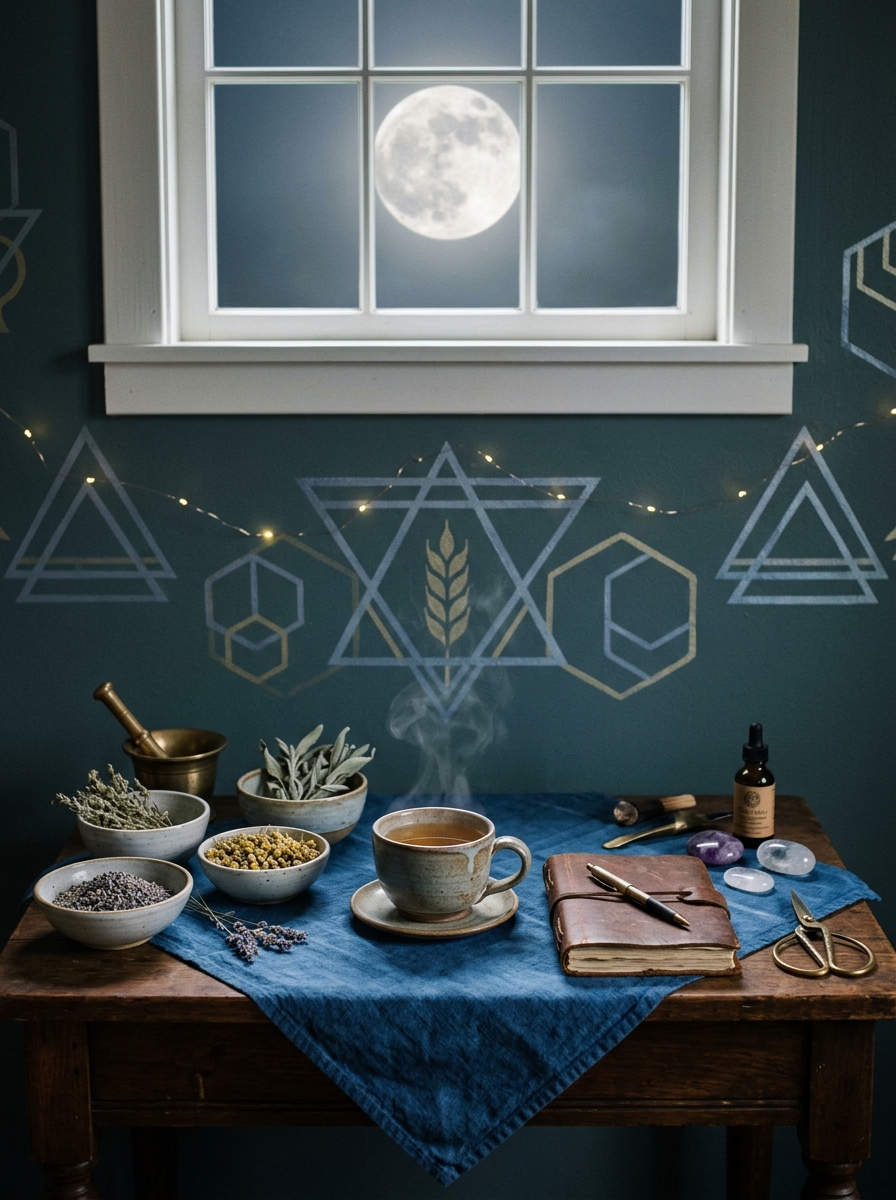
When Feelings Live in the Body Clock
There is a particular kind of person who, when asked how they feel, instinctively answers with what they've been doing. I've been cooking all morning. I reorganized the whole filing system. I just got back from a walk. Ask them again — how do you actually feel? — and they'll pause, slightly confused, as if the question has arrived in a foreign language.
This is the quiet signature of the Moon in the 6th House: emotional life that expresses itself through action, through rhythm, through the body's daily contract with the world. For most people, feeling and doing are separate tracks that occasionally intersect. For this placement, they run on the same rail. The emotional body and the physical body are not just related; they are, at the deepest level, the same instrument.
The 6th House in the Western astrological tradition governs daily routine, physical health, craft, skilled work, and service — the un-glamorous machinery of ordinary life. It's the house of Tuesday afternoon, of the recurring appointment, of the work that doesn't make headlines but keeps everything running. When the natal Moon — the planet of emotional need, instinct, and the unconscious matrix of safety — inhabits this territory, it transforms the mundane into the sacred. Routine becomes ritual. Work becomes devotion. The body becomes a confessional.
Liz Greene, in her landmark work Saturn: A New Look at an Old Devil, established the principle that planetary house placements describe the arena where a planet must do its psychological work. Applied to the Moon in the 6th, this means that the emotional work — the work of feeling safe, of being nourished, of forming and breaking attachments — gets enacted in the daily grind, not in the grand dramatic moments of life. Your emotional growth happens at the kitchen counter, in the weekly check-in at work, in the way you care for your body when it starts to protest.
This is not a glamorous placement on its surface. It does not have the mystique of Moon in the 12th, the relational drama of Moon in the 7th, or the ambition-charge of Moon in the 10th. What it has is staying power. A Moon in the 6th House person can sustain deep care over long periods of time. They can maintain the practice. They can show up, day after day, with focused attention and skilled hands. In a culture obsessed with peak experiences, this placement is a quiet master of the ordinary — and the ordinary, in the long arc of a life, is where most of the meaning actually lives.
Daily Rituals as Emotional Regulation
The Nervous System's Need for Rhythm
For Moon in the 6th House, routine is not a cage — it's a container. The distinction matters enormously. Where other Moon placements might crave spontaneity, emotional peaks, or relational intensity to feel alive, this placement experiences deep wellbeing through the reliable repetition of meaningful small acts. The morning coffee made the same way. The ten-minute walk before lunch. The inbox cleared before the day ends. These are not compulsive behaviors; they are the nervous system's way of saying the world is predictable, I am safe, I can feel.
Carl Jung's concept of the Self as a regulatory center of the psyche maps usefully here. When the Moon is in the 6th, the Self exerts its regulating function through the physical order of daily life. A disrupted schedule isn't just inconvenient — it's destabilizing at an emotional level that can seem disproportionate to observers. Cancel a Moon-in-the-6th person's routine without warning, and you haven't just changed their Tuesday. You've pulled a load-bearing wall out of their emotional architecture.
This means that building conscious, intentional routines is a genuine act of self-care for this placement — not a workaround or a crutch, but a primary emotional technology. The distinction between ritual and rigidity, however, becomes important. A ritual has meaning; rigidity has fear at its center. The invitation for this Moon is to build routines that serve genuine wellbeing rather than routines that serve anxiety — the difference between a morning practice that grounds you and a compulsive checklist that you run through with mounting dread if a single item goes undone.
Structure as an Act of Self-Respect
Steven Forrest, in The Inner Sky, writes about the Moon as representing our most primal emotional needs — what we must have to feel emotionally at home in the world. For Moon in the 6th, that primal need is for structured engagement with daily life: not the rigid structure of fear, but the purposeful structure of craft. A workspace organized to support focus. A diet that pays attention to the body's actual signals. An evening wind-down that signals the nervous system toward rest. These are not trivial preferences. They are the infrastructure of emotional wellbeing for this placement.
The practical implication is significant: when Moon-in-the-6th people are in chaos — sudden job changes, illness, a living situation turned upside down — they don't just lose their schedule. They lose their emotional mooring. Rebuilding feels, at first, not like productivity but like therapy. In a very real sense, it is. Re-establishing even the simplest routines — consistent sleep times, regular meals, a brief daily practice of any kind — begins to restore the sense of interior safety that pure willpower cannot manufacture.
There is also a vocational relevance here. Jobs that deny this person any structural regularity — chaotic environments, constantly shifting priorities, no clear sense of what "done" looks like — will generate chronic low-grade emotional stress that eventually surfaces as physical symptoms, professional burnout, or both. Understanding this is not a complaint about weakness; it is accurate self-knowledge in service of better choices.
The Somatic Connection: The Body as an Emotional Mirror
When Emotions Bypass Language
The 6th House has long been associated with health in astrological tradition, and with the Moon here, the body becomes the primary site where emotional life gets expressed when words or awareness fail. This is not a malfunction — it is the design. In Jungian psychology, the psyche has multiple channels for communicating unconscious material to conscious awareness: dreams, symptoms, projections, repeating life patterns. For Moon in the 6th, the body's symptoms are often the most direct and eloquent channel.
The digestive system, in particular, tends to bear the brunt. Stomach tension before a difficult conversation. Nausea when something feels fundamentally wrong. Appetite shifts that track mood changes more reliably than any journaling practice. The immune system, too, tends to respond to emotional overload — recurrent colds that appear precisely when someone has been overdoing, suppressing feelings, or failing to enforce necessary limits. These are not imagined symptoms, and they are not random. They are the body's faithfully kept record of the emotional life's unfinished business.
Understanding the somatic connection is liberating rather than alarming once you stop treating it as a malfunction to be corrected. The practice is to develop fluency in the body's language: to notice that a recurring tension headache tends to appear after certain kinds of social interactions, or that a flare-up of digestive issues correlates with periods of feeling unappreciated at work. This kind of somatic tracking turns the body from a mysterious enemy into an honest ally.
Reading the Body's Signals
The shadow version of this somatic sensitivity — the territory of hypochondria — emerges when the emotional content behind the symptoms remains unnamed. When Moon-in-the-6th people lack the vocabulary or the permission to say "I am overwhelmed, I am resentful, I am afraid," the body's symptoms can escalate from signal to obsession, as the person focuses intensely on the physical manifestation while the emotional root goes unexamined. This is not a character flaw but a structural dynamic: the channel is wide open, the volume is high, but without emotional literacy as the decoding key, the message gets lost in the static.
Building that emotional literacy requires, first, giving physical symptoms the benefit of the doubt as meaningful rather than random. Second, developing a practice of tracing symptoms back to their emotional context: When did this start? What else was happening in my life at that time? What feeling have I been avoiding or suppressing? Third — and this is the work that Moon-in-the-6th people often resist most — learning to feel the feeling directly, before it routes to the body. This is exactly the kind of somatic-emotional work that modalities like Internal Family Systems therapy, somatic experiencing, and certain movement practices address with particular effectiveness for this placement.
Nurturing Through Service: Practical Care as a Language of Love
The Devotion That Shows Up
Acts of service are not just what Moon-in-the-6th people do for those they love. They are how this placement speaks love — the primary vocabulary of emotional intimacy. Where a Moon-in-Leo person might express care through affirmation and theatrical warmth, and a Moon-in-Cancer person through emotional attunement and protective embrace, Moon in the 6th expresses through the competent, devoted act of making someone's life better in concrete terms.
This is the astrologer who drives three hours to help a friend move. The partner who learns to cook the exact meal that helps you recover from illness. The colleague who sends you the document you needed before you even had to ask. The parent who quietly attends to every logistical detail of a child's school year so the child can focus purely on learning. These are not small gestures. They are expressions of deep, sustained emotional investment in someone's wellbeing — investment measured not in words but in time, attention, and skilled effort.
The Rider-Waite-Smith Tarot tradition, which A.E. Waite grounded in the Hermetic current, gives us the Page of Pentacles as an image that resonates here: a young figure holding a single golden pentacle aloft, studying it with complete attention, surrounded by fertile earth. There is devotion in this image — not the fire of passion but the steady, grounded attention of someone who finds meaning in mastery and service. Moon in the 6th recognizes itself in this card: not flashy, but utterly reliable, genuinely absorbed in the work of care.
When Service Becomes Self-Erasure
The shadow here is the confusion between genuine devotion and the compulsive need to be needed. When Moon-in-the-6th people haven't metabolized the deeper emotional wound around worthiness — the fear that they are only valuable insofar as they are useful — service can become servitude. They give beyond their actual capacity, fail to communicate their own needs, and then cycle into resentment and exhaustion while maintaining the external posture of the selfless helper.
This is the martyr dynamic that astrologers consistently flag with 6th House Moon placements, and it is worth taking seriously. The martyr narrative is internally consistent: I give everything, I ask for nothing, I am therefore good and necessary and safe from abandonment. It is also, over time, corrosive — to health, to authentic intimacy, and to the soul's genuine vitality. The work is not to stop caring. It is to care in ways that include yourself in the circle of those deserving care.
Moon in the 6th House in Love and Relationships
What You Need from a Partner
A partner of someone with Moon in the 6th House needs to understand, at the outset, that emotional expression here is primarily enacted rather than verbalized. This is not emotional unavailability — it is a different dialect. The person who prepares your meals with careful attention to what you actually like to eat, who tracks your medical appointments and reminds you to drink water, who fixes the small thing in your apartment because they noticed it was bothering you — this person is pouring emotional investment into these acts. Not seeing them as love is like missing the entire meaning of the gesture.
At the same time, Moon in the 6th people benefit enormously from partners who actively invite them to express needs verbally rather than always encoding them in action. Because the emotional life routes through service and routine, it's possible to spend years in a relationship deeply caring for a partner while never having asked for care in return — not out of genuine self-sufficiency, but out of the unconscious belief that asking is a burden or a risk.
The Challenge of Receiving
Receiving care — particularly unsolicited care, care that arrives without any implied transaction — is often the harder edge for this placement. Being cared for without having earned it through service disrupts the implicit equation that governs emotional safety here: I give, therefore I belong. This is one of the most intimate pieces of evolutionary work for Moon in the 6th: learning that you are not only lovable when you are useful. Learning, as the poet Mary Oliver might say, to let the soft animal of your body love what it loves — including rest, including being held, including having nothing at all to offer except your presence.
Career Implications and the Ideal Work Environment
Work as Vocation, Not Just Employment
With the Moon in the 6th House, the line between emotional life and professional life is thin. Work is not merely a means to financial ends; it is a primary arena for emotional expression, relational intimacy, and a sense of contributing something real to the world. When work is meaningful — when it involves genuine craft, direct service to others, and a clear standard of quality — this placement thrives with an energy and commitment that many other placements cannot sustain over the long haul. When work is meaningless or chaotic, the emotional cost accrues quickly and quietly.
Ideal Vocational Paths
The vocational directions that tend to call most strongly to Moon in the 6th placements share certain qualities: they are service-oriented, they involve mastery of a specific skill set, they operate according to discernible standards of quality, and they produce tangible outcomes. Healthcare in its many forms — medicine, nursing, physical therapy, acupuncture, nutrition, mental health therapy — draws strongly on this placement. Veterinary and animal care work belongs here too. So does teaching, particularly with younger students or in specialized skill development. The culinary arts, with their combination of nurturing intent, technical craft, and daily rhythm, fit naturally.
Beyond the helping professions, any work that combines precision with service works well: editing and publishing, logistics and operations management, quality assurance, research support, library science, archival work. The common thread is not industry but approach: Moon-in-the-6th people bring an emotional investment to the quality of their work that elevates it from competent to exceptional, and they feel most professionally alive when that investment is recognized as meaningful rather than taken for granted.
The Environment Matters
The physical and interpersonal environment of work is not a peripheral concern for this placement — it directly affects emotional wellbeing and therefore performance. Chaotic, disorganized, politically toxic, or emotionally cold work environments create low-grade chronic stress that eventually surfaces as burnout, physical illness, or both. Clean, orderly, respectful, purpose-driven environments with clear expectations support remarkable levels of sustained high-quality output. This is practical information for career decisions, not squeamishness: choosing your work environment with the same care you choose your diet is genuine self-care for Moon in the 6th.
The Shadow Side: Perfectionism, Hypochondria, and Martyrdom
The Perfectionist's Bargain
Perfectionism in this placement is not vanity. It is a survival strategy that has outgrown its usefulness. When the implicit emotional bargain is I am safe as long as I am needed, and I am needed as long as I am excellent, perfectionism becomes the enforcer of that bargain. Every substandard output is a threat not just to professional reputation but to emotional safety itself.
Liz Greene's work on the psychological dimension of Saturn gives a useful frame here, even when the Moon rather than Saturn is the active planet. She writes about the defense mechanisms the ego constructs to protect itself from the original wound — the felt sense of inadequacy or unworthiness that precedes all the compensating behaviors. For Moon in the 6th, perfectionism, overwork, and self-criticism are three expressions of that defense. They protect the person from having to test whether they would be loved without their usefulness — a test that, from inside the defense, feels too dangerous to run.
The therapeutic insight is not to abandon high standards. Moon-in-the-6th people often have genuinely excellent standards that produce remarkable work, and that is worth honoring. The question is whether those standards are chosen in service of genuine quality, or compelled by fear. The perfectionist who cannot submit the work because it isn't perfect yet is in the grip of the compulsion. The craftsperson who revises deliberately and then releases with self-respect is living the gift.
Martyrdom and Resentment
The martyrdom dynamic forms slowly, often invisibly. Moon in the 6th people rarely begin by intending to give more than they can sustain. They begin by being genuinely good at caring, genuinely fulfilled by service, and genuinely inclined to prioritize others' comfort. The slide into martyrdom happens when self-awareness doesn't keep pace — when the giving continues past the point of genuine generosity, past willingness, into resentment that can't be acknowledged because acknowledging it would mean confronting the identity built around selfless service.
The internal signal to watch for is the accumulation of what psychologists call invisible contracts: the unspoken expectation that extraordinary care will be matched with gratitude, loyalty, or reciprocal care. When those invisible contracts go unmet — as they inevitably do, since they were never actually negotiated — the result is resentment that seems to arrive from nowhere. It didn't come from nowhere. It came from a pattern of giving without asking.
Health Anxiety and Its Roots
The hypochondriac version of this shadow operates as follows: emotional material that hasn't found expression routes into somatic symptoms, which become a focus of anxious attention. Because the person is genuinely somatically sensitive — their body really does respond to emotional states — the physical symptoms are real. But the interpretive layer on top of them — the catastrophizing, the repeated medical consultations, the online symptom research at midnight — belongs to anxiety seeking an object, not to the body's actual distress signal.
The way through is not to dismiss the physical symptoms but to investigate the emotional layer beneath them with equal seriousness. When a Moon-in-the-6th person can say, with specificity, "I notice my stomach tightens every Sunday evening and I've been avoiding asking myself whether I hate my job," the somatic symptom loses its grip on the imagination. It has delivered its message. The anxiety that was borrowing the body for its signal no longer needs to do so.
Evolutionary Integration: Balancing Self-Care With Service
The Axis of the 6th and 12th Houses
The 6th House always operates in dialogue with the 12th House directly opposite it on the chart's axis. The 12th House is the domain of dissolution, surrender, transcendence, the unconscious ocean of all that is not personal. In evolutionary astrology, as Steven Forrest articulates in Yesterday's Sky, the nodal axis and house polarities reflect a soul-level tension between what has been mastered and what must be developed. For Moon in the 6th, the 12th House polarity points toward the work of surrender — not surrender as defeat, but surrender as the release of control.
The Moon in the 6th tendency is toward mastery, toward the carefully managed, the technically correct, the day efficiently organized. The evolutionary pull toward the 12th calls this person to include the unmanageable, to accept imperfection as part of the full picture, to rest in a kind of spiritual ease that is not contingent on anything being done correctly. Practices like meditation, contemplative prayer, time in nature without an agenda, or bodywork that bypasses the analytical mind can all serve this integrative purpose.
Self-Care as an Ethical Practice
One of the most important reframes for Moon in the 6th people is to understand self-care not as indulgence or selfishness but as an ethical practice in service of the care they want to offer. You cannot give from depletion. The healer who neglects their own health is eventually unavailable to heal. The caregiver who never lets themselves be cared for develops a hidden resentment that poisons the care they give. Tending to your own wellbeing — with the same attentive craftsmanship you bring to tending others — is the act that makes all the service sustainable.
This means learning to ask directly for what you need, in words, rather than hoping it will be inferred from your devotion. It means building non-negotiable rest and nourishment into your schedule rather than treating them as rewards for finished work. It means accepting that your value as a human being is not a function of your output — that you are enough in stillness, in rest, in the ordinary act of simply being present without an agenda.
Moon in the 6th House vs. Moon in Virgo: A Crucial Distinction
Same Neighborhood, Different Architecture
Because Virgo is the natural ruler of the 6th House, Moon in Virgo and Moon in the 6th House share significant thematic territory. Both involve an emotional relationship with precision, order, analysis, and practical service. Both can manifest perfectionism, hypochondria, and the impulse to care through concrete acts. A reader encountering these descriptions for the first time might reasonably assume they're reading about the same thing. They are not.
Moon in Virgo is a sign placement. It describes the style, quality, and flavor of the emotional nature. A Moon in Virgo person processes emotions analytically, needs clarity and order to feel safe, tends toward critical self-examination, and expresses care through precision and discernment — regardless of which house that Moon occupies. Moon in Virgo in the 1st House brings this quality to self-presentation and identity. Moon in Virgo in the 9th House brings it to philosophy, travel, and meaning-making.
Moon in the 6th House is a structural placement. It describes the arena where emotional life plays out — the life domain through which emotional patterns express, develop, and resolve — regardless of which sign occupies the Moon. Moon in Sagittarius in the 6th House brings an emotionally expansive, philosophically inclined, freedom-seeking energy into the realm of daily routine and work. That person's emotional satisfaction comes from work that feels adventurous or meaningful in a big-picture sense, and their routines tend toward variety and flexibility. The 6th House structure is the same; the Sagittarian style makes it look quite different from Moon-in-Virgo-in-the-6th.
Where They Converge and Diverge
When Moon is in Virgo and in the 6th House, the sign and house reinforce each other, producing a particularly concentrated expression of the Virgo-6th House archetype: precise, service-oriented, somatically sensitive, prone to self-criticism, remarkably capable in skilled practical work, and deeply needing of orderly routine. This is an intense version of the placement.
When Moon occupies the 6th House in other signs, the 6th House structure remains constant — the emotional arena of routine, health, service, and work — but the emotional style changes significantly. Moon in Aries in the 6th House brings urgency and directness to work, and their body signals stress through inflammation and headaches. Moon in Pisces in the 6th House brings compassion, boundarylessness, and a nearly psychic sensitivity to collective emotional fields into their work environments, with a tendency to dissolve into others' needs at the cost of their own clarity.
This distinction matters enormously for accurate interpretation. The house tells you where emotional life unfolds. The sign tells you how it feels and behaves. Both are necessary for the full picture. Neither is reducible to the other.
Applying the Distinction in Practice
For someone with Moon in Virgo in, say, the 7th House, the primary arena for emotional work is relationship — partnership, intimacy, the one-to-one encounter with another person — but it is approached with Virgo's analytical, service-oriented, precision-minded emotional style. For someone with Moon in Gemini in the 6th House, daily work and routine are the primary emotional arena, but approached with Gemini's intellectual curiosity, versatility, and need for variety and communication. These are genuinely different psychological profiles despite their shared Virgo-6th House adjacency, and flattening them together produces interpretation that fits neither person accurately.
The richer your ability to hold both sign and house as distinct-but-interactive layers, the more precisely you can map the emotional architecture of any natal Moon placement. This is the craft of psychological astrology at its best: not a collection of fixed meanings but a living dialogue between symbolic layers, producing a unique portrait of each individual chart.
This interpretation is offered within the tradition of Western psychological astrology. House systems vary across traditions — Placidus, Whole Sign, Koch, and others may place your natal Moon in different houses. Consult with an astrologer to confirm your house placements using your precise birth time and location.
Frequently asked questions
- Why do I get physically sick when I'm emotionally stressed?
- With Moon in the 6th House, the body is your most honest emotional barometer. When feelings go unprocessed — especially anxiety, resentment, or a sense of inadequacy — they route directly into the digestive system, the nervous system, and the immune response. This isn't psychosomatic weakness; it's a built-in early-warning system. Your body is giving you information your conscious mind hasn't acknowledged yet. The path forward is to treat somatic symptoms as invitations to check in emotionally, not as inconveniences to suppress.
- Does Moon in the 6th House mean I'm destined to be a caretaker or healer?
- Not destined in a fixed sense, but strongly inclined. The 6th House is the domain of skilled service, and the Moon here brings emotional fulfillment through usefulness. That could manifest as a nurse, therapist, acupuncturist, or nutritionist — but also as a meticulous editor, a devoted teacher, a veterinarian, or a logistics manager who quietly keeps the whole operation running. What matters is that your work feels purposeful and that it involves caring for something beyond yourself. The shadow to watch: confusing service with self-erasure.
- How does Moon in the 6th House express love in relationships?
- Practical care is your native love language. You show up with the home remedy when your partner is sick, remember the small preferences no one else tracks, and feel most affectionate when you can do something genuinely useful for someone you love. The challenge is that partners who need verbal reassurance or grand romantic gestures may feel your devotion isn't visible. Learning to name your care out loud — 'I made dinner because I love you' — bridges the gap between what you feel and what your partner receives.
- What's the difference between Moon in the 6th House and Moon in Virgo?
- Moon in Virgo is a sign placement describing the emotional style: analytical, precise, prone to worry, needing order to feel safe. Moon in the 6th House is a structural placement describing the arena where emotions play out: daily routines, the physical body, work, and service. A person can have Moon in Virgo in the 7th House (emotional style is Virgoan, but the arena is relationships) or Moon in Sagittarius in the 6th House (emotional style is expansive and freedom-loving, but it's enacted through work and habits). They share thematic overlap — Virgo naturally rules the 6th — but they're distinct layers of interpretation.
- Can Moon in the 6th House become a perfectionist or workaholic?
- Absolutely, and this is one of the placement's central shadow dynamics. Because emotional security is tied to usefulness and routine, there's a powerful temptation to equate constant productivity with personal worth. When the deeper need — for belonging, for being enough just as you are — goes unmet, the compensating behavior is to work harder, refine more, criticize more. Recognizing the difference between genuine craftsmanship (which this placement excels at) and anxiety-driven perfectionism is essential psychological work for this Moon.
- What daily practices most support Moon in the 6th House wellbeing?
- Consistency matters far more than intensity. A short, regular morning ritual — even fifteen minutes of movement, a nourishing breakfast eaten slowly, a brief review of the day's priorities — signals safety to your nervous system. Tracking your physical symptoms alongside your emotional state in a journal helps you decode your body's language over time. And building deliberate rest into your schedule, not as a reward for finishing work, but as a non-negotiable practice, addresses the martyrdom tendency before it calcifies.
Comments
Loading comments…