Midheaven Astrology: Vocation, Persona, and the Vertical Axis of the Soul
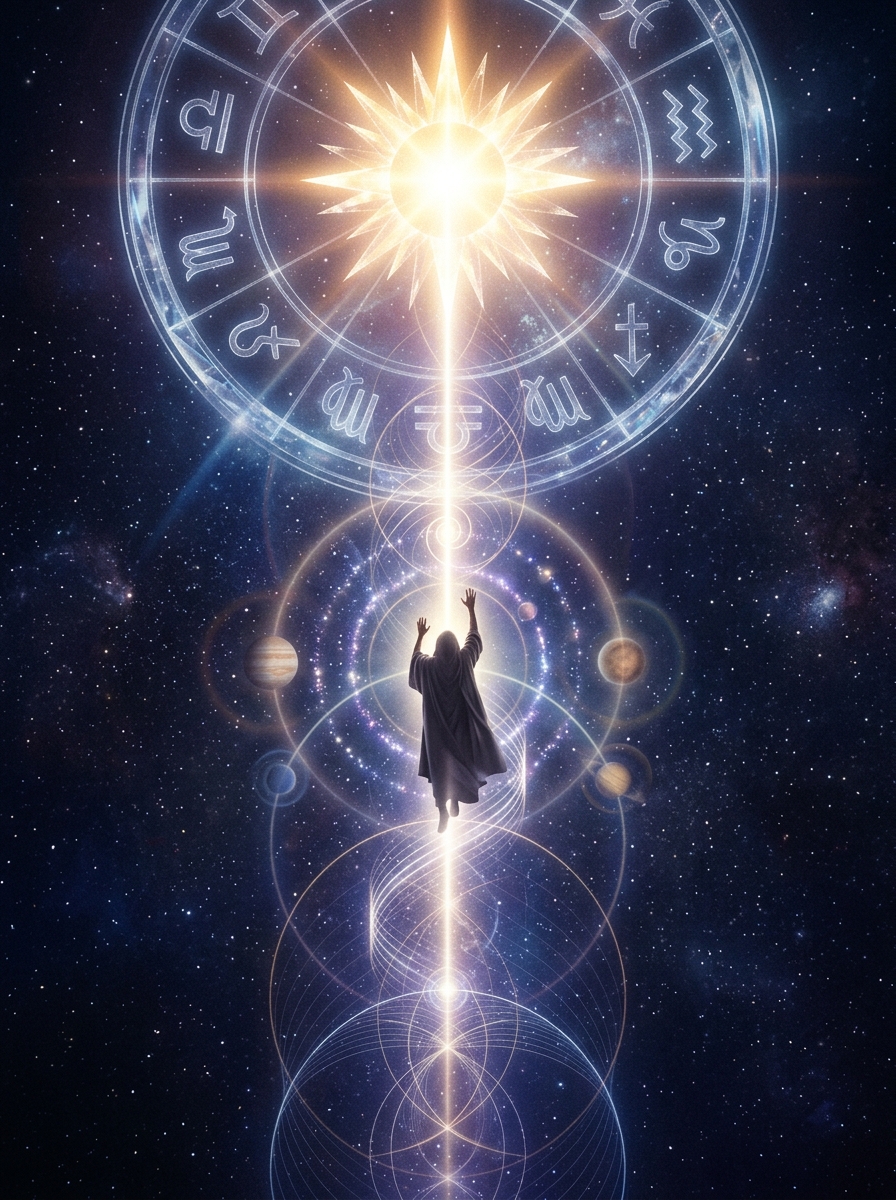
The MC-IC Axis: The Vertical Backbone of the Natal Chart
To understand the Midheaven (Medium Coeli, or MC), one must first grasp the concept of the meridian axis as the vertical spine of the natal chart. While the horizontal axis—composed of the Ascendant and Descendant—anchors our relational experience, mapping the boundary between the self and the other, the vertical axis maps the trajectory of human growth. It is the line of structural tension that runs from the deepest, most private depths of the psyche to the highest, most visible heights of public life. This vertical line represents a developmental journey, a structural highway through which the soul moves from unconscious dependency to conscious, self-actualized maturity.
At the very bottom of this axis lies the Imum Coeli (IC), Latin for the "bottom of the sky." Directly opposing it at the top of the chart stands the Medium Coeli (MC), or "middle of the sky." Together, they form the meridian line, a profound astrological polarity that mirrors the natural architecture of a tree. The IC represents the hidden root system, buried deep within the dark, moist earth of the subconscious, family history, and subjective emotional experience. The MC represents the branches, the leaves, and the fruit that stretch toward the light of the public sky, seeking to blossom in the sight of the collective.
In the practice of depth astrology, as articulated by practitioners like Liz Greene and Steven Forrest, these two points cannot be interpreted in isolation. They are functionally inseparable. To focus entirely on the Midheaven while ignoring the Imum Coeli is to expect a tree to stand tall and withstand the wind without a healthy, deep root structure. The vertical axis demands a constant psychic circulation: energy must flow downward to nourish the roots before it can ascend to feed the branches. When we attempt to force our way into public prominence, career success, or social authority without honoring the psychological foundations of the IC, our external achievements become hollow, fragile, and prone to sudden collapse.
The Polarity of Public and Private Self
This polarity represents the fundamental tension between who we are when we are entirely alone, surrounded by the walls of our private sanctuary, and who we are when we step onto the public stage. The IC is our private face, the instinctual, vulnerable self that we reveal only to those who share our intimate space. It is the realm of the subjective, where we do not need to perform, justify, or achieve. In contrast, the MC is our public face, the version of ourselves that we project into the social arena. It is how we are perceived by people who do not know us personally—our clients, our employers, our competitors, and the broader community.
Psychologically, this axis coordinates the balance between being and doing. The IC is the state of pure, receptive being, rooted in our feelings, our history, and our sense of belonging. The MC is the state of active, purposeful doing, driven by the desire to make a lasting mark on the world. Healthy psychological functioning requires a fluid dialogue between these two modes of existence. If we over-identify with the public sphere, we risk losing our subjective emotional center, becoming caricatures of our professional titles. Conversely, if we retreat entirely into the private world of the IC, we may struggle to actualize our potential, leaving our talents unexpressed and failing to meet the collective challenges of our generation.
The Celestial Meridian: Astronomy and Psychological Maturity
From an astronomical perspective, the meridian is a great circle that projects onto the celestial sphere, passing directly over the observer’s head through the zenith and down through the nadir, intersecting the celestial poles. The intersection of this meridian circle with the ecliptic (the path of the Sun) defines the Midheaven and the Imum Coeli. The MC is specifically the point where the ecliptic intersects the meridian in the south (in the Northern Hemisphere) or the north (in the Southern Hemisphere). This astronomical reality carries profound symbolic weight: the MC is the highest point the Sun can reach on its daily journey. It is the solar noon, the moment of maximum illumination and visibility.
Because the MC is associated with the noon Sun, it symbolizes the peak of conscious awareness and external manifestation. In the developmental psychology of the birth chart, the movement along the meridian axis represents the gradual transition from the dark, nocturnal, undifferentiated state of early childhood toward the bright, diurnal, highly differentiated state of psychological maturity. It is a journey of solar realization. The child begins life at the nadir (the IC), completely merged with the family container and the unconscious matrix of the environment. As the individual grows, they must climb the celestial meridian, moving upward through the houses of the chart to establish their own light in the public sky.
This climb is not merely about landing a high-paying job or achieving professional status; it is about the acquisition of psychological maturity. The tenth house, which is ushered in by the cusp of the Midheaven, is traditionally ruled by Saturn in the natural alphabet of the zodiac. Saturn represents time, structure, responsibility, boundaries, and the reality principle. Therefore, the ascent to the Midheaven is an encounter with the Saturnian dimension of life. It requires us to grow up, to take responsibility for our actions, to establish realistic boundaries, and to submit our individual desires to the larger needs of the collective.
The Path of Individuation
Carl Jung’s concept of individuation—the process of integrating the conscious and unconscious aspects of the psyche to become a whole, unique individual—finds its primary astrological map along the meridian axis. The journey begins with the recognition of our conditioning. We are born into a specific family, a specific culture, and a specific historical moment, all of which are encoded in the Imum Coeli. Individuation requires that we separate ourselves from this primary matrix, not by rejecting it, but by consciously integrating it, so that we can stand on our own feet.
As we move up the meridian toward the Midheaven, we are called to articulate our own values and define our own sense of purpose. This is the work of finding one's true vocation. A vocation is different from a job; it is a calling, a feeling that there is a specific task in the world that we are uniquely equipped to perform. Steven Forrest often emphasizes that the MC is not just about what we do for a living, but about the quality of character we are called to embody in the public sphere. The sign on the Midheaven represents the specific archetype that we must learn to express with integrity, authority, and skill if we are to feel aligned with our true destiny.
The Imum Coeli (IC): The Psychic Womb and Transgenerational Roots
To understand the heights of the Midheaven, we must descend into the depths of the Imum Coeli. Positioned at the lowest point of the chart, the IC is the root system of the psyche, the place where we touch the ground of our being. It represents the psychic womb from which our individuality emerges. Here, we find the cumulative deposits of our early childhood experiences, our domestic environment, our relationship with our parents, and the emotional tone of our home. It is the sphere of absolute privacy, the interior sanctuary where we retreat to restore our emotional equilibrium when the demands of the outer world become too intense.
But the IC extends far deeper than our immediate childhood experiences. It represents our transgenerational lineage, the ancestral soil from which we have grown. The traumas, victories, secrets, and unfulfilled dreams of our ancestors are stored within the psychic soil of the IC. In the words of Liz Greene, the fourth house is where we carry the ghosts of our family line. These ancestral dynamics function as an invisible gravity, shaping our emotional responses, our instinctual fears, and our core beliefs about safety and belonging. If we do not make these unconscious dynamics conscious, they will act as a silent drag on our attempts to climb the meridian, undermining our professional efforts through self-sabotage or unexplained anxiety.
The IC is also the realm of the subjective emotional foundation. It is the place where we experience our most basic feelings of vulnerability, dependency, and emotional need. To have a healthy, functioning IC is to have a secure inner home—a place within ourselves where we feel safe, accepted, and at peace. Without this inner sanctuary, we are constantly at the mercy of external validation. We seek from our careers, our bosses, and our public reputation the unconditional love and safety that can only be found within the deep recesses of our own subjective self.
Bachelard’s House and the Architecture of the Soul
In his seminal work The Poetics of Space, the French philosopher Gaston Bachelard used the architectural metaphor of the house to describe the structure of human consciousness. He wrote that the house is a tool for analysis of the human soul, providing a space where our memories and dreams can find shelter. Bachelard divided the house into two primary vertical dimensions: the cellar and the attic. The cellar represents the deep, subterranean, irrational roots of the house. It is a place of darkness, mystery, and connection to the earth. In contrast, the roof or the attic represents the rational, light-filled, intellectual height of the structure.
This architectural metaphor aligns perfectly with the MC-IC axis. The IC is the cellar of the birth chart. It is the place where we keep the old family trunks, the forgotten memories, and the raw, unrefined materials of our emotional life. The cellar is sometimes frightening because it is dark and close to the earth, yet it is also the source of the house's stability. If the foundations in the cellar are cracked, the entire structure is unstable. The MC, by contrast, is the roof, the chimney, and the tower. It is the part of the house that stands visible against the horizon, catching the wind and the sun. It is the statement the house makes to the world.
To build a life that is psychologically sound, we must travel between the cellar and the roof. We must be willing to go down into the dark, damp cellar of the IC to inspect our emotional foundations, to clean out the ancestral debris, and to claim the hidden treasures stored there. Only then can we safely ascend to the roof of the MC, standing tall in our authority without fear that the ground will give way beneath us. The integration of this axis requires us to honor both the irrational, emotional depths of the cellar and the rational, structured heights of the roof.
The Midheaven (MC) and the Tenth House: Public Persona and Reputation
The cusp of the tenth house, the Midheaven, is the gateway to our public life. In traditional astrology, this house governs career, social standing, public reputation, government, authority figures, and our legacy. It is the stage where we perform our duties, demonstrate our competence, and receive recognition from the collective. The tenth house represents the demands that society places on us to contribute to the maintenance and development of the social order. It is where we transition from being consumers of culture to creators of culture, leaving a permanent footprint in the history of our community.
In psychological terms, the Midheaven is closely linked to the Jungian concept of the Persona. Carl Jung defined the persona as a system of adaptation or a manner of behavior through which we relate to the world. It is the social mask that we wear to facilitate interactions with others, protect our vulnerability, and perform our professional duties. A doctor, a teacher, a lawyer, and an artist all require different personas to function effectively in their respective roles. The sign on the Midheaven and the planets aspecting it describe the specific qualities of this persona—how we dress our social self, the professional style we adopt, and the image we project to gain the respect and trust of the collective.
A well-developed persona is a psychological necessity. It serves as a protective barrier, shield, and bridge, allowing us to interact with the public without exposing our sensitive, vulnerable core (the IC) to unnecessary harm. It allows us to keep a healthy distance between our professional responsibilities and our private lives. However, the persona becomes a source of psychological distress when we forget that it is merely a mask. When we begin to believe that we are our titles, our reputations, or our achievements, we fall into the trap of persona inflation.
The Persona and the Danger of Inflation
Persona inflation occurs when the conscious ego identifies entirely with the public mask. This is a common occupational hazard in contemporary culture, where professional success is highly glamorized and equated with personal worth. When we are inflated by our persona, we lose touch with our subjective reality, our emotional needs, and our physical limitations. We become rigid, dry, and disconnected from our roots. The executive who cannot turn off their authoritative managerial style at home, the spiritual teacher who cannot admit to having personal flaws, and the artist who is paralyzed by the fear of losing their public acclaim are all suffering from persona inflation.
Astrologically, this inflation represents a state of extreme imbalance along the meridian axis. The energy has run entirely to the top of the chart, leaving the IC dry, neglected, and starved of attention. When the IC is ignored in this way, it does not simply disappear. Instead, it goes under, operating from the unconscious to disrupt the inflated persona. This disruption often manifests as sudden emotional collapses, relationship crises, physical illnesses, or vocational crises that force the individual to step down from their public pedestal and return to the vulnerable reality of their private self.
To prevent this, we must consciously maintain the boundary between our MC and our IC. We must cultivate a persona that is flexible, authentic, and expressive of our true values, while remaining deeply aware that our ultimate worth as human beings is not determined by our public achievements. We must be willing to take off the mask at the end of the day, returning to the simple, unadorned state of being represented by the Imum Coeli.
Vertical Integration: Reconciling Ambition with Emotional Roots
The ultimate goal of working with the meridian axis is vertical integration. This is the process of building a conscious, flowing bridge between the MC and the IC, allowing us to reconcile our external ambitions with our deep emotional needs. Vertical integration requires that we acknowledge the validity of both poles of our experience. We must honor our drive for success, recognition, and public contribution, while simultaneously protecting our need for privacy, rest, emotional connection, and inner peace.
In modern society, this integration is particularly challenging. We live in a culture that is heavily biased toward the Midheaven. We are encouraged from an early age to focus on our careers, to accumulate wealth and status, and to project an image of constant competence and success. The private, receptive, introspective qualities of the IC are often dismissed as unproductive or self-indulgent. We are taught to treat our bodies and our emotional lives as instruments to be managed in service of our professional goals, rather than as the very foundation of our existence.
This cultural bias leads to a widespread split in the collective psyche. Many individuals achieve great external success, reaching the peak of their Midheaven potentials, only to find themselves feeling empty, anxious, and deeply lonely. They have built a magnificent house, but the foundation in the cellar is unstable, and the rooms are cold and uninhabited. Reclaiming the IC is the remedy for this collective split. It requires us to slow down, to tend to our emotional roots, to heal our transgenerational wounds, and to create a domestic life that genuinely supports and nourishes us.
Healing the Split and Preventing Burnout
Professional burnout is one of the most common manifestations of a split vertical axis. Burnout is not simply the result of working too many hours; it is the consequence of working from a place of emotional depletion. When we attempt to drive our careers forward without a functioning connection to our IC, we are running on empty. We are using our sheer willpower to force our way through the world, bypassing our need for rest, emotional nourishment, and self-care. Eventually, the psychological and physical systems collapse under the strain.
To heal this split and prevent burnout, we must establish a rhythmic flow between the two ends of the meridian axis. This involves several practical and psychological shifts:
- Establishing Sacred Privacy: We must create physical and temporal boundaries that protect our private lives from the intrusion of our careers. This means creating a home environment that is a genuine sanctuary, free from the demands of work, and setting aside time where we can step out of our professional roles and simply be.
- Tending to the Emotional Soil: We must do the psychological work of exploring our early conditioning and transgenerational history. This may involve therapy, journaling, or creative work that allows us to process family wounds, release ancestral burdens, and build a secure inner attachment to ourselves.
- Aligning Career with Character: We must ensure that our professional goals (MC) are aligned with our deep, authentic values (IC). If our career requires us to act in ways that violate our basic integrity or suppress our emotional truth, we will experience a persistent, draining internal conflict.
- Recognizing the Cyclic Nature of Achievement: We must accept that life has phases of output (MC) and phases of incubation (IC). There are times when we are called to be highly visible and active in the world, and times when we need to retreat into our shell to heal, reflect, and regenerate.
By consciously navigating the vertical axis, we can transform our careers from a source of stress and exhaustion into a natural expression of our inner wholeness.
Interpreting the Midheaven: Signs, Planets, and the Work of Vocation
When interpreting the Midheaven in a natal chart, we look at several key factors: the sign on the MC cusp, the ruler of that sign and its placement, any planets conjunct or aspecting the MC, and the planetary placements within the tenth house. Together, these elements paint a detailed picture of our vocational path and our public persona.
The Element of the Midheaven Sign
The element of the sign on the Midheaven indicates the primary energy, style, and approach we bring to our professional lives:
- Fire Midheavens (Aries, Leo, Sagittarius): These individuals need careers that offer independence, adventure, leadership, and creative expression. They project a public persona of enthusiasm, courage, and vision. Their primary challenge is to avoid self-centeredness, impatience, and burnout from over-extension.
- Earth Midheavens (Taurus, Virgo, Capricorn): These individuals seek stability, material security, tangible results, and structural authority. They project a persona of reliability, practical competence, and realism. Their challenge is to avoid excessive rigidity, materialism, and a tendency to prioritize work over emotional well-being.
- Air Midheavens (Gemini, Libra, Aquarius): These individuals thrive in careers focused on communication, intellectual exploration, social connection, and collective ideals. They project a persona of objectivity, intellect, and social facility. Their challenge is to avoid becoming scattered, detached, or overly focused on abstract ideas at the expense of practical application and emotional depth.
- Water Midheavens (Cancer, Scorpio, Pisces): These individuals need careers that allow them to express their empathy, intuition, healing capacities, and imaginative depth. They project a persona of emotional sensitivity, psychological insight, and mystery. Their challenge is to establish clear professional boundaries and avoid being overwhelmed by the emotional environment of their work.
Planets Conjunct or Aspecting the Midheaven
Planets that lie close to the Midheaven or make strong aspects to it act as powerful dynamic forces that shape our public reputation and career path. For instance, Sun conjunct MC suggests a strong drive for visibility, recognition, and self-actualization through the career; the individual is called to shine brightly and lead in their field. Moon conjunct MC indicates that the career is deeply tied to emotional needs and public service; their reputation may fluctuate, and they are often perceived as nurturing or responsive to the public mood.
Mercury conjunct MC highlights communication, writing, teaching, or analytical skills as central to the vocation, projecting a persona of mental agility and curiosity. Venus conjunct MC suggests a public reputation built on charm, artistic ability, diplomatic skill, and the creation of harmony; the career often involves aesthetics, relationships, or finance. Mars conjunct MC brings a competitive, assertive, and highly energetic drive to the career; these individuals are natural pioneers and risk-takers, but must guard against public conflict and power struggles.
Jupiter conjunct MC brings a sense of opportunity, optimism, and philosophical expansion to the vocational path, often indicating success in education, publishing, law, or travel. Saturn conjunct MC highlights a career path that requires hard work, discipline, patience, and the gradual assumption of heavy responsibilities; these individuals often achieve lasting authority later in life after overcoming significant obstacles. Uranus conjunct MC points to an unconventional, highly independent, and potentially volatile professional path, where the individual must be free to innovate and challenge established norms.
Neptune conjunct MC infuses the career with artistic imagination, spiritual longing, and ideals, but can also bring confusion, boundary issues, or a tendency to seek glamour and illusion. Finally, Pluto conjunct MC suggests a career path marked by profound transformations, encounters with power dynamics, and the capacity to facilitate deep systemic change, requiring the individual to handle authority with absolute psychological integrity.
Frequently Asked Questions About the Midheaven
What is the difference between my Midheaven sign and my Sun sign when it comes to career?
Your Sun sign represents your core identity, your vital life force, and the central hero's journey of your life. It is who you are learning to become at the deepest level. Your Midheaven sign, on the other hand, represents your public role, your vocation, and the specific mask (persona) you wear to negotiate the professional world. While your Sun sign defines the essential energy that fuels your entire life, the Midheaven describes the structured channel through which that energy is directed to make a public impact. For example, if you have a Pisces Sun and a Capricorn Midheaven, your core identity is imaginative, sensitive, and spiritual (Pisces), but your public role and career style will need to be structured, disciplined, organized, and authoritative (Capricorn) to successfully manifest your creative visions in the real world.
Can you have a successful career if your Midheaven has challenging planetary aspects?
Yes, absolutely. In depth astrology, challenging aspects (such as squares or oppositions) from planets to the Midheaven are not indicators of failure. Instead, they represent dynamic psychological tensions that require integration. These "hard" aspects provide the friction and energy necessary for growth and achievement. A square from Saturn to the Midheaven, for example, may manifest as early career delays, self-doubt, or conflicts with authority figures, but it ultimately builds the resilience, discipline, and authentic competence required for long-term success. The key is to consciously work with the challenging planetary energies, understanding them as internal psychological dilemmas that must be resolved, rather than external bad luck.
How does the Imum Coeli (IC) directly affect my ability to achieve my Midheaven goals?
The Imum Coeli represents your psychological foundation, your childhood conditioning, and your capacity for emotional self-regulation. If your IC is neglected, or if you carry unresolved childhood trauma or transgenerational family patterns, you will struggle to sustain your career achievements. You may find yourself self-sabotaging your success, experiencing intense anxiety when you gain visibility, or feeling hollow and unfulfilled despite significant accomplishments. To successfully reach your Midheaven goals, you must do the inner work of healing your roots, establishing a secure sense of self, and cultivating a private life that provides genuine emotional safety and rest.
What does it mean if I have no planets in my Tenth House or conjunct my Midheaven?
Having an "empty" tenth house or no planets near the Midheaven does not mean you will not have a successful career or a clear vocation. It simply means that your career is not the primary focus of planetary tension or activity in this lifetime. The sign on your Midheaven cusp is still active and provides the necessary blueprint for your public persona and career style. To interpret an empty tenth house, you look to the ruling planet of the sign on the Midheaven. The house position, sign, and aspects of that ruling planet will show where and how your career energy is directed. For example, if you have an empty Aries Midheaven, you look to the placement of Mars in your chart to understand your vocational drive.
How does the Jungian Persona relate to the Midheaven in daily professional life?
In daily professional life, the Midheaven functions as the astrological signature of your Persona. It represents the professional character you project to establish authority, build trust, and protect your private self. For instance, a Leo Midheaven person will project a persona of confidence, warmth, and leadership, while a Scorpio Midheaven person will project a persona of intense focus, discretion, and psychological depth. This persona is a tool that helps you perform your job effectively. The key to psychological health is maintaining a conscious boundary between this public role and your true, complex inner self. When you leave work, you must be able to put down the Midheaven mask and return to the receptive, intimate reality of your Imum Coeli.
Comments
Loading comments…