Mercury Sextile Mars: The Mind That Can Move
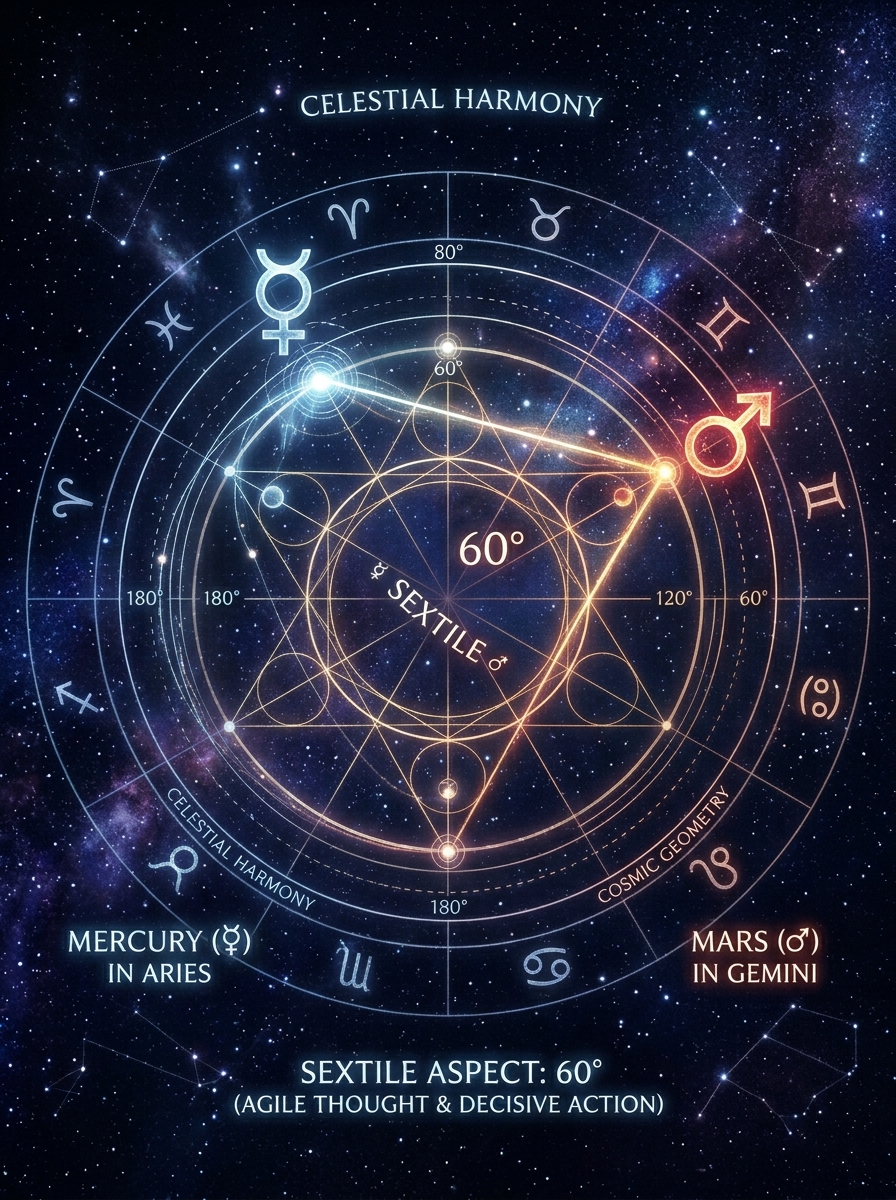
The mind that moves before the thought settles
Mercury sextile Mars is not a gentle handshake between cognition and action — it is a live circuit. Where a square would create static and a trine a smooth current, the astrological sextile offers latent cooperation that requires deliberate use. Here, the two planets occupy compatible elemental territory: Mercury rules how we name, compare, and transmit; Mars governs how we initiate, strike, and defend. In sextile, they converge without the friction of a hard angle, producing a psyche that can think, decide, and act in almost the same breath.
This does not mean the native is perpetually impulsive. It means there is unusually little lag between seeing and doing. The signature rhythm is I see it, I name it, I act on it. That three-step compression is the aspect’s primary gift. In practice, it shows up as mental quickness that retains strategic shape — the person can argue a point without dissolving into dithering, or intervene without losing sight of why they intervened. They are rarely content with elegant ideas that have no test; they want ideas that can be moved into the world.
To understand how this works, it helps to recall that Mercury in astrology is never just “communication.” It is the meaning-making function of the nervous system. Mars gives that function teeth. Together, they produce a mind that engages reality rather than merely observing it. The aspect behaves like an open channel that still asks to be activated — and activation usually happens when the environment demands speed, leverage, or candor.
The architecture of verbal nerve
Psychologically, this aspect builds a bridge between two drives that often run on separate tracks: the drive to know and the drive to assert. Mercury sextile Mars gives the native the courage to name what they see, even when the naming carries consequence. There is a natural willingness to ask the difficult question, to press the weak seam in an argument, to state the thing others only think. That is not recklessness — the sextile preserves enough self-command that the person can be direct without being incendiary.
The result is a kind of strategic honesty. In conversation, the native reads the room quickly and identifies leverage points. In writing, they prefer crisp prose and efficient structure; fluff feels like a betrayal of the mind’s contract with reality. This is why the aspect often appears in people who thrive in debate, editing, technical troubleshooting, law, sales, or any role where timing and precision matter. They do not merely collect information — they mobilize it.
Compared to the subtler, more fragile semi-sextile, which whispers from the edge of awareness and requires delicate translation, the sextile is an accessible corridor. The friction between Mercury and Mars here is productive rather than obscure. The psyche does not have to work hard to bring thought into action; the channel is already open. This is also why the native often becomes impatient with mental paralysis, overanalysis, or passive-aggressive communication. There is an instinctive preference for movement, candor, and conclusions that can be acted on.
When speed burns the thread
The same quickness that makes this aspect gifted can also make it sharp-edged. A mind that moves readily can start to overvalue movement itself. The native may mistake response for wisdom, or precision for permission to cut too cleanly. The aspect does not typically produce the prolonged warfare of a hard square, but it can still create habitual impatience, especially when the environment feels slow, vague, or bureaucratic.
Under stress, the combination becomes verbally combative. Mercury wants to name; Mars wants to strike. Together, they can produce a tendency to interrupt, anticipate the end of someone else’s sentence, or answer before listening all the way through. The issue is usually not hostility in the crude sense — it is momentum. The mind has already completed the circuit while everyone else is still entering the room. This can show up as a low tolerance for incompetence or evasiveness, and the person’s judgments, though accurate, may land as abrasion.
The circuit can also turn inward. Some natives develop a private drill sergeant: the same critical speed used to solve external problems becomes a weapon against vulnerability. They may mentally rehearse confrontations, sharpen arguments in their head, or use thought as a blade against their own feelings. Here the danger is not ignorance but overassertion — the psyche becomes a courtroom where emotion is cross-examined until it has no room to breathe. This is one reason the aspect is best understood not as “smart and assertive” but as an energetic pact between cognition and combat. That pact can defend the self brilliantly, but it can also keep the person in a subtle state of readiness, as if life were always an argument waiting to happen.
The remedy often lies in the body. Mars is not abstract; it lives in pulse, heat, tension, and instinct. When the native ignores the body, the mind becomes overclocked. Exercise, manual work, movement, or any practice that lets thinking settle into action can be quietly transformative. The goal is not to “burn off” Mars but to give it a legitimate channel so Mercury does not have to carry all the voltage alone. A person with this aspect who also has, say, Mars in Gemini may find that verbal speed needs physical grounding; someone with Mercury in Aries might need to slow the ignition step by step.
The one life in which it shows
Because the aspect is a relationship pattern between two core functions, it can play out in any life arena. But it tends to be especially visible in work, relationships, and conflict — not because the dynamic changes, but because these settings demand exactly what the aspect provides.
In the workplace, the native thrives where quick diagnosis and decisive communication are valued. They are the colleague who cuts through confusion in a meeting, the writer who makes dense material usable, the manager who delivers feedback without three paragraphs of fog. Mercury in the third house or in the first house can amplify the personal presence of this mental edge; Mars in the first house adds visible initiation. But even without those reinforcements, the sextile itself favors roles that reward strategic nerve — entrepreneur, editor, coach, technician, negotiator.
In relationships, the aspect shows as a preference for directness over decorum. The native can say difficult things in a clean way, which is valuable in long-term partnerships where unspoken resentments accumulate. They are often less likely to freeze in conflict and more likely to mobilize — they become more articulate under pressure, not less. That is an asset, but it can also unbalance a partner who needs more time to process. The lesson is not to become softer for its own sake but to distinguish accuracy from abrasion. For those with stronger Venusian signatures, such as Mars in Libra, the aspect can produce an unusual balance of firmness and fairness.
In all domains, the native benefits from tasks that involve troubleshooting, editing, systems thinking, or rapid adaptation. This is not merely the “talkative” chart signature — it is the signature of someone who wants language to have consequences. With deliberate work, this aspect can become a craftsman’s tool, especially when Mercury is in an earth sign like Virgo or Capricorn, where method refines speed into precision.
The maturation of calibrated aliveness
At its highest level, Mercury sextile Mars asks for disciplined aliveness — not hyperactivity, not clever aggression, but a mind that can enter reality without flinching and a will that can be named without distortion. The mature expression of the aspect is not just quickness but calibrated quickness: knowing when to push and when to pause, when to state and when to gather more data, when the point needs force and when it needs a sharper question instead.
That calibration often requires periods of deliberate delay. Not because the native is too impulsive in a moral sense, but because good friction sometimes belongs in the process. A little pause can keep the mind from becoming merely efficient; it can make room for context, timing, and consequence. The aspect benefits from any practice that honors both planets: giving Mercury the depth of reflection and Mars the satisfaction of directed action.
In the end, this aspect is one of the cleanest signatures for effective mental agency in a natal chart. It favors people who can think under pressure, speak with edge, and act without severing intelligence from will. If the chart elsewhere leans contemplative, this aspect supplies ignition; if the chart already runs hot, it supplies steering. Either way, it marks a psyche that does not merely have ideas — it knows how to move them into the world.
Related
- Mercury Square Mars: The Mind Under Pressure, the Tongue as a Blade
- Mercury Trine Mars: The Mind That Moves Like a Blade
- Mercury Conjunct Mars: The Word with Teeth
- Synastry Mars Sextile Mercury: The Spark of Quick Minds and Clean Friction
- Mars Conjunct Mercury in Synastry: The Spark, the Argument, the Us
Comments
Loading comments…