Mars Sextile Uranus: The Spark That Knows Where to Land
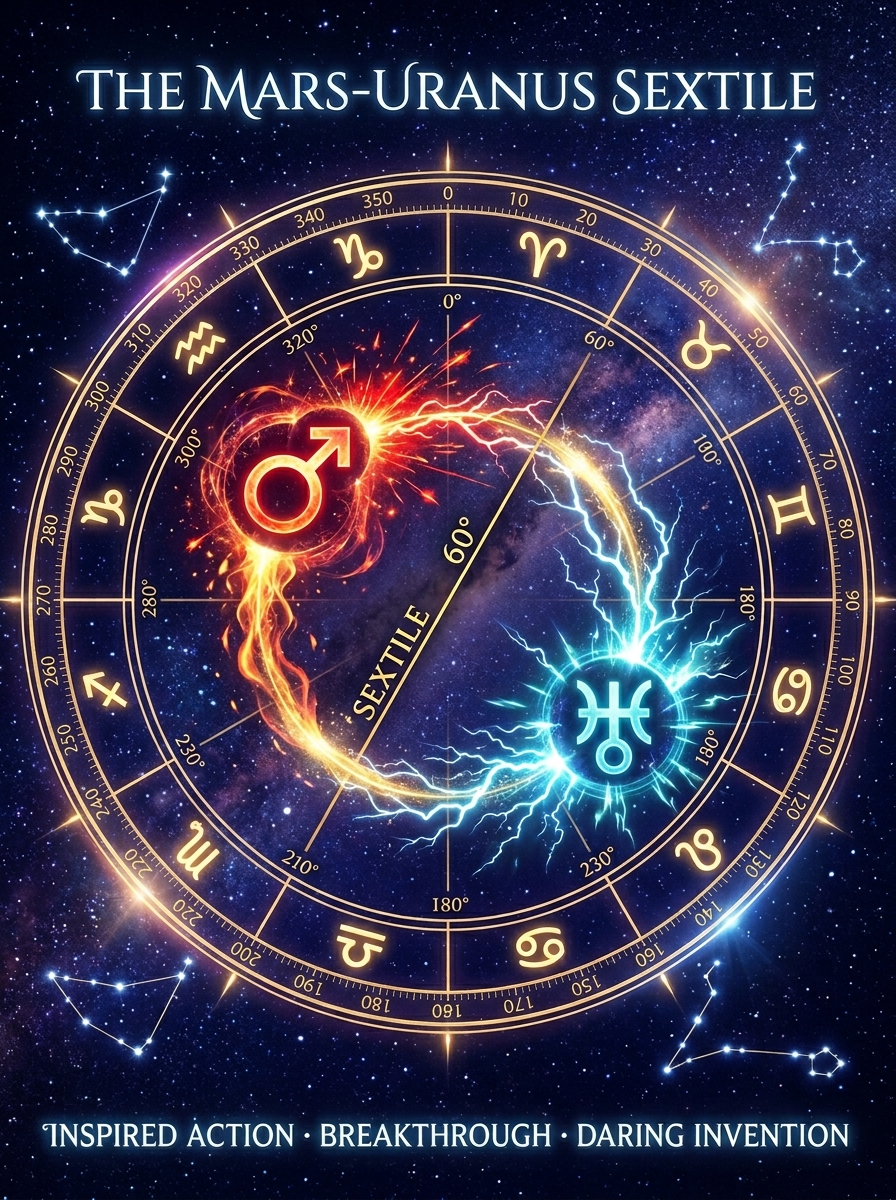
Mars sextile Uranus describes a native talent for acting fast without losing contact with reality. The will of Mars and the electric originality of Uranus do not fuse into chaos here; they form a cooperative circuit. This is an aspect of tactical invention: the instinct to change course at the right second, to break a stale pattern without needing to burn the whole house down. The core thesis is simple: when Mars and Uranus are in sextile, the psyche learns how to turn irritation into innovation and courage into usable momentum.
The Core Dynamic: A Cooperative Circuit, Not a Short
A sextile is not a command; it is a ready-made passage. In the language of aspect interpretation, it resembles latent talent that becomes real through use, which is why it sits so differently from the more obvious friction of a square. The sextile aspect itself is about opportunity that rewards conscious activation rather than brute force. With Mars sextile Uranus, the mind and body are wired for adaptive action: quick reflexes, a low tolerance for stagnation, and an almost athletic relationship to surprise.
What emerges psychologically is a person who needs freedom in motion. Mars wants to do, strike, initiate, protect; Uranus wants to liberate, innovate, sever dead ties, and keep the future from being smothered by convention. In sextile, those drives can cooperate without constant internal rebellion. The result is a temperament that dislikes being micromanaged yet is not automatically oppositional. You may not simply resist authority; you may redesign the machine so it runs with less waste. This is courage with options—not blunt heroism but lateral movement: feints, pivots, breakthroughs, alternate routes. The person often knows how to escape a trap without escalating it or how to cut through a stalemate by introducing an unexpected variable.
The Psychological Wiring: A Mind That Edits While It Acts
This aspect is more cerebral than people expect. Uranus is not only the planet of shocks; it is the planet of pattern recognition, and Mars supplies the nerve to test a new pattern in real time. People with this aspect often make abrupt-seeming decisions that are actually the product of subtle inner calibration. They sense where tension is accumulating in a situation and move before the break becomes crisis. That can look like spontaneity, but it is often a form of live intelligence—a kind of real-time editing of reality.
The psychology here is one of restless attention. Boredom is not merely unpleasant; it feels like a signal that something vital is being missed. Because Mars rules heat and Uranus rules electrical discharge, the body can become a sensitive instrument for scanning the environment. The native is rarely truly idle; even when still, the mind is running scenarios, timing the next move. This makes the aspect valuable in crisis work, startup environments, performance, tech, emergency response, and any arena where improvisation matters. It also explains why repetitive labor feels physically oppressive unless there is room to improve the process. They are not lazy; they are sensitized to inefficiency. When the work is deadening, their body knows it before their ideals do.
For a deeper look at how the sextile’s latent potential activates, the guide to the sextile aspect in astrology provides context on the geometry and elemental pairing. But the specific signature of Mars sextile Uranus is that the activation feels electric—a sudden clarity in motion rather than a slow, careful build.
Shadow and Maturation: The Danger of Mistaking Voltage for Direction
A harmonious aspect is not a bland one. The friction in Mars sextile Uranus is subtler than outright conflict, and that subtlety is exactly why it matters. Because the channel between action and innovation is clean, the psyche can confuse aliveness with disruption. The native may unconsciously chase novelty just to feel voltage in the system. This can lead to relationships abandoned at the first sign of routine, jobs discarded before they mature, or projects brilliantly launched and then left unfinished. Uranian speed is a gift, but Mars also needs completion. Not every transformation is a revolution; some are simply the patient work of refinement.
The shadow also shows up as impatience. Because this person sees the quickest path forward, they may become irritated with slower minds. The aspect can produce elegant independence, but it can also create a tone of “Why can’t everyone just move?” That attitude misses the fact that good timing includes social timing. A breakthrough that arrives too early can land like provocation. When the energy is underused, it can leak into irritability, sleep disruption, scattered focus, or a craving for stimulation that is more about escaping confinement than creating value.
Maturation involves learning to distinguish impulse from signal. Not every jolt is a message from genius. The challenge is over‑identifying freedom with constant motion. This is where the aspect’s intelligence must be cultivated. The sextile behaves like a door that opens easily, but only if you notice it. If ignored, the psyche may create excitement to prove it is alive. If engaged, it can become disciplined innovation. Physical outlets, fast learning, and work that rewards experimentation help channel the energy. For those whose Mars is retrograde, the same drive turns inward and requires even more deliberate application—the Mars retrograde dynamic shows how the fire retools itself when delayed or internalized.
In the Lived Life: Work, Relationships, and the Body
This aspect does not float in the abstract; it lands in houses, signs, and specific circumstances. In practice, Mars sextile Uranus favors careers and callings that involve adaptation: technology, engineering, emergency medicine, media, reform work, entrepreneurial ventures, or any field where old methods need replacement. The person thrives when trusted to work autonomously. Uranus does not do well under constant supervision, and Mars resents being slowed by unnecessary hierarchy. Give this aspect a problem worth solving and enough freedom to solve it, and excellence often follows. The page on Mars in the 10th House illustrates how martial energy expresses in career and public authority, while Mars in Aquarius shows the futuristic will that complements this sextile.
In relationships, this aspect needs both chemistry and room to breathe. The person often attracts or seeks unconventional partners, stimulating dynamics, or relationships that stay alive through novelty, humor, and mutual respect for independence. The gift here is erotic freshness and the ability to avoid possessive stagnation. The risk is that excitement can be mistaken for compatibility, or that distance is used as a substitute for true vulnerability. This is not the signature of someone who necessarily avoids commitment—rather, it is someone who cannot thrive where commitment means predictability without vitality. Relationship becomes sustainable when both people understand that freedom is not the enemy of bond; it is one of the conditions that keeps the bond electrically alive. The dynamic of Mars in the 7th House and Uranus in Libra deepens this picture: the warrior in the mirror of partnership, and the reformer of relational structures.
The body itself can be a channel for insight. Physical artistry—dance, martial arts, athletics, design—benefits greatly from this aspect. The native’s nervous system may not love boredom, but it can be astonishingly resourceful under pressure. Mars gives mettle; Uranus gives improvisational brilliance. Together they produce the person who fixes the system while everyone else is still describing the problem.
The Higher Expression: Disciplined Rebellion and Timely Bravery
At its best, Mars sextile Uranus matures into a style of courage that is neither reckless nor obedient. It is the courage to update what is obsolete, to trust the strange idea that arrives mid-motion, and to keep one’s instincts electrically awake without becoming enslaved to reaction. This is the aspect of the person who can leave a dead situation cleanly, start over without melodrama, and build a future without fetishizing rupture.
The higher expression is especially clear when the native learns to tell the difference between a genuine signal and a nervous jolt. When the body, mind, and circumstance all light up at once, this aspect can move with uncanny precision. That is the real promise of the sextile: not raw rebellion, but usable revolt. Not chaos, but the capacity to alter the field with intelligence and nerve. The archetype of Uranus in Aquarius broadens the picture: a generational impulse toward evolution, not tantrums. The native with Mars sextile Uranus carries that impulse into personal action—making change happen without losing their footing. The spark is real. So is the steering.
Related
- Mars Opposition Uranus: The Electric Rebel and the Warrior at the Break Point
- Mars Square Uranus: The Electric Rebel and the Wound of Interruption
- Mars Conjunct Uranus: The Spark That Refuses to Behave
- Mars Trine Uranus: The Wired Warrior and the Gift of Clean Instinct
- Sun Sextile Uranus: The Genius of Awake Selfhood
Comments
Loading comments…