Mars in Sagittarius: The Archer's Fire, Freedom, and Quest for Meaning
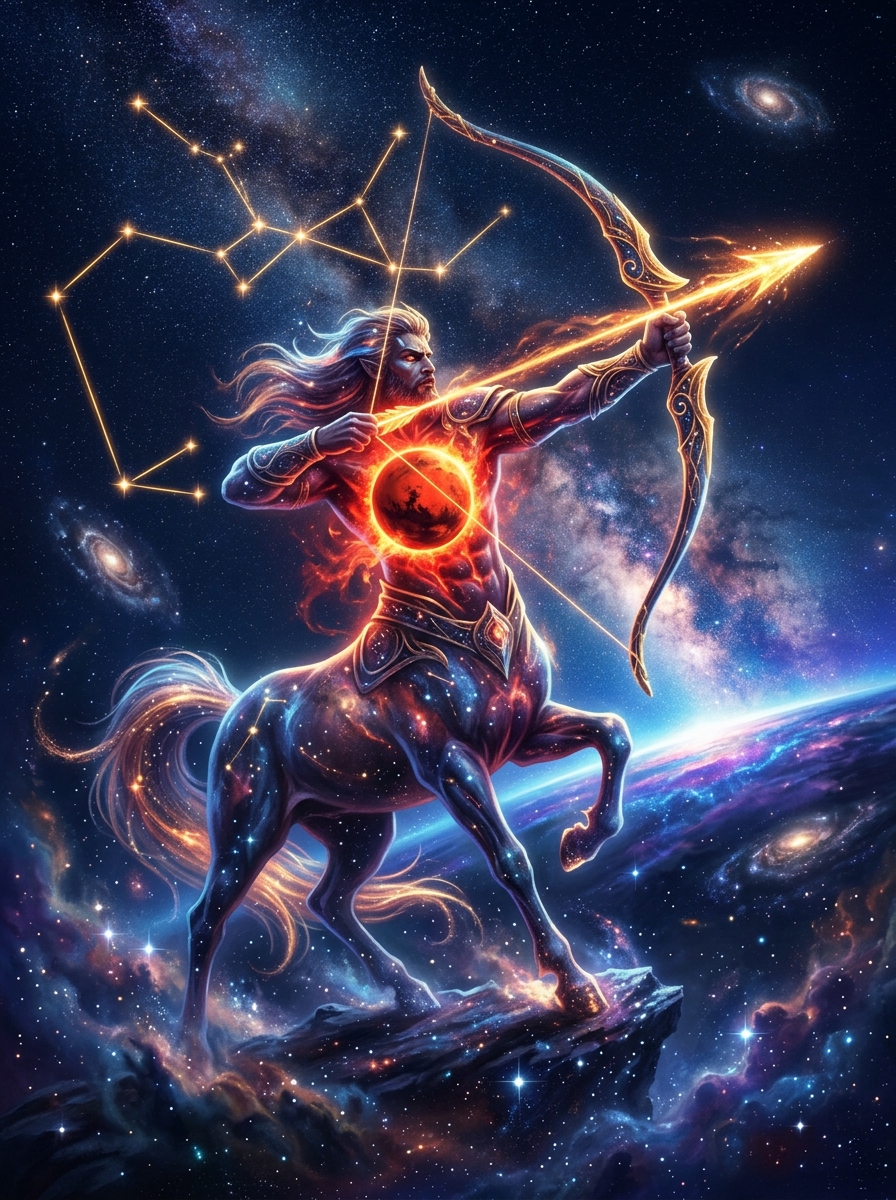
Mars in Sagittarius: Action, Ambition, and Jupiter's Amplifying Hand
The Nature of Martian Energy Through a Mutable Fire Lens
Mars is the planet of raw, unmediated drive. It governs the instinct that propels us out of bed before the alarm sounds, into conflict when our territory is threatened, into bed with someone we've just met, and out the door before dawn because something unnamed is calling from a distance. In the natal chart, Mars describes the quality and style of our desire, aggression, physical energy, and initiative. Its sign placement acts as a lens — not changing the essential nature of the drive, but filtering it into a particular flavor, a specific coloring of the fire that motivates every act of will.
When Mars occupies Sagittarius, that fire encounters an expanding current. Not the cold intellectual breeze of Gemini, not the organized logic of Virgo, but something far more combustible: the philosophical, magnifying wind of Jupiter, Sagittarius's ruling planet. Jupiter doesn't merely add — it amplifies, philosophizes, moralizes, and reaches outward without an obvious stopping point. The result is a Mars that acts not purely from instinct or ego protection, but from conviction. These individuals don't simply want to win; they want to win for a reason. They need their aggression, their desire, their forward motion to mean something beyond the immediate transaction.
Steven Forrest, in The Inner Sky, describes Sagittarius as the sign in which "the soul is in search of meaning" — that restless forward lean toward the horizon where all questions finally resolve. When Mars is placed here, this search refuses to remain abstract or purely contemplative. It becomes embodied, kinesthetic, athletic. The meaning doesn't arrive through stillness; it arrives through motion, through velocity, through the felt experience of crossing into new territory.
The Instinct to Expand
If a single reflex governs Mars in Sagittarius, it is expansion. Where other Mars placements act to protect (Cancer), to control (Scorpio), to perfect (Virgo), or to consolidate (Capricorn), the Sagittarian Mars acts to enlarge. Enlarge the conversation. Enlarge the territory. Enlarge the circle of experience. There is something almost biological about this impulse — as though remaining in one place, one idea, one relationship, one cultural frame of reference produces a genuine physiological anxiety, a slow suffocation of the spirit.
This restlessness is not immaturity, though it can look that way to more fixed temperaments. It is something far more archaic: a deep cellular signal that fires whenever the horizon goes static. Mars in Sagittarius people are, at their core, migratory animals. They are built to move across physical geography, across intellectual landscapes, across belief systems, across identities. Liz Greene, writing on the mutable signs in The Astrology of Fate, observes that mutability carries within it a deep archetypal memory of impermanence — a recognition that nothing is permanent enough to justify complete investment in the fixed position. For mutable fire — for Sagittarius specifically — this manifests as the bone-deep certainty that the next horizon holds something the current position cannot offer.
What this means practically is that Mars in Sagittarius individuals act first and plan second. They leap before the net appears, trusting that enthusiasm and something very like luck will arrange the landing. Jupiter's rulership reinforces this gamble: these natives are often genuinely fortunate, because they enter situations with such unguarded openness that possibilities others would never notice suddenly present themselves. The shadow side of this magnificent trust in forward motion — incompletion, restlessness, and difficulty sustaining routine — will be addressed at length. First, we need to meet the archetype at its source.
The Centaur Archetype: Where Animal Drive Meets Spiritual Vision
Chiron's Legacy and the Divided Self
The symbol of Sagittarius is the centaur — specifically, the archer centaur — and no image in the entire zodiacal vocabulary captures a psychological tension more precisely. The centaur is half horse, half human. The lower body is pure animal: muscular, instinctive, governed by appetite, responsive to terrain, driven by the herd's collective momentum. The upper body is human: reasoning, aspiring, capable of aiming at distant targets, holding the bow with intentional precision.
For Mars in Sagittarius, this split is not merely symbolic. It is the central psychological drama of their lives. The animal half — the raw Martian drive for territory, pleasure, conquest, and forward motion — is enormous in this placement. Jupiter amplifies rather than refines, meaning the appetites here are genuinely large: large hunger, large sexuality, large anger, large ambition. But the human half — the philosophical aspiration, the moral conviction, the need for the action to carry meaning — is equally powerful and demands equal expression.
C.G. Jung's concept of the shadow is particularly useful here. The horse-half of the centaur does not disappear because the archer half points toward heaven. It runs underneath, often faster than the archer can steer. The Mars in Sagittarius person who constructs an elaborate philosophical identity — the seeker, the teacher, the enlightened wanderer — may be genuinely shocked when the horse erupts: in an impulsive affair, in a reckless financial decision, in a blunt verbal outburst that obliterates a carefully cultivated relationship. The integration demanded by this archetype is not the suppression of the animal but the gradual, honest collaboration between the archer's vision and the horse's power.
The Mythological Chiron and the Wound of Wisdom
In Greek mythology, Chiron was the most noble of the centaurs — a healer, teacher, and prophet who instructed heroes including Achilles and Asclepius. He was wounded accidentally by a poisoned arrow and, being immortal, could neither heal nor die. He eventually offered his immortality to free Prometheus, accepting death as a gift. The wound became wisdom; the limitation became the very source of the teaching.
This mythological dimension matters for Mars in Sagittarius, even though Chiron is now classified as a minor body rather than a sign ruler. The archetype embedded in Sagittarius carries this theme: the greatest freedom this Mars will achieve comes not despite its wounds but through them. The restlessness that drives them — that maddening inability to settle, to be satisfied, to stay — is itself the wound. And the task, as with Chiron, is to transform that wound into philosophical understanding, into the teaching that can only be offered by someone who has genuinely traveled the distance.
Primal Drive as Philosophical Fuel
What distinguishes Mars in Sagittarius from other fire Mars placements is the way primal drive — aggression, libido, competitive instinct — becomes philosophically charged. The native rarely experiences desire as mere desire. They experience it as evidence of something. The affair is a quest for authentic connection in a world of compromises. The fight is a defense of principle. The physical adventure is a spiritual initiation. This isn't rationalization, though it can certainly function as rationalization. At its best, it is a genuine sublimation in the classical sense: animal energy channeled into higher-order human expression, what Aleister Crowley called the True Will made manifest through every act.
The risk is inflation — Jupiter's most characteristic shadow. When every impulse becomes philosophically justified, every desire becomes a spiritual calling, and every personal preference becomes a universal truth, the animal has simply dressed up as the archer. Real integration requires the humility to distinguish between genuine vision and inflated appetite.
Mutable Fire in Motion: Inspiration, Restlessness, and the Shadow of Incompletion
The Mutable Fire Paradox
Of the three fire signs, only Sagittarius is mutable. Aries is cardinal — initiating, direct, personally focused. Leo is fixed — sustained, creative, ego-invested. Sagittarius is mutable — adaptive, multi-directional, permeable to new input. This modality distinction is critical for understanding how Mars operates here. Mutable fire is not the contained, maintained flame of a fireplace. It is more like fire in open country: responsive to every shift in wind, capable of incredible speed and reach, but also capable of splitting, changing direction, and occasionally consuming the very territory it was meant to illuminate.
For Mars in Sagittarius, this mutability manifests as a profound responsiveness to new ideas, new possibilities, and new enthusiasms. When inspiration arrives — and it arrives often, because Jupiter guarantees an abundant supply of ideas — the response is immediate and total. The native is in, completely and physically. The project begins, the trip is booked, the new philosophy is embraced, the relationship begins at full throttle. The problem is that mutability is also the quality of inconstancy: the same permeability that opens this Mars to inspired beginnings also opens it to the next inspiration before the first one is complete.
When Inspiration Replaces Completion
The unfinished project is one of the signature wounds of this placement, and it deserves honest examination rather than gentle framing. Mars in Sagittarius people can leave behind an impressive archaeology of abandoned beginnings: half-written manuscripts, companies incorporated but never launched, relationships that burned intensely for two years and then ended in a mutual shrug, degrees pursued and dropped, languages studied to intermediate level and forgotten. This is not laziness — these people often work at extraordinary intensity when engaged. It is the mutable fire problem: the inspiration that launches the project is finite, and when it fades, it is genuinely replaced by a new inspiration that feels just as real, just as important, just as destined.
Understanding this pattern requires moving past self-criticism. The issue is not weak character. The issue is that for a Jupiter-ruled Mars, beginning carries enormous energetic charge. The moment of initiation — the leap into new territory — is experienced as peak aliveness. Completion, by contrast, requires tolerating diminishing novelty, navigating administrative detail, and sitting with the gap between the original vision and the actual finished product. These are precisely the experiences that mutable fire finds most costly.
Working With the Energy Rather Than Against It
The practical resolution — and there is one — does not involve becoming a Capricorn. It involves redesigning the relationship to the project cycle. Mars in Sagittarius tends to thrive on meaningful completion ceremonies: the public launch, the graduation, the final crossing of the finish line when framed as a new beginning. When the completion of one chapter is explicitly reframed as the initiation of the next, the mutable fire that threatens to abandon the process gets recruited into finishing it.
Collaboration with complementary temperaments is equally effective. A trusted Virgo or Capricorn partner — in business or in life — who handles the structural follow-through while the Sagittarian Mars handles vision and momentum is not a compensatory workaround. It is an intelligent division of labor based on accurate self-knowledge. The developmental task is arriving at that self-knowledge without shame: seeing the mutable fire accurately, neither romanticizing it as pure freedom nor condemning it as a personal failing.
Anger, Conflict, and the Blunt Arrow
The Vocabulary of Sagittarian Anger
Mars governs anger as naturally as it governs desire — they are, at root, the same energy moving in different directions. In Sagittarius, the expression of anger is as distinctive as everything else about this placement: sudden, verbal, philosophical, and brief. The Sagittarian Mars does not simmer. It does not build an elaborate internal case, nurse grievances in private, or deploy strategic silence. When anger arrives, it erupts. It speaks. It says, with great confidence and remarkable volume, exactly what the native believes to be true in that moment.
This is the placement most likely to be described as "brutally honest" — with emphasis on both words. The honesty is genuine: Mars in Sagittarius is constitutionally incapable of the social dishonesty that requires pretending everything is fine when it clearly isn't. The brutality is situational: the directness that feels like liberation to the speaker feels like an ambush to the listener who wasn't braced for this level of unfiltered candor. The classic Jupiter excess applies — more truth than the moment required, delivered at a volume calibrated for a larger audience than was present.
The Speed of Fire: Ignition and Extinction
What makes Sagittarian anger genuinely different from, say, Scorpio or Taurus Mars anger is its brevity. This fire burns fast and moves on. The outburst is total but short: five minutes of volcanic clarity, and then — nothing. Not suppressed, not simmering below the surface, genuinely gone. The Sagittarian Mars has said what needed to be said, the truth has been spoken into the room, and now the air is clear. From their perspective, the conflict is over.
The problem is that the people on the receiving end often haven't finished processing the outburst before it's already ancient history for the person who delivered it. This temporal mismatch is one of the more common sources of chronic relational difficulty for this placement. They cannot understand why their partner is still upset an hour later about something they finished feeling ten minutes ago. The partner cannot understand how someone can say something that pointed and then immediately propose lunch. Understanding this pattern — not as a character defect but as a genuinely different relationship to emotional time — is essential for both the native and their close circle.
Learning Verbal Containment Without Losing the Gift
The developmental lesson embedded in this anger pattern is not the elimination of directness. Liz Greene makes a similar point about all fire placements in The Development of the Personality: fire's shadow is not fire itself but fire without awareness of its impact. The Sagittarian Mars who learns to pause before speaking — not to suppress the truth, but to consider the timing, the framing, the relational context in which the truth will land — does not become dishonest. They become a genuinely effective communicator, someone whose directness carries weight precisely because it is delivered with care.
The archer metaphor is instructive here: the arrow flies with maximum power when the archer's aim is conscious and deliberate. Releasing the bow in mid-gallop, without checking the sight line, wastes the very precision that makes the archer formidable. Strategic tact is not a compromise of truth. It is accuracy applied to human terrain.
Eros and the Open Road: Sexuality Under Sagittarian Fire
The Adventurous Libido
Mars governs the libido directly — the raw sexual drive, the nature of erotic desire, the style of pursuit and seduction. In Sagittarius, the libido is, unsurprisingly, adventurous. Not adventurous in the Scorpionic sense of transgression for its own sake, but adventurous in the sense of genuine curiosity, geographic openness, and the eroticization of novelty. New territory, in all its forms, is inherently exciting to this placement.
This erotic adventurousness manifests across several dimensions. Physically, there is a love of the outdoors — these are people who find the setting of an encounter almost as charged as the encounter itself. A hotel room in a city they've never visited, a tent under a spectacular sky, a cabin at altitude: these spaces intensify rather than distract. The environment is not backdrop; it is participant. Mars in Sagittarius eroticizes geography in a way that is quite unlike any other placement.
Travel romances carry special psychological weight for this Mars. The combination of physical displacement, cultural foreignness, and compressed time creates exactly the conditions of novelty, freedom from social surveillance, and consequential uncertainty that this placement finds most energizing. The long-distance relationship, too, paradoxically suits them: the reunion, the airport, the temporary nature of each visit — all of these feed the mutable fire's love of threshold moments, of being perpetually at the beginning of something.
Intellectual Eros and the Requirement for Mental Engagement
What distinguishes Mars in Sagittarius from purely sensualist Mars placements is the libido's genuine dependence on intellectual engagement. Physical attraction is the ignition, but it does not sustain the flame. A partner who is beautiful but intellectually unstimulating will hold a Sagittarian Mars for a season at most. Conversation, shared inquiry, philosophical debate, the experience of learning something from or alongside a lover — these are not supplements to the erotic experience. They are constitutive of it.
This means that the quintessential Sagittarian Mars seduction involves the mind as much as the body. They are drawn to people who hold strong, clearly articulated views — even, and perhaps especially, views that differ from their own. The erotic charge of the intellectual disagreement, of a conversation that goes somewhere genuinely unexpected, is real and substantial for this placement. They want to be surprised. They want to be expanded. They want the relationship to feel like an education, not a routine.
Freedom, Non-Possessiveness, and the Limits of Confinement
The single most important relational condition for Mars in Sagittarius is freedom — not license, necessarily, but genuine psychological space. The threat of confinement, whether through jealousy, excessive demand for closeness, rigid scheduling, or the expectation of identical values and preferences, activates the centaur's legs before the archer can even form a response. These people do not leave relationships out of cruelty or indifference. They leave when the relationship itself begins to feel like a smaller world than the one they inhabited before it.
This is not a character flaw to be corrected. It is an honest account of what this placement requires. The most functional relationships for Mars in Sagittarius involve a partner who has their own independent life, their own strong interests and pursuits, who experiences the native's independence as respecting rather than threatening theirs. Two people who are each genuinely living their own adventure, who come together by active choice rather than mutual dependency — this is the relationship architecture that allows Sagittarian Mars to remain present rather than perpetually eyeing the exit.
Body, Sport, and the Need for Open Horizons
The Outdoor Imperative
The body itself, for Mars in Sagittarius, is not well suited to enclosure. This is one of the most physically restless placements in the zodiac — not with the nervous, wiry energy of Gemini or Virgo, but with the large-muscled, forward-leaning energy of an animal that genuinely needs to run. Desk work is not merely boring for this placement; it is experienced as physically stressful, as a kind of chronic low-grade confinement that accumulates over a week and then demands vigorous outdoor release on the weekend.
The relationship to the natural world is not recreational for Mars in Sagittarius in the way it might be for an earth sign. It is genuinely restorative in a deep, almost primal way. Open sky, visible horizon, the physical sensation of moving across terrain rather than within a defined space — these experiences reset the nervous system in a way that indoor exercise simply cannot replicate. This placement tends to have a poor relationship with gyms, not because physical training bores them, but because the absence of horizon is itself enervating.
Extreme Sports and the Edge of Risk
The sports that draw Mars in Sagittarius tend to share certain qualities: large physical scale, an element of genuine risk, some relationship to altitude or open space, and the quality of travel built into the activity itself. Rock climbing, trail running, long-distance cycling, skiing, sailing, surfing, mountaineering, horse riding, archery (inevitably), and endurance events across natural terrain all speak to this Mars with particular directness.
The risk element deserves attention. Jupiter is the planet of expansion and luck, and Jupiter-ruled Mars tends to carry a relationship to risk that more cautious placements find alarming. There is a genuine belief — usually not consciously formulated but functionally operative — that fortune favors the bold, that the universe tends to catch them when they leap. This belief is not entirely wrong: these natives often are lucky in ways that cannot be fully accounted for by calculation. The shadow is that Jupiter's luck is not infinite, and the Mars in Sagittarius person who never develops a mature relationship to physical risk may eventually find that experience teaching the lesson the chart tried to deliver more gently.
Movement as Philosophy Made Flesh
For this placement, physical activity is never purely physical. The long run is a meditation. The mountain climb is an initiation. The ocean crossing is a philosophical statement about human capability and the nature of limits. This is what makes the body-mind split that other signs sometimes experience largely irrelevant here — for Sagittarian Mars, the body is the philosophical instrument. Thought becomes clear in motion. The best ideas arrive at mile ten, not at the desk. The spirit, as understood by this placement, does not transcend the body; it runs through the body, lit up by effort and open air.
This understanding, when claimed consciously rather than simply enacted, opens the door to powerful physical discipline. The native who recognizes that their physical practice is also their philosophical practice — their living engagement with the question of what human beings are capable of — brings to sport exactly the commitment and seriousness that Jupiter alone might not sustain.
The Path of Integration: From Wild Enthusiasm to the Zen Archer
The Central Developmental Challenge
Every Mars placement carries a developmental arc: a movement from the raw, unmediated expression of the sign's energy toward a more conscious, integrated form of that same energy. For Mars in Sagittarius, the arc moves from enthusiasm to intention. From the mutable fire's initial form — expansive, multi-directional, responsive to every inspiring gust — toward something that retains all the fire's power while adding the archer's deliberate aim.
This is not a movement away from freedom. It is a movement from freedom as reaction (running from every constraint) toward freedom as choice (knowing what you're aiming at and committing to the flight path). The distinction is enormous in practice. The immature Sagittarian Mars is free the way a fire is free: moving wherever the wind blows, consuming whatever is in reach, brilliant and warming and also somewhat unpredictable about where it will spread next. The integrated Sagittarian Mars is free the way an arrow in flight is free: fully committed to its trajectory, moving with absolute precision toward a chosen target, released from a bow drawn with full intentional force.
Kyudo and the Discipline of Intention
The Japanese art of Kyudo — Zen archery — offers the most precise metaphor available for what integration looks like for this placement. In Kyudo, the goal is not simply to hit the target. The goal is to achieve a state of such complete internal alignment — of breath, posture, presence, and intention — that the release of the arrow is the natural outflow of that alignment. The target is hit not as the result of calculation but as the external manifestation of internal correctness. Eugen Herrigel's Zen in the Art of Archery describes this process: the archer must stop trying to hit the target and instead cultivate the conditions from which accurate release becomes inevitable.
For Mars in Sagittarius, this teaching strikes directly at the source of both the placement's greatest gift and its most persistent wound. The gift is the archer — the capacity for inspiring vision, for action in service of genuine ideals, for the kind of bold movement that changes people's lives. The wound is the horse — the scattered, undirected forward velocity that mistakes motion for progress. Kyudo asks the archer to bring the horse to stillness not by breaking it but by integrating it: grounding the vast energy of the lower body into the earth, and then releasing it upward through the spine, through the shoulders, through the draw, through the release, into the arrow's flight.
Moving From Blind Enthusiasm to Focused Will
In psychological terms, what Kyudo describes is the movement from impulsive action to what Aleister Crowley, in Magick in Theory and Practice, called the operation of the True Will — the deepest, most aligned form of desire, distinguished from the ego's momentary appetites by its coherence with the soul's genuine direction. Crowley's formulation, whatever its controversial context, maps onto the Mars in Sagittarius developmental arc with unusual precision: the horse's appetite and the archer's aspiration must eventually find a single direction, a single coordinated act of will, in which there is no internal conflict between what the animal wants and what the philosopher envisions.
This kind of integration is never completed once and left behind. It is an ongoing practice, a daily recalibration between the pull of the new horizon and the commitment to the current trajectory. The mature Mars in Sagittarius person doesn't stop feeling the pull of the horizon. They develop the internal authority to choose, consciously and deliberately, which horizon is worth the full commitment of their fire.
The Gift to the World
When this integration is achieved — even partially, even provisionally — Mars in Sagittarius becomes one of the most genuinely inspiring forces in any human community. These are the people who point toward possibilities that others have rationalized away, who take the physical and philosophical risk that demonstrates something important about human capacity, who teach by embodying rather than by theorizing, who bring the fire of Jupiter's optimism into contact with Mars's concrete, physical, world-changing action.
Steven Forrest, in Yesterday's Sky, observes that each soul's evolutionary journey involves both the wounds of the past and the gifts those wounds were meant to develop. For Mars in Sagittarius, the wound is the centaur's split — the animal and the archer in unresolved tension. The gift is what emerges from that tension's resolution: a human being who has made friends with their own wildness, who carries their philosophical conviction in their body rather than merely in their head, and who moves through the world like an arrow that knows exactly where it's going and has no question about its own flight.
The archer doesn't aim because they're afraid to miss. They aim because the target matters. That distinction — between fear-driven precision and love-driven precision — is the entire developmental journey of Mars in Sagittarius, compressed into a single breath before the release.
Frequently asked questions
- Is Mars in Sagittarius a strong placement?
- Mars in Sagittarius is a moderately powerful placement — Mars is neither exalted nor in detriment here, but Jupiter's amplifying rulership gives this Mars exceptional reach, enthusiasm, and ideological force. It operates best when the native channels restless energy into meaningful, clearly defined goals rather than diffusing it across too many simultaneous pursuits. In contests that reward boldness, vision, and physical endurance over sustained precision, this Mars consistently outperforms more cautious placements.
- How does Mars in Sagittarius express anger?
- Anger here is sudden, verbal, and blazing — the classic 'foot in mouth' fire. The Sagittarius Mars will say exactly what they think, often louder and more directly than the situation calls for. Philosophically, they experience anger as truth-telling: they are simply stating what is obviously the case. The upside is that the anger burns fast and clears completely; they rarely hold grudges, and ten minutes after an outburst they may genuinely not understand why you're still upset. The developmental challenge is learning verbal containment and strategic tact without suppressing the radical honesty that is, at its best, genuinely their gift.
- What does Mars in Sagittarius mean for sexuality and relationships?
- Erotically, this placement craves variety, adventure, and intellectual stimulation in equal measure with physical chemistry. Physical compatibility alone rarely holds a Sagittarius Mars for long — they need a partner who engages their mind, matches their curiosity, and who is willing to explore both literally and figuratively. Long-distance connections, travel romances, and relationships that cross cultural, linguistic, or philosophical lines carry a particular charge for this placement. Freedom and emotional non-possessiveness are effectively non-negotiable: confine them and the desire extinguishes almost immediately.
- What careers suit Mars in Sagittarius?
- Any career that combines movement, vision, and the active transmission of ideas aligns with this placement. Publishing, higher education, constitutional law, international business, adventure travel, outdoor sports coaching, documentary filmmaking, missionary or humanitarian work, and philosophical or religious leadership all draw on the Sagittarian Mars at its best. The common thread is a big horizon and permission to keep moving toward it. Desk-bound roles with narrow scope and no clear expansion path tend to produce acute burnout and restlessness in these natives, regardless of compensation.
- How can someone with Mars in Sagittarius avoid leaving projects unfinished?
- The key is pairing Sagittarian inspiration with structured accountability — a trusted collaborator who handles logistics, a firm external deadline, or a personal discipline practice that acts as an anchor. The Zen archer metaphor used in Kyudo is instructive here: infinite open space requires infinite internal precision. Channeling the broad field of possibility into one committed arrow, one project at a time, transforms scattered enthusiasm into genuine mastery. Practically, this can mean committing to a project publicly, working in focused sprints rather than open-ended timelines, or building in regular check-ins that make incompletion visible before it becomes habitual.
- How does Mars in Sagittarius compare to Mars in Aries or Mars in Leo?
- All three are fire Mars placements, but with crucial distinctions in motivation and style. Mars in Aries is the purest, most instinctual fire — immediate, physical, self-referential, and uninterested in ideology. Mars in Leo is theatrical and pride-centered, fighting for recognition, creative expression, and the consolidation of personal authority. Mars in Sagittarius is the most idealistic of the three: action is always consciously or unconsciously in service of a larger idea, a belief system, or a quest for meaning. The Sagittarian Mars doesn't just want to win — it needs the victory to validate a worldview. This makes them inspiring leaders and exhausting opponents: you're never just arguing with a person, you're arguing with their entire cosmology.
Comments
Loading comments…