The Lovers and The Chariot: From Sacred Alignment to Victorious Mobilization
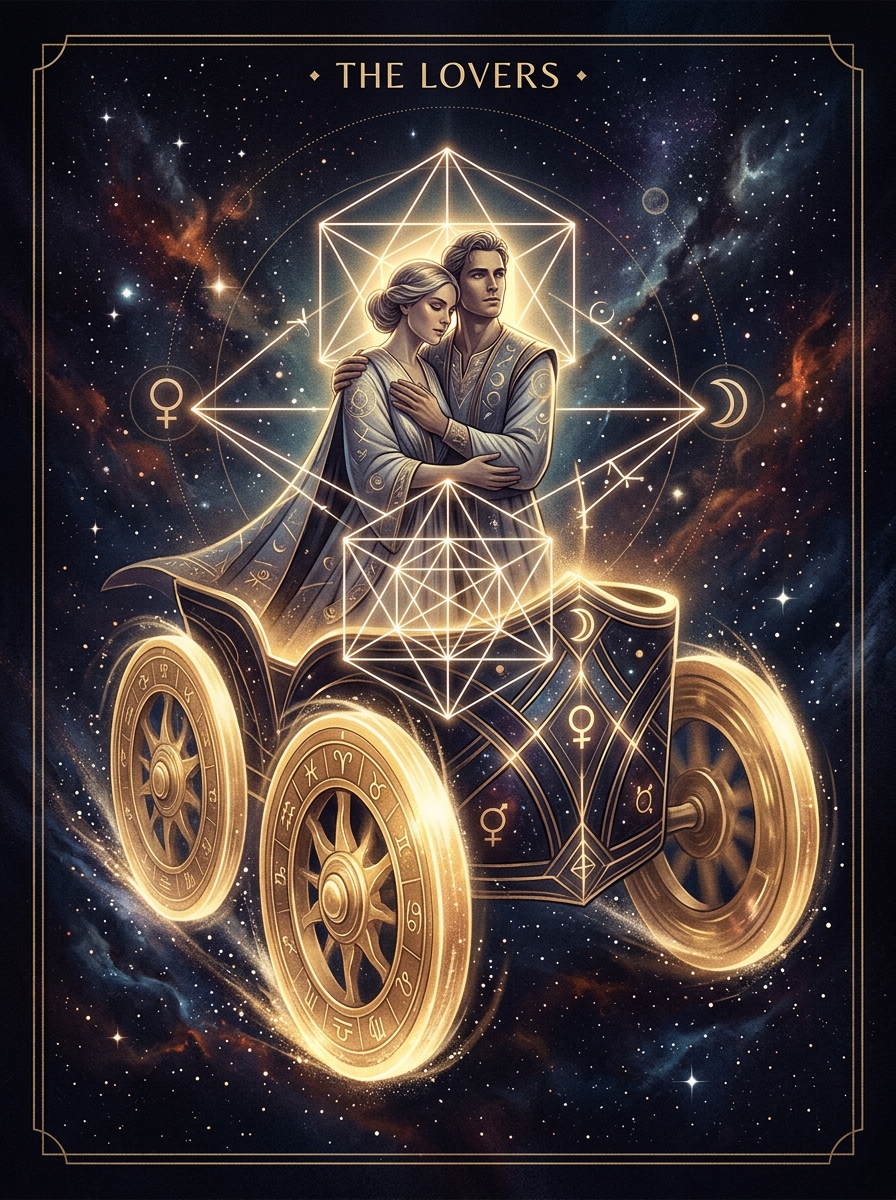
The Archetypal Dynamics of The Lovers and The Chariot
In the sacred geometry of the Major Arcana, the progression from Arcanum VI, The Lovers, to Arcanum VII, The Chariot, represents one of the most critical developmental thresholds in the human journey. It is the transition from the internal crucible of conscious choice to the external mobilization of willpower. When these two cards appear together in a tarot spread, they signal a profound call to move from contemplation to three-dimensional manifestation. It is not enough to simply know what one desires or to align with a particular truth; one must also build the psychological vehicle necessary to carry that truth out into the material world. This sequence demonstrates that the discovery of personal alignment is merely the first phase of initiation; the subsequent phase demands the courage to defend, structure, and drive that alignment forward.
Arthur Edward Waite, in his seminal work The Pictorial Key to the Tarot, depicted The Lovers not merely as a representation of romantic attachment, but as a card of choice, discernment, and spiritual alignment. Under the watchful gaze of the angel Raphael, the figures in the Rider-Waite-Smith deck stand at a crossroads of self-awareness. They represent the intellectual and spiritual differentiation required to make an authentic choice. The tree of knowledge and the tree of life behind them frame this choice as one of cosmic importance. However, the energy of Arcanum VI is inherently static; it exists in the realm of potentiality, of mental evaluation, and of spiritual vows. The Lovers represents the alignment of the heart and mind, the moment of deep resonance, but it does not, by itself, build the bridge to the outer world. It is a state of grace that must eventually be tested by the friction of reality.
This is where Arcanum VII, The Chariot, enters the narrative. The Charioteer, clad in armor adorned with lunar crescents and holding the reins of dual sphinxes, represents the active expression of the will. Having made a choice under the influence of The Lovers, the seeker must now harness the energy of The Chariot to propel that choice forward. The transition is one of containment and direction. The soft, receptive space of Arcanum VI is encased in the hard, protective shell of Arcanum VII. The Chariot is the vehicle of focus, determination, and victory. It is the manifestation of the ego-will disciplined and aligned with the higher choice made in the previous stage of the journey. The Charioteer does not linger in the garden; he rides out into the world to claim his victory.
From Contemplation to the 3D Manifestation of Desire
To understand this dynamic in practical terms, we must examine how these cards operate as a developmental sequence. The Lovers asks the seeker: "What do you value? With what do you align your soul?" The Chariot asks: "How will you protect this choice? How will you drive it through the obstacles of the physical world?" Without the initial choice of The Lovers, the Chariot is a runaway vehicle, driven by raw ambition without a guiding moral or spiritual compass. Conversely, without the Chariot, the Lovers remains a beautiful dream, an idealized state of alignment that never leaves the sanctuary of the mind.
When drawn together, the synergy suggests that the seeker has reached a point where their internal decisions are ready to be tested in the crucible of action. The transition requires a shift from passive reflection to active engagement. The seeker must step out of the garden of Eden (as depicted in The Lovers) and onto the battlefield of life (as symbolized by the Chariot's armor). This is a necessary evolution; the soul cannot remain in a state of perpetual contemplation. It must test its values against the resistance of the external world, using the willpower of the Charioteer to navigate the dualities and conflicts that inevitably arise.
The Dialectic of the Crossroads and the Path
In this light, we can see the relationship between these two cards as a dialectical process. The Lovers represents the thesis—an idealized alignment of opposites, a state of harmony and choice. The Chariot represents the antithesis—the confrontation with the external world, the need for defense, control, and separation. The synthesis is the successful manifestation of the soul's choice through disciplined action. The Charioteer's canopy of stars mirrors the celestial background of the angel in The Lovers, showing that even in the midst of the material struggle, the spiritual source is never entirely lost. The stars on the canopy remind the driver that his journey is still guided by the heavens, even as his wheels roll upon the dusty earth.
The Free-Will Dilemma of Arcanum VI: Gemini, Mercury, and the Crucible of Choice
At the heart of Arcanum VI lies the profound dilemma of free will. Traditionally associated with the sign of Gemini and its ruling planet, Mercury, The Lovers represents the mental agility, curiosity, and dualistic tension that characterize the human intellect. In the Western esoteric tradition, particularly through the lens of modern astrologers like Steven Forrest, Gemini is understood not merely as a sign of superficial communication, but as the archetype of the witness—the part of the psyche that observes, categorizes, and ultimately must choose between multiple paths.
The card itself depicts a fundamental tension between opposites. This is not merely a choice between right and wrong, but a choice between different levels of consciousness. The figures are suspended between the instinctual pull of the earthly realm and the spiritual calling of the angelic figure above. This dualistic structure mirrors the mythological story of Castor and Pollux, the Gemini twins. One twin was mortal, born of human seed, while the other was immortal, fathered by Zeus. When Castor died, Pollux chose to share his immortality with his brother, splitting his existence between the underworld and the heavens. This myth highlights the central challenge of Arcanum VI: the integration of our dual nature. We are simultaneously bound to our earthly, instinctual desires and called toward our divine, spiritual potential.
Castor, Pollux, and the Dialectic of the Soul
The Mercurial discernment required by The Lovers is not a cold, purely rational calculation. It is a holistic alignment of the conscious ego, the instinctual body, and the superconscious self. The presence of the tree of knowledge and the tree of life behind the figures suggests that choice always carries consequences; to choose one path is to let go of another. This is the source of the anxiety that often accompanies Arcanum VI. The Gemini energy wants to explore all possibilities, to keep every door open, and to avoid the finality of commitment.
However, the spiritual evolution of the seeker demands that they move past the state of perpetual exploration. Mercurial discernment must eventually lead to a definitive decision. The Lovers represents the moment where the seeker ceases to simply gather information and instead makes a commitment to a specific path, relationship, or value system. This choice must be made with full awareness of the dualities involved. It is an act of free will that binds the seeker to their destiny, preparing them for the physical journey that lies ahead in the next card of the sequence.
The Mercurial Mind and the Burden of Choice
To choose is to experience a minor death—the death of all the paths not taken. For the Gemini archetype, which thrives on variety and potential, this choice is particularly painful. Liz Greene, in her work on psychological astrology, notes that the Gemini path requires learning to accept the limitations of the material world. One cannot be everything and go everywhere; to manifest anything of value, one must select a single direction. The Lovers card represents that critical moment of selection. It is the crucible where the mercurial mind is refined by the heat of commitment, transforming scattered thoughts into a singular, potent intent.
The Astrological Pivot: Crossing the Threshold from Gemini to Cancer
The transition from Arcanum VI to Arcanum VII mirrors the transition from Gemini to Cancer in the zodiac. This astrological shift represents a movement from mutable air to cardinal water—from the airy, intellectual, and communicative realm of Gemini to the watery, emotional, protective, and foundational realm of Cancer. Understanding this astrological transition is key to unlocking the deeper meaning of the Lovers-Chariot pairing.
Gemini explores the world through curiosity, language, and connection. It is outward-looking, seeking to understand the relationships between different ideas, people, and concepts. It is the realm of the intellect, where nothing is fixed and everything is subject to debate. However, as the sun moves from Gemini into Cancer, the energy shifts dramatically inward. Cancer is the sign of the home, the womb, the family, and the emotional foundations of the self. It seeks to protect, to nurture, and to establish a secure base from which to operate.
Stabilizing Mental Curiosity into Emotional Security
In the context of the tarot, this shift represents the consolidation of Gemini's mental discoveries into Cancer's emotional reality. The intellectual choices made in Arcanum VI must be anchored in the emotional depths of Arcanum VII. The Chariot, which is traditionally ruled by Cancer, represents the emotional armor we build to protect our vulnerability as we navigate the world. The Charioteer's vehicle is decorated with symbols of the moon, emphasizing that the driving force behind this card is not cold logic, but deep, instinctual emotion.
To move from Gemini to Cancer is to move from talking about our values to living them. It is the process of taking the abstract alignments of The Lovers and giving them a physical, emotional container. The Chariot represents the mobilization of our emotional energy. It takes the passion and connection of The Lovers and channels it into a focused, disciplined direction. This transition is not always easy; it requires the seeker to leave behind the lighthearted, exploratory freedom of Gemini and accept the heavy, protective responsibilities of Cancer. Yet, it is only through this anchoring in the emotional self that our choices can gain the power and resilience needed to withstand the challenges of life.
Water and Air: The Alchemy of Cardinal and Mutable Energies
In the teachings of Steven Forrest, mutable air (Gemini) represents the gathering of data, while cardinal water (Cancer) represents the initialization of emotional security. Air is light, objective, and detached; water is heavy, subjective, and deeply attached. The transition from air to water in this pairing represents a process of emotional maturation. We must allow the ideas we have chosen to sink down into our feelings, where they can become a source of strength. The Chariot's armor is not just physical; it is an emotional shield built from our deepest convictions. It is the realization that our intellectual alignments must be backed by emotional commitment if they are to survive the trials of the world.
The Triumph and Ordeal of Arcanum VII: Willpower, the Chariot, and Lunar Guidance
Arcanum VII, The Chariot, is a card of victory, but it is a victory that comes with a warning. The Charioteer is a figure of immense focus and determination, standing victorious within his vehicle. He has harnessed the opposing forces of the black and white sphinxes that draw his chariot, representing the mastery of duality through sheer force of will. However, this mastery is fragile, and the path of the Chariot is fraught with the danger of hubris.
In the Western esoteric tradition, the Chariot is often associated with the myth of Phaeton, the son of the sun god Helios. Phaeton, seeking to prove his divine lineage, demanded to drive his father's sun chariot across the sky. Despite his father's warnings, Phaeton could not control the fiery steeds. He veered too close to the earth, burning the land, and too high into the heavens, freezing the stars. Ultimately, Zeus was forced to strike him down with a thunderbolt to save the cosmos from destruction. This myth serves as a stark warning about the limits of the ego-will. When willpower is driven by pride, ambition, or the desire to prove oneself, it leads to disaster.
The Myth of Phaeton and the Necessity of Self-Discipline
To avoid the fate of Phaeton, the Charioteer must operate under lunar and Cancerian guidance. The willpower of the Chariot must not be a rigid, dictatorial force, but a responsive, emotionally intelligent discipline. The Charioteer's armor is adorned with the Urim and Thummim, symbols of divine guidance and oracle. This indicates that his path must remain aligned with a higher purpose, rather than just personal ambition.
Aleister Crowley, in his interpretation of the Chariot in the Thoth Tarot, emphasized that the Charioteer carries the Holy Grail—the cup of spiritual vision. The true victory of the Chariot is not the subjugation of others or the achievement of material dominance, but the successful containment and protection of the spiritual spark within. The black and white sphinxes do not have reins; the Charioteer must control them through his mind, intent, and inner balance alone. If he loses his internal alignment, the sphinxes will pull in opposite directions, tearing the vehicle apart. Thus, the Chariot teaches us that true willpower is not about forcing our way through obstacles, but about maintaining inner equilibrium and emotional alignment as we move forward.
The Steeds of Desire: Sphinxes and the Control of Dual Forces
The sphinxes in the Rider-Waite-Smith deck represent the dualities of life: the conscious and unconscious, the rational and irrational, the active and passive. They do not look in the same direction, suggesting that without the guiding will of the Charioteer, they would pull the chariot apart. The Charioteer's ability to control them without reins is a symbol of mental and emotional mastery. He does not force them through physical violence; instead, he directs them through the power of his focus and alignment. This is the essence of true discipline—not the suppression of our instincts, but their integration and direction toward a higher goal.
The Journey of Individuation: A Jungian Mapping of the Pair
From the perspective of Jungian psychology, the sequence from The Lovers to The Chariot maps out a crucial phase in the process of individuation—the psychological journey toward wholeness. Carl Jung emphasized that the first half of life is primarily concerned with the development of a healthy ego and a functioning persona, which allows us to adapt to the demands of society.
The Lovers represents the stage of development where we encounter the archetypes of the Anima (the feminine aspect of the male psyche) and the Animus (the masculine aspect of the female psyche). In our early lives, we tend to project these internal archetypes onto external partners, seeking completion through romantic relationships. The Lovers card, with its depiction of the primal couple, reflects this stage of projection and the longing for union. However, true psychological maturity requires us to withdraw these projections and integrate the Anima/Animus within ourselves. The choice presented by Arcanum VI is, at its deepest level, the choice to recognize our own dual nature and accept the responsibility of our own psychological wholeness.
Anima, Animus, and the Persona's Armor
Once the seeker has begun the process of integrating these internal polarities, they must build a vehicle to express this integrated self in the outer world. This is the role of The Chariot, which symbolizes the formation of the Persona and the strengthening of the Ego container. The Charioteer's armor is the Persona—the functional mask we wear to navigate society, protect our vulnerability, and project a clear identity.
In Jungian terms, the Chariot is the ego-vehicle. It must be strong enough to contain the powerful, often contradictory forces of the unconscious (represented by the sphinxes) while steering a clear path through the external world. If the ego is too weak, the unconscious will overwhelm the personality, leading to psychological instability. If the armor of the Persona is too rigid, the individual becomes disconnected from their emotional depths, resulting in a sterile, ego-driven existence. The integration of The Lovers and The Chariot requires us to ensure that our external armor (the Chariot) is always in service of our true, inner alignment (The Lovers).
Building the Ego Vessel for the Unconscious Voyage
In Jungian analysis, the Chariot is seen as the container that protects the fragile conscious ego from being overwhelmed by the collective unconscious. The water symbolisms associated with Cancer (ruler of the Chariot) represent the vast, chaotic depths of the unconscious mind. The Chariot is a boat, a vessel designed to travel across these watery depths without sinking. The Charioteer is the captain who must navigate the tides and currents of emotion. By combining the integration of opposites from The Lovers with the container of The Chariot, the seeker is able to journey into the depths of the psyche without losing their sanity or their identity.
Real-World Alchemy: Practical Interpretations in Love, Career, and Life
When we translate the lofty symbolism of The Lovers and The Chariot into the practical affairs of daily life, we find a message that is both encouraging and demanding. Whether applied to relationships, career, or personal development, this pairing indicates that success requires both clear choice and disciplined execution.
In the realm of love and relationships, the combination of The Lovers and The Chariot highlights the delicate balance between deep bonding and personal autonomy. The Lovers represents the initial, intense attraction and the alignment of values that brings two people together. It is the card of soul-to-soul connection. However, relationships cannot survive on romantic ideals alone. The Chariot introduces the necessity of boundaries, effort, and structured commitment. It warns against the dangers of codependency, where two individuals lose their identities in the relationship. The Chariot calls for each partner to maintain their own direction and drive, using their willpower to support the relationship without losing their individual agency.
Love and Relationships: Balancing Deep Bonding with Autonomy
In career and finance, the Lovers-Chariot pairing is a powerful indicator of success, but only if the seeker maintains ethical integrity. The Lovers represents the choice to pursue work that is aligned with one's true values, rather than simply seeking financial gain. It suggests finding partnerships that are mutually beneficial and built on trust.
Once that ethical foundation is established, The Chariot demands that the seeker mobilize their resources, create a structured plan, and execute it with discipline. This is not a time for passive waiting; it is a time for active determination. The Chariot indicates that obstacles will arise, but they can be overcome through focus and willpower. The key is to ensure that the ambition of the Chariot remains rooted in the ethical choice of The Lovers. If the seeker loses sight of their values in the pursuit of success, the victory of the Chariot will be hollow, leading to the hubristic collapse symbolized by the myth of Phaeton.
Career, Finance, and the Path of Ethical Ambition
Ultimately, the real-world alchemy of this pairing lies in the integration of the passive and active principles. It is the realization that alignment without action is useless, and action without alignment is dangerous. The seeker is called to be both the lover, receptive to the truths of the soul, and the warrior, ready to protect and champion those truths in the physical world.
Practical Synastry: Relationships Guided by Choice and Will
When drawing this combination in relationship spreads, it acts as a guide for couples navigating major life transitions. If a couple is deciding whether to buy a home, start a family, or relocate, The Lovers represents the alignment on the decision itself, ensuring both partners are in agreement. The Chariot represents the physical effort, planning, and determination needed to make that decision a reality. It tells the couple that their love must now take the form of teamwork, where both partners pull in the same direction, like the sphinxes of the Chariot, to reach their destination.
Strategic Mobilization: Reaching Milestones without Losing Integrity
In professional settings, this pairing advises against taking shortcuts. If you are starting a new business or embarking on a project, The Lovers urges you to ensure your partners share your vision and ethics. The Chariot then advises you to establish clear boundaries, define roles, and maintain a rigorous work ethic. The combination suggests that your project has the potential for great success, but only if you remain disciplined and true to your initial vision. It is a reminder that the path to victory is paved with both ethical clarity and unyielding effort.
Frequently Asked Questions
What does it mean to draw The Lovers and The Chariot together as a future outcome?
When drawn together as a future outcome, this combination indicates that you are moving toward a period where a significant, heart-centered decision will lead directly to a major victory. The key to this outcome is that the victory will not happen by chance; it will require you to actively drive your choice forward with discipline and determination. The Lovers represents the decision you must make, ensuring it aligns with your core values. Once that choice is made, The Chariot shows that you will have the energy, focus, and willpower to overcome any obstacles in your path and achieve a successful, triumphant result. It is a sign that your conscious choices are about to manifest in the physical world through your own efforts.
How does the relationship between Gemini and Cancer influence this combination?
The relationship between Gemini (the ruler of The Lovers) and Cancer (the ruler of The Chariot) represents the transition from intellectual exploration to emotional anchoring. Gemini provides the curiosity, communication, and multiple perspectives needed to make an informed choice. Cancer then takes that choice and internalizes it, providing the emotional depth, protective boundaries, and maternal care needed to nurture it. Astrologically, this combination suggests that you must move from the airy, theoretical realm of thoughts and ideas to the watery, practical realm of emotions and instinct. It is a call to align your mind with your heart and use your emotional intelligence to guide your actions.
In a love reading, does this pair lean more toward romance or personal growth?
While this pairing certainly has strong romantic implications, it leans heavily toward personal growth within the context of a relationship. The Lovers represents the deep connection and shared values between partners, but The Chariot emphasizes the need for individual autonomy and boundaries. This combination warns against codependency, suggesting that a healthy relationship requires both partners to maintain their own identities and paths. It is a call to work together toward common goals while supporting each other's individual journeys. It suggests that the relationship will serve as a vehicle for mutual growth, demanding discipline, communication, and a shared commitment to personal development.
How can I apply the lesson of the Sphinxes to my daily life?
The sphinxes that draw the Chariot represent the opposing forces of duality—light and dark, active and passive, conscious and unconscious. In your daily life, you can apply their lesson by recognizing that you do not need to eliminate these opposing forces; instead, you must learn to balance and direct them. The Charioteer controls the sphinxes not with physical reins, but with his will and internal alignment. This suggests that you can navigate the conflicts and dualities of your life by maintaining your inner equilibrium and focus. When you feel pulled in different directions, return to the core values you identified under the influence of The Lovers, and use that alignment to steer your life forward.
What is the warning when The Chariot appears next to The Lovers?
The primary warning of this combination is the danger of ego inflation or hubris. The Chariot's energy is powerful and ambitious, and it can easily lead to a state where you believe you can force your will upon the world without regard for consequences. If you lose connection with the heart-centered values of The Lovers, your actions can become ruthless, self-serving, and ultimately destructive, similar to the myth of Phaeton. The presence of The Lovers acts as a moral compass for The Chariot, reminding you that your willpower must always be in service of your true self and ethical principles, rather than just personal ambition or control.
How do Arthur Edward Waite and Aleister Crowley differ in their interpretation of these cards?
While Arthur Edward Waite focused on the moral, spiritual, and relational aspects of choice in The Lovers and the concept of controlled willpower in The Chariot, Aleister Crowley took a more alchemical and dynamic approach in the Thoth Tarot. For Crowley, The Lovers represents the alchemical marriage of opposites (the Red King and the White Queen), representing a deeper level of psychological and spiritual unification. The Chariot in the Thoth deck is associated with the Holy Grail and the preservation of the spiritual vision, placing a greater emphasis on the mystical quest of the Charioteer as a champion of the light. Understanding these differing perspectives allows the tarot reader to appreciate both the practical, psychological guidance of Waite and the deep, alchemical transformation suggested by Crowley.
Comments
Loading comments…