Lilith in Libra: The Relational Shadow and the Quest for Authentic Union
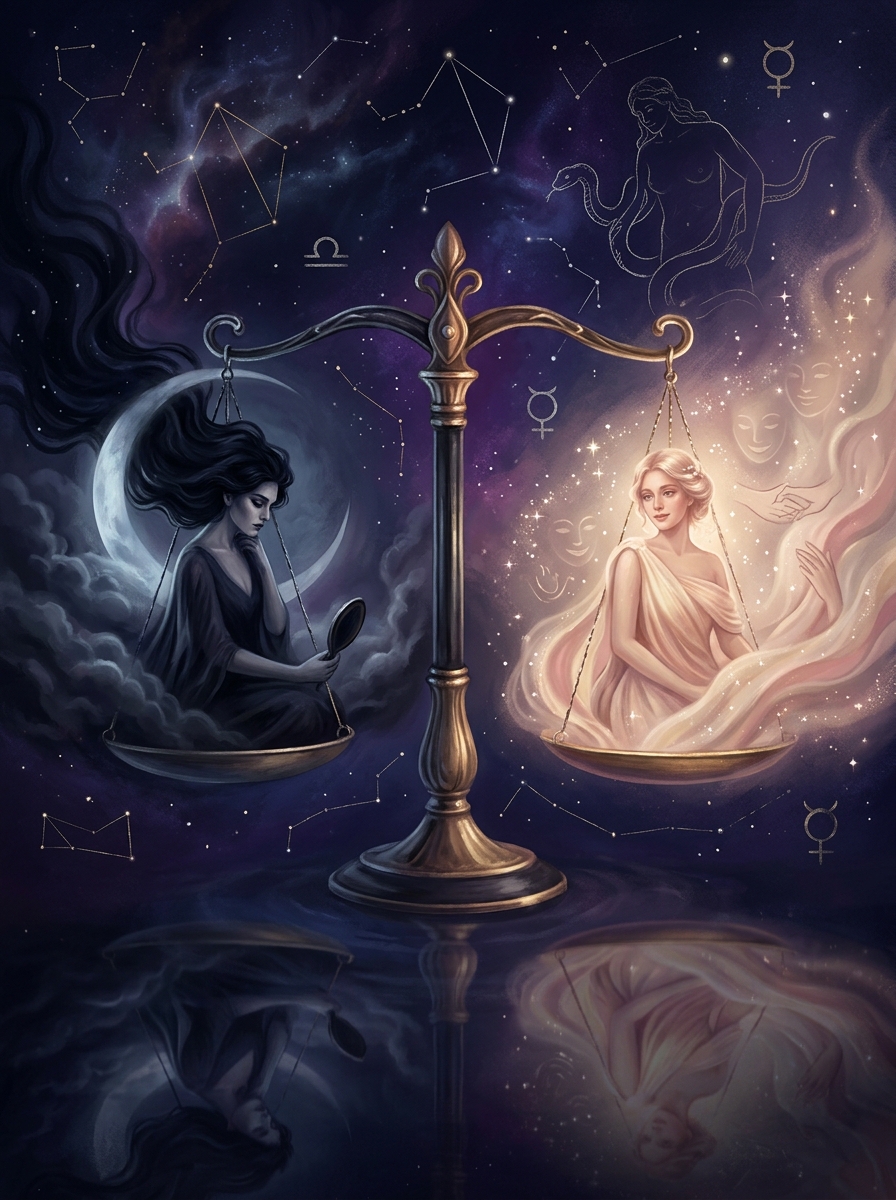
The astrological chart is a map of competing impulses, a celestial tapestry woven with both the light of conscious aspiration and the deep, fertile dark of the repressed unconscious. Among the most potent and enigmatic points in this map is the Black Moon Lilith. Not a physical body, but rather the lunar apogee—the point in the Moon's orbit that is furthest from the Earth—Lilith represents the wild, untamed, and suppressed dimensions of the psyche. It is the raw, instinctual self that refuses to negotiate, compromise, or submit to societal expectations. When this primal force is placed within the Venus-ruled, air sign of Libra, a profound and complex psychological tension is born. Libra is the sign of the Scales, representing harmony, symmetry, diplomacy, and the civilized art of partnership. Here, Lilith's wild, uncompromising nature meets the Venusian urge for connection, creating a lifelong dance between the desire for intimate union and the fierce demand for personal freedom.
For the seeker possessing this placement, the natal chart points to a sacred battleground located in the realm of relationships. Libra seeks to balance, to beautify, and to merge, often at the expense of individual boundaries. Lilith, however, demands absolute truth, even if that truth shatters the peace. This placement is a cosmic paradox: it represents a deep hunger for the perfect, harmonious union alongside an equally powerful impulse to disrupt, challenge, and dismantle the very structures of relating when they become stifled by polite pretense. To understand Lilith in Libra is to embark on a journey through the relational shadow, examining the ways in which we project our suppressed wildness onto others, tolerate toxic dynamics to avoid solitude, and ultimately learn to build relationships based on authentic sovereignty rather than codependent compromise.
This archetype functions as a mirror, reflecting back the unresolved wounds of the collective feminine and the deeply ingrained fear of social exclusion. In the context of American relationships, where the ideals of egalitarian partnership are often balanced against traditional expectations of romance, the Lilith in Libra individual faces a unique set of challenges. They must navigate the fine line between compromise and self-effacement, discovering that the only true path to union is through the recognition of their own internal polarity. This placement challenges the native to look past the surface-level beauty of their connections and dive into the messy, uncomfortable, and ultimately liberating depths of emotional honesty.
The Archetype of Black Moon Lilith in Libra: The Lunar Apogee in the House of Venus
To understand Black Moon Lilith in Libra, we must first understand the physics of the lunar apogee. As the Moon travels its elliptical path around the Earth, it reaches a point of maximum distance. This point of furthest remove is a place of isolation, of looking back at the Earth from the cold, quiet depths of space. In psychological astrology, as championed by Liz Greene and Steven Forrest, this apogee represents the parts of our nature that feel cast out, misunderstood, and exiled from the comfortable, familiar territory of the conscious ego. In Libra, the sign of Venus, this exile occurs within the domain of human connection. The house of Venus is typically a place of warmth, social grace, and aesthetic appreciation. When Lilith resides here, the native's relationship style is marked by a deep, almost haunting sense of otherness. They do not fit neatly into the conventional expectations of partnership.
This archetype represents the search for an authentic relational truth that transcends superficial social contracts. Libra is naturally attuned to the expectations of others, possessing an innate social radar that detects conflict before it arises. However, Lilith in Libra cannot tolerate the superficial peace that Libra so easily constructs. Instead, Lilith acts as an instigator of raw truth within the relationship. The native may feel a split: on one hand, they crave the idealized, harmonious partnership represented by the Scales; on the other, they feel a deep-seated rebellion against the compromises required to maintain that harmony. Astrologer Steven Forrest often emphasizes that Lilith represents our wildness, and in Libra, this wildness is expressed through an unconventional approach to love, a refusal to adhere to traditional relationship scripts, and a demand that partners meet them in their rawest, most unvarnished state.
This placement also highlights the inherent tension between the element of Air and the instinctual nature of the Black Moon. Air signs operate in the realm of ideas, aesthetics, and social structures. Lilith, however, operates in the gut, the blood, and the deep unconscious. When Lilith is placed in Libra, the native tries to conceptualize their wildest instincts, attempting to intellectualize or aestheticize their deepest passions and rages. This can lead to a sophisticated, highly refined expression of the shadow, where the native uses charm and intellectual dialogue to negotiate their boundaries, yet beneath the surface, a wild and volatile emotional current remains unaddressed. The journey of Lilith in Libra is the integration of this visceral, instinctual wildness with the civilized, rational, and loving qualities of the Libran Scales.
Furthermore, this placement challenges the native's relationship with the concept of justice. Libra, symbolized by the Scales, is deeply concerned with fairness and equality. However, under Lilith's influence, the definition of justice undergoes a dramatic shift. It is no longer about adhering to societal norms or keeping everyone happy; instead, it becomes a quest for a deeper, cosmic justice that honors the wild soul. The native may become highly sensitive to power imbalances in relationships, reacting strongly to any attempt by a partner to control, manipulate, or diminish them. They must learn that true fairness in partnership is not achieved by keeping a meticulous ledger of compromises, but by ensuring that both partners have the space to exist in their full, uncompromised individuality.
Relational Magnetism and Seduction: The Refined and Enigmatic Charm
There is a distinct, magnetic allure to those with Lilith in Libra. Venus gives them a natural understanding of beauty, charm, and social dynamics, while Lilith infuses this grace with an underlying current of danger, mystery, and raw sexual power. This is not the overt, dramatic seduction of Lilith in Scorpio, but rather a subtle, intellectual, and aesthetic enchantment. The native knows exactly how to mirror the desires of others, presenting an idealized image of the perfect partner. They possess a refined charm that can captivate others, drawing them into a sophisticated web of shared ideas, art, and intellectual compatibility. This magnetism often attracts partners who are drawn to their elegance, yet sense that there is a wild, untamable core hidden just beneath the surface.
This placement frequently manifests as an attraction to high-status, intellectually powerful, or creatively gifted partners. Because Libra is associated with social standing and refinement, Lilith here seeks a partner who can match their intellectual capacity and aesthetic standards. The native may find themselves drawn to individuals who represent an idealized version of partnership—people who are respected, accomplished, and socially polished. However, the Lilithian shadow ensures that this attraction is rarely simple. Often, the native attracts partners who are magnetic but chaotic, individuals who carry the raw, unexpressed wildness that the Lilith in Libra native has suppressed in themselves. The relationship becomes a high-stakes mirror, where the partner acts out the native's hidden desires, rages, and impulses.
In the realm of seduction, Lilith in Libra uses the art of relationship itself as a tool of engagement. They are masters of the romantic dance, knowing when to lean in and when to pull back, creating an intoxicating rhythm of accessibility and distance. Yet, this charm carries a dual nature. The very qualities that make them seductive—their ability to harmonize, to intellect, and to charm—can also become a prison. The native may become so skilled at playing the role of the perfect, desirable partner that they lose touch with their own genuine needs. The seduction is successful, but the resulting relationship is built on a performance rather than the authentic self. Healing begins when the native uses their magnetic charm not to capture the approval of others, but to express their true, uncensored individuality within the partnership.
This magnetic pull is also deeply connected to their aesthetic presentation. Lilith in Libra individuals often possess an innate sense of style, design, and symmetry. They use their environment, their clothing, and their personal presentation to project an image of balanced perfection that is simultaneously alluring and slightly intimidating. This aesthetic capability is not mere vanity; it is a shield and a language. It allows them to communicate their internal complexity without having to speak it directly. However, the temptation is always to hide behind this beautiful facade. The true test of their seductive power is whether they can allow a partner to see the chaotic, asymmetrical aspects of their soul that lie beneath the polished exterior, allowing for a connection that is beautiful not because it is perfect, but because it is real.
The Venusian Eclipse: Harmony vs. Raw Authenticity
The internal experience of Lilith in Libra is often one of profound conflict, a psychological phenomenon that can be described as the Venusian Eclipse. Venus, the ruler of Libra, seeks connection, social harmony, and the avoidance of discord. It instructs the psyche to adapt, to please, and to smooth over the rough edges of human interaction. Lilith, conversely, demands raw authenticity and the expression of the sovereign self, regardless of the social consequences. When these two forces collide, the native experiences an intense internal pressure. They want to speak their truth, to establish their boundaries, and to say "no," but the Venusian urge warns them that doing so will destroy the harmony of the relationship and lead to abandonment.
The Pathology of Polite Submission
This conflict often results in a habit of polite submission. The native suppresses their anger, their frustrations, and their unconventional desires in order to keep the peace. They become the consummate peacekeeper, adapting to the partner's schedule, preferences, and values. Yet, Lilith cannot be permanently silenced. The suppressed wildness builds up pressure within the unconscious, eventually erupting in sudden, unpredictable ways. These eruptions may take the form of passive-aggressive behavior, sudden relational sabotage, or intense, irrational outbursts of anger over minor issues. The native is shocked by their own intensity, and the partner is left confused by the sudden shift from the accommodating "ideal partner" to the raging Lilithian archetype.
This pattern of suppression and eruption creates a volatile dynamic within the home. The native may go to great lengths to avoid direct confrontation, instead using subtle hints, icy silences, or administrative control to express their discontent. This passive-aggression is a direct result of the Venusian fear of direct conflict. Because they have been taught that open anger is ugly and destructive, they channel Lilith's fire into cold, intellectual maneuvers. The tragedy of this dynamic is that it prevents any real resolution. By refusing to bring their true grievances into the light, they deny the partnership the opportunity to clear the air and rebuild on firmer ground.
To resolve the Venusian Eclipse, the native must realize that conflict is not the enemy of connection, but often its prerequisite. True harmony is not the absence of tension, but the capacity to hold and resolve it. By allowing Lilith to speak—by expressing disagreement, asserting boundaries, and risking the discomfort of discord—the native frees themselves from the prison of polite submission. They learn that a relationship which cannot survive their truth is not a relationship worth preserving, and that authentic connection can only exist between two fully sovereign individuals. This requires a profound re-education of the nervous system, which has been trained to equate disagreement with danger.
The Mirror of Projection: Shadow, Anima, and Animus in Partnership
In Jungian psychology, the shadow consists of those aspects of the self that the conscious ego rejects, suppresses, or denies. Because Libra is the sign of the "Other," those with Lilith in Libra are uniquely prone to projecting their shadow onto their romantic partners. The qualities they have disowned in themselves—their selfishness, their anger, their wildness, and their demand for absolute independence—are projected onto the screen of the partner. The partner is then perceived as the wild, unpredictable, selfish, or chaotic one, while the native views themselves as the long-suffering, accommodating victim of the partner's behavior.
Idealization and the Inevitable Collapse
This projection dynamic is particularly powerful in the early stages of relationship. The native may experience a magnetic attraction to a partner who appears to embody the absolute freedom and raw passion that the native has suppressed. They idealize this partner, viewing them as a savior who will free them from their own rigid, polite boundaries. However, because this attraction is built on projection rather than a realistic appraisal of the other person, it is destined to collapse. Over time, the very qualities that were once idealized—the partner's wildness, independence, or disregard for social rules—become sources of intense pain and resentment. The native begins to judge the partner for the very traits they secretly long to express.
This projection also involves the Jungian concepts of the Anima and Animus—the unconscious feminine side of a man and the masculine side of a woman. Lilith represents the raw, instinctual, and rejected aspect of these inner guides. When projected, the native attracts partners who act out these raw archetypes, leading to intense, karmic relationships that feel incredibly fated but are often fraught with conflict. The path to liberation lies in withdrawing these projections. The native must recognize that the wildness, the sovereignty, and the capacity for intense boundary-setting they see in their partners are actually their own repressed qualities. By reclaiming their Lilith, they stop demanding that their partners carry their shadow, clearing the way for a realistic and mature love.
Moreover, the withdrawal of projection requires the native to take responsibility for their own capacity for chaos. It is easy to play the role of the civilized partner while accusing the other of being the disruptor. But Lilith in Libra must look in the mirror and ask: How am I subtly inviting this chaos into my life? How am I using my partner to act out the rebellion I am too afraid to express myself? When the native owns their inner disruptor, the partner is freed from the heavy burden of playing the shadow. The relationship can then transition from a theater of unconscious projection to a real, conscious meeting of two distinct individuals, each carrying their own light and dark.
Saturnian Karmic Lessons: Dismantling the Myth of Marriage
In traditional astrology, Saturn is exalted in Libra. This means that the structured, disciplined, and boundary-focused energy of Saturn operates with high efficiency and dignity in this sign. Libra represents the social contract of marriage, the legal and moral agreements that bind individuals together. When Lilith is placed in Libra, the native's relationship path is deeply intertwined with these Saturnian themes of responsibility, structure, and karma. They are forced to confront the rigid societal expectations surrounding marriage, partnership, and long-term commitment.
Reconstructing Relational Responsibility
The karmic task of Lilith in Libra is to dismantle the inherited myths of marriage and partnership. The native often grows up with idealized, fairy-tale notions of romance, believing that union requires the complete merging of two souls into a single entity. They may feel societal pressure to conform to traditional relationship structures, finding themselves entering marriages or long-term commitments that feel safe and socially acceptable, but which ultimately suffocate their Lilithian nature. The Saturnian lesson here is one of trial and error: the native must experience the weight of restrictive, unauthentic commitments in order to learn the necessity of building partnerships based on mutual freedom and spiritual responsibility.
This dismantling process can be painful. It often requires the native to walk away from relationships that look perfect on paper but are spiritually dead. Through these challenges, the Saturnian energy forces the native to construct a new definition of commitment. They must learn that true partnership is not a legal or social contract designed to provide security at the expense of growth, but a dynamic, evolving agreement between two independent sovereigns. They learn to establish boundaries not as walls to keep the partner out, but as containers that protect the integrity of the love they share.
This reconstruction also involves a deep reckoning with the concept of duty. For many years, the native may have confused duty to the relationship with self-sacrifice. Saturn in Libra, when integrated with Lilith, teaches that the highest duty one has in a relationship is to remain true to oneself. When we sacrifice our truth to save the partnership, we are actually offering a hollow shell to our partner, which is a form of relational betrayal. The native must learn to build a new kind of contract—one that is written not in the ink of social expectation, but in the fire of mutual respect for each other's individual destiny. This is a mature, Saturnian love that does not fear the distance between two souls, but honors it as the space in which love can breathe.
The False Self and the Dread of Solitude
At the core of the Lilith in Libra placement lies a deep, existential dread: the fear of solitude. Libra is a sign that understands itself through reflection, requiring the mirror of the other to feel complete. Lilith, representing the primal fear of rejection and exile, amplifies this Libran vulnerability. The native fears that if they reveal their true, untamed self—their anger, their raw desires, their boundaries—they will be rejected and left entirely alone in the cold void of isolation. To defend against this terrifying prospect, they construct what psychologist D.W. Winnicott termed the "False Self."
Somatization of the Silenced Self
The False Self is a psychological mask designed to secure approval, love, and safety. For Lilith in Libra, this mask is characterized by perpetual politeness, compliance, and the constant anticipation of the partner's needs. The native learns to smile when they are angry, to agree when they disagree, and to minimize their own desires to keep the partner comfortable. They become expert caretakers of the relationship, but in doing so, they abandon themselves. The true, instinctual self—the Lilithian core—is pushed deep into the unconscious, where it is denied expression.
This chronic suppression of the true self has severe consequences, often manifesting as somatic issues. When emotional truth cannot be spoken, the body speaks it instead. The native may experience chronic physical symptoms, such as tension in the throat (the chakra of communication), digestive issues (associated with processing suppressed anger), or skin conditions (reflecting issues with boundaries and contact). These physical ailments are the body's protest against the dominance of the False Self. Healing requires the native to face the dread of solitude, realizing that the loneliness of being alone is far less damaging than the loneliness of being in a relationship where one's true self is entirely absent.
Furthermore, the False Self creates a sense of profound exhaustion. The energy required to constantly monitor one's behavior, scan the partner for signs of disapproval, and maintain the facade of harmonious perfection is immense. Many natives with this placement reach a point of burnout, where they simply cannot maintain the performance any longer. This burnout, though painful, is a crucial turning point. It is the moment when the False Self cracks open, allowing the raw, authentic Lilith to emerge. The native must learn to treat this collapse not as a failure, but as a breakthrough, a vital step toward reclaiming their somatic and psychological integrity.
Pathways to Healing: Marrying the Self First
The ultimate spiritual and psychological goal for Lilith in Libra is the process of "marrying oneself first." This is the foundational healing path that transforms the placement from a source of relational suffering into a wellspring of personal power and authentic connection. Before the native can enter into a balanced, sovereign partnership with another, they must establish an unbreakable commitment to their own soul. They must become their own primary partner, providing themselves with the validation, security, and love they so desperately seek from others.
The Sacred 'No'
The first step in this healing journey is learning the art of the sacred "No." Because the native is conditioned to say "yes" to maintain peace, reclaiming the power of refusal is a revolutionary act. The native must practice setting boundaries, expressing disagreement, and tolerating the temporary discomfort of discord. They must understand that a healthy relationship is not one that is free of conflict, but one that is strong enough to hold the truth of both individuals. Saying "no" to a partner's demands when they conflict with one's own integrity is an act of self-love that strengthens the relational container.
Marrying oneself first also means cultivating a rich, independent life outside of relationships. The native must learn to enjoy their own company, developing hobbies, friendships, and spiritual practices that do not depend on a partner's participation or approval. When the fear of solitude is healed, the native no longer enters relationships out of a desperate need to avoid loneliness, but out of a genuine desire for shared growth and connection. They attract partners who respect their independence because they respect it themselves, creating a balanced, dynamic, and truly harmonious union.
Additionally, this path requires a reconciliation with the inner wildness. The native must create safe containers to express their repressed anger and passion—whether through creative projects, physical movement, or shadow work. They must learn to love the messy, unpredictable parts of themselves that they have hidden away for so long. By integrating Lilith, they bring a rich, vibrant authenticity to their partnerships. They no longer present a flat, two-dimensional image of perfection, but a complex, three-dimensional human being who is capable of deep intimacy precisely because they are not afraid to be seen in their completeness.
FAQ: Understanding Lilith in Libra
What does Lilith in Libra mean in a natal chart?
Lilith in Libra in a natal chart indicates that your shadow work, karmic lessons, and deepest desires for sovereignty are centered around relationships and partnerships. It represents a tension between your need for social harmony and your urge for raw, uncompromising truth in your connections with others. It highlights where you are most prone to people-pleasing and where you must learn to stand firm in your own power.
How does Lilith in Libra affect romantic relationships?
This placement often leads to a cycle of codependency, people-pleasing, and the creation of a "False Self" to keep the peace. You may suppress your true feelings to avoid conflict, only to experience sudden outbursts of anger or attract partners who project your own repressed wildness. Over time, it forces you to redefine what commitment means to you.
Why do I attract chaotic or toxic partners with this placement?
Because you may suppress your own wild, independent, and assertive qualities to maintain harmony, you project these traits onto others. You attract magnetic, unpredictable partners who live out the repressed Lilithian energy you are afraid to express in yourself. Reclaiming your own wildness breaks this cycle.
How can I heal the codependency associated with Lilith in Libra?
Healing begins by "marrying yourself first." This means developing your own boundaries, learning to express disagreement, embracing the power of the sacred "No," and overcoming the fear of solitude. Cultivating a rich, independent life is essential for breaking the cycle of codependency and building a strong relationship with your own soul.
What are the career implications of Lilith in Libra?
While primarily focused on relationships, this placement can manifest in your career as a talent for mediation, diplomacy, and artistic expression, combined with a strong aversion to unfair power dynamics. You may struggle with office politics but thrive in roles where you can advocate for justice, authentic cooperation, and artistic integrity.
Does this placement affect how I deal with conflict?
Yes, Lilith in Libra makes you highly sensitive to conflict. You may go to great lengths to avoid direct confrontation, often resorting to passive-aggressive behavior or silent retreats. Part of your healing journey involves learning that direct, honest communication is a form of respect and that healthy conflict can actually strengthen a relationship.
Comments
Loading comments…