Jupiter Transits: The Astrological Journey of Expansion, Meaning, and Archetypal Wisdom
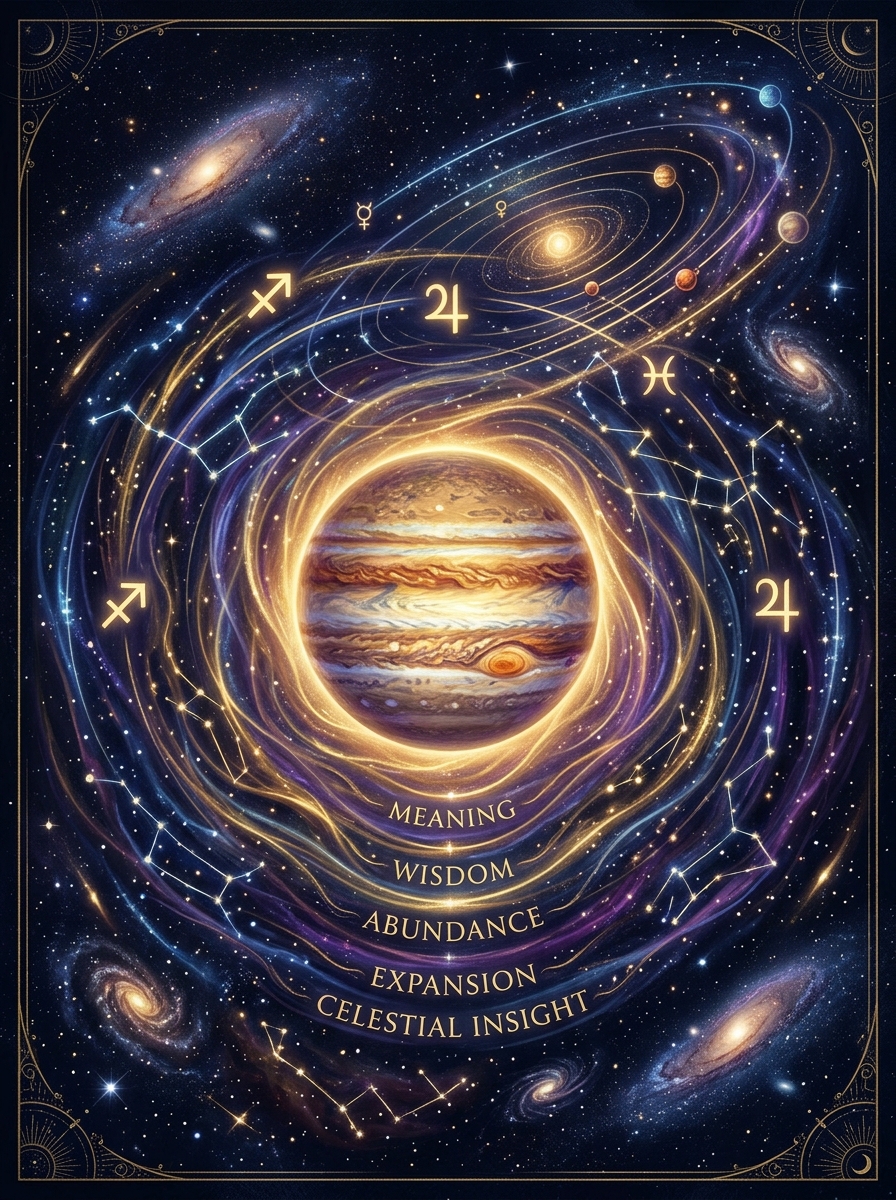
The 12-Year Cycle: Understanding Jupiter's Journey and the Jupiter Return
Jupiter, known in the ancient Latin tradition as the planet of wisdom, abundance, faith, and higher learning, takes approximately twelve years to complete a full journey around the zodiac. This means that Jupiter spends roughly one year in each astrological house, marking a distinct twelve-year cyclical rhythm of development and expansion in our lives. In evolutionary and psychological astrology, this cycle represents the slow unfolding of our search for meaning. As the Swiss psychologist Carl Jung remarked, the psyche seeks wholeness, and Jupiter is the astrological archetype that pushes us beyond our current boundaries to find that wholeness in the outer world. When Jupiter transits a particular house or makes contact with a natal planet, it acts as a cosmic magnifying glass, highlighting the evolutionary potential of that area and urging us to take calculated risks to grow. It is a time when the doors of perception swing open, prompting us to ask deeper questions about who we are, what we believe, and what we are capable of achieving. It represents the urge to find coherence and purpose in what might otherwise seem like random experiences.
During a Jupiter transit, we are invited to challenge the self-limiting beliefs that have kept us small. It is as if the universe is granting us permission to occupy more space, speak our truth more boldly, and align ourselves with a larger, more hopeful vision of existence. However, because Jupiter is an archetype of boundless expansion, its transits do not work in isolation. They are part of a continuous conversation with Saturn, which provides the necessary boundaries and structures to ground Jupiter's vision. Without this grounding, the opportunities presented by Jupiter can dissipate like steam, leaving behind nothing but a sense of vague optimism and missed connections. Therefore, understanding Jupiter's journey requires us to look not just at the moments of sudden luck or expansion, but at the entire twelve-year structural journey of our personal evolution. It is a slow, methodical unfolding where each stage builds upon the last.
From an astronomical perspective, Jupiter's movement is relatively steady, traversing approximately 30 degrees of the zodiac every year. This steady pace translates psychologically into a reliable developmental momentum. It gives us sufficient time—roughly twelve months—to fully experience, integrate, and ground the lessons of each house activation. It is neither too fast to be missed nor too slow to cause stagnation. Instead, it offers a balanced tempo that allows the psyche to expand naturally, adapting to new dimensions of awareness and integrating them into our daily routines, relationships, and sense of purpose.
The Anatomy of the 12-Year Cycle
Every twelve years, the developmental spiral of our lives resets, initiating a new chapter of personal exploration. During this orbit, Jupiter acts as a celestial searchlight, revealing opportunities where there previously seemed to be dead ends. Astrologer Steven Forrest describes Jupiter’s path as a journey of faith, where the universe asks us to trust in our own potential and step outside of our comfort zones. The first six houses of the birth chart (Houses 1 through 6) represent the subjective, internal phase of the cycle. During this time, Jupiter’s transits are focused primarily on subjective, internal growth, self-discovery, the refinement of skills, and the cultivation of personal resources. This is a time of quiet preparation, where we build the inner container that will eventually support our outer aspirations.
The second half of the cycle, as Jupiter crosses into the southern hemisphere of the chart (Houses 7 through 12), shifts the focus outward toward social contribution, relationships, public visibility, and professional achievement. In this phase, the work we did in the first six houses begins to bear fruit in the public eye. We are called to share our wisdom with the community, form alliances, and step into roles of greater responsibility and leadership. Recognizing where you are in this twelve-year cycle allows you to align your personal efforts with the natural tide of expansion rather than swimming against it. It helps you understand when it is time to focus on personal development, and when it is time to showcase your talents to the outer world.
Navigating the Jupiter Return: Ages 12, 24, 36, 48, 60, and 72
The Jupiter Return occurs when transiting Jupiter returns to the exact zodiacal degree it occupied at the moment of your birth. This happens every twelve years, most prominently at ages 12, 24, 36, 48, 60, and 72. Each Jupiter Return acts as a major developmental threshold, initiating a new twelve-year cycle of growth and redefining our relationship with hope and meaning. At age 12, the first return coincides with the transition into adolescence, the beginning of secondary education, and the rapid expansion of the intellectual and social horizons. The child begins to see themselves as an independent thinker, forming beliefs that are distinct from those of their parents.
At age 24, the second return often marks a period of defining one's independent path in the world, seeking a career direction, embarking on higher education, or travelling the world to find oneself. It is a time of intense idealism, where we test our philosophies against the realities of adult life. By age 36, the third return invites a reassessment of one's life philosophy and societal role, prompting individuals to seek deeper authenticity and discard beliefs that no longer fit. At age 48, the fourth return often correlates with a midlife re-evaluation of goals and achievements, opening new channels for sharing wisdom and mentoring others. At age 60 and 72, the later returns represent opportunities to harvest the wisdom of a lifetime, finding peace in one's legacy and exploring the deeper spiritual dimensions of existence. As Liz Greene notes in her work on psychological astrology, these returns are moments of potential liberation from outdated psychological conditioning and dogmas, allowing us to redefine what success, abundance, and purpose mean to us on an individual level.
House Activations: How Jupiter Expands Different Areas of Life
When Jupiter enters a new house in the birth chart, it initiates a year-long phase where the themes of that house are brought to the forefront of our conscious experience. The house occupied by transiting Jupiter is where we are encouraged to dream bigger, take risks, and expand our conscious awareness. To understand these transits deeply, we must explore how Jupiter behaves within each of the twelve houses, organized by the four classical elements that define their basic developmental orientation.
Fire Houses: The Call to Adventure (1st, 5th, and 9th Houses)
When Jupiter transits the Fire houses, the focus is on creative expression, identity, and personal vision. It is an invitation to display courage, enthusiasm, and confidence in your unique path.
- The First House: Jupiter crossing the Ascendant into the first house brings a powerful wave of physical vitality, optimism, and personal presence. It is a period of self-reinvention where you present a more confident, expansive version of yourself to the world, often accompanied by a desire to change your physical appearance, style, or lifestyle. You feel a renewed sense of agency and readiness to meet the world on your own terms. The primary task is to expand your sense of identity, take up space, and project your authentic self with confidence.
- The Fifth House: Here, Jupiter expands your creative capacity, romantic life, and willingness to play and take risks. This transit demands authentic self-expression, encouraging you to engage in artistic pursuits, explore hobbies, or experience the joy of romance without overthinking. It is a time when the inner child is liberated, prompting you to share your unique gifts with others. The focus is on finding joy, spontaneity, and creative validation.
- The Ninth House: As the natural home of Jupiter, this transit supercharges the search for truth, meaning, and worldview. It is a prime time for long-distance travel, philosophical exploration, writing, publishing, or returning to university to expand your intellectual horizon. You are urged to seek the larger picture and synthesize diverse ideas into a coherent philosophy. Growth comes from exposing yourself to foreign cultures, ideas, and systems of thought.
Earth Houses: Materializing Opportunity (2nd, 6th, and 10th Houses)
In the Earth houses, Jupiter’s expansive energy must find a tangible, practical outlet. Without grounding, the abundance of Jupiter remains a mere concept, leading to wasted potential and unfulfilled dreams.
- The Second House: This transit focuses on financial growth, self-worth, and personal resources. While it can bring material opportunities, it also demands that you reassess your values, ensuring that your pursuit of material wealth aligns with your internal integrity. It is a time to invest in your skills, believe in your value, and build financial security, though you must guard against impulse buying and extravagance.
- The Sixth House: Jupiter here brings expansion to your daily routines, physical health, and work environment. It is an excellent time to improve your physical well-being through new health routines, refine your work skills, or find more meaningful work. The environment you work in becomes more supportive, though you must guard against overcommitting to tasks or overindulging in daily habits that strain your physical body.
- The Tenth House: Transiting the Midheaven into the tenth house brings career visibility and professional recognition. Your ambitions are highlighted, and opportunities for advancement, public recognition, or leadership roles naturally present themselves. It is a time when your professional authority is recognized and expanded, allowing you to influence a wider audience.
Air Houses: Expanding Intellectual and Social Networks (3rd, 7th, and 11th Houses)
The Air houses direct Jupiter’s search for meaning toward communication, intellect, and social relationships, teaching us that growth occurs through connection and the exchange of ideas.
- The Third House: This transit stimulates the mind, encouraging local travel, writing projects, teaching, and the learning of new skills. Your immediate environment becomes a source of curiosity and intellectual stimulation. You are prompted to share your ideas with your community and engage in dialogues that stretch your thinking, improving your communication and networking capacities.
- The Seventh House: Jupiter in the house of partnerships brings opportunities for growth through significant relationships. It can indicate the arrival of a supportive mentor, a business partner, or a romantic relationship that broadens your perspective. Existing partnerships undergo a phase of growth and renewal, though the desire for freedom within relationships may also increase.
- The Eleventh House: Here, Jupiter expands your social circle, alliances, and future aspirations. It is a time when collaborating with groups, community organizing, or pursuing humanitarian goals can bring deep fulfillment and open new doors. Your dreams for the future become larger, more collaborative, and more aligned with the collective good.
Water Houses: The Inner Journey and Psychological Growth (4th, 8th, and 12th Houses)
When Jupiter enters the emotional realm of the Water houses, expansion is felt internally rather than externally. The growth is psychological, spiritual, and emotional.
- The Fourth House: This transit brings growth to the domestic sphere, family relationships, and your psychological foundation. It is a period of cultivating emotional security, healing ancestral patterns, or expanding your home through renovation or relocation. You seek to create a sense of sanctuary in your private life, anchoring your soul.
- The Eighth House: Jupiter here facilitates psychological excavation, deep intimacy, and shared resources. It is a time for confronting shadow material, undergoing therapeutic transformation, or finding financial opportunities through investments, inheritance, or shared finances. You learn to trust others and share power without losing your individuality.
- The Twelfth House: Often called the transit of the "guardian angel," Jupiter in the twelfth house offers deep spiritual protection and psychological integration. It is a quiet, reflective period that invites meditation, dream work, and the release of subconscious fears. It allows you to connect with the collective unconscious, preparing you for the outer renewal of the first house.
Planetary Contacts: Jupiter Transiting Natal Planets and Angles
The transits of Jupiter to your natal planets and angles represent specific, dynamic interactions that trigger the expression of those natal energies. When Jupiter makes contact with a planet in your chart, it temporarily amplifies that planet's archetypal drives, making its expression more prominent and seeking to elevate it to a higher level of integration. This amplification can be experienced as a sudden burst of energy, a shift in attitude, or external events that force you to engage with that planet's themes.
Contacting the Personal Planets: Sun, Moon, Mercury, Venus, and Mars
- Jupiter-Sun Transits: These periods bring a powerful boost to your core identity, confidence, and creative self-expression. You feel a strong desire to be seen and appreciated for who you truly are, often leading to new leadership opportunities or creative breakthroughs. It is a time to claim your authority and express your authentic self, though you must guard against arrogance and overestimating your capabilities.
- Jupiter-Moon Transits: This contact amplifies your emotional life, intuition, and need for security. It brings a sense of emotional generosity, making it easier to nurture others and receive care in return. It is also an excellent time for expanding your home environment, resolving long-standing family matters, and deepening your connection to your roots.
- Jupiter-Mercury Transits: Your intellectual capacity, communication skills, and curiosity are supercharged. You may feel inspired to write, teach, learn a new language, or diagnose complex ideas. The risk here is overlooking important details or making promises you cannot keep, as the mind focuses heavily on broad, sweeping generalizations and future possibilities.
- Jupiter-Venus Transits: These are classic periods of social harmony, artistic appreciation, and romantic opportunity. You are more receptive to pleasure, beauty, financial flow, and love. It is an excellent time to socialize, create art, and improve relationships, though you must watch for a tendency to overspend, overindulge, or romanticize situations that require clear boundaries.
- Jupiter-Mars Transits: This contact boosts your physical energy, drive, and assertiveness. You feel courageous and ready to take bold actions to achieve your goals. It is a time to launch new projects and test your strength, though the shadow side can manifest as impulsiveness, impatience, or an aggressive pursuit of your desires without considering the needs of others.
Crossing the Threshold: The Ascendant, Midheaven, Descendant, and Imum Coeli
When Jupiter crosses the four angles of the birth chart, it marks major turning points in your life structure, shifting how you interact with the world around you and redefining your public and private boundaries.
- The Ascendant (AC): Crossing the Ascendant, Jupiter initiates a cycle of personal renewal and physical vitality. It changes how you project yourself into the world, boosting your self-confidence, physical presence, and willingness to initiate new projects. It is a time of personal liberation where you shed old skins.
- The Midheaven (MC): When Jupiter reaches the peak of your chart, your professional path and public standing are highlighted. This is a time of career expansion, professional honors, and aligning your public work with your personal philosophy. You are called to step into the role of the mentor or guide within your professional field.
- The Descendant (DC): Entering the seventh house via the Descendant, Jupiter shifts the focus to your one-on-one relationships. It brings supportive partnerships, mentors, and collaborative ventures into your life, helping you grow through connection. It encourages you to seek relationships that expand your worldview.
- The Imum Coeli (IC): Crossing the lowest point of the chart, Jupiter brings blessings to your private life, home, and emotional foundations. It is a time of deepening your roots, healing childhood issues, and creating a sanctuary in your domestic life, emphasizing that outer success must be built on a stable inner foundation.
Aspect Dynamics: Navigating Hard Aspects vs. Flowing Aspects
Not all Jupiter transits manifest as easy opportunities. The nature of the aspect—the geometric relationship between transiting Jupiter and your natal planets—dictates how the energy is experienced. Understanding the difference between hard aspects and flowing aspects helps you work constructively with the planetary energies, transforming potential challenges into paths of conscious development.
The Crucible of Hard Aspects: Conjunctions, Squares, and Oppositions
Hard aspects from transiting Jupiter challenge us to grow, but they often do so by creating tension, restlessness, or a feeling of dissatisfaction with the status quo. They demand conscious effort to integrate the expanded energy.
- Conjunctions: When transiting Jupiter conjuncts a natal planet, it merges with that planet's energy. This is a highly potent contact that marks the initiation of a new developmental cycle, demanding that we expand how we express that planet's themes. It is a double-edged sword that can bring massive success or massive amplification of existing issues.
- Squares: Jupiter squares create a dynamic, urgent push for growth. You may feel an overwhelming urge to escape limitations, which can lead to impulsive decisions, conflicts with authority, or overextending your resources. The key to navigating a square is channelizing the restlessness into productive action rather than reckless behavior.
- Oppositions: An opposition projects the Jupiterian energy onto the outer world or onto other people. You may encounter individuals who embody the archetype of the teacher, the guide, or, conversely, the dogmatic zealot. It demands that you find a balance between your own beliefs and the perspectives of others, integrating the projection.
The Easy Flow: Trines and Sextiles
Flowing aspects from transiting Jupiter bring opportunities that feel natural, harmonious, and relatively effortless. They are periods of ease and receptivity, allowing for smooth development.
- Trines: Trines represent a harmonious flow of energy between transiting Jupiter and your natal chart. Doors open easily, and support seems to manifest just when you need it. The challenge with a trine is that because the energy flows so smoothly, you might take it for granted, fall into complacency, and fail to actively seize the opportunities presented.
- Sextiles: Sextiles offer potential opportunities that require your conscious participation to manifest. The cosmic doors are unlocked, but you must take the step to walk through them. It is an excellent time to make connections, pitch ideas, and take initiative, translating potential into reality.
The Shadow of Jupiter: Managing Hubris, Inflation, and Wasteful Excess
While traditional astrology often refers to Jupiter as the "Greater Benefic," modern psychological astrology recognizes that every archetype has a shadow. Jupiter's shadow is rooted in the concepts of inflation, hubris, and overextension. Because Jupiter represents the principle of expansion, it does not know when to stop, and it lacks the inherent capacity for boundary-setting. Without conscious awareness, a Jupiter transit can lead to significant setbacks caused by over-optimism and a lack of grounding.
The Psychological Mechanism of Jovian Inflation
Psychologically, Jovian inflation occurs when the ego identifies too closely with the archetype of unlimited potential. You begin to believe that you are untouchable and that you cannot fail, leading to poor judgment, extravagance, and a total disregard for practical realities. This can manifest as taking on too much financial debt, committing to projects you do not have the time or energy to complete, or becoming dogmatic and self-righteous in your beliefs. Liz Greene warns that when we fall into Jupiterian inflation, we lose touch with our human limitations, setting ourselves up for a sudden and painful fall back to earth. Inflation blinds us to risk, turning opportunity into liability. It can lead to spiritual bypassing, where we use optimistic beliefs to avoid dealing with real-world problems.
When we experience a Jupiter transit to our natal Sun or Venus, for instance, we might feel an intoxicating rush of confidence that makes us ignore the warning signs of a business deal or a relationship conflict. We might feel that everything is destined to work out, which prevents us from taking simple, practical precautions. This kind of hubris can alienate those around us, as we project a sense of moral or intellectual superiority. The key is to enjoy the influx of optimism while maintaining a healthy dose of self-awareness.
Saturn as the Grounding Counterweight
To manifest Jupiter's potential constructively, we must integrate the lessons of Saturn, the planet of structure, discipline, boundaries, and realism. While Jupiter says "yes" and seeks to expand, Saturn says "no" and seeks to define. Astrologer Steven Forrest emphasizes that without the containment of Saturn, the energy of Jupiter simply dissipates into vague optimism and wasted opportunities. True abundance is not just about expanding; it requires the discipline to organize, build, and sustain what Jupiter inspires us to create. By bringing Saturnian realism, planning, and responsibility to your Jupiter transits, you can build a stable foundation that allows your growth to endure long after the transit has passed.
How to Prepare for and Consciously Align with Jupiter's Expansive Energy
To make the most of a Jupiter transit, you must move from passive expectation to conscious partnership. The universe does not simply deliver rewards; it presents invitations for development. When we align our consciousness with the archetype of expansion, we can harvest the opportunities presented by these transits while avoiding the pitfalls of excess. Here are practical strategies to align with Jupiter’s transit through your chart:
- Identify the Territory: Locate which house transiting Jupiter is currently moving through in your birth chart. This reveals where you are being asked to grow, explore, and take calculated risks over the coming year. Knowing the house allows you to focus your energy where the wind is at your back.
- Clarify Your Intentions: Set clear, realistic goals for that area of your life. Ask yourself: Where have I been playing it too safe? What beliefs are limiting my progress? How can I expand my understanding here?
- Practice Discernment: Guard against the shadow of over-optimism. Before committing to new projects, loans, or agreements, run them through a reality check. Ensure you have the Saturnian resources—time, discipline, and structure—to support your plans.
- Cultivate Curiosity: Approach the transit with a beginner's mind. Read books, take courses, and seek out mentors who can help you broaden your understanding of the world and challenge your existing perspectives.
- Say Yes to Calculated Risks: When opportunities present themselves, do not let fear or inertia hold you back. Trust in your ability to adapt, learn, and expand your horizons, knowing that growth requires stepping into the unknown.
Frequently Asked Questions
What is a Jupiter Return and how does it affect me?
A Jupiter Return occurs every twelve years when transiting Jupiter returns to the exact position it held in your birth chart at the time of your birth. This transit marks a significant turning point in your life, initiating a new twelve-year cycle of personal growth, philosophical exploration, and developmental expansion. It is a period to reassess your life goals, release self-limiting beliefs, and embrace new opportunities.
Can a Jupiter transit bring negative experiences?
Yes, if its energy is not consciously managed. The shadow of Jupiter involves inflation, over-optimism, and excess. During hard transits (squares, oppositions, or challenging conjunctions), you may experience financial overextension, poor judgment, or interpersonal conflicts stemming from dogmatism or hubris. The key is to balance Jupiter’s expansion with Saturn’s discipline.
How does Jupiter’s transit through the 12th house differ from other houses?
Unlike transits through the outer houses, which bring tangible professional or social opportunities, Jupiter in the twelfth house operates in the internal, spiritual realm. It is a year of psychological integration, spiritual protection, and deep self-reflection. It is often described as a period of having a "guardian angel," helping you heal old wounds and prepare for the renewal that comes when Jupiter crosses the Ascendant into the first house.
How long does a typical Jupiter transit last?
Jupiter takes about twelve years to orbit the Sun, meaning it spends approximately one year in each zodiac sign and astrological house. A transit to a specific natal planet or angle usually lasts for a few weeks to several months, depending on Jupiter’s retrograde cycles, which can cause it to cross the same point in your chart up to three times.
What should I do if Jupiter is transiting my career house (10th house)?
When Jupiter transits your tenth house of career and public standing, it is a prime opportunity to seek professional advancement, pitch major projects, and take on leadership roles. You are more visible to the public and to authority figures, making it an excellent time to showcase your skills. However, ensure you do not overcommit or promise more than you can deliver.
How do I know if I am experiencing Jupiterian inflation?
You are likely experiencing Jupiterian inflation if you feel a sense of absolute certainty that you cannot fail, leading you to disregard practical details, ignore warnings from others, or take on unsustainable levels of debt or responsibility. If you find yourself preaching your views as the absolute truth or feeling restless with any form of structure or limitation, it is a sign to ground yourself. Integrating Saturnian planning and seeking objective feedback from trusted friends or professionals can help you bring this energy back into balance.
Related
- The Jupiter Return: Your 12-Year Invitation to Expand, Deepen, and Begin Again
- Jupiter Retrograde: The Inner Journey of Meaning and Metanoia
- Jupiter in the First House: The Alchemy of Personality and Abundance
- Jupiter in the Second House: Abundance, Self-Worth, and the Art of Conscious Prosperity
- Sun Sextile Jupiter: The Ease of Generous Selfhood
Comments
Loading comments…