The Hermit and The Wheel of Fortune Tarot Combination
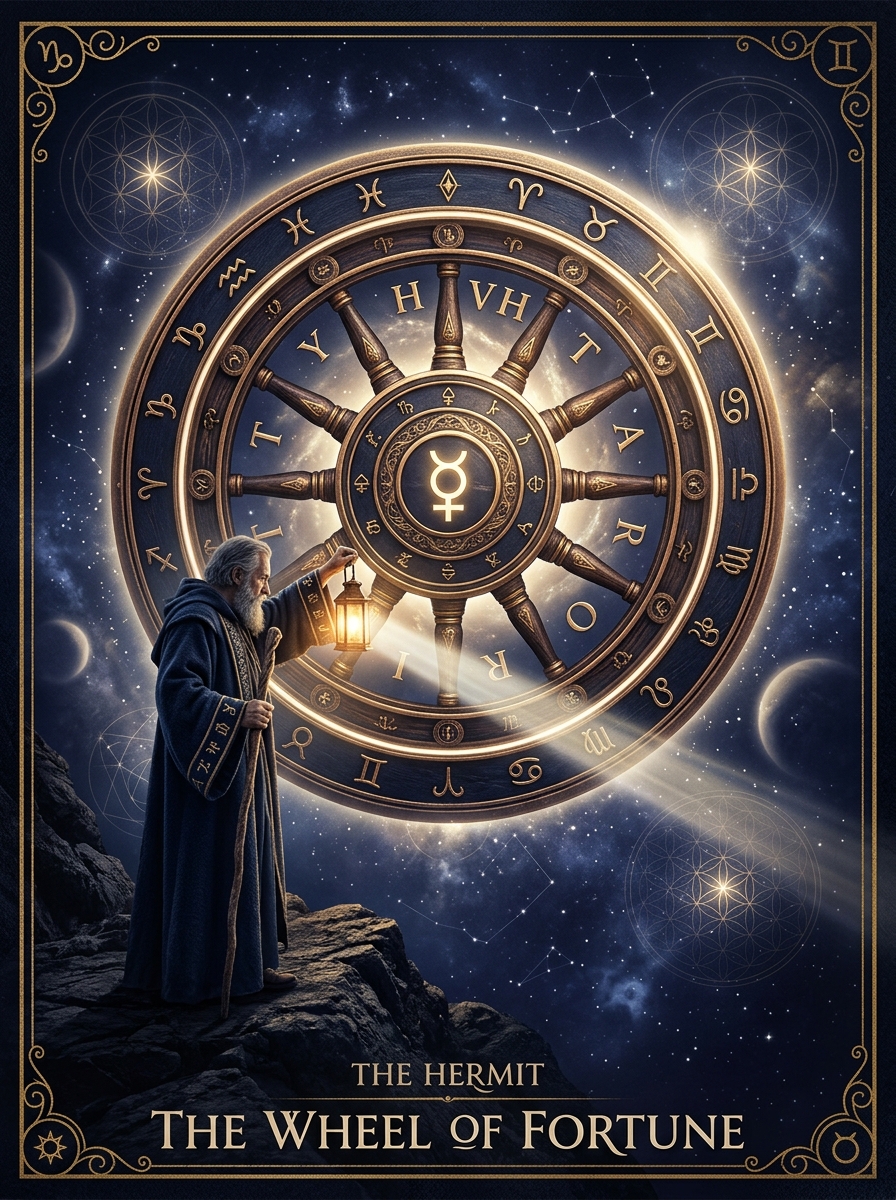
Archetypal Dynamics of The Hermit and The Wheel of Fortune Combined
The card combination of The Hermit (Arcanum IX) and The Wheel of Fortune (Arcanum X) represents one of the most intellectually and spiritually stimulating configurations in the Tarot. At its core, this pairing brings together two forces that seem fundamentally at odds: the static, inward-looking containment of the introspective seeker and the dynamic, outward-looking movement of cosmic change. When these two cards appear together in a spread, they signal a profound transition in the querent’s life, a moment where the lessons of voluntary isolation, self-reflection, and inner stabilization meet the inevitable, turning cycles of external destiny.
In Jungian terms, this combination represents the dialogue between the subjective psyche and the objective world. Carl Jung emphasized that the process of individuation—the journey toward becoming one's true, undivided self—requires periodic retreats from the collective noise. The Hermit is the personification of this withdrawal. By retracting our projections from the external world, we stop blaming others or circumstances for our unhappiness, looking instead at the internal architecture of our minds. However, the individuation process cannot be completed in a cave. Eventually, the seeker must reintegrate with the external world, which is where The Wheel of Fortune comes in. The Wheel represents the return of the individual to the flow of collective life, but this time, the return is marked by a heightened state of self-awareness.
Within the sequence of the Major Arcana, the transition from Arcanum IX to Arcanum X is a natural progression. The Hermit has spent time standing on the peak, holding high the lantern of truth, looking down at the path he has traveled. He has integrated the lessons of the previous eight cards. In Arcanum X, the perspective shifts from the individual's effort to the cosmic play. The Wheel of Fortune represents the realization that we are part of a larger, constantly shifting mechanism. If we attempt to navigate the turning of the Wheel without having first integrated the lessons of the Hermit, we are likely to experience the motion as chaos or misfortune. The Hermit’s lantern provides the steady focal point necessary to maintain equilibrium when the ground beneath our feet begins to spin.
The Meeting of Chronos and Fortuna
To understand the deeper layers of this combination, we must examine its astrological correlations. The Hermit is traditionally associated with the sign of Virgo, which, while ruled by Mercury, shares a strong thematic connection with Saturn—the planet of boundaries, structure, and time (Chronos). Saturn represents the necessity of limits and the wisdom that comes only through patience, discipline, and aging. Conversely, The Wheel of Fortune is ruled by Jupiter, the planet of expansion, luck, opportunity, and cosmic benevolence. The interplay between these cards is therefore a direct manifestation of the Saturn-Jupiter cycle in psychological astrology.
As Liz Greene has noted in her psychological studies of the outer planets, the dialogue between Saturn and Jupiter is central to human development. Saturn provides the structure, the vessel, and the critical boundaries that keep us grounded, while Jupiter provides the vision, the aspiration, and the urge to expand beyond our current limitations. When The Hermit and The Wheel of Fortune appear together, they suggest that the querent has reached a point where their Saturnian containment is ready to be expanded by a Jupiterian shift. The boundaries that once protected the Hermit's contemplation must now open up to receive the opportunities brought by the turning of the Wheel. It is a time when the inner work (Saturn) is met by an outer event (Jupiter), creating a synchronized moment of destiny.
The Hermit: Saturnian Solitude, Introspection, and the Old Sage
To fully appreciate this combination, we must first examine each card individually, starting with the quiet figure of The Hermit. Standing alone on a snow-dusted mountain summit, wrapped in a simple gray cloak, Arcanum IX presents a stark image of voluntary isolation. Unlike the hanging figure of Arcanum XII, who is suspended by external circumstances, the Hermit chooses his solitude. His posture is not one of defeat, but of deep, active contemplation. He carries a wooden staff in one hand, representing his connection to the earth and his practical grounding, and in the other, he holds a lantern containing a six-pointed star—the Star of Solomon.
Psychologically, the Hermit embodies the archetype of the Wise Old Sage, or the Senex. In Jungian psychology, the Senex represents the structure of the psyche, the principles of order, wisdom, and historical memory. In its positive aspect, the Senex offers guidance, discipline, and a deep understanding of natural laws. The Hermit represents that part of us that knows when to step away from the crowd, to silence the external chatter, and to look at our lives with cold, objective clarity. This is a time when the ego submits to the higher Self, seeking not social validation or material success, but the essential truth of its own existence. The gray cloak of the Hermit symbolizes the concealment of this inner light from the uninitiated, indicating that true wisdom is often quiet and unassuming.
The Hermit's association with Virgo highlights the importance of discrimination and purification. Virgo is the sign of the harvest, the process of separating the wheat from the chaff. In the Hermit's realm, this translates to psychological sorting. We must examine our beliefs, our relationships, and our desires, discarding those that are no longer authentic to our path. The snow on the mountain peak represents the purity of this elevated state of consciousness, far removed from the emotional swamps of the lower valleys. It is a place of cold, clear air, where the mind can operate without the distortions of passion or external influence.
The Light of the Lantern: Self-Reflexive Consciousness
In the Rider-Waite-Smith tradition, Arthur Edward Waite described The Hermit as a card of initiation and silent guidance. The lantern is not a spotlight designed to illuminate the entire landscape; rather, it shines just enough light to reveal the next step on the path. This is a crucial distinction. The Hermit does not offer a grand, all-encompassing roadmap for the future. Instead, he teaches us to trust the process of self-reflexive consciousness. By focusing on the immediate truth of our present state, we find the guidance we need to take the next step, trusting that the path will unfold as we walk it.
Furthermore, the six-pointed star within the lantern represents the union of opposites: the upward-pointing triangle of spirit and fire, and the downward-pointing triangle of matter and water. This symbol indicates that the Hermit’s wisdom is not a rejection of the physical world, but an integration of the spiritual and the material. The Hermit has gone into the heights of the spirit to find the light, but he holds it down to illuminate the physical path. He is the bridge between the heavens and the earth, using his solitude to bring down truths that can be applied to the everyday world.
The Wheel of Fortune: Jupiterian Impermanence, Cycles, and Destiny
In sharp contrast to the silent stability of The Hermit, Arcanum X, The Wheel of Fortune, is a card of movement, change, and cosmic complexity. In the Rider-Waite-Smith deck, the card features a large wheel covered in symbols, floating in the clouds. At the top of the wheel sits a blue Sphinx, holding a sword, representing the intellect and the stabilizing force of cosmic law. On the left side of the wheel, a snake (Typhon or Seth) descends, representing the downward force of material decay and chaos. On the right, a jackal-headed figure (Hermanubis) rises, symbolizing the upward journey of consciousness. In the corners of the card, four winged creatures—an angel, an eagle, a bull, and a lion—represent the four fixed signs of the zodiac (Aquarius, Scorpio, Taurus, and Leo), each holding a book, suggesting that the laws of the universe are written and must be studied.
The Wheel of Fortune represents the concept of impermanence, a fundamental truth in Western esotericism and Eastern philosophy alike. Nothing stays the same; the wheel is constantly spinning. Those who are at the top of the wheel today will find themselves at the bottom tomorrow, and vice versa. This is the realm of Jupiter, the planet of expansion, luck, and destiny. Jupiter represents the overarching cosmic intelligence that guides our lives through cycles of growth, challenge, and opportunity. While the ego may perceive the sudden shifts of the Wheel as random luck or misfortune, the Sphinx at the top reminds us that there is a cosmic order to the spin. Every change is an opportunity for learning and growth.
In his tarot writings, Aleister Crowley emphasized the dynamic nature of The Wheel of Fortune, linking it to the three Hindu gunas—the qualities of energy that govern the physical world. In the Thoth Tarot, the wheel represents the interplay of Sattva (the force of light and balance, represented by the Sphinx), Rajas (the force of activity and passion, represented by Hermanubis), and Tamas (the force of darkness and inertia, represented by Typhon). These three forces are constantly in motion, and it is the interaction between them that drives the physical universe. The Wheel is not a machine that operates independently of us; rather, we are participants in its spin, and our state of consciousness determines how we experience its movements.
The Hub of the Wheel: Finding Stability in Motion
The core psychological challenge of The Wheel of Fortune is to find the "still point" at the center of the wheel—the hub. While the outer rim of the wheel moves rapidly, rising and falling with the vicissitudes of life, the center remains completely still. If we identify our happiness and identity with the outer rim—our external success, our relationships, our wealth—we will be constantly thrown up and down, experiencing anxiety and instability. However, if we can anchor our consciousness in the hub, we can watch the wheel turn without losing our balance.
This is where the wisdom of evolutionary astrology, as taught by Steven Forrest, becomes invaluable. Forrest describes the Wheel as the unfolding of our karmic path, a series of lessons that we must encounter in order to grow. The events that the Wheel brings are not random; they are precisely the experiences our souls require at any given moment. By remaining at the hub—a state of consciousness that is cultivated through the Hermit’s introspection—we can respond to the Wheel’s changes with agility and wisdom, rather than reacting with fear or resistance. The hub is the seat of the observer, the place of pure consciousness that remains untouched by the storms of fate.
Love and Relationships: From Contemplative Isolation to Relational Motion
When The Hermit and The Wheel of Fortune appear together in a reading focused on love and relationships, they point to a significant shift in the querent’s relational dynamics. Historically, the Hermit in a relationship reading has been associated with singlehood, emotional distance, or a period of necessary celibacy. It indicates a time when the individual must focus on their own growth, learning to be comfortable in their own skin before they can successfully share their life with another. The Wheel of Fortune, however, is a catalyst. Its appearance alongside the Hermit suggests that this period of isolation or introspection is coming to an end, driven by an unexpected shift in fate.
For those who have been single for a long time, this combination is a powerful sign that the cycles are turning. The inner work of the Hermit has prepared the ground, and now the Wheel is bringing a new phase. This often manifests as a sudden, fateful encounter—a meeting that feels destined or karmically significant. Because the individual has spent time in the Hermit’s cave, they enter this new relationship with a higher level of maturity. They are less likely to fall into the traps of codependency or projection, because they have already found their inner light. They do not look to the partner to save them; instead, they welcome the partner as a fellow traveler on the path.
For those already in relationships, this pairing can indicate a transition from a phase of quiet, insular focus to a period of active, external change. Relationships, like individuals, go through Saturnian and Jupiterian cycles. There are times when a couple needs to withdraw from the world, to focus on their internal dynamics, heal old wounds, and rebuild their foundation (The Hermit). But if they stay in this phase too long, the relationship can become stagnant and heavy. The Wheel of Fortune represents the wind that blows open the doors, bringing new experiences, travel, social engagements, or changes in the living situation. It forces the couple to adapt and grow together in response to external shifts.
The Transition from Solitude to Shared Destiny
Navigating the transition from the safety of the Hermit’s solitude to the unpredictable movement of the Wheel requires a delicate psychological balance. It can be terrifying to leave the cave. The Hermit has complete control over his environment; there is no one to disappoint him, no one to hurt him, and no one to challenge his views. The Wheel, however, introduces the element of the unexpected. It requires vulnerability. To step onto the Wheel is to accept that we cannot control everything, that we must trust the flow of life and the actions of another person.
This is where the integration of the two cards is crucial. The goal is not to abandon the Hermit when the Wheel begins to turn, but to carry the Hermit’s lantern with us. In relationships, this means maintaining our boundaries, our self-awareness, and our personal practices even as we engage deeply with another person. We must remain anchored in our own center (the hub) while participating in the dance of partnership (the rim). If we can do this, we can experience the excitement and growth of the Wheel without losing the self-knowledge and peace that we worked so hard to achieve during our Hermit phase.
Career, Work, and Finance: Navigating Changes and Inner Guidance
In the realm of career, work, and finances, the combination of The Hermit and The Wheel of Fortune suggests a dynamic interplay between preparation and opportunity. The Hermit represents the phase of quiet study, research, skill acquisition, and strategic planning. It is the time spent behind the scenes, working on a project, writing a book, earning a degree, or simply reflecting on one's career goals. It is a slow, methodical process that requires patience and discipline. The Wheel of Fortune, by contrast, is the sudden opening of a door. It represents a shift in the market, a sudden job offer, a promotion, or a financial opportunity that comes out of nowhere.
When these cards appear together, the message is clear: success is what happens when preparation meets opportunity. The Hermit’s work is the preparation; the Wheel’s spin is the opportunity. If the Wheel turns and we have not done our Hermit work, we will not be ready to capitalize on the opportunities. We might be offered a promotion but lack the skills to perform the job, or we might see a market trend but lack the strategic understanding to exploit it. Conversely, if we remain in the Hermit phase forever, studying and planning but never taking action, we will miss the turning of the Wheel. We will become over-prepared and under-experienced, stuck in a cycle of analysis paralysis.
In financial matters, this combination advises a conservative but agile approach. The Hermit counsels prudence, careful budgeting, and a deep skepticism of get-rich-quick schemes. He reminds us to look at the long-term value of our investments and to make decisions based on solid research rather than market hype. The Wheel of Fortune, however, indicates that the financial climate is about to change. This could be a positive shift, such as a sudden windfall or a profitable investment opportunity, or it could be a challenging turn in the market. The Hermit’s presence ensures that we do not let our greed or fear run away with us when the Wheel spins. It keeps us grounded, allowing us to make rational decisions in a volatile environment.
Strategic Pauses and Cyclical Breakouts
A common scenario represented by this combination is the cyclical breakout in a person’s career. Many professionals reach a plateau where they feel their career has stalled. The Hermit advises using this plateau as a strategic pause. Instead of forcing progress or making desperate moves, the individual should focus on deepening their expertise, seeking mentorship, or reassessing their values. This is not wasted time; it is the accumulation of potential energy. When the Wheel of Fortune inevitably turns, this potential energy is released, resulting in a sudden and dramatic leap forward.
This dynamic requires us to develop a fine-tuned sense of timing. We must learn to recognize when we are in a Hermit phase and when we are in a Wheel phase. A Hermit phase is characterized by introspection, study, and a lack of external progress. A Wheel phase is characterized by movement, synchronicity, and rapid change. If we try to push for external success during a Hermit phase, we will meet only resistance. If we try to hide away and study during a Wheel phase, we will miss our window of opportunity. The key is to yield to the prevailing cycle, using the Hermit's wisdom to know when to rest and the Wheel's energy to know when to run.
Evolutionary Advice and Spiritual Alignment: Navigating Transitions
From an evolutionary perspective, the combination of The Hermit and The Wheel of Fortune offers profound advice for the soul's journey. It addresses the fundamental human struggle between fate and free will, action and surrender. The Hermit represents our free will and conscious choice—our decision to seek truth, to discipline ourselves, and to cultivate awareness. The Wheel of Fortune represents the forces of fate—the events, environments, and cosmic timings that are beyond our control. The spiritual task of this combination is to align our conscious choices with the larger cosmic flow.
In his discussions of the tarot, Arthur Edward Waite spoke of the need to align our personal will with the divine will. When we are stuck in the ego, we experience the turning of the Wheel as a series of random, often painful events. We fight against the changes, clinging to what we are losing and fearing what is to come. But when we cultivate the Hermit's perspective, we begin to see that these changes are not arbitrary. They are the movements of a larger pattern, a cosmic dance that is designed to help us evolve. We realize that we cannot control the wind, but we can adjust our sails. The Hermit’s lantern is our tool for sail-adjustment, helping us see the direction of the wind and the best way to respond.
This combination also teaches us the importance of non-attachment. The Wheel of Fortune shows us that everything in the material world is impermanent. Success, failure, joy, sorrow—all of these states are temporary. If we attach our identity to any of these states, we will suffer. The Hermit teaches us to find our identity in that which does not change: the observer within, the pure light of consciousness. By anchoring ourselves in this unchanging center, we can participate fully in the drama of life, enjoying the highs and learning from the lows, without being destroyed by the cycle. We become, in the words of the mystics, "in the world but not of it."
Aligning the Inner Light with the Turning Sky
To practice this alignment, we must develop rituals and habits that bridge the Hermit’s introspection with the Wheel’s activity. One of the most effective ways to do this is through the study of astrology or the tracking of natural cycles. By observing the movements of the planets (Jupiter's transits, Saturn's returns, the phases of the moon), we can see the reflection of the Wheel in the sky. This helps us understand the natural timing of our lives, showing us when it is time to withdraw and reflect (Saturnian Hermit energy) and when it is time to expand and take risks (Jupiterian Wheel energy).
Another important practice is mindfulness meditation, which is the direct experiential cultivation of the hub of the wheel. During meditation, we sit quietly (like the Hermit) and watch the thoughts, emotions, and sensations rise and fall (like the Wheel). We do not try to stop the thoughts or cling to the pleasant sensations; we simply observe them, recognizing their impermanence. This practice builds the psychological muscle of non-attachment, allowing us to maintain our center when we step off the cushion and face the turning wheel of our daily lives.
Frequently Asked Questions About The Hermit and The Wheel of Fortune
Here are some of the most common questions readers ask when interpreting the combination of The Hermit and The Wheel of Fortune in a tarot reading.
What does it mean when The Hermit is reversed but The Wheel of Fortune is upright in a reading?
When The Hermit is reversed, it suggests a resistance to introspection, toxic isolation, or a refusal to face truth. The seeker may be using distractions to avoid looking inward. If followed by an upright Wheel of Fortune, it indicates that the universe is about to force a shift. Since the individual has refused to do the necessary inner work voluntarily, the outer world will bring an event that forces them out of their stagnation. This can feel disruptive, but it is ultimately a benevolent intervention by Jupiter, designed to break the deadlock and restart the cycle of growth.
Does this combination indicate a sudden reconciliation in love after a period of separation?
Yes, this combination can indicate a reconciliation, but with a specific condition. The Hermit represents the period of separation—a time when both partners needed to be alone to reflect, heal, and learn who they are outside of the relationship. The Wheel of Fortune represents the turning of the cycle and a sudden, unexpected change in circumstances. If the Hermit phase was successful—meaning both individuals have truly gained wisdom and taken responsibility for their own lives—the turning of the Wheel can bring them back together in a much healthier, more mature partnership.
How do the Saturnian and Jupiterian influences of these cards affect financial decisions?
The Saturnian influence of The Hermit counsels caution, long-term planning, and meticulous research, warning against speculative investments. The Jupiterian influence of The Wheel of Fortune, however, indicates that a window of opportunity is opening. The advice here is to apply the Hermit's rigorous evaluation to the Wheel's opportunities. Do not jump in blindly, but do not let your fear prevent you from taking a calculated risk when conditions are right. Use the Hermit's analysis to find the safest way to ride the Wheel's upward wave.
What is the spiritual lesson of moving from Arcanum IX (The Hermit) directly to Arcanum X (The Wheel of Fortune)?
The spiritual lesson is the integration of inner stillness with outer action. In Arcanum IX, the seeker learns the value of the quiet mind. But the spiritual path does not end in isolation. Arcanum X represents the return to the marketplace, the family, and the community, teaching us that true enlightenment must be lived in the world. The transition from IX to X is the transition from theory to practice, from contemplation to action, testing whether we can maintain our peace when we face the turning wheel of daily lives.
How does the Sphinx on The Wheel of Fortune relate to the Hermit's quest for wisdom?
The Sphinx on the Rider-Waite-Smith Wheel of Fortune represents the stabilizing power of the intellect and the guardian of cosmic mysteries. The Sphinx is famous for posing riddles to travelers, testing their wisdom and self-knowledge. This connects directly to the Hermit's quest. The Hermit is the one who has answered the Sphinx's riddle by looking inward and understanding the nature of the Self. When the Hermit faces the Wheel, the Sphinx sits at the top as a symbol of the mental clarity that the Hermit has achieved, with its sword pointing upward to indicate spiritual liberation.
How can I tell if I need to stay in the Hermit's solitude or embrace the Wheel's movement?
A Hermit phase feels like a natural contraction: external doors close, social invitations dry up, and you feel a strong internal urge to be alone or rest. Attempting to force outward action during this time will feel like swimming upstream. A Wheel phase feels like an expansion: synchronicities abound, unexpected opportunities appear, and you feel a surge of energy and curiosity. If you try to stay in your cave during this phase, you will feel restless and out of sync. Trust these natural currents, knowing that both are necessary for evolution.
Comments
Loading comments…