Fixed Star Spica: The Wheat Ear of Grace, Talent, and Timely Fortune
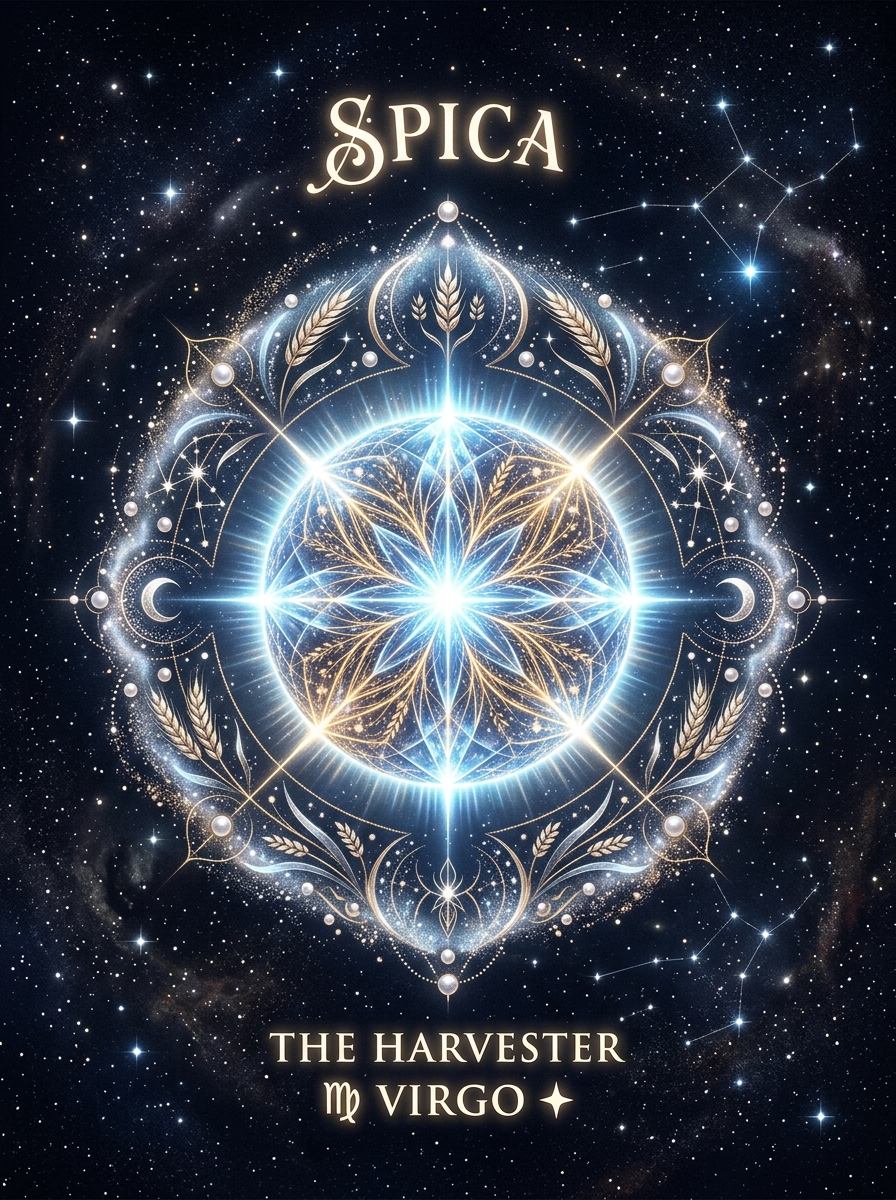
The Promise of Spica Is Not Luck — It Is the Harvest of Care
Spica is the brightest star in Virgo, but its reputation as a “lucky star” misleads more than it reveals. Favor here is not random; it is the result of something earned. Spica rewards skill, discrimination, and timing — not optimism or passive hope. The traditional image of the ear of wheat held by the Virgin captures this: grain does not fall from the sky. It is cultivated, selected, stored, and offered. A chart with Spica prominent often shows a capacity to produce something refined, useful, and culturally valued — art, language, design, scholarship, medicine, leadership, any work that distills chaos into form.
Astrologically, Spica sits at the boundary where Virgo’s exacting analysis meets Libra’s sense of proportion. That blend is key. The star confers a Venus-Mercury quality: Venus gives beauty and attraction; Mercury gives technique and pattern recognition. But the combined grace is not diffuse. Spica insists that the native’s talent be made visible through precise execution. It is the star of the editor who cuts a paragraph to its essence, the surgeon whose hand knows exactly where to incise, the architect who aligns function with elegance. If the native does not live up to the standard, the star’s promise remains unharvested.
For readers who know the Star Tarot card, a kinship is clear: both signatures speak of refinement after ordeal. But Spica is more earthly, more exacting, more concerned with the harvest than the open sky. The Star offers hope as a cosmic replenishment; Spica offers the chance to turn that hope into something that feeds others.
The Mythic Seed: What the Virgin’s Wheat Ear Actually Means
The constellation Virgo has been imagined as Demeter, Isis, Astraea, and many others, but the essential image behind Spica is the ear of wheat in the Virgin’s hand. That wheat prevents Virgo from being reduced to a sterile ideal of purity. The Virgin here is not absence; she is the bearer of civilization’s seed. In mythic terms, Spica is tied to goddesses of harvest and sacred order — figures who protect what must be preserved through time.
This matters psychologically. Spica describes a person who instinctively guards quality, honors craft, or serves as a vessel through which a useful thing enters the world. The native may not be overtly “creative” in the romantic sense, but they will have an unerring sense of what deserves to survive. That instinct can feel like a responsibility. In tarot, the Temperance and the Star combination explores a similar alchemy: blending disparate elements into something whole. Spica is the fixed-star equivalent of that same process — not blending for its own sake, but blending to produce a nourishing result.
The star’s benefic nature is not mere fortune. It is the earned blessing of having kept the seed safe through harsh seasons. That is why the mythology always circles back to grain, storage, and the intelligence of knowing what to carry forward.
The Price of Grace: How Spica Matures and How It Distorts
From the outside, Spica often looks like an easy gift. The native may be praised for talent that seems effortless — but that ease is often the result of hidden labor. People with Spica prominent sometimes feel a pressure to be consistently brilliant, polished, or wise, even when they are simply human. This can create perfectionism, a tendency to overedit, or a quiet sense that nothing is ever quite finished.
The shadow side of Spica is the refusal to tolerate imperfection — in oneself, in others, in the work. The native may become hypercritical, withholding, or so exacting that the gift never fully reaches an audience. In a healthy expression, that same instinct becomes mastery. The chart must show where the native learns to release the work at the right moment, not when it is flawless.
Spica matures when the native moves from private aptitude to public usefulness. That could mean publishing, teaching, designing, healing, curating, or simply trusting that careful work can be shared without apology. For those who struggle with this, the Star and the Moon tarot combination is a useful mirror: it shows how a half-seen gift can be doubted into invisibility. Spica asks the opposite — to bring the gift into light, even when it feels incomplete.
When Spica Conjuncts a Planet — The Star Sharpens the Instrument
A Spica conjunction tightens and elevates whatever planet it touches. The star does not replace the planet’s nature; it sharpens its style and fate-signature, making the talent more visible, more polished, and more likely to be received well. The native is often trusted because others sense that what they offer has been carefully weighed.
With the Sun, identity becomes associated with excellence or aesthetic intelligence. These people carry authority that feels clean rather than domineering. The Star and the Sun tarot combination contrasts hopeful renewal with full illumination; Spica with the Sun is earned brightness, not sudden dawn.
With the Moon, emotional life takes on a protective, nurturing grace. The native may have an instinct for the right food, the right words, the right timing. Instead of diffuse sentimentality, feelings organize into artistry or service — a meal that comforts, a home that restores, a presence that calms.
With Mercury, Spica is exceptionally strong: language, analysis, editing, mathematics, diagnosis, design become vehicles of distinction. The mind tunes to what is usable, elegant, correctly placed. This placement is one of the clearest markers for precision with style, and it often appears in editors, writers, architects, and analysts.
With Venus, beauty becomes clean-lined rather than lush, but it lands. The native attracts goodwill through composure and refinement, and may have a knack for making value visible. The Empress and the Star combination shares a fertility-and-grace theme, but Spica is more selective: it asks for the right harvest, not overflowing abundance.
Mars, Jupiter, and Saturn also respond distinctively — Mars gains disciplined precision, Jupiter gains magnanimity with discernment, Saturn gains painstaking mastery that endures. In every case, Spica sets one condition: the native must make something real.
The Star in a Life: Where Spica’s Talent Becomes Visible
Because Spica is a fixed star, its influence is most potent when it contacts the Ascendant, Midheaven, or luminaries. In those cases, the star enters the native’s visible reputation: they are seen as competent, tasteful, trustworthy, unusually gifted. This attracts projection. Others may expect the native to be consistently refined, even when they are merely human. The challenge is to inhabit the gift without being imprisoned by it.
In relationships, Spica tends to attract partners who admire the native’s competence and taste. The love that forms is often built on shared standards, aesthetic alignment, or mutual respect for craft. Romance may be less about passion and more about a quiet recognition: “This person does quality work. I trust them.” That can be deeply sustaining, but it may lack the chaos that some souls need. The native may need to seek that chaos elsewhere, or learn to let a partner be imperfect.
At work, Spica thrives when the native’s talent is public and useful. The star does not demand fame, but it does want the work to matter. A Spica-strong chart often leads to a role where the native curates, edits, heals, teaches, or builds — anything that involves selecting the right material and shaping it for others. The Star tarot spread offers a complementary practice: it asks what inner light is actually usable in life. Spica answers by pointing to the harvest that is already ready, waiting for the hand to gather it.
Related
- Fixed Star Vega: The Lyre’s Brightness and the Price of Genius
- Fixed Star Capella: The Goat-Star of Swift Sight and Restless Success
- Fixed Star Sirius: The Bright Fire of Fame, Fate, and Devotion
- Fixed Star Castor: The Twin of Skill, Fracture, and Restless Light
- Fixed Star Arcturus: The Reaching Hand of Skill, Honor, and Direction
Comments
Loading comments…