Fixed Star Regulus: Royal Power, Honor, and the Price of Greatness
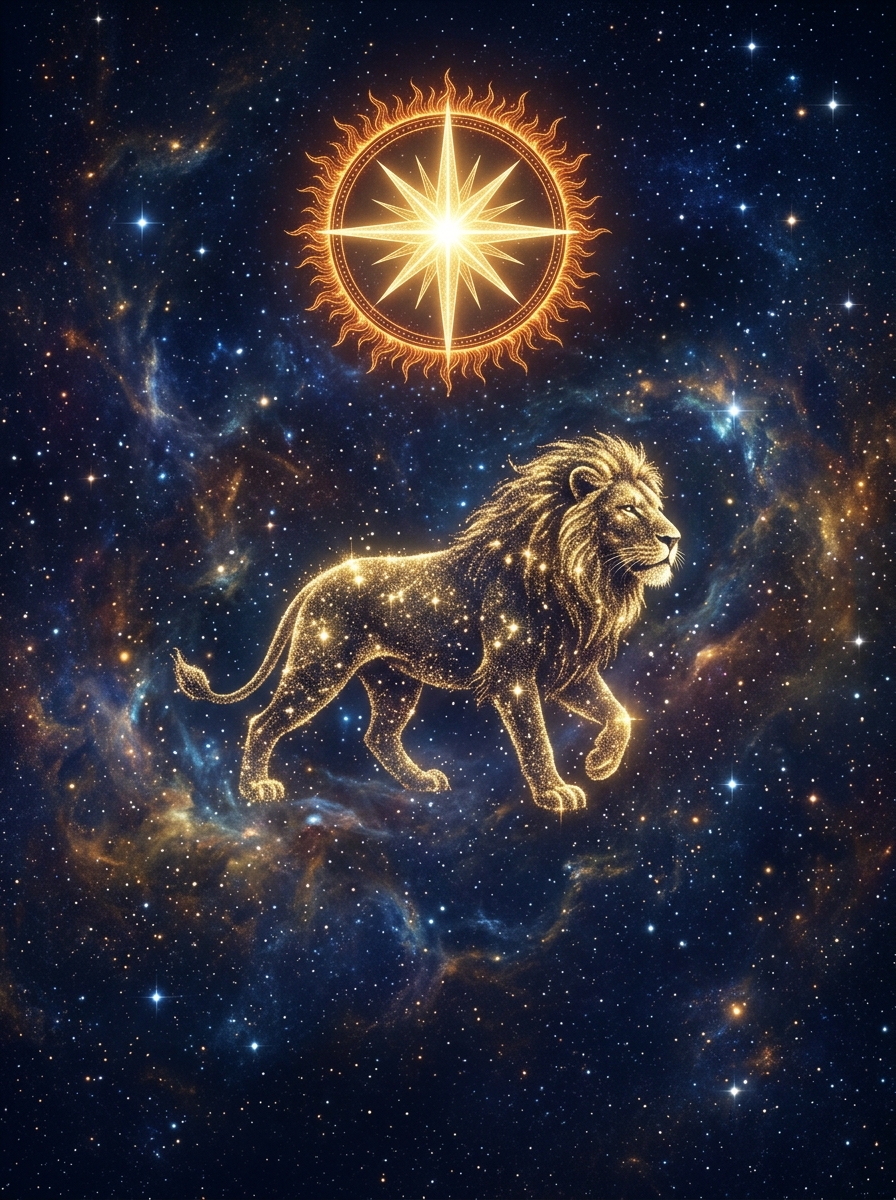
Regulus is the star that hands you a crown and then watches whether you will remember that it was lent.
This is not the feel-good astrology of effortless success. Regulus is one of the four royal stars, the heart of the Lion, and its signature is elevation under alert. When a natal planet meets Regulus by conjunction, the native is marked for prominence—but also for the kind of public trial that separates genuine authority from ego inflation. The star does not bless indiscriminately. It promotes, then tests. In that sense, Regulus is less a lucky charm than a coronation with conditions.
The core dynamic is simple: Regulus amplifies whatever planet it touches, pushes that function into the public square, and then demands that the native wield the resulting power without becoming possessed by it. That is the thesis this guide will unfold—not in a loop of repeating variations, but by moving from the star’s nature, to its psychological roots, to its mature expression versus its shadow, and finally to concrete life applications.
What kind of star Regulus is
Astronomically, Regulus sits nearly on the ecliptic, which gives it an unusually direct relationship with the planets. It is the brightest star in Leo, and in traditional astrology it carries a Mars-Jupiter temperament: the courage of Mars joined to the largesse of Jupiter. That combination explains why Regulus can make a person both decisive and magnanimous, but also prone to overreach and retaliation when crossed.
Regulus belongs to the class of fixed stars known as the royal stars—alongside Aldebaran, Antares, and Fomalhaut. In ancient Persian and Babylonian traditions, these stars were regarded as guardians of the four cardinal directions and as markers of moral gravity. Regulus (the watcher of the north) was associated with kingship, honor, and the visible seat of justice. Its influence is not subtle. It tends to confer charisma, authority over groups, and the unnerving capacity to attract attention. But its blessing is never free. The star comes with an implicit contract: you will be seen, and you will be held to the standards of what you claim to represent.
This is why Regulus resonates so naturally with tarot’s The Star card—the 17th trump of hope and healing—but with a twist. Where The Star pours water in private restoration, Regulus holds a scepter in full public view. Both are about renewal after ordeal, but Regulus adds the weight of reputation. If you want to feel the difference, consider the pairing of Temperance and The Star: one blends, the other heals. Regulus is the part of the equation that asks, “What will you do once the healing is over and you are back on stage?”
The psychology of being watched
A Regulus conjunction does more than affect career or status. It alters the native’s relationship to visibility itself. The person may have known from childhood that they were somehow different—that their presence altered a room, that their voice carried extra weight, that people watched them more closely than seemed normal. That can feel like destiny or like a target.
In Jungian terms, Regulus activates the king archetype. The ego begins to identify with the role of the one who leads, judges, or commands. That identification is problematic when it becomes unconscious: the native no longer sees a distinction between themselves and the authority they hold. They start to believe that because they are seen, they are entitled. They mistake visibility for virtue.
This inflation is the star’s classic trap. Regulus is famous for producing figures who rise fast and then fall hard—not because the star withdraws its favor, but because the person began to treat the favor as a birthright. The historical record is full of generals, performers, and monarchs whose charts carried a strong Regulus and whose careers ended in exile, scandal, or violent reversal. The star does not punish. It simply mirrors back the quality of the person’s grip on power.
The psychological work for a Regulus native is to remain aware that the crown is on loan. That awareness is not humility in the self-deprecating sense; it is the sober recognition that public elevation comes with reciprocal obligation. The star’s highest expression is a leader who serves the system rather than feeding on it.
How Regulus matures versus how it goes shadow
The difference between a mature and shadow Regulus is best captured by the question: is the power used to build or to dominate?
When a Regulus conjunction matures well, the native becomes a steward. They use their influence to protect the larger body—whether that is a family, an organization, or a creative field. They can bear the weight of decision without becoming drunk on its prestige. Their courage is steady, not reactive. They accept that visibility brings scrutiny, and they do not flinch from it. This kind of placement often shows up in charts of leaders who remain respected even after their authority wanes.
When it goes shadow, Regulus expresses as tyranny in miniature. The native may become controlling, vengeful when crossed, or addicted to praise. They retaliate against anyone who suggests they are not as special as they believe. The shadow can also appear as a refusal to be ordinary even for a moment—a constant demand for exceptional treatment that exhausts everyone around them. In extreme cases, the native may engineer their own downfall because they cannot tolerate the gap between their self-image and the world’s recognition.
The star’s mythic association with the lion’s heart is instructive here. A healthy lion hunts to sustain the pride, not to terrorize the savanna. The shadow Regulus, by contrast, behaves like a lion that has forgotten it is part of an ecosystem. It sees only its own hunger.
This arc from elevation to possible fall echoes the pairing of The Tower and The Star in tarot. The Tower demolishes the structure of the inflated ego; The Star offers renewal. Regulus is the preamble to that cycle—the moment when the building is still standing but already cracking, waiting to see whether the architect will repair the foundation or ignore the warnings.
Regulus in a life: the planet determines the arena
Because Regulus always modifies a planet, its effect varies by which planet it touches and where that planet sits in the chart. The star does not erase the planet’s nature; it stages it on a public platform.
With the Sun, Regulus magnifies personal radiance and will to lead. These natives often attract authority whether they seek it or not. The danger is pride that mistakes itself for self-sufficiency. With the Moon, the emotional life itself becomes visible. The native may become a public caregiver, a matriarch or patriarch whose instincts carry weight, or someone whose loyalties are scrutinized. With Mercury, speech becomes a throne. The voice gains authority—useful for writers, broadcasters, or advocates—but only if the intelligence is used to clarify rather than manipulate.
With Venus, attractiveness and charm open doors. The native may be admired, but must guard against relationships built on status rather than connection. With Mars, courage is sharpened into a blade. These natives act decisively under pressure, but they risk provoking enemies through bluntness. With Jupiter, the star’s royal quality becomes most explicit: elevation, patronage, institutional trust. But Jupiter expands everything, including arrogance. The test is whether generosity or entitlement dominates. With Saturn, authority comes late and through ordeal. These natives earn respect through discipline and endurance; the star matures them slowly, but the results are often the most durable.
Each of these expressions shares the same underlying dynamic: a planet pushed into visibility, offered a chance at nobility, and subjected to the risk of inflation. The wise reading does not treat Regulus as a standalone verdict but as a modifier. A Mars-Regulus in the 10th house will not feel the same as a Mars-Regulus in the 4th, even if both people share the same star.
For deeper reflection, consider using The Star Tarot Spread to examine how hope and reputation interact in your life. The five-pointed layout can reveal where the self-image aligns with the public image—and where it does not. Or, if the chart carries a strong lunar undertow, the tension may resemble The Star and The Moon combination: aspiration on one side, emotional fog on the other. Regulus sharpens that contrast by insisting that the light be used responsibly.
The nobility test
There is no way to guarantee a mature Regulus, but one pattern separates those who succeed with the star from those who are broken by it: they treat their prominence as a responsibility, not a right.
Regulus does not reward talent alone. It rewards character under pressure. The native who can take the hit of public failure without losing their center—and who can take the drug of public praise without losing their humility—will likely pass the test. The one who cannot will find that the same star that lifted them also participates in their fall, because it did not create the fall; it only brought the person into view.
In tarot, The Star and The Sun combination speaks to this directly. The Sun is conscious radiance; Regulus is radiance under judgment. The Sun celebrates vitality; Regulus asks whether vitality has become command, and whether command is just. It is one of astrology’s most exacting gifts: not fame for its own sake, but the chance to become worthy of what fame reveals.
Related
- Fixed Star Arcturus: The Reaching Hand of Skill, Honor, and Direction
- Fixed Star Sirius: The Bright Fire of Fame, Fate, and Devotion
- Fixed Star Rigel: The Blue Foot of Orion and the Will to Ascend
- Betelgeuse in the Natal Chart: The Red Shoulder of Orion
- Fixed Star Vega: The Lyre’s Brightness and the Price of Genius
Comments
Loading comments…