Fixed Star Pleiades: The Seven Sisters and Their Sharpened Light
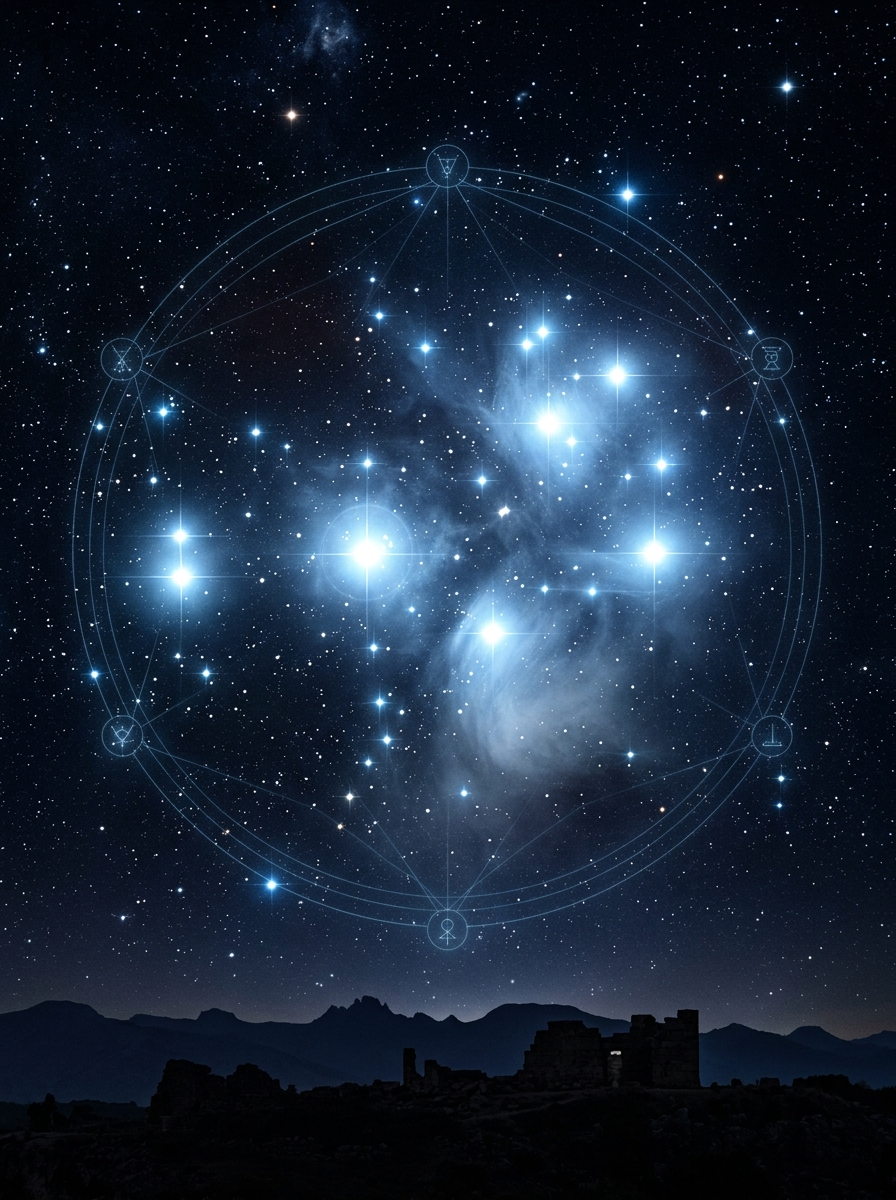
The Cluster’s Signature: Perception Sharpened by Grief
A planet conjunct the Pleiades does not receive a simple boost or a curse. It becomes porous to a particular frequency: the shimmer of beauty that knows it will not last, the grief that lives inside longing, the sight that sees through surfaces because it has been wounded. This is not a star you read as a static symbol. It is a dynamic — an intensification that makes a planet both more perceptive and more exposed. The key to this configuration lies in the cluster’s double nature: astronomically, it is a tight knot of seven sister stars in Taurus; mythologically, it is a story about pursuit, loss, and transformation into light. A natal conjunction to the Pleiades rarely produces a quiet life. It produces a life lived close to the vanishing edge of things.
Because the Pleiades are a cluster, they operate as a chorus, not a solo. The native often carries multiple inner voices, competing loyalties, or a deep attunement to groups and inherited patterns. The Taurus placement adds an earthy frame — body, value, material presence — but the cluster’s shimmer unsettles that steadiness. The result is a psyche where form and flux coexist uneasily. This is why, in practice, a Pleiades conjunction tends to show up in charts of artists, healers, mourners, and those whose work involves seeing what others prefer to ignore. The gift is sacramental vision. The cost is a recurring sense that what is loved is also fleeting.
Psychological Roots: Porous Boundaries and Collective Resonance
The Inner Atmosphere
The planet that contacts the Pleiades becomes a receptor for atmospheres, subtext, and collective emotion. With the Moon conjunct the cluster, feelings are absorbed rather than merely felt. The person may walk into a room and register its emotional weather before anyone speaks. This can produce extraordinary empathy, but also a tendency to confuse compassion with obligation — to take on suffering as if it were personal property. A Mercury conjunction sharpens symbolic thinking and pattern recognition, but the mind can drown in impressions, struggling to separate signal from seduction. The Sun here often grants visibility that feels fated: the person is seen before they are understood, and their identity carries a quality of inevitability, as if they were born into a role that includes both admiration and interruption.
The Earthy Disturbance
Because the cluster sits in fixed earth, the body and the material world become charged with meaning. A Venus-Pleiades conjunction may produce beauty that haunts — a face, a voice, a creative work that expresses both tenderness and elegy. Love is often idealized, and the native may be drawn to what is fragile or impermanent. With Mars, instinctive action becomes vivid and emotionally charged; the person may defend a vulnerable other with fierce passion, but also burn out by reacting to every injury in the field. Jupiter amplifies vision and spiritual reach, but risks inflation: the dream outruns the container. Saturn conjunct the Pleiades is especially poignant — the need to shape what is diffuse. Early responsibility, grief carried in silence, a disciplined art born from sorrow — these are the Saturnine resolutions of the cluster’s permeability.
Maturation and Shadow: When Receptivity Becomes Overexposure
The Healthy Current
When well-supported — by Saturn dignity, by a grounded house placement, by the rest of the chart — the Pleiades conjunction matures into a capacity to hold beauty and sorrow together without collapsing into either. The person learns to contain the vividness they receive. They may become a quiet healer, a poet of the threshold, someone whose presence steadies others because they have already walked through grief and come out the other side. This is the territory of The Star Tarot Card after it has crossed a difficult sky: not naive hope, but hope that survives exposure. The Pleiades ask an alchemical question: can you remain receptive without flooding, inspired without inflation, tender without collapse?
The Shadow
The shadow is not “too much emotion.” It is overexposure — taking in more than the psyche can process. The native may trust too quickly, convert intuition into certainty without checking evidence, or attract relationships that mirror the cluster’s myth: pursuit, flight, transformation. There can be a pattern of loss around what is loved — ideals that shatter, bonds that dissolve, grief that feels larger than the initiating event. This is not moral failure. It is the consequence of a psyche built to receive more than it can contain, without adequate filtering. The same placement that grants sacramental sight can, under stress, lead to a romantic vulnerability that bleeds into martyrdom, or an artistic sensitivity that becomes self-consuming.
Reading the Conjunction in a Life
House and Dignity
To read the Pleiades in a natal chart, start with the planet’s dignity and the house. A conjunction within one degree speaks louder than a looser one; beyond two degrees, the influence is often suggestive but not defining. In angular houses — the first, fourth, seventh, tenth — the native’s public self is marked by visibility mixed with vulnerability. The person may become a symbol to others, even unintentionally. In cadent houses, the emphasis shifts to quieter arenas: dreams, private artistry, research, spiritual work, or the backstage labor of keeping a world intact.
The house tells you where the cluster’s intensity lands, and the planet tells you what faculty gets charged. A Venus-Pleiades in the seventh house is not about solitude; it is about union through beauty, and the risk of idealizing the beloved. A Mars-Pleiades in the tenth house may fight for a public calling that repeatedly tests courage. Compare the stark reset of The Tower and The Star: that pairing describes destruction followed by restoration. The Pleiades conjunction does not require destruction — but it does require the native to learn how to remain intact while holding what is broken.
Concrete Expressions
- Love: The Pleiades native often loves with a quality of remembrance — as if they already know the goodbye. This can make them deeply attentive partners, but also prone to staying too long in relationships that are already ending. They may be drawn to artists, outsiders, or those carrying visible sorrow. The relationship becomes a vessel for the cluster’s paradox: closeness and distance woven together.
- Work: Many with this conjunction thrive in fields that involve symbolic language, healing, or preservation — poetry, therapy, anthropology, restoration, hospice, midwifery. They are natural diagnosticians of what is hidden, and their work often carries a quiet signature of care that others can feel but not name.
- Creativity: The cluster is fertile ground for art that does not flinch. The native’s creative output often blends beauty with an edge of the uncanny or elegiac. Their work may not be commercially easy, but it tends to be memorable — it leaves a residue.
Integration: The Frequency, Not the Verdict
The final principle for reading a Pleiades conjunction is to avoid treating it as a moral verdict. It is a frequency — a description of how a planet is colored by brightness that borders on ache. The native does not choose to be more perceptive or more vulnerable. They simply are. The work of integration is to give that frequency a vessel: a practice, a craft, a discipline, a relationship with limits. When Saturn is supportive, the cluster finds its container. When the chart lacks earth or boundary, the native may need to build deliberate structures — meditation, solitude, clear schedules, physical grounding — so that the vision does not outrun the life.
This is where the cluster’s tarot resonance becomes practical. Think of The Star Tarot Spread as a method for asking: “What still glows after the fracture?” The Pleiades teach that beauty often arrives already carrying the memory of pain. That is not a flaw. It is the source of their sharpened light.
Related
- Fixed Star Alcyone: The Pleiades, Grief, and the Eye That Sees Too Much
- Fixed Star Arcturus: The Reaching Hand of Skill, Honor, and Direction
- Fixed Star Vega: The Lyre’s Brightness and the Price of Genius
- Fixed Star Castor: The Twin of Skill, Fracture, and Restless Light
- Deneb Algedi: The Goat’s Tail of Judgment, Fidelity, and Strange Mercy
Comments
Loading comments…