Fixed Star Algol: The Gorgon's Eye, Terror, Power, and Natal Conjunctions
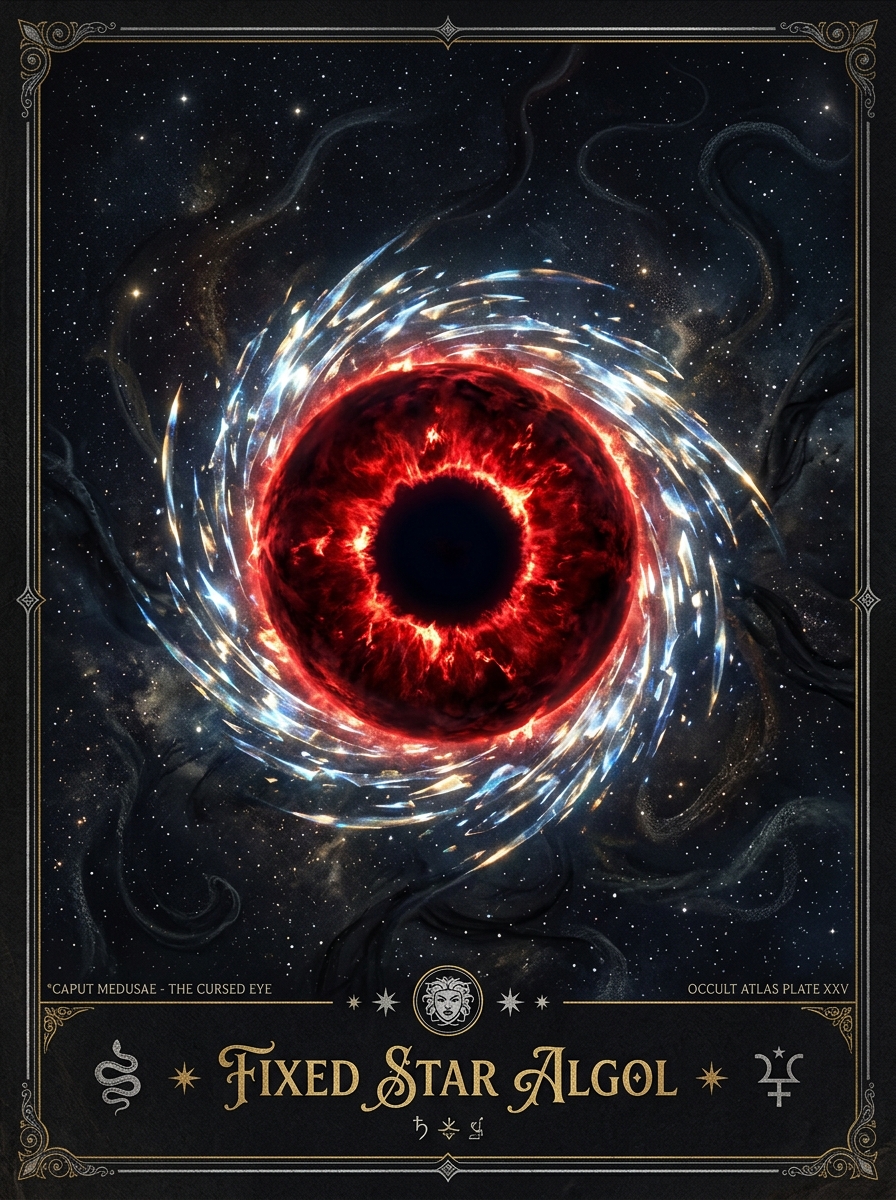
Fixed Star Algol: The Gorgon's Eye in Natal Astrology
Algol sits at approximately 26° Taurus, in the constellation Perseus at the severed head of Medusa, and it is the most charged fixed star in Western astrology. Its name derives from the Arabic ra's al-ghūl — the demon's head — and its reputation was built across millennia of observation, not superstition. What makes Algol different from other fixed stars is not intensity alone but the specific quality of that intensity: it marks the place where the psyche meets what it would most prefer not to see.
That is the thesis, stated once: a natal conjunction to Algol means the conjunct planet becomes the carrier of ungovernable voltage — primal fear, raw power, the particular fertility that can only emerge after contact with the unsanitized real. Everything else in this article is an application or elaboration of that single dynamic, not a restatement of it.
Myth, Astronomy, and the Logic of the Reputation
Algol is a binary star system — technically a spectroscopic eclipsing binary — which means it dims rhythmically as one star passes in front of the other. Ancient observers noticed that variation and associated it with the blinking eye of the Gorgon, a pulsing, uncanny light. The astronomy itself suggests the myth: something that looks directly at you, then goes dark, then returns.
Medusa, in the oldest versions of her myth, is not only a monster. She is a being of annihilating beauty whose gaze petrifies because the ego cannot remain casual in her presence. Perseus can only approach her indirectly, using a mirrored shield — which is to say, he must refuse direct confrontation and work through reflection. That psychological structure is precisely what Algol asks of the charts it touches: not avoidance, not bravado, but the capacity to witness the most difficult content without being frozen by it or consumed by it.
The star's ancient reputation for violence and severing is real, but it is also overdetermined by fearful interpreters who read the myth only at its surface. Algol does not simply cause harm. It marks the point where harm has already entered the psyche's field, where something irrevocable has been encountered, and where the question becomes: what does the person do next?
Why Exactness and House Placement Matter
In fixed-star work, orb is everything. A conjunction to Algol within one degree carries the full symbolic load; beyond two degrees, the contact blurs unless the planet is angular or heavily emphasized by other factors. Wider contacts exist but function more as a undertone than a main theme.
The house tells you where the pressure surfaces. Algol on the Ascendant inscribes the dynamic onto the body, the face, and the first impression the person makes — these natives are often perceived as magnetic or unsettling before they have said a word. In the 8th, the star works through crisis, inheritance, and death-rebirth territory. In the 10th, it can attach to public identity, controversy, or a career built around what culture finds taboo or formidable. A cadent placement is less visible in the world but no less operative in the interior life; these people often carry the Medusan dynamic as an internal weather pattern rather than an outward event.
Planet by Planet: What the Conjunction Actually Does
No Algol placement can be read in isolation. The planet it touches, the planet's condition, and the sign ruler of Taurus in the chart all determine whether the star has a clear channel or a structural blockage. With that context established, here is what each contact characteristically produces.
Sun, Moon, Mercury
Sun conjunct Algol forges identity through confrontation with danger or collective taboo. These natives are rarely casual; there is often a sense of being seen for the wrong thing, or of seeing what others want hidden and being unable to pretend otherwise. In a well-integrated chart, this can produce leadership under pressure — the capacity to name collective fear without flinching. The shadow version is a life organized around threat, whether real or anticipated.
Moon conjunct Algol tends to be more bodily and immediate. Emotions arrive in waves that feel non-negotiable, and these people frequently inherit family patterns of grief, silence, or unprocessed shock. The gift — when the chart supports integration — is extraordinary instinct: the ability to detect what is toxic in a room before anyone speaks, and fierce protective love forged from firsthand knowledge of what damage looks like. The combination of lunar ambiguity with Algol's flash of dread is usefully explored in the Star and Moon tarot pairing, which maps the terrain of hope that survives its encounter with shadow.
Mercury on Algol speaks in a blade-like register. This is not cruelty by nature; it is language arriving with unusual force and precision, stripped of the social cushioning most communication relies on. The constructive expression is investigative writing, forensic thinking, trauma work, or testimony that names what culture buries. The shadow is compulsive exposure, verbal violence, or an inability to stop a thought once it has been weaponized.
Venus, Mars, Jupiter, Saturn
Venus conjunct Algol is among the most misread signatures in the fixed-star tradition. It can confer striking, unsettling beauty and a magnetic aesthetic — but it also tends to attract projections. Admiration mixes with envy; desire mixes with fear; intimacy mixes with a control dynamic the person may not have invited. The core lesson is learning that being wanted is not the same as being loved. When the placement matures, it can produce artistry that makes the unbearable beautiful — which is its own form of power.
Mars with Algol is raw instinct at close range: the body that knows what fight, defense, and survival mean before the mind catches up. This placement is not inherently violent, but it does demand that the native learn the difference between transmuted force and pure reactivity. Mars-Algol people are often the ones who move toward danger when others freeze; whether that produces heroism or escalation depends entirely on what the rest of the chart is doing.
Jupiter here can magnify Algol into public scope — a role in medicine, law, crisis work, or social controversy, or a philosophical framework built around mortality and extremity. The risk is righteous excess: believing that because one has survived the gaze, one has understood it. Saturn conjunct Algol is typically the sternest expression. It can produce extraordinary containment, hard-won authority, and mastery over pain — but usually only after a long apprenticeship in limits that the person did not choose. Old terror can become posture; that posture can become armor; the work is making the armor conscious before it becomes a cage.
With the outer planets, the contact is generational but still potent when personal planets reinforce it. Uranus can radicalize Algol into rupture or sudden liberation. Neptune blurs it into psychic permeability and sacrificial patterning. Pluto deepens the underworld association, shifting the star's meaning from fright toward the necessity of descent as transformation — a movement that The Tower and The Star maps well for readers who think in tarot terms: ego demolition as the precondition for genuine renewal.
How Maturation and Shadow Diverge
The central question for any Algol contact is not whether the star is active — it is — but whether the person has learned to witness the Medusan material without either freezing into it or dissociating from it. Those are the two failure modes: petrification and flight. Both look different from the outside but function identically as avoidance.
Maturation with Algol usually arrives through repeated exposure to the star's themes until the ego stops treating them as emergencies. A person with Sun-Algol who has spent decades believing they are defined by catastrophe eventually discovers that catastrophe is one of their registers, not their identity. A person with Moon-Algol who has inherited a family's unprocessed grief eventually becomes the one who processes it — not by choice, but because avoidance stopped working. The Temperance and The Star combination captures this alchemical turn: the restoration of measure after extremity, the mixing that only becomes possible once the most volatile element has been acknowledged.
Shadow expression tends to be one of two patterns. The first is identification: the person becomes the Gorgon, weaponizing the intensity they carry because it has never been metabolized. The second is avoidance by proxy: the person systematically attracts Algol themes through other people — dangerous partners, volatile environments, public crises — because they cannot yet look at the star in their own chart. Both patterns resolve the same way: by turning to face what has been generating the charge.
Chart Synthesis: Reading Algol in Context
A few practical notes for the interpreter. First, check the dispositor chain: Venus rules Taurus, so the condition of Venus in the chart tells you whether the Algol planet has a functional channel or a structural knot. A well-placed Venus can give the native genuine access to the star's transformative potential; an afflicted Venus may mean the charge stays stuck in reactivity.
Second, look at the broader elemental balance. Algol in a chart with strong earth or Saturn tends toward containment and grim realism. In a chart heavy with water and Neptune, the same star can feel like psychic flooding, with boundaries that dissolve under pressure. In a fire-dominant chart, it can become combative courage or public defiance — sometimes useful, sometimes a liability. The star is not the whole story; it is the voltage. The chart is the wiring.
For a reading structure that honors multiple layers of meaning at once, the Star Tarot spread is a useful interpretive scaffold — not because Algol belongs in tarot, but because the five-pointed layout forces the interpreter to approach one symbol from several distinct angles before settling on a reading.
Algol and the Question of Renewal
Algol refuses the fantasy that growth is always gentle. It belongs in the same symbolic field as the myths of descent — Inanna, Persephone, Orpheus — where something essential is only recovered after the darkest passage. In a natal chart, a conjunction to this star often marks a life that cannot be fully understood without attending to what has been repressed, endured, or survived. The star does not abolish tenderness; it makes tenderness hard-won.
What distinguishes a well-read Algol from a poorly read one is precisely this: the refusal to treat the star as either a sentence or a superpower. It is neither. It is a point of symbolic pressure that asks whether the planet it touches can hold intensity without being defined by it. When that question is answered — through time, through crisis, through the slow work of integrating what the ego resisted — the star can produce something the myths always promised was possible: the Gorgon's head used not to petrify but to protect.
That movement from ordeal to earned strength, from confrontation to new ground, is what connects Algol's territory to the Empress and The Star — where survival becomes fertile again, and the body and imagination recover their capacity to make life after ordeal. Algol is the face of the ordeal. What comes after belongs to the chart, the person, and the work they are willing to do.
Related
- Fixed Star Alcyone: The Pleiades, Grief, and the Eye That Sees Too Much
- Fixed Star Aldebaran: The Watcher in the Bull's Eye
- Deneb Algedi: The Goat’s Tail of Judgment, Fidelity, and Strange Mercy
- Fomalhaut: The Southern Watcher and the Promise of Exception
- Fixed Star Vega: The Lyre’s Brightness and the Price of Genius
Comments
Loading comments…