Ceres in Aquarius: Nourishment Without Possession
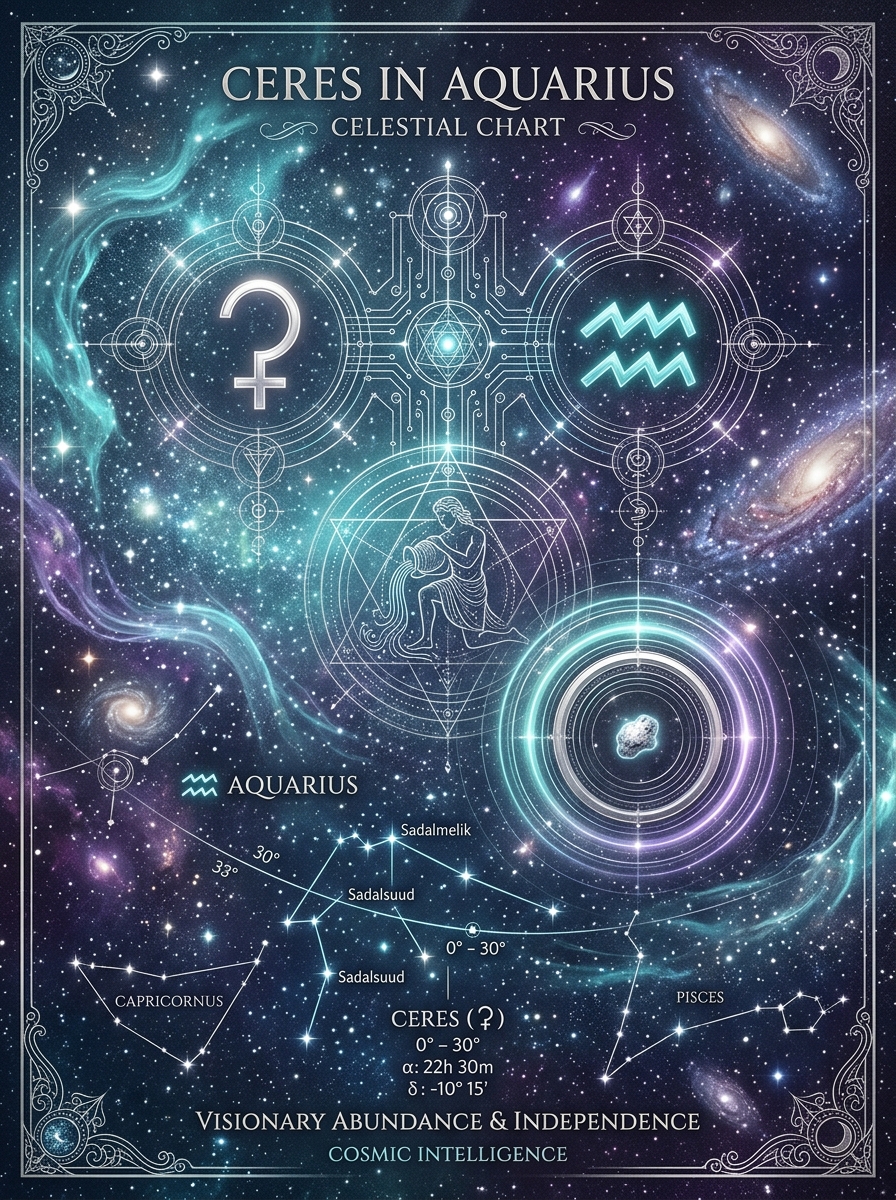
The Core Dynamic: Care That Cannot Prove Itself by Enclosure
Ceres in Aquarius names the part of the psyche that gives and receives nourishment through the sign of ideas, distances, and collective futures. The placement’s essential insight is that love cannot be proven by enclosure. To feed another person is not to own them; to be fed is not to surrender. In Aquarius, Ceres expresses care as permission to differ, as structural support rather than emotional fusion, and as a commitment to the future over the possessive grasp of the present.
This is not a gentle placement by conventional measure. Ceres in Aquarius often learns early that institutions fail, groups fracture, and affection can be withdrawn for reasons that feel impersonal—ideological, logistical, or simply because the caregiver’s attention moved elsewhere. The child of this placement may have been fed intellectually but left cold emotionally, praised for independence long before they were ready, or valued for what they could contribute rather than for their simple presence. That mismatch shapes a distinct psychology: one part of the self becomes extraordinarily capable of caring for the collective, while another part remains wary of dependency because dependency can be turned into control.
Love without ownership
The gift of Ceres in Aquarius is its refusal to treat care as a transaction. This person does not want emotional hostages. They nourish by creating room: room to think, to dissent, to be odd without punishment. Their affection is often impersonal in the best sense—non-possessive, respectful, and steady. They may organize a mutual-aid network before they learn to ask for a hug. They can be the friend who shows up with a spreadsheet when a crisis hits, the parent who defends a child’s right to be different, the partner who grants freedom without resentment.
But the same freedom that makes their care ethical can become a shelter from intimacy. Ceres in Aquarius often prefers to feed ten people rather than admit to one person that they are hungry for being cherished. They may use principles to dodge messy singular needs, treating fairness as a substitute for tenderness. The shadow is not coldness but abstraction: explaining feelings instead of feeling them, solving problems instead of sitting with pain, choosing “equality” over attunement.
Where the Wound Lives: The Emotional Signature of Deprivation
In Ceres mythology, the loss of Persephone is a story of interrupted nourishment—a mother who cannot find her child, a world that starves. In Aquarius, the deprivation rarely arrives as melodrama. It comes as emotional discontinuity: the sense that one was fed by systems that did not know one’s name, valued for utility or originality but not for need itself. The grief is conceptual before it is tearful.
Rejection by the norms of care
The Aquarius wound is not abandonment so much as being tolerated, analyzed, or admired—but not fully received. A parent may have encouraged independence too early. A family may have praised resilience while ignoring loneliness. A peer group may have rewarded cleverness while punishing emotional dependence. This creates a person who can read the room with surgical accuracy but struggles to feel held by it. For a deeper look at this signature of belonging and its wounding, Chiron in Aquarius explores the same territory of outsiderhood, though Ceres speaks more to the body’s memory of what was withheld.
What makes this placement unusual is that loss often registers as a social question long before it registers as a personal one. The child may ask, “Why does the group decide some needs are inconvenient?” and carry that question into adulthood as a commitment to the excluded. The Ceres in Aquarius person becomes exquisitely responsive to collective harm because they know what it is like when care is distributed selectively.
Detachment as survival
Aquarius is a fixed air sign; it can hold an idea with extraordinary tenacity. With Ceres, that fixity becomes a strategy for endurance. When feeling is unsafe, thought becomes shelter. The person may organize, theorize, classify, volunteer, or engineer systems of care because direct need feels naked. They may be more at ease designing a humane policy than admitting they are hungry for intimacy. This is not hypocrisy; it is adaptation. The psyche learns that tenderness without boundaries can become enmeshment or manipulation, so it builds a caregiving style that is principled, efficient, and emotionally self-protective.
But adaptation that works in childhood can become a cage in adulthood. The person may become allergic to ordinary dependency and mistake distance for maturity. The medicine is not to abandon the Aquarian mind—that would be a second loss—but to let it admit a truth it hates: some losses can only be mourned by allowing yourself to need again. Moon in Aquarius depicts a similar emotional architecture of detachment and longing, while Aquarius Rising shows how this same tension plays out in first impressions and the identity the world first meets.
How It Matures: From Abstraction to Horizontal Belonging
The healing path for Ceres in Aquarius is not to become more sentimental. It is to become more inhabited. That means letting grief be personal, not only social; letting affection be reciprocal, not only ethical; letting the body count, not only the mind. The person must learn to let themselves be nourished by the same communities they help build.
Collective service as self-repair
One of the most interesting features of this placement is that service itself can be reparative. Building a mutual-aid network, mentoring marginalized youth, or organizing around justice becomes a way of giving to the self what was missing: reliable context, fair rules, room to exist without pretense. But there is an important distinction. Ceres in Aquarius is not healed by endless activism alone. If service becomes a defense against grief, the original wound stays intact. The deeper repair happens when the person allows themselves to be dependent—on a friend, a community, a partner—and discovers that dependence does not automatically mean domination.
This is where the placement’s affinity for horizontality becomes crucial. Aquarius does not want hierarchies of care. It wants networks where everyone gives and receives. The mature Ceres in Aquarius understands that community is not a theory but a practice of noticing who is cold, who is unseen, who is carrying more than their share, and then intervening without making them beg. Pluto in Aquarius deepens this theme of redistributed power, while Saturn in Aquarius shows how structure and discipline can serve that redistribution rather than resist it.
The final lesson: love that does not hold
If Ceres in Aquarius is done well, it becomes a figure of liberated devotion. It knows that people thrive when they are not caged by expectations. It knows that food, attention, money, time, and ideas are political objects, not private treasures. And it knows that loss is part of any real community: friends drift, movements fracture, ideals fail their first test. Yet this placement can keep faith without becoming naive. It can mourn the broken thing and still refuse to stop inventing.
The deepest intelligence of Ceres in Aquarius is that care which violates freedom becomes hunger in disguise, but care which honors freedom can become a new kind of home. That home is not a house with a locked door. It is a space where you can come and go, where your mind is welcome, where your difference is not a problem to solve. The person with this placement learns to offer that space to others, and—most difficult of all—to accept it for themselves.
For readers wanting to see how this plays in specific signature blends, Sun in Aquarius, Moon in Aquarius doubles the dynamic, while Leo Sun, Aquarius Moon shows the creative tension between personal sovereignty and collective devotion. [Mars in Aquarius] brings the activist edge, and [Mercury in Aquarius] reveals the circuitry of a mind that thinks its way toward tenderness.
Comments
Loading comments…