Aries Sun, Aries Moon: The Double Fire Archetype
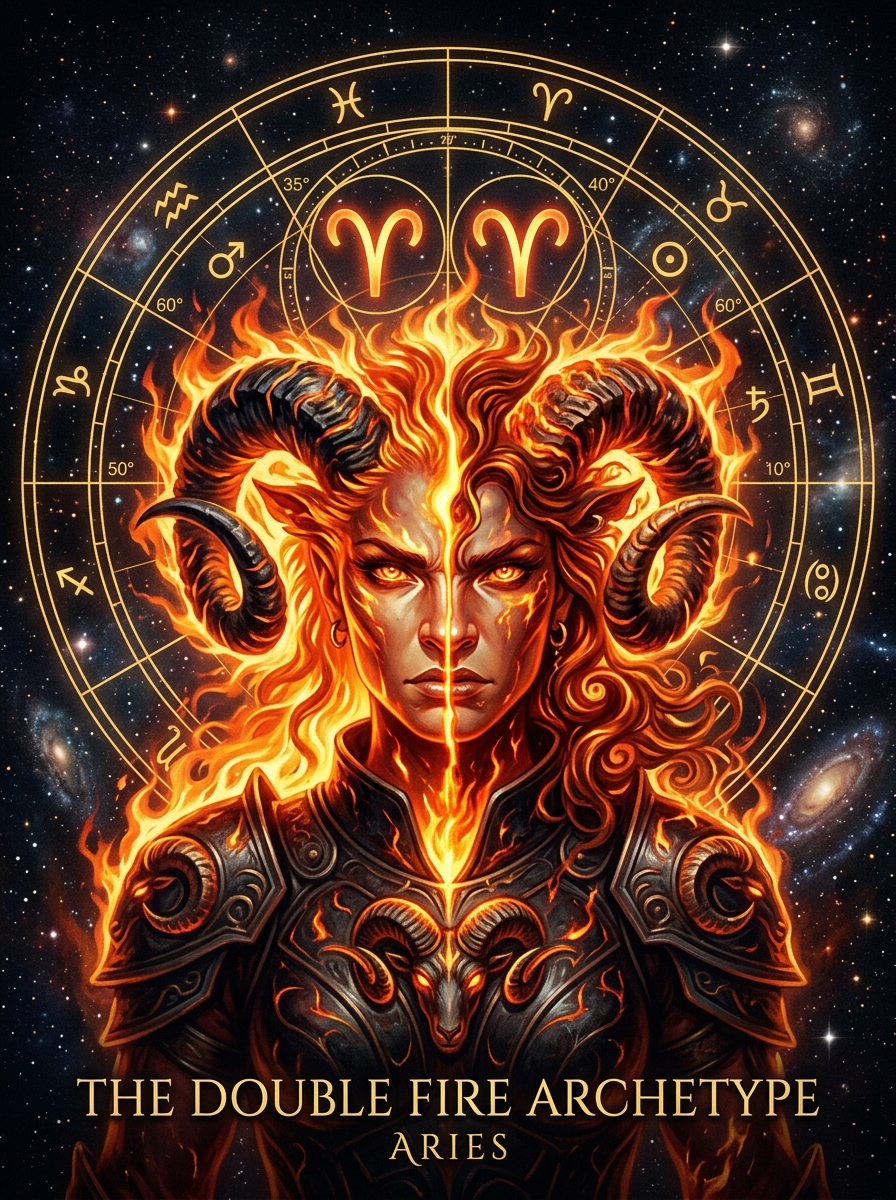
There is a particular kind of person who never seems to arrive at a room so much as detonate into it. They decide while others are still deliberating. They forgive before they finish being angry. They tell you the truth you didn't ask for, and somehow you trust them more for it. When the Sun and the Moon both occupy Aries, you are looking at this person: a being of almost frightening coherence, in whom the will to be and the instinct to feel point in exactly the same direction.
Astrology rarely offers placements this unambiguous. Most charts are negotiations—a watery Moon arguing with a fiery Sun, an airy identity uneasy with an earthy gut. The double Aries native has no such internal committee. Conscious purpose and emotional reflex are forged from the same metal, tempered in the same forge, and that forge belongs to Mars. To understand this person is to understand what happens when a human life refuses, on principle, to install a buffer between impulse and act.
The Double Cardinal Fire Personality
To speak of Aries Sun and Aries Moon together is to speak of an absolute alignment, and alignment of this kind is far rarer in human experience than we tend to assume. The Sun, in the symbolic grammar of Western astrology, describes the conscious will—the hero we are trying to become, the solar self that organizes a life around purpose and visibility. The Moon describes something older and more involuntary: the instinctive emotional body, the way we are soothed and the way we are startled, the reflex that fires before thought catches up. In most people these two principles speak different dialects. In the double Aries native they speak with one voice, and that voice is loud.
One Will, One Instinct
Liz Greene has written at length about the Moon as the seat of our most primitive needs, the part of us that wants what it wants without apology or strategy. Place that lunar hunger in Aries—the sign of raw beginning, of the warrior who acts first and considers later—and you remove the last cushion between feeling and doing. The ordinary person feels a flash of anger and then, somewhere in the millisecond that follows, a quiet internal voice asks whether expressing it is wise. The double Aries native often has no such voice, or rather the voice arrives only after the deed is already done. This is not stupidity. It is structural. The lunar instinct and the solar intention are made of identical material, so there is nothing inside to slow the current down.
The result is a personality of extraordinary authenticity. You are never in doubt about where you stand with these people, because they themselves are never in doubt, and they have no talent for concealment. Carl Jung described individuation as the slow reconciliation of opposites within the psyche; the double Aries begins life with fewer opposites to reconcile, which is both a gift and a peculiar burden. The gift is wholeness—a sense of being undivided, of meaning exactly what one says. The burden is that wholeness without friction can mean wholeness without reflection. Growth, for most of us, happens in the gap between contradictory impulses. When there is no gap, growth has to be deliberately, almost artificially, constructed.
The Cardinal Fire Engine
Aries is cardinal fire, and the cardinal modality is the principle of initiation—the equinoctial surge that cracks winter open and insists that something new begin. Fire is spirit, enthusiasm, the metabolic heat of the psyche. Fuse the two and you get an engine built for one purpose: to start. The double Aries is the person who founds the company, throws the first punch, asks the difficult question in a silent meeting, walks toward the emergency everyone else is backing away from. Steven Forrest often describes Aries as the archetype of courage developed through facing the unknown directly, and the double Aries lives this around the clock, because both the conscious self and the emotional self are wired to charge.
What is harder for this native to grasp is that initiation is only the first phase of any cycle. The fixed signs sustain what cardinal signs begin; the mutable signs adapt and release it. A double Aries can ignite a hundred fires and tend none of them. The same engine that makes them magnificent at zero-to-one—the launch, the rescue, the founding—can leave them restless and faithless at the long, unglamorous middle of things, where endurance rather than courage is the relevant virtue. Recognizing this is the first real act of self-knowledge available to the placement: to see that their genius for beginning is not a universal competence but a specialized one, and that maturity will ask them to borrow patience they were not issued at birth.
Mars-Driven Vocations
Every Sun-Moon pairing carries a vocational signature, but few are as legible as this one. When Mars rules both lights, the working life is not merely a means of earning—it is the arena in which the entire self comes alive. The double Aries native does not want a job. They want a fight worth having, a frontier worth crossing, a problem urgent enough to justify the heat they were born carrying. Put them anywhere that rewards initiative and courage, and they flourish. Put them anywhere that rewards patience, consensus, and procedural caution, and they quietly die inside.
The Frontier and the Emergency
The clearest expressions of this energy cluster around risk and immediacy. Entrepreneurship suits the placement almost perfectly: the founder's task is to act decisively under radical uncertainty, to begin before the path is clear, to absorb the terror of the blank page and convert it into momentum. The double Aries is built for exactly this, and tends to be far better at the founding sprint than at the marathon of scaling—a self-awareness worth purchasing early, perhaps by partnering with a more fixed temperament who can hold the structure they create.
Emergency services draw the same wiring toward a public good. Firefighters, paramedics, ER physicians, frontline crisis responders—these roles demand the very thing that makes the double Aries dangerous in a dinner-party argument: an instinct that fires before fear can intervene. Where most people freeze, the Mars-ruled native moves, and in a burning building that reflex is not a flaw but a vocation. Competitive sport channels the impulse into clean, rule-bound combat, giving the body a sanctioned place to discharge its enormous kinetic charge. The military, trial law, high-stakes sales, investigative journalism, surgery—anywhere the first mover wins and hesitation costs—these are the native's natural habitats.
When the Engine Stalls
The shadow of this vocational gift is equally predictable. The double Aries withers in environments designed around delay. Committee work, deep bureaucracy, roles where success is measured in years of quiet maintenance rather than visible conquest—these settings starve the placement of its oxygen. The native will often mistake this starvation for a personal failing, wondering why they can't simply settle down and be content with a stable, sensible position. The truth is more dignified: a cardinal fire engine idling in a fixed-earth garage is not broken; it is misassigned.
There is also the matter of authority. The double Aries instinctively wants to lead, and not out of arrogance so much as sheer forward velocity—they are already moving, and leadership is simply what happens when others follow. But this can curdle into an inability to be led, a reflexive resistance to any hand on the reins. The mature native learns to distinguish between domination and contribution, to ask whether a given fight is theirs to win or merely theirs to start. Crowley, for all his provocations, understood Aries as the sign of pure undirected will, the force that must eventually learn a discipline equal to its strength. The vocational task of a lifetime, for this placement, is precisely that: to find work big enough to hold the fire, and a self steady enough to aim it.
Unfiltered Emotional Processing
If the Sun in Aries describes how this native acts, the Moon in Aries describes how they feel—and the two are nearly indistinguishable, because for this person, feeling is a kind of acting. The defining feature of the Aries Moon is the absence of delay. In most charts, an emotional stimulus enters, gets processed through the lunar temperament, and only then translates into behavior. The watery Moons marinate; the airy Moons analyze; the earthy Moons absorb and digest. The Aries Moon does none of this. The stimulus arrives and the body responds in the same instant, as though emotion and motion were never separate words.
Emotion as Motion
This gives the double Aries a relationship to feeling that other placements struggle to comprehend. They do not "have" emotions so much as enact them. Joy becomes immediate movement—a leap, a shout, a sudden plan. Hurt becomes an immediate flinch or a sharp word. Anger, as we will see, becomes heat with almost no latency at all. There is something deeply honest in this. The Aries Moon cannot easily sulk, because sulking requires holding a feeling in reserve, and reserve is precisely the capacity this Moon lacks. What you see is genuinely what is there. The feeling is on the surface because, for this native, there is no deep storage tank below the surface to keep it in.
Jung's concept of affect is useful here. He distinguished a mere feeling from an affect, which is a feeling that has seized the body and overridden conscious control—the flush, the quickened pulse, the trembling hand. For most people, affect is an occasional flood. For the Aries Moon, the channel between feeling and affect is permanently open. This is why the placement can seem so intensely alive, and why it can also seem exhausting, both to live with and to live as. The nervous system is running without the usual insulation.
The Cost of No Buffer
The advantages of this wiring are real. The double Aries rarely suffers the slow corrosions that plague more repressed temperaments—the resentment that accumulates over years, the passive aggression, the somatized grief of feelings never expressed. What is felt is discharged, and discharge has a cleansing function. These natives tend to recover from emotional storms with startling speed, having already let the weather move through them rather than damming it up.
But the absence of a buffer is also a genuine liability, and pretending otherwise does the native no favors. A buffer is what allows a person to feel something fully and still choose not to act on it—to register the insult and decline the fight, to want the thing and wait for the right moment. Without it, the double Aries is perpetually vulnerable to their own first reaction, which is not always their wisest one. The integration work that this placement requires is, at bottom, the deliberate manufacture of a buffer that nature did not provide: a chosen, practiced gap between the feeling and the deed. Liz Greene reminds us that the Moon's lessons are rarely about changing what we feel and almost always about changing our relationship to what we feel. For the Aries Moon, that relationship begins the moment the native discovers they can witness an impulse without instantly obeying it—a small revolution that can take a lifetime to win.
The Double Aries Shadow
No placement is its own caricature, and the double Aries is far more than a bundle of temper and impatience. But to discuss this combination honestly is to look squarely at its shadow, because here the shadow is not subtle or buried—it is the brightly lit other face of the very strengths we have been praising. Jung taught that the shadow is made of the same energy as the gift; it is simply the gift turned destructive for lack of consciousness. For the double Aries, every virtue has a precisely corresponding vice, and the vice is always a matter of the same fire used badly.
Impulsivity and the Explosive Temper
The courage that lets this native charge a burning building is the same impulsivity that lets them quit a good job in a fit of pique, send the unsendable message, or make an irreversible decision in the heat of a single afternoon. Because there is no buffer, there is no built-in safeguard against acting on a passing storm as though it were a settled conviction. The double Aries can mistake the intensity of a feeling for its truthfulness, assuming that because an impulse is strong it must also be right. Strength and rightness are not the same thing, and learning to tell them apart is perhaps the central moral task of the placement.
Then there is anger. The Mars rulership of both lights means that the native's first response to threat, frustration, or even mild obstruction tends to be heat. The explosion is usually brief—double Aries anger flares and clears like a summer thunderstorm—but its suddenness can be genuinely frightening to softer temperaments, and the damage done in those few minutes can take far longer to repair than the anger itself lasted. The native often emerges from such an episode bewildered that anyone is still upset, because for them the feeling has already passed and been forgotten. This asymmetry—a storm that the double Aries forgets and everyone else remembers—is the source of much of the placement's relational trouble.
Impatience and the Burning of Bridges
Impatience is the quieter, more pervasive face of the shadow. The cardinal fire engine wants results now; it experiences delay not as neutral waiting but as a kind of suffering. This makes the double Aries brilliant at urgency and terrible at process. They interrupt. They finish other people's sentences. They abandon worthwhile projects at the first plateau because the absence of forward motion feels intolerable. And in relationships and careers alike, this impatience contributes to the placement's most characteristic self-sabotage: the burning of bridges.
To burn a bridge is to act so decisively in a moment of anger or frustration that you destroy a connection you may later need. The double Aries is exquisitely prone to this, because the same wiring that makes them honest and direct also makes them capable of saying, in five unfiltered seconds, something that forecloses a relationship permanently. Steven Forrest frames the Aries shadow as courage that has forgotten its purpose—aggression spent on the wrong target, the warrior's energy turned against the warrior's own interests. The mature double Aries learns, often through painful repetition, that not every bridge needs crossing at a run, and that the most courageous act available to a person of pure fire is sometimes the deliberate choice to do nothing at all until the heat subsides.
Love and Relational Longevity
In romance, the double Aries is a study in magnificent beginnings. No one falls in love faster, more completely, or more flatteringly. When this native turns their full attention on a person, it can feel like standing in direct sunlight after years of overcast skies. The pursuit is ardent, the declarations are immediate and unguarded, and the early weeks of a double Aries romance have a velocity and a heat that more cautious lovers can only envy. The difficulty is never ignition. The difficulty is everything that comes after the spark has caught.
Passion and the Boredom Cycle
The structural challenge of the placement in love is the same one we have traced through career and emotion: the cardinal fire engine is built to begin, not to sustain. The conquest phase of a relationship is, to a double Aries, deeply satisfying—it is a frontier, an uncertainty, a fight worth having. But once the conquest is won and the relationship settles into the long, unglamorous work of partnership, the native is at risk of a peculiar restlessness. The very security they fought for can begin to feel like stagnation. Where a watery temperament finds safety nourishing, the double Aries can find it suffocating, and the mind begins, almost against its will, to scan the horizon for the next ignition.
This is the boredom cycle, and naming it without shame is the first step toward escaping it. The double Aries is not shallow or incapable of devotion; they are simply mismatched, by nature, to the idea that love is a thing you achieve once and then possess. For this placement, love has to keep being begun—reinitiated, re-conquered, made new—or it goes cold. The healthiest double Aries relationships are the ones in which both partners understand this and build deliberate novelty into the structure of the bond: shared adventures, new challenges undertaken together, a refusal to let the partnership ossify into routine. The fire does not need to be extinguished. It needs to be continually fed.
The Grounding Partner
The most durable pairings for a double Aries almost always involve a partner who supplies what the native structurally lacks: steadiness, patience, the capacity to hold a feeling without acting on it. Often this is an earth-sign or fixed-sign emotional temperament—someone whose nervous system runs slower and deeper, who can absorb the double Aries' storms without being destroyed by them and without retaliating in kind. Such a partner provides the hearth that the fire needs in order to warm rather than consume. They are the banks that give the river its direction.
But the grounding partner cannot do the work alone, and the double Aries who treats a calm partner as a mere thermostat for their own volatility will eventually exhaust them. Liz Greene's writing on relationship is unsparing on this point: we are drawn to those who carry our missing half, and we resent them for the same reason, because their steadiness silently indicts our chaos. The mature double Aries learns to receive a grounding partner's calm as a gift rather than a reproach, and to develop, internally, a measure of the very steadiness they sought in another. The goal is not to find someone to manage your fire for you. The goal is to become someone who can manage it themselves—and then to share that hard-won self with a partner who loves the heat and is not afraid of it.
Paths to Mature Integration
Everything we have described—the unfiltered emotion, the explosive temper, the boredom cycle, the burned bridges—points toward a single developmental task: the construction of an internal buffer that nature declined to install. Integration, for the double Aries, is never about becoming someone else. The fire is not a defect to be cured. It is the native's whole vitality, the source of their courage and honesty and magnetism, and any "growth" that dims it is a betrayal rather than a maturation. The real work is structural. It is the building of a vessel strong enough to hold the heat, so that the energy can be aimed rather than spilled.
Physical Exertion as a Pressure Valve
The first and most reliable strategy is also the most physical. Because the Aries Moon discharges feeling through the body, the body must be given a legitimate outlet, or it will improvise destructive ones. Hard physical exertion—running, lifting, martial arts, competitive sport, any discipline that demands the full engagement of the muscles—gives the placement's enormous kinetic charge a sanctioned place to go. This is not a metaphor. The double Aries who trains hard several times a week is measurably less likely to detonate at a colleague or a partner, because the Mars energy has already been honorably spent. Steven Forrest frequently prescribes physical courage as a way of feeding the Aries archetype directly, on the principle that an energy denied all healthy expression will always find an unhealthy one. For this native, the gym, the trail, and the sparring mat are not hobbies. They are emotional regulation.
The Mindful Pause and the Therapeutic Outlet
The second strategy targets the missing buffer head-on: the deliberate cultivation of a pause between stimulus and response. Mindfulness traditions speak of the gap—the small, trainable space between what happens to us and how we choose to answer it. The double Aries is born with almost no gap, but the gap can be built. The practice is unglamorous and lifelong: noticing the first flush of heat, breathing once before speaking, counting to ten when ten seconds feels like an eternity. Each time the native chooses to witness an impulse without instantly obeying it, the buffer thickens by a fraction. Over years, this accumulates into something that looks, from the outside, like wisdom, and feels, from the inside, like freedom—the freedom to feel the full force of an Aries emotion and still remain its author rather than its servant.
The third strategy is the honest therapeutic outlet. The double Aries' feelings move too fast to be understood in the moment they occur; they are over before they can be named. A reflective practice—therapy, journaling, a trusted confidant, any structured space for looking back at what the fire did and why—lets the native metabolize emotions that were too quick to digest in real time. Jung believed that what we do not make conscious returns to us as fate, governing our lives from the shadows. For the double Aries, whose shadow is so close to the surface and so quick to act, this work of making the impulse conscious is not a luxury. It is the difference between a life of repeated, bewildering collisions and a life in which the same magnificent fire, finally given a hearth, becomes a source of warmth and light for everyone fortunate enough to stand near it.
Frequently Asked Questions
Does Aries Sun, Aries Moon make someone a natural leader? Yes, though the leadership is of a specific kind. The double Aries leads by moving first—by being already in motion when everyone else is still deciding whether to act. This makes them superb at the founding moment, the crisis, the charge, and less naturally suited to the patient, consensus-building leadership that sustains an organization over decades. Their authority is charismatic and kinetic rather than administrative. The mature native learns to pair their gift for initiation with collaborators who excel at endurance, rather than mistaking their talent for beginning as a talent for everything.
Will two double Aries people work as a couple? It is possible but volatile. Two cardinal fire engines generate extraordinary passion and total mutual understanding—each instantly recognizes the other's wiring—but they also double the explosive potential and provide no grounding ballast for either partner. Such a pairing can thrive if both individuals have done significant integration work and have built their own internal buffers, channeling the shared intensity into adventure rather than conflict. Without that work, the relationship tends to burn brilliantly and briefly, two fires feeding each other until both are spent.
Is the Aries Moon harder to live with than the Aries Sun? In intimate settings, often yes. The Sun is public and purposeful; the Moon is private and reflexive, and it governs how a person behaves at home, under stress, in the unguarded moments of daily life. An Aries Moon brings the warrior's reflex into the kitchen and the bedroom, where its lack of a buffer is felt most acutely by the people closest to the native. Understanding that the bluntness is speed rather than cruelty—and that the storm passes as quickly as it arrives—goes a long way toward making the placement livable for loved ones.
How does this placement handle grief and loss? Differently from what others expect. The double Aries tends to meet grief with motion—action, anger, a fierce need to do something—rather than with the still, slow processing that other temperaments require. This can look like a failure to mourn, when in fact it is simply mourning in the Aries dialect. The danger is that genuine sorrow, having no patience to sit in, may go unmetabolized. The healthiest path lets the native move through grief actively at first, then deliberately creates the quiet, reflective space their nature would otherwise skip.
Can a double Aries ever become genuinely patient? Not by nature, but very much by practice. Patience for this placement is never effortless; it is a discipline, built through the same repeated pause that constructs the emotional buffer. The double Aries who has done this work does not become a placid person—the fire remains—but they gain the crucial ability to choose when to act and when to wait. This learned patience, precisely because it is hard-won rather than innate, often carries more depth and conviction than the easy patience of those for whom waiting costs nothing.
What is the single most important growth edge for this placement? The deliberate insertion of a gap between feeling and action. Nearly every difficulty traced through this portrait—the temper, the impulsivity, the burned bridges, the boredom in love—stems from the absence of that gap, and nearly every strength is preserved when the native learns to build it. The work is not to feel less or act less, but to become the conscious author of the relationship between the two. A double Aries who masters this does not lose a single degree of their heat; they simply gain a hearth, and the fire that once threatened to consume becomes the fire that warms a whole life.
Frequently asked questions
- What does it mean to have both the Sun and Moon in Aries?
- It means your conscious identity (Sun) and your instinctive emotional nature (Moon) are governed by the same archetype and the same planet, Mars. There is no internal translation step between what you feel and what you do—the impulse and the expression are a single motion. This produces unusual authenticity and force, along with a chronic difficulty in slowing down long enough to reflect.
- Is the Aries Sun, Aries Moon combination good for relationships?
- It can be electric and deeply honest, but longevity requires conscious effort. The native falls in love fast and burns hot, then risks boredom once the conquest phase ends. Pairing with a partner who provides grounding—often earth or fixed-sign emotional steadiness—gives the fire something durable to warm rather than consume.
- Why is anger such a recurring theme for double Aries people?
- Because the Aries Moon discharges feeling instantly through the body, and Mars colors that discharge with heat. Anger isn't a character flaw here so much as an unfiltered first response. The work is not to suppress it but to insert a deliberate pause—what mindfulness traditions call the gap between stimulus and reaction—so the energy can be aimed rather than spilled.
- What careers suit an Aries Sun, Aries Moon native?
- Fields that reward initiative, courage, and a high tolerance for risk: entrepreneurship, competitive athletics, emergency services, trial law, sales, the military, and any frontier role where being first matters more than being polished. Routine, consensus-heavy, slow-moving environments tend to drain them.
- How can a double Aries person mature emotionally without losing their fire?
- Through disciplined physical exertion, a practiced pause before reacting, and an honest therapeutic outlet for the feelings that move too fast to name in the moment. Integration for this placement is never about extinguishing the flame—it's about building a hearth so the heat has a structure to live in.
- Does the Aries Moon make someone emotionally cold or just blunt?
- Almost always blunt rather than cold. The Aries Moon feels intensely; it simply has no patience for nuance, hesitation, or unspoken subtext. What can read as insensitivity is usually speed—the feeling arrives and exits before the social filter engages. Naming this directly to loved ones prevents a great deal of unnecessary hurt.
Comments
Loading comments…